
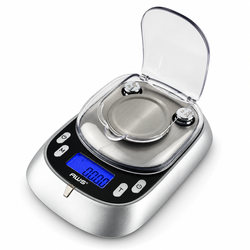
A 100g x 0.01g digital scale combines a maximum capacity of 100 grams with readability in increments of 0.01 gram. This balance makes it a popular specification for jewelry, coins, gemstones, watch parts, small hardware, crafts, tea, coffee and other lightweight items.
However, the specification is useful only when both numbers match the task.
A 100-gram capacity may be more than enough for a loose gemstone but insufficient for an object placed in a heavy glass container. A readability of 0.01 gram may be suitable for finished jewelry while remaining too coarse for work that requires single-milligram changes.
Before purchasing, consider:
-
The heaviest total load
-
The weight of the container or tray
-
The smallest change you need to observe
-
The dimensions of the platform
-
The required measurement units
-
Calibration requirements
-
Power source
-
Operating environment
-
Intended personal or commercial use
This guide explains what 100g x 0.01g means and how to determine whether it is the right specification for your work.
What Does 100g x 0.01g Mean?
Digital-scale specifications are normally written as:
Maximum capacity x readability
For a 100g x 0.01g scale:
-
100g is the maximum total load.
-
0.01g is the smallest displayed increment.
The scale can display readings such as:
-
1.00g
-
1.01g
-
1.02g
-
1.03g
-
25.47g
-
99.99g
It does not display thousandths of a gram, such as 1.001g or 25.473g.
Buyers can compare current designs and related capacities in the wholesale pocket scale category.
Understanding the 100-Gram Capacity
The scale is designed to support no more than 100 grams at one time.
That total includes everything resting on the platform:
-
The item being measured
-
A tray
-
A bowl
-
A container
-
A lid used as a weighing surface
-
Any packaging placed on the scale
If the total load exceeds 100 grams, the scale may display an overload warning. Continued overloading can damage its weighing mechanism.
Converting 100 grams
For general reference:
-
100 grams = 0.1 kilogram
-
100 grams is approximately 3.53 ounces
-
100 grams = 100,000 milligrams
NIST’s reference for SI units of mass confirms that one gram equals 1,000 milligrams.
Conversions should not be used to assume that every scale displays all those units. Check the individual model’s supported modes.
Understanding the 0.01-Gram Readability
A readability of 0.01 gram means the display changes in increments of one-hundredth of a gram.
Because:
0.01g = 10mg
the scale displays changes in 10-milligram increments.
For example, it may move from:
-
3.20g to 3.21g
-
12.48g to 12.49g
-
75.00g to 75.01g
It cannot directly display a difference of one milligram. A scale designed for 0.001-gram readability is required when single-milligram display resolution is important.
Readability Is Not the Same as Accuracy
The second number in the specification describes the scale’s displayed increment. It does not guarantee that every reading is accurate to exactly ±0.01 gram under all conditions.
Measurement performance can be affected by:
-
Calibration
-
Repeatability
-
Linearity
-
Temperature
-
Drafts
-
Vibration
-
Static electricity
-
Surface stability
-
Battery condition
-
Off-center loading
-
Mechanical wear
-
Object placement
-
Overloading
NIST describes a digital scale division as the incremental size between consecutive indications. Its discussion of scale division and verification scale division demonstrates why the displayed increment should not be treated as a complete performance specification.
When comparing scales, look at the full model specifications, intended use, construction and calibration process—not only the number of decimal places.
How Much Can You Actually Weigh?
The usable sample capacity depends on the weight of the container.
Use this formula:
Usable sample capacity = 100g − Container weight
Examples
| Empty container weight | Remaining sample capacity |
|---|---|
| 5g | 95g |
| 10g | 90g |
| 20g | 80g |
| 35g | 65g |
| 50g | 50g |
| 75g | 25g |
If a container weighs 40 grams and the material weighs 70 grams, the combined load is:
40g + 70g = 110g
That load exceeds the scale’s 100-gram capacity.
Tare Does Not Restore Physical Capacity
The tare function removes the displayed weight of a container so the screen shows only the contents added afterward.
The basic process is:
-
Turn on the scale.
-
Wait for the display to show zero.
-
Place the empty container on the platform.
-
Press tare.
-
Confirm the display returns to zero.
-
Add the item or material.
Tare changes the displayed reference point. It does not remove the container’s physical weight from the load cell.
If a 30-gram container is tared on a 100-gram scale, approximately 70 grams of capacity remain for the contents.
Theoretical Display Intervals
Dividing capacity by readability gives the nominal number of displayed intervals across the scale’s range:
100g ÷ 0.01g = 10,000 intervals
This calculation can help compare specifications, but it does not prove:
-
Accuracy
-
Repeatability
-
Linearity
-
Minimum reliable weight
-
Calibration quality
-
Legal-for-trade status
It simply describes the theoretical relationship between maximum capacity and displayed increment.
Who Should Buy a 100g x 0.01g Scale?
This specification is best suited to people who:
-
Work with lightweight objects
-
Need hundredth-of-a-gram readings
-
Do not expect the total load to exceed 100 grams
-
Want a compact portable scale
-
Use lightweight trays or containers
-
Need common units such as grams, ounces, carats or grains
-
Do not require single-milligram readability
-
Do not need kilogram-level capacity
It provides a useful middle ground between milligram scales and higher-capacity 0.1-gram models.
Common Uses for a 100g x 0.01g Scale
Jewelry
A 100g scale can work well for:
-
Rings
-
Earrings
-
Pendants
-
Small chains
-
Findings
-
Clasps
-
Lightweight finished pieces
-
Precious-metal components
For heavier watches, large necklaces or multiple items, 100 grams may be restrictive.
Gemstones
A model with carat mode can be useful for:
-
Loose gemstones
-
Beads
-
Small mineral specimens
-
Groups of stones
For extremely small stones or work requiring finer distinctions, consider 0.001-gram readability.
Coins
The scale can accommodate many individual coins and small groups.
It may support:
-
Coin identification
-
Comparison
-
Sorting
-
General collection documentation
Weight alone does not authenticate a coin. Dimensions, composition, design and provenance should also be considered.
Watch parts
A 100g x 0.01g scale can handle:
-
Cases
-
Movements
-
Clasps
-
Crowns
-
Links
-
Springs
-
Groups of components
Individual tiny components may require finer readability if differences smaller than 0.01 gram matter.
Small hardware
The specification can work for:
-
Screws
-
Nuts
-
Washers
-
Electronic parts
-
Small fasteners
-
Model-making components
Dense metal pieces should be placed gently on the platform to avoid impact loading.
Tea leaves
A 0.01-gram display offers more detail than most general kitchen scales, making it useful for tea portions and blending.
Ensure that the scoop, bowl or container does not consume too much of the 100-gram capacity.
Coffee
The scale may be suitable for:
-
Individual coffee doses
-
Bean samples
-
Small roasting samples
-
Ground-coffee portions
It is generally not suitable for a complete pour-over setup because the brewer, server and water can easily exceed 100 grams.
Fishing tackle
Potential items include:
-
Hooks
-
Swivels
-
Sinkers
-
Fly-tying components
-
Lightweight lures
Heavier lure collections or grouped tackle may require greater capacity.
Archery components
A 100g scale supporting grains can help compare small components. Confirm that the model offers the required unit mode.
For safety-sensitive equipment selection, follow component manufacturers’ instructions rather than relying solely on a general-purpose consumer scale.
When 100g Is Not Enough
Choose a higher-capacity scale when weighing:
-
Heavy watches
-
Multiple pieces of jewelry
-
Large coin groups
-
Glass containers
-
Bottles
-
Larger hardware
-
Postal items
-
Full coffee-brewing setups
-
Large craft projects
-
Containers approaching 100 grams
-
Finished batches above 100 grams
A 200g or 500g scale with the same 0.01-gram readability can provide more flexibility without changing the displayed increment.
When 0.01g Is Not Fine Enough
Consider a 0.001-gram milligram scale when:
-
Single-milligram changes matter
-
Samples are extremely small
-
The total load remains within the lower capacity
-
You can control environmental conditions
-
You are weighing fine ingredients
-
You work with tiny gemstones
-
You need three decimal places in grams
A finer display is useful only when the scale’s total capacity, environment and performance also suit the application.
Comparing Current 100g x 0.01g Models
American Weigh Wholesale currently lists multiple models with this specification. Their capacity and readability are the same, but their designs, platforms, units and accessories differ.
DZ2-100
The DZ2-100 digital pocket scale provides:
-
100g x 0.01g capacity and readability
-
Gram, ounce, carat and grain modes
-
Calibration using a 100g weight
-
Compact pocket-scale format
-
Battery-powered operation
The calibration weight is listed as not included.
AXIS 100
The AXIS 100g bowl pocket scale uses a round design and lists:
-
100g x 0.01g capacity and readability
-
Six weighing units
-
Approximately 2.9-inch-diameter platform
-
Two included AAA batteries
-
Calibration with a 100g weight
Its bowl-oriented format may be useful for loose objects that could roll from a flat platform.
ES-100
The ES-100 digital pocket scale offers:
-
100g x 0.01g specification
-
Gram, ounce, carat and grain modes
-
Approximately 2.4-by-2.18-inch platform
-
Two included AAA batteries
-
Calibration with a 100g weight
Its compact rectangular form supports portable use.
CDV2-100
The CDV2-100 compact digital scale provides:
-
100g x 0.01g specification
-
Approximately 4-by-4-inch platform
-
Gram, ounce, carat and grain modes
-
Two included CR2032 batteries
-
Calibration using a 100g weight
Its larger platform can be useful for lightweight objects or containers with a wider base.
Blade 100 Special Edition
The Blade 100g Special Edition combines the same weighing specification with:
-
Approximately 2.7-by-2.7-inch platform
-
Silicone mat
-
Two expansion trays
-
Leather sleeve
-
Gram, ounce, carat and grain modes
-
Two included AAA batteries
The accessory package may be important for customers who want storage and multiple weighing surfaces.
Model Comparison Table
| Model | Platform | Units | Power | Notable feature |
|---|---|---|---|---|
| DZ2-100 | Compact | g, oz, ct, gn | Battery | Simple pocket format |
| AXIS 100 | Approx. 2.9-inch diameter | Six units | Two AAA | Round bowl design |
| ES-100 | Approx. 2.4 x 2.18 in | g, oz, ct, gn | Two AAA | Compact rectangular format |
| CDV2-100 | Approx. 4 x 4 in | g, oz, ct, gn | Two CR2032 | Larger platform |
| Blade 100 SE | Approx. 2.7 x 2.7 in | g, oz, ct, gn | Two AAA | Trays, mat and sleeve |
Specifications and current availability should be verified before purchasing.
Platform Size Matters
A scale can have adequate weight capacity but an unsuitable platform.
Before buying, measure:
-
The object’s width and length
-
The container’s base
-
The space available for the scale
-
Whether the display remains visible
-
Whether the object can be centered safely
An oversized container may:
-
Touch the scale housing
-
Rest partly on the table
-
Cover the display
-
Become unstable
-
Transfer part of the load away from the platform
The CDV2-100’s approximately 4-by-4-inch platform provides more physical space than many traditional pocket scales, even though its capacity remains 100 grams.
Measurement Units
Available units vary by model.
Common modes include:
-
g: grams
-
oz: ounces
-
ct: carats
-
gn: grains
-
ozt: troy ounces
-
dwt: pennyweights
Choose units based on the application.
Jewelry and gemstones
Carats, troy ounces and pennyweights may be helpful.
Archery and reloading components
Grains may be relevant, subject to appropriate safety practices.
General household use
Grams and ounces are usually sufficient.
Do not assume that every 100g scale supports all six units. Confirm the specific model.
Calibration Requirements
Many 100g x 0.01g models specify calibration with a 100-gram weight.
In the examples above, that calibration weight is generally listed as not included.
Before ordering, determine:
-
Which calibration weight is required
-
Whether it is included
-
Whether it must be purchased separately
-
How the calibration process is activated
-
What surface and environment are recommended
-
Whether formal traceability is required
Basic calibration conditions
For ordinary consumer calibration:
-
Use a stable, level surface.
-
Keep the scale away from fans and vents.
-
Allow the scale and weight to reach room conditions.
-
Use the weight specified in the manual.
-
Do not touch the reference weight excessively.
-
Follow the exact button sequence.
-
Confirm successful completion.
-
Recheck the scale with the reference weight.
A random household item is not an appropriate substitute for a calibration weight because its exact mass is not known.
How Often Should the Scale Be Calibrated?
There is no universal schedule for every user.
Consider checking or calibrating:
-
Before important measurements
-
After moving the scale
-
After extended storage
-
After a substantial temperature change
-
After replacing batteries
-
After an overload
-
After a fall or impact
-
When repeated readings become inconsistent
-
According to the manufacturer’s instructions
Frequent unnecessary adjustment can be counterproductive. First verify that the scale is on a stable surface and that environmental conditions are controlled.
How to Test Repeatability
Repeatability describes how closely the scale agrees with itself when the same item is weighed repeatedly under unchanged conditions.
A simple user check is:
-
Place the scale on a stable surface.
-
Turn it on and allow it to settle.
-
Confirm that it reads zero.
-
Place the same stable object on the center.
-
Record the reading.
-
Remove the object.
-
Wait for zero.
-
Repeat several times.
If the readings vary significantly, investigate:
-
Drafts
-
Vibration
-
Weak batteries
-
An uneven surface
-
Dirt under the object
-
Off-center placement
-
Calibration
-
Possible damage
Do not interpret a simple user check as a formal laboratory calibration.
Operating Environment
A 0.01-gram scale can respond to conditions that are insignificant during ordinary kilogram-level weighing.
Use a rigid surface
Soft, flexible or uneven surfaces can affect readings.
Avoid airflow
Keep the scale away from fans, open windows and air-conditioning vents.
Reduce vibration
Do not place it beside speakers, running machinery or frequently slammed drawers.
Keep the platform clean
Dust, liquid residue or objects trapped around the platform can interfere with movement.
Allow temperature adjustment
A scale brought from a cold vehicle into a warm room may need time to acclimate.
Watch for static
Plastic containers and dry conditions may create static effects, particularly with lightweight samples.
Battery and Power Considerations
Most compact 100g x 0.01g scales use AAA or coin-cell batteries.
Compare:
-
Battery type
-
Whether batteries are included
-
Replacement availability
-
Low-battery indicator
-
Auto-off timing
-
Battery-compartment access
-
Rechargeable capability
-
AC-adapter option
AAA batteries may be easier to replace quickly. Coin cells may support a thinner design.
A dim display, slow response or unstable reading can sometimes indicate weak batteries, though other causes should also be considered.
Protective Covers, Bowls and Trays
Accessories can improve usability.
Protective cover
A cover helps protect the platform and controls during storage. Some covers can also be used as weighing trays.
Bowl
A bowl helps contain:
-
Beads
-
Screws
-
Tea leaves
-
Small components
-
Loose craft materials
Expansion tray
A tray can create a larger surface, but its weight still counts toward the 100-gram capacity.
Silicone mat
A mat can reduce sliding and protect the platform. Its weight must be tared.
Carrying sleeve
A sleeve can protect the exterior during transport but does not replace careful handling.
Choose accessories based on actual use rather than the number of items advertised in the package.
Minimum Weight and Practical Measurement
A 0.01-gram displayed increment does not automatically establish the minimum reliable sample weight.
An extremely light object may produce a display value, but the suitability of that result depends on:
-
The scale’s performance
-
Required accuracy
-
Repeatability
-
Environmental stability
-
Application tolerance
-
Manufacturer specifications
-
Measurement uncertainty
For informal comparison, a buyer may accept more uncertainty than a laboratory or regulated business.
NIST’s publication Accuracy Matters explains why accuracy, precision and uncertainty must be communicated appropriately.
Is a 100g x 0.01g Scale Suitable for Laboratories?
It may be useful for:
-
Education
-
Demonstrations
-
Preliminary comparisons
-
Nonregulated sample preparation
-
General internal work
It should not automatically be described as an analytical balance, certified laboratory balance or validated instrument.
Laboratory buyers should define:
-
Required uncertainty
-
Minimum sample weight
-
Repeatability
-
Linearity
-
Calibration traceability
-
Environmental controls
-
Documentation
-
Quality-system requirements
A consumer pocket scale may not satisfy those requirements even if its displayed increment appears fine enough.
Is It Legal for Trade?
A 100g x 0.01g specification does not prove that a scale is legal for trade.
A scale used to determine the price in a commercial transaction may require:
-
NTEP evaluation
-
A Certificate of Conformance
-
Correct accuracy class
-
State or local approval
-
Inspection
-
Registration
-
Sealing
-
Proper installation
-
Required markings
-
Periodic testing
NIST explains that legal metrology regulates measurement instruments used in trade and other legally controlled applications. Review its overview of legal metrology before using a scale for a price-determining transaction.
NIST’s weighing and scales FAQs state that commercial scales must comply with the laws of the state where they are used.
The current NIST Handbook 44 provides technical requirements used by many weights-and-measures jurisdictions.
Calibration does not turn a noncommercial consumer scale into a legal-for-trade device.
How to Use the Scale Correctly
For more consistent results:
-
Place the scale on a solid, level surface.
-
Keep it away from airflow and vibration.
-
Confirm that the platform is clean.
-
Install fresh batteries.
-
Allow the scale to acclimate after major temperature changes.
-
Turn it on without anything touching the platform.
-
Wait for a stable zero.
-
Add the empty container.
-
Press tare.
-
Add the item gradually.
-
Keep the total physical load below 100 grams.
-
Wait for the reading to stabilize.
-
Record the correct unit.
-
Remove the load after use.
-
Store the scale with its protective cover.
How to Avoid Overloading
Overload can occur through:
-
A heavy container
-
Pressing on the platform
-
Dropping an item
-
Storing objects on the scale
-
Transporting the scale with weight on the platform
-
Attempting to weigh an object above 100 grams
Impact force can temporarily exceed capacity even if the object’s final resting weight is below 100 grams.
Place objects gently and never use the scale as a storage surface.
Cleaning and Storage
Cleaning
-
Turn off the scale.
-
Remove loose debris.
-
Wipe the platform with a soft, lightly dampened cloth.
-
Use cleaning products appropriate for the platform material.
-
Prevent liquid from entering buttons, seams or the battery compartment.
-
Do not immerse the scale.
Storage
-
Remove all objects from the platform.
-
Use the protective cover.
-
Store it in a dry location.
-
Avoid extreme temperatures.
-
Remove batteries before very long storage when appropriate.
-
Keep calibration weights protected from dirt and damage.
How to Choose Among 100g x 0.01g Models
Since the central weighing specification is the same, compare the surrounding features.
Choose based on platform size
A larger platform is useful for wide containers and finished objects.
Choose based on units
Jewelry users may want carats and pennyweights. Archery users may want grains.
Choose based on accessories
A bowl, tray, sleeve or silicone mat can improve a particular workflow.
Choose based on batteries
Select a battery type that is easy for you to replace.
Choose based on form factor
Consider whether the scale will remain on a desk, fit in a pocket or travel in a tool case.
Choose based on calibration
Check whether the required 100-gram weight is included or must be ordered separately.
Choose based on warranty and support
Review the written warranty and claim process before purchasing.
Buying Checklist
Before ordering a 100g x 0.01g scale, confirm:
-
The combined load remains below 100g.
-
The container’s weight has been included.
-
A 0.01g displayed increment is sufficient.
-
The object fits on the platform.
-
The model supports the required units.
-
The calibration requirement is understood.
-
A suitable calibration weight is available.
-
The battery type is convenient.
-
The accessories match the application.
-
The operating environment is stable.
-
The warranty has been reviewed.
-
Legal-for-trade approval is not being assumed.
Common Buying Mistakes
Ignoring the container
A 40-gram container leaves only 60 grams for the sample.
Assuming tare restores capacity
Tare changes the displayed value, not the physical load.
Choosing by decimal places alone
A scale needs suitable capacity, platform size and performance—not just a detailed display.
Assuming readability equals accuracy
The last displayed digit is not a universal accuracy guarantee.
Using a random calibration object
Coins and household objects are not substitutes for a proper calibration weight.
Selecting an undersized platform
A wide object may touch the housing or table and interfere with the measurement.
Overloading through pressure
Pressing on the platform can exceed capacity even without placing a heavy object on it.
Expecting kitchen-scale capacity
A 100-gram pocket scale is not designed for bowls of ingredients or full brewing setups.
Assuming it is legal for trade
Commercial approval must be confirmed for the exact model.
Frequently Asked Questions
What does 100g x 0.01g mean?
The scale can hold up to 100 grams and displays measurements in increments of 0.01 gram.
Is 0.01 gram the same as 10 milligrams?
Yes. One gram equals 1,000 milligrams, so 0.01 gram equals 10 milligrams.
How many decimal places does the scale show in grams?
It normally displays two decimal places, such as 12.34g.
Can it weigh an object that is exactly 100 grams?
The maximum listed capacity is 100 grams, but repeatedly operating at the limit leaves no safety margin. Do not exceed the rated capacity.
Does the container count toward the 100 grams?
Yes. The scale supports the physical weight of the container even after the display has been tared.
Is this specification good for jewelry?
Yes, it can suit rings, earrings, pendants and other lightweight pieces. Larger finished jewelry may require more capacity.
Is it suitable for gemstones?
It can be useful for many gemstones, especially if it supports carat mode. Extremely small stones may benefit from 0.001g readability.
Can it weigh coffee?
It can weigh individual coffee doses and small bean samples. It is not suitable for an entire brewing setup that exceeds 100 grams.
What calibration weight does it need?
Many models specify a 100-gram calibration weight, but you should follow the instructions for the exact scale.
Is a calibration weight included?
It varies by model. Many current 100g x 0.01g pocket scales list the calibration weight as not included.
Is it legal for trade?
Not based on the specification alone. Verify the exact model’s certification and applicable local requirements.
Final Verdict
A 100g x 0.01g digital scale is a strong choice when you need a compact scale for lightweight objects and hundredth-of-a-gram readings.
It works particularly well for:
-
Jewelry
-
Coins
-
Gemstones
-
Watch parts
-
Small hardware
-
Tea portions
-
Coffee doses
-
Crafts
-
Lightweight components
Choose another specification when:
-
The combined load may exceed 100 grams.
-
The container is heavy.
-
The object requires a larger platform.
-
Single-milligram changes must be visible.
-
The application requires formal laboratory performance.
-
The scale will determine prices in regulated commerce without confirmed approval.
Before buying, identify the heaviest total load, weigh the empty container and decide whether 0.01-gram readability is sufficient. If those three requirements fit within the specification, a 100g x 0.01g scale can provide a practical balance of portability, capacity and precision.