
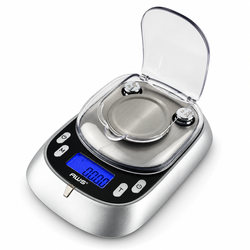
A 100g x 0.01g scale and a 200g x 0.01g scale share the same displayed increment, but they do not offer the same usable weighing range.
Both scale types display measurements in 0.01-gram steps. The critical difference is capacity:
-
A 100g x 0.01g scale supports a maximum total load of 100 grams.
-
A 200g x 0.01g scale supports a maximum total load of 200 grams.
-
Both display results in increments of 0.01 gram, or 10 milligrams.
The 200g model provides twice the nominal capacity without sacrificing the stated gram readability. That makes it attractive for users who work with heavier samples, larger containers or batches containing multiple items.
However, higher capacity does not automatically make a scale better. A smaller 100g model may be more compact, easier to transport and entirely sufficient for lightweight objects. Platform dimensions, calibration requirements, accessory weight, unit modes and physical design can matter as much as the capacity printed on the package.
This guide compares the two specifications and explains when each one makes sense. Buyers can also review the current selection of digital pocket and precision scales from American Weigh Wholesale.
Quick Comparison: 100g x 0.01g vs 200g x 0.01g
| Feature | 100g x 0.01g scale | 200g x 0.01g scale |
|---|---|---|
| Maximum capacity | 100g | 200g |
| Gram readability | 0.01g | 0.01g |
| Display increment | 10mg | 10mg |
| Relative capacity | Standard | Twice the 100g capacity |
| Best for | Lightweight individual items | Heavier items, containers and batches |
| Container allowance | More limited | More flexible |
| Portability | Often highly compact | Can still be pocket-sized |
| Typical calibration weight | Often 100g | Often 200g |
| Main advantage | Compact precision weighing | More working capacity at the same readability |
| Main limitation | Easier to overload | May be larger or unnecessary for very small items |
The choice is primarily about capacity—not finer display resolution. If two models are both rated to 0.01g, the 200g model does not show additional decimal places.
What Does 100g x 0.01g Mean?
A 100g x 0.01g scale has:
-
A stated maximum capacity of 100 grams
-
A displayed gram increment of 0.01 gram
The value 0.01g is equal to:
-
One-hundredth of a gram
-
10 milligrams
-
0.00001 kilogram
The National Institute of Standards and Technology explains the relationship between kilograms, grams and other SI units used to express mass.
A 100g scale is suitable when the combined weight of the sample and its container remains below 100g. In practice, users should leave some room below the maximum instead of planning every measurement at the exact capacity limit.
What Does 200g x 0.01g Mean?
A 200g x 0.01g scale has:
-
A stated maximum capacity of 200 grams
-
A displayed gram increment of 0.01 gram
It can handle twice the nominal load of a 100g scale while retaining the same displayed gram increment.
For example, both scales can display:
-
3.27g
-
25.41g
-
78.96g
Only the 200g scale can accept a total load greater than 100g, assuming the load remains within its stated capacity.
A 200g scale might display:
-
112.35g
-
148.22g
-
199.40g
Those loads exceed the range of a 100g model.
Does the 200g Scale Have Less Precision?
Not according to the basic readability specification.
Both scales are described as displaying gram results in 0.01g increments. The 200g model therefore provides more capacity while maintaining the same nominal readability.
That does not establish that two specific models will perform identically.
Readability is only one scale characteristic. Actual weighing performance can also depend on:
-
Accuracy
-
Repeatability
-
Linearity
-
Calibration
-
Corner-load behavior
-
Temperature
-
Air movement
-
Vibration
-
Platform design
-
Load placement
-
Manufacturing tolerances
-
Battery condition
-
Proper use
NIST distinguishes a displayed scale division from a verification scale division in its discussion of scale division “d” versus verification scale division “e”. A displayed division should not be treated as a complete statement of measurement accuracy or regulatory performance.
Therefore, it is more accurate to say that both specifications offer the same readability—not necessarily identical accuracy under every condition.
The Main Difference Is Usable Capacity
The clearest advantage of the 200g scale is the additional 100g of capacity.
That extra capacity can matter in several ways:
-
You can use a heavier container.
-
You can weigh a larger batch.
-
You can place multiple objects on the platform.
-
You have more room for variations in sample weight.
-
You are less likely to overload the scale accidentally.
-
You can accommodate heavier accessories or trays.
A 100g scale remains suitable when your total loads are consistently light. If the sample and container together rarely exceed 50g, the added capacity may offer little practical benefit.
Tare Does Not Restore Capacity
The tare function is essential, but it is frequently misunderstood.
Tare resets the displayed value to zero after a container is placed on the platform. It allows the user to view the net displayed weight of the material added to that container.
It does not remove the container’s physical weight from the load cell.
Example With a 100g Scale
Suppose a container weighs 42g.
After placing it on the scale and pressing tare, the display reads 0.00g. The scale still physically supports 42g.
The approximate remaining capacity is:
100g − 42g = 58g
Attempting to add 80g of material would create a combined load of 122g, exceeding the scale’s stated capacity.
Example With a 200g Scale
Place the same 42g container on a 200g scale and tare it.
The approximate remaining capacity is:
200g − 42g = 158g
This gives the user substantially more room for the sample.
Capacity Comparison by Container Weight
| Empty container weight | Approximate room on 100g scale | Approximate room on 200g scale |
|---|---|---|
| 5g | 95g | 195g |
| 10g | 90g | 190g |
| 25g | 75g | 175g |
| 40g | 60g | 160g |
| 60g | 40g | 140g |
| 80g | 20g | 120g |
This table shows why a 200g scale can be more practical even when the samples themselves weigh less than 100g. The container may consume a significant part of the lower-capacity model’s range.
When a 100g x 0.01g Scale Is the Better Choice
A 100g model makes sense when compactness and portability matter and your total load remains comfortably below 100g.
Small Jewelry and Gemstones
Rings, earrings, loose stones, beads and small jewelry components often fall well within a 100g range.
Depending on the model, unit modes may include:
-
Grams
-
Ounces
-
Carats
-
Grains
-
Troy ounces
-
Pennyweight
A model such as the AXIS-100 digital bowl pocket scale adds a removable bowl for loose pieces. Its listed specifications include a 100g capacity, 0.01g readability and multiple weighing units.
Individual Coins
Many individual coins weigh far less than 100g. A 100g model can be useful for comparisons, sorting and collecting.
Weight alone cannot establish a coin’s authenticity or grade. It should be used as one data point alongside dimensions, composition, condition and professional evaluation where necessary.
Beads and Craft Components
A 100g scale can handle small quantities of:
-
Beads
-
Charms
-
Findings
-
Miniature parts
-
Embellishments
-
Pigments
-
Dry craft additives
The smaller scale may be convenient for a crowded craft station or portable kit.
Small Hobby Parts
Fishing tackle, model components, electronic parts and archery accessories may fit comfortably within the 100g range.
Users should weigh the normal combination of object and container—not only the object—to confirm that the capacity is sufficient.
Maximum Portability
A 100g pocket scale can be extremely compact. If it will be carried between workstations, markets, trade events or collection sites, the smaller housing may be preferable.
The CDV2-100 compact digital scale provides 100g x 0.01g performance with an approximately four-by-four-inch platform, showing that a 100g model can still offer a relatively generous weighing surface.
When You Do Not Need Extra Capacity
There is no benefit in choosing capacity that will never be used if the smaller model otherwise fits the workflow better.
If the heaviest anticipated total load is 30g, both a 100g and 200g scale offer sufficient nominal capacity. Platform dimensions, accessories, durability and price can then become the deciding factors.
When a 200g x 0.01g Scale Is the Better Choice
A 200g model is preferable when total loads may approach or exceed 100g.
Heavier Containers
Glass dishes, metal trays and durable reusable bowls can weigh enough to consume much of a 100g scale’s capacity.
A 200g model gives the user more flexibility to choose a container based on shape and material rather than selecting the lightest possible option.
Larger Batches
A user may start by weighing individual 10g or 20g samples but later need to combine several items into one batch.
The 200g capacity supports:
-
Larger ingredient portions
-
More pieces in one container
-
Combined sets of components
-
Multiple collectibles
-
Heavier samples
-
Batch comparisons
Inventory Sorting
When several small objects need to be weighed together, a 100g scale may reach its limit quickly. A 200g scale allows larger groups to remain on the platform.
This can be useful for approximate count-by-weight workflows, although variations between individual pieces must be considered. A displayed batch weight does not guarantee an exact piece count.
Increased Overload Margin
Accidental overload can happen when the user does not know an object’s approximate weight before placing it on the platform.
A 200g scale offers additional room for uncertainty. It should still be protected from loads above its stated maximum.
Price-Computing and Collection Applications
The PC-201 price-computing pocket scale offers a 200g capacity and 0.01g readability along with a larger stainless-steel platform and price-calculation functionality.
Its published features include:
-
Programming for up to seven preset unit prices
-
A full numerical keypad
-
Gram, ounce, troy-ounce, pennyweight, carat and grain modes
-
An approximately 4.4-by-4.8-inch platform
-
Calibration using a 200g weight, not included
-
Two included AAA batteries
-
A ten-year manufacturer warranty
The product description expressly identifies its price calculation as not legal for trade.
This model illustrates an important point: capacity is only one consideration. A larger platform and specialized controls may influence the buying decision more than the extra 100g alone.
Practical Load Examples
The following examples demonstrate how the same task may fit differently within each capacity.
| Weighing setup | Total physical load | 100g scale | 200g scale |
|---|---|---|---|
| 5g tray + 15g sample | 20g | Suitable | Suitable |
| 20g container + 35g sample | 55g | Suitable | Suitable |
| 35g bowl + 55g sample | 90g | Within capacity, limited margin | Suitable |
| 50g dish + 65g sample | 115g | Not suitable | Suitable |
| 30g tray + 120g batch | 150g | Not suitable | Suitable |
| 70g container + 125g sample | 195g | Not suitable | Near 200g maximum |
| 90g dish + 120g sample | 210g | Not suitable | Not suitable |
A scale should not be selected for regular operation at its exact maximum. Leaving working margin helps accommodate container variation, additional material and unexpectedly heavy objects.
Platform Size Can Be More Important Than Capacity
A scale can have enough load capacity but still be inconvenient if the object does not fit the platform.
An oversized object may:
-
Obscure the display
-
Touch the scale housing
-
Touch the work surface
-
Shift during measurement
-
Apply force unevenly
-
Be difficult to center
Platform size is not determined by capacity. A 100g model can have a larger platform than some 200g models, and a 200g pocket scale can still be physically compact.
Before ordering, measure:
-
The object’s length and width
-
The base of the intended container
-
The space available at the workstation
-
The display position relative to the loaded object
The goal is to support the load centrally without external contact.
Comparing 100g Scale Designs
Not all 100g x 0.01g scales follow the same format.
Bowl Design
A bowl helps contain loose beads, seeds, small hardware and similar materials. It can reduce spills and make transferring materials easier.
The bowl’s weight still counts toward capacity.
Large-Platform Design
A large flat platform is useful for:
-
Weighing paper
-
Flat collectible items
-
Small trays
-
Irregular objects
-
Multiple parts
It may be more important than extra capacity when objects are wide but lightweight.
Accessory-Focused Design
The Blade-100 Special Edition digital pocket scale is listed with a silicone weighing mat, two expansion trays and a leather sleeve. It has a 100g capacity, 0.01g readability and an approximately 2.7-by-2.7-inch platform.
This type of package may appeal to users who value portability and included accessories more than increased capacity.
Comparing 200g and Near-200g Scale Designs
The 200g class also includes different forms.
Standard Pocket Scale
A conventional pocket model prioritizes portability and basic weighing functions. It may include a protective cover that doubles as a tray.
Large-Platform Scale
A model such as the PC-201 provides a larger weighing surface and specialized controls. It takes up more space but may be more practical for larger objects.
Bowl Scale
A 200g bowl scale can provide both increased capacity and containment. This combination is useful for loose materials, but the bowl’s empty weight must be included when calculating the remaining capacity.
Nearby 220g Alternatives
Buyers comparing 200g models may also encounter scales with slightly higher ratings, such as the ACPro-220 digital pocket scale.
The ACPro-220 is listed at 220g x 0.01g and uses a 200g calibration weight that is not included.
A 220g model provides 20g more nominal capacity than a 200g model. That additional room may be useful, but it does not change the displayed 0.01g increment.
When comparing these nearby capacities, consider the full model specifications rather than treating the difference between 200g and 220g as the only deciding factor.
Calibration Differences
Many 100g scales are designed to calibrate using a 100g calibration weight. Many 200g scales use a 200g weight.
The correct requirement depends on the exact model.
Do not assume that:
-
Every 100g scale uses a 100g weight
-
Every 200g scale uses a 200g weight
-
A weight is included
-
Any object labeled 100g or 200g is suitable for calibration
-
One model’s procedure applies to another
Consult the instructions for the exact scale.
NIST’s publication Accuracy Matters: Weighing in the Balance provides useful background on why reference standards, procedures and appropriate weighing equipment matter.
Why Household Objects Are Poor Calibration Substitutes
Users sometimes attempt to calibrate with coins, packaged goods or household objects. These are not reliable replacements for appropriate calibration weights because their mass may vary due to:
-
Manufacturing tolerances
-
Wear
-
Dirt
-
Packaging changes
-
Moisture
-
Damage
-
Material loss
A calibration process should use the correct reference weight and follow the manufacturer’s procedure.
Is 0.01g the Minimum Weight?
Not necessarily.
The 0.01g value tells you the display increment. It does not, by itself, establish the minimum reliable load.
A scale might display a number when an extremely small object is placed on the platform, but that does not prove that the result satisfies a particular accuracy or repeatability requirement.
To evaluate very small samples, review available specifications for:
-
Minimum load
-
Accuracy
-
Repeatability
-
Linearity
-
Tolerance
-
Recommended operating range
If the application requires reliable measurements below 0.1g, a buyer may need equipment with finer readability and more detailed performance documentation.
Environmental Factors Affect Both Capacities
Neither scale is immune to environmental influences.
For more consistent measurements:
-
Place the scale on a firm, level surface.
-
Avoid fans, vents and open windows.
-
Keep it away from vibrating equipment.
-
Center the load.
-
Avoid leaning on the table.
-
Keep the platform clean.
-
Allow the scale and sample to acclimate when temperatures change.
-
Wait for the display to stabilize.
-
Replace weak batteries.
-
Recalibrate when appropriate under the manufacturer’s instructions.
NIST’s frequently asked questions about weighing and scales offer additional information about weighing devices and measurement practices.
Air Movement
A draft can affect light samples, weighing paper and open containers. The influence can appear as a fluctuating display.
Vibration
Nearby machinery, loud equipment, unstable tables and repeated contact with the work surface can disturb the reading.
Temperature
Moving a scale between environments can create temperature-related instability. Where practical, allow the scale and sample to reach the working environment’s temperature before measurement.
Static Electricity
Lightweight materials, plastic containers and dry conditions can introduce static effects. These may be more noticeable during small-sample weighing.
Applications Compared
Jewelry and Gemstones
A 100g scale is usually sufficient for individual rings, loose stones, beads and small jewelry components.
Choose 200g when:
-
Weighing several pieces together
-
Using a heavier tray
-
Working with larger chains or sets
-
Needing more capacity for grouped inventory
Verify the required unit modes, such as carats, troy ounces or pennyweight.
Coins and Collectibles
A 100g model works for many individual coins. A 200g model is more versatile for coin groups, holders, capsules and small sets.
For authentication or valuation, weight should be combined with additional evaluation methods.
Small Hardware
Both specifications work for individual screws, washers, springs and connectors.
Choose 200g when weighing:
-
Larger groups
-
Metal containers
-
Heavier assemblies
-
Bulk component samples
Crafts and Hobbies
A 100g scale works well for beads, miniature parts and small portions of material. A 200g model provides more flexibility for mixing bowls, trays and larger batches.
Tea and Dry Ingredients
A 100g scale may be sufficient for individual portions. A 200g scale is more practical when the container is heavy or several servings are prepared together.
Use an appropriate food-safe container and avoid direct food contact if the scale’s platform is not intended as a food-contact surface.
Coffee
A 100g scale can weigh small quantities of beans, but it may have limited room once a cup or dosing container is added. A 200g model provides more capacity for the vessel and coffee together.
Neither specification alone confirms that the scale includes timing functions or is protected from liquids.
Which Scale Is More Portable?
Capacity alone does not determine portability, but 100g models are often designed around very small objects and may have compact enclosures.
Compare:
-
Overall dimensions
-
Product weight
-
Cover design
-
Battery type
-
Accessory storage
-
Platform protection
-
Whether the scale fits its intended case or drawer
A 200g pocket scale may be just as portable as a 100g scale. Check the specific model dimensions instead of assuming that twice the capacity means twice the physical size.
Which Scale Offers Better Value?
Value depends on the intended application.
A 100g scale can offer better value when:
-
All loads are well below 100g.
-
Maximum portability is important.
-
The preferred model includes useful accessories.
-
A specialized platform design fits the objects.
-
The user does not need additional capacity.
A 200g scale can offer better value when:
-
Containers reduce the usable range of a 100g model.
-
Loads sometimes exceed 100g.
-
Multiple objects are weighed together.
-
Future applications may require more capacity.
-
The price difference is small compared with the added flexibility.
Do not choose solely by the highest capacity or lowest price. A scale that does not fit the object, container or workflow provides poor value regardless of its specifications.
Are These Scales Legal for Trade?
A fine display increment does not make a scale legal for trade.
When scale results determine the price charged to a customer, the device may be subject to legal-metrology requirements.
NIST describes legal metrology and its role in commercial measurements, including measurements used in trade and regulatory applications.
Before using any scale for a commercial transaction, verify:
-
The exact model’s certification status
-
National Type Evaluation Program requirements
-
State rules
-
Local registration requirements
-
Inspection and sealing requirements
-
Suitability for the commodity
-
Minimum-load and division requirements
The current edition of NIST Handbook 44 contains technical requirements, specifications and tolerances for many commercial weighing and measuring devices.
A scale may be useful for internal estimates or comparisons while still being unsuitable for determining a customer’s price.
How to Choose Between 100g and 200g
Use this step-by-step method.
Step 1: Weigh or Estimate the Container
Determine the weight of the heaviest bowl, tray, liner or holder you expect to use.
Step 2: Add the Heaviest Sample
Calculate:
Container weight + maximum expected sample weight = total physical load
Step 3: Add Working Margin
Do not select a scale whose capacity exactly matches the calculated total. Allow room for variations and unexpected additions.
Step 4: Compare Platform Dimensions
Measure the object and container base. Confirm that they fit securely without blocking the display or touching the surrounding housing.
Step 5: Verify Unit Modes
Make sure the exact model displays the units required for the application.
Step 6: Check Calibration Requirements
Identify the correct calibration weight and determine whether it is included or sold separately.
Step 7: Review the Complete Feature Set
Compare:
-
Tare function
-
Auto-off settings
-
Display size
-
Backlighting
-
Power source
-
Accessories
-
Protective cover
-
Platform material
-
Warranty
-
Overall dimensions
Step 8: Consider Future Needs
If current loads are already close to 100g, the 200g scale is usually the more practical choice. If all normal loads remain below 40g or 50g, a 100g model may provide ample capacity.
Simple Decision Table
| Your situation | Better starting choice |
|---|---|
| Items and container total less than 50g | 100g x 0.01g |
| Total load sometimes reaches 80g to 90g | 200g x 0.01g for more margin |
| Container alone weighs 40g or more | 200g x 0.01g |
| Maximum portability is the priority | Compare 100g model dimensions first |
| Weighing multiple pieces together | 200g x 0.01g |
| Only individual coins or gemstones | 100g x 0.01g may be sufficient |
| Batch size may increase later | 200g x 0.01g |
| Need finer than 0.01g readability | Neither; consider a 0.001g model |
| Need to determine selling price | Verify legal-for-trade requirements |
| Objects are wide but lightweight | Choose by platform dimensions |
Frequently Asked Questions
Is a 200g x 0.01g scale more accurate than a 100g x 0.01g scale?
Not necessarily. Both display gram measurements in 0.01g increments. Actual accuracy depends on the specific model, calibration, repeatability, environment and operating conditions.
Is a 100g scale more precise because it has less capacity?
Not based on these two specifications. Both have the same stated 0.01g readability. Lower capacity does not automatically mean better accuracy.
Does a 200g scale display more decimal places?
No. A 200g x 0.01g scale and a 100g x 0.01g scale both normally display grams to two decimal places.
Is 0.01g equal to 10mg?
Yes. There are 1,000 milligrams in one gram, so 0.01g equals 10mg.
Can a 100g scale weigh exactly 100g?
Its nominal maximum is 100g, but regular operation at the exact limit leaves no capacity margin. The container and every accessory must also be included in the load.
Can I put a 60g container on a 100g scale?
Yes, provided the container fits correctly and the combined load remains within the stated capacity. After accounting for the 60g container, only about 40g of physical capacity remains.
Does tare subtract the container from the capacity?
No. Tare subtracts it from the displayed result, not from the physical load.
Can a 200g scale weigh very small objects?
It can display in 0.01g increments, but the minimum reliable load cannot be determined from readability alone. Review the exact model’s performance specifications.
Should I buy a 200g scale for future flexibility?
Choose 200g if you reasonably expect heavier containers, larger batches or grouped objects. If all loads are consistently small, the added capacity may not be necessary.
What calibration weight does each scale need?
Many 100g models use a 100g calibration weight, while many 200g models use a 200g weight. Always follow the instructions for the exact model.
Can I calibrate with a 100g object?
Use an appropriate calibration weight specified for the scale, not an ordinary object that is merely labeled 100g.
Are 100g and 200g pocket scales legal for trade?
Capacity and readability alone do not establish legal-for-trade status. Verify the exact model and applicable jurisdictional requirements.
Final Verdict
Choose a 100g x 0.01g scale when you primarily weigh lightweight individual items, use light containers and value a compact form factor. It is a strong fit for small jewelry, gemstones, individual coins, beads, hobby components and other objects that remain comfortably below 100g.
Choose a 200g x 0.01g scale when you need more room for containers, batches, multiple pieces or heavier items. It provides twice the nominal capacity while maintaining the same 0.01g displayed increment.
The deciding calculation is simple:
Container + accessories + sample + working margin
If that total can approach 100g, select the 200g model. If it remains well below 100g, compare the models based on platform dimensions, accessories, power source, unit modes and portability.
Neither capacity is universally better. The right scale is the one that supports the entire physical load, fits the object properly and provides the features required for the actual weighing process.