
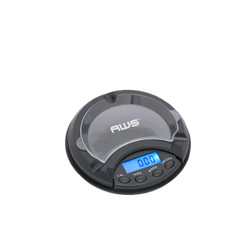
Choosing between a 100g x 0.01g scale and a 500g x 0.01g scale may appear simple. Both display weight in increments of 0.01 gram, but the 500g model supports five times the maximum load.
That extra capacity can substantially change how the scale is used.
A 100g x 0.01g scale is designed for small, lightweight objects and containers. It is commonly selected for jewelry, gemstones, individual coins, beads, hobby components and other compact items.
A 500g x 0.01g scale accommodates heavier containers, larger batches, multiple objects and samples that exceed the practical range of a 100g model. Depending on the design, it can still be compact enough for a drawer, workbench or portable kit.
The higher-capacity scale does not necessarily display a finer result. Both specifications show grams to two decimal places. The primary difference is how much total physical load each scale can accept.
This guide explains the capacity difference, compares practical applications and helps buyers select the appropriate model from the available range of digital pocket scales.
Quick Comparison: 100g x 0.01g vs 500g x 0.01g
| Feature | 100g x 0.01g scale | 500g x 0.01g scale |
|---|---|---|
| Maximum capacity | 100g | 500g |
| Gram readability | 0.01g | 0.01g |
| Smallest displayed gram increment | 10mg | 10mg |
| Relative capacity | Standard | Five times greater |
| Best for | Individual lightweight objects | Larger samples, containers and batches |
| Container flexibility | Limited | Much greater |
| Typical physical format | Pocket scale | Pocket, compact or bowl scale |
| Common calibration requirement | Often 100g | Often 500g or model-specific |
| Main advantage | Compact, portable format | High capacity with 0.01g readability |
| Main limitation | Easy to outgrow | Extra capacity may be unnecessary |
The 500g specification offers a wider usable range. The 100g specification can remain the better choice when every anticipated object and container fits comfortably within its limit.
What Does 100g x 0.01g Mean?
The two numbers describe separate characteristics.
-
100g is the stated maximum capacity.
-
0.01g is the readability or displayed increment.
A 100g x 0.01g scale displays gram values such as:
-
1.25g
-
14.72g
-
53.09g
-
99.84g
The display changes in steps of one-hundredth of a gram. One-hundredth of a gram equals 10 milligrams.
NIST provides additional information about grams, kilograms and related SI units for measuring mass.
The entire physical load must remain within 100g. This includes the object, container, weighing paper, tray, mat and any other material supported by the platform.
What Does 500g x 0.01g Mean?
A 500g x 0.01g scale has:
-
A stated maximum capacity of 500 grams
-
A readability of 0.01 gram
-
A display increment equivalent to 10 milligrams
It offers five times the nominal capacity of the 100g model without changing the stated gram readability.
A 500g scale can display all the values that fall within the 100g scale’s range. It can also support heavier loads such as:
-
125.48g
-
247.16g
-
376.82g
-
498.20g
A 500g capacity is approximately half a kilogram. It creates a substantially wider working range for containers, grouped objects and larger samples.
Do Both Scales Have the Same Precision?
They have the same nominal readability when results are displayed in grams.
Both show measurements in 0.01g steps. Neither specification displays 0.001g increments.
However, matching readability does not prove that two individual scale models have identical accuracy, repeatability or performance.
A complete comparison may involve:
-
Accuracy specifications
-
Repeatability
-
Linearity
-
Minimum load
-
Stabilization time
-
Calibration procedure
-
Corner-load response
-
Environmental sensitivity
-
Platform construction
-
Operating-temperature range
-
Manufacturing tolerances
NIST explains that a scale’s displayed division and its verification division have distinct meanings. Its guidance on scale division “d” versus verification scale division “e” helps clarify why the smallest displayed digit should not be treated as a universal accuracy guarantee.
It is accurate to say that the two specifications have equal readability. It is not accurate to claim that every 100g and 500g model will deliver identical measurement performance.
The Biggest Difference Is Working Capacity
The 500g scale provides an additional 400g of nominal capacity.
That means it can accommodate:
-
Heavier containers
-
Larger sample sizes
-
Multiple objects
-
Wider batch variation
-
More substantial trays and bowls
-
Loads that would overload a 100g scale
The practical difference often becomes clear only after the container is included.
Tare Does Not Increase Capacity
The tare function resets the displayed value to zero after a container is placed on the platform. This allows the scale to display the net weight of the material added afterward.
Tare does not remove the physical weight of the container.
Example With a 100g Scale
Suppose an empty bowl weighs 65g.
After placing it on the scale and pressing tare, the display reads 0.00g. However, the scale is still physically supporting 65g.
Its approximate remaining capacity is:
100g − 65g = 35g
Adding 60g of material would create a total load of 125g and exceed the scale’s stated capacity.
Example With a 500g Scale
Place the same 65g bowl on a 500g scale and press tare.
The approximate remaining physical capacity is:
500g − 65g = 435g
The 500g model can accept the 60g sample with considerable capacity remaining.
Remaining Capacity by Container Weight
| Container weight | Remaining capacity on 100g scale | Remaining capacity on 500g scale |
|---|---|---|
| 5g | 95g | 495g |
| 20g | 80g | 480g |
| 40g | 60g | 460g |
| 60g | 40g | 440g |
| 80g | 20g | 420g |
| 100g | No remaining capacity | 400g |
| 150g | Over capacity | 350g |
| 250g | Over capacity | 250g |
This is why users who routinely work with glass dishes, metal trays or substantial bowls may benefit from a 500g scale even when the sample itself weighs less than 100g.
When a 100g x 0.01g Scale Is the Better Choice
A 100g scale is a sensible choice when portability and small-object weighing are the main priorities.
Jewelry and Gemstones
Individual rings, earrings, loose stones, beads and small findings usually fall comfortably within a 100g range.
Useful unit modes may include:
-
Grams
-
Ounces
-
Carats
-
Grains
-
Troy ounces
-
Pennyweight
Verify the unit modes of the exact scale because not every model provides the same selection.
Individual Coins
Many individual coins weigh only a few grams or a few dozen grams. A 100g scale therefore provides ample capacity for individual pieces.
A scale can support comparison and documentation, but weight alone does not establish authenticity, grade or market value.
Small Craft Materials
A 100g model works well with lightweight:
-
Beads
-
Charms
-
Miniature components
-
Pigments
-
Decorative pieces
-
Model-making parts
-
Resin additives
-
Small dry ingredients
The AERO-100 digital pocket scale is one example of a current 100g x 0.01g model available through American Weigh Wholesale.
Fishing and Archery Components
Hooks, sinkers, points, inserts and other individual components may remain well below 100g.
Users should calculate the combined weight of the object and any tray used to hold it.
Maximum Portability
Many 100g scales are small enough to store in a pocket, drawer, tool case or collector’s kit.
Compact models may be preferable when the scale:
-
Travels between locations
-
Is used at trade events
-
Must fit in a small case
-
Is stored with other tools
-
Is used for occasional spot checks
Included Calibration Convenience
Some buyers want a package that includes a calibration weight. Package contents vary by model and must be confirmed before purchase.
For example, the PowerBank-100 rechargeable digital pocket scale is listed as a 100g x 0.01g scale and is offered in a rechargeable pocket-scale format.
The specific calibration requirements and included accessories should always be checked on the current listing.
When a 500g x 0.01g Scale Is the Better Choice
A 500g scale is the stronger option when the workflow involves more than individual lightweight objects.
Heavier Containers
A substantial container can consume most or all of a 100g scale’s capacity before the material is added.
A 500g model supports a broader range of:
-
Glass bowls
-
Metal dishes
-
Large plastic containers
-
Collection trays
-
Parts bins
-
Dosing cups
-
Weighing vessels
Larger Batches
A 500g scale can accommodate more material in one measurement.
This is helpful for:
-
Coffee beans
-
Tea blends
-
Craft batches
-
Small hardware
-
Multiple pieces of jewelry
-
Groups of coins
-
Model-making materials
-
Soap and cosmetic ingredients
-
Dry formulation components
Grouped Objects
When several small objects are weighed together, their combined mass can quickly exceed 100g.
A 500g scale is more useful for:
-
Coin rolls or groups
-
Sets of fasteners
-
Collections of beads
-
Multiple fishing weights
-
Several components from one assembly
-
Inventory samples
Greater Room for Variation
If objects vary significantly in weight, a 500g scale reduces the risk that an unusually heavy item will exceed capacity.
This added range is particularly useful when the user does not know the approximate weight before placing the object on the platform.
Bowl-Scale Applications
A higher-capacity scale can support both a bowl and a substantial sample.
The LB-501 digital bowl scale is listed with a 500g capacity and 0.01g readability. Its bowl-style configuration can help contain loose materials while preserving more usable capacity than a 100g model.
Benchtop or Repeated Use
A 500g model may be preferable for a fixed workstation where portability is less important than flexibility.
A larger platform, AC-power option or bowl can make repeated measurements easier, depending on the selected model.
Direct Capacity Comparison With Realistic Loads
| Weighing setup | Total load | 100g scale | 500g scale |
|---|---|---|---|
| 5g tray + 10g sample | 15g | Suitable | Suitable |
| 20g container + 30g sample | 50g | Suitable | Suitable |
| 35g dish + 50g sample | 85g | Suitable, limited margin | Suitable |
| 60g bowl + 55g sample | 115g | Over capacity | Suitable |
| 75g tray + 125g sample | 200g | Over capacity | Suitable |
| 100g bowl + 250g sample | 350g | Over capacity | Suitable |
| 80g bowl + 390g sample | 470g | Over capacity | Near maximum |
| 125g container + 390g sample | 515g | Over capacity | Over capacity |
A user should avoid selecting a scale that will routinely operate at its exact maximum. Working margin helps accommodate sample variation and reduces the chance of accidental overload.
100g and 500g Model Examples
100g Pocket Scales
A 100g pocket scale is usually designed around individual objects and small containers.
Common characteristics may include:
-
Protective cover or tray
-
Battery operation
-
Compact platform
-
Tare function
-
Multiple weighing units
-
Automatic shutoff
-
Backlit display
These features make the specification suitable for portable small-item weighing.
SM-501-BLK 500g Scale Mate
The SM-501-BLK 500g x 0.01g digital pocket scale provides 500g capacity with 0.01g readability in a portable scale format.
This type of model is useful for buyers who need significantly more capacity but still want a compact scale rather than a full-size bench balance.
SC501A With AC Adapter
The SC501A 500g precision digital pocket scale combines 500g x 0.01g specifications with an AC-adapter option.
An AC adapter may be useful for a scale that remains at a workstation and is used repeatedly. Battery power can still be valuable for portable use, depending on the model’s current specifications.
AWS-501 500g Series
The AWS-501 digital pocket scale is listed with a 500g x 0.01g capacity, easy tare and calibration functions, color-changing weighing modes, a collapsible silicone cup and a microfiber cloth.
This illustrates how accessories can influence the buying decision. A collapsible cup can help contain loose material while remaining easier to store than a rigid bowl.
Does Higher Capacity Mean a Larger Scale?
Not always.
Some 500g x 0.01g scales remain small enough to qualify as pocket scales. Capacity refers to the maximum load the weighing mechanism is designed to support—not the exterior dimensions.
Still, a 500g model may have:
-
A larger platform
-
A stronger physical structure
-
A larger housing
-
More substantial accessories
-
An AC-power option
-
A bowl or cup
Always compare the published platform and overall dimensions.
A 100g scale can occasionally have a larger platform than a particular 500g model. The capacity printed on the scale does not determine whether a wide object will fit.
Platform Size and Object Fit
An object should sit securely and centrally on the platform.
A poorly fitting object may:
-
Block the display
-
Extend far beyond the platform
-
Touch the scale housing
-
Contact the work surface
-
Shift during weighing
-
Apply force away from the intended loading area
Measure both the object and the base of the container before purchasing.
For wide but lightweight objects, a 100g scale with a large platform may be more useful than a 500g model with a very small platform. For dense or grouped objects, the 500g model may still be necessary.
Why Readability Is Not an Accuracy Guarantee
The 0.01g value describes how the display changes. It does not guarantee that every reading is accurate to exactly ±0.01g.
Consider a display reading of 25.47g. That number tells the user the indicated mass. It does not, by itself, establish:
-
The measurement uncertainty
-
The permitted error
-
Repeatability across multiple trials
-
Whether the scale was calibrated correctly
-
Whether the result is traceable
-
Whether the environment affected the measurement
NIST’s publication Accuracy Matters: Weighing in the Balance explains why equipment, standards and measurement procedures all contribute to dependable weighing.
Buyers should avoid product descriptions that use “readability,” “resolution,” “precision” and “accuracy” as though the terms always mean the same thing.
Is 0.01g the Minimum Reliable Weight?
The smallest displayed increment does not automatically establish the minimum reliable sample weight.
A scale may react to a 0.01g change near zero, but that does not prove that every 0.01g sample can be measured with the performance required for a particular application.
Minimum usable weight can depend on:
-
Accuracy requirements
-
Repeatability
-
Linearity
-
Environmental stability
-
Scale design
-
Calibration
-
Acceptable uncertainty
-
Regulatory rules
For very small samples, a buyer should review the manufacturer’s complete specifications rather than relying only on the last decimal place.
If 0.001g readability is required, neither a 100g x 0.01g nor a 500g x 0.01g scale provides it.
Calibration Requirements
Calibration connects the scale’s indication with a known reference under the applicable procedure.
A 100g model may require a 100g calibration weight. A 500g model may require a 500g weight or a sequence involving other weights. Requirements vary by model.
Before purchasing, verify:
-
Required weight value
-
Required weight class, if specified
-
Whether the weight is included
-
Calibration sequence
-
Recommended calibration frequency
-
Acceptable operating conditions
Do not calibrate the scale using a random household object marked as 100g or 500g.
Coins, packaged goods and household items may vary because of:
-
Manufacturing tolerances
-
Wear
-
Dirt
-
Packaging variation
-
Moisture
-
Damage
-
Material loss
Use the reference and procedure specified by the manufacturer.
Environment and Measurement Stability
A 0.01g display can respond to environmental conditions that appear insignificant during coarser weighing.
NIST’s weighing and scales frequently asked questions offer additional background on weighing equipment and measurement practices.
Air Movement
Fans, air-conditioning vents, open windows and movement around the workstation can disturb lightweight samples.
Use a stable location away from direct airflow.
Vibration
Vibration can come from:
-
Appliances
-
Machinery
-
Foot traffic
-
Unstable tables
-
Speakers
-
Repeated contact with the work surface
A firm, level surface generally supports more consistent measurements.
Temperature Changes
Moving the scale between a cold vehicle and a warm room can create temporary instability. Where practical, allow the scale and sample to acclimate to the working environment.
Static Electricity
Plastic containers, dry ingredients and low-humidity conditions can create static effects. These may be noticeable when weighing lightweight materials.
Load Placement
Place the object near the center of the platform. Avoid letting it touch the surrounding housing or work surface.
Battery Condition
Weak batteries can contribute to unstable operation or display problems. Replace batteries according to the manufacturer’s instructions.
Application-by-Application Comparison
Jewelry
Choose 100g for individual rings, stones, earrings and small components.
Choose 500g for:
-
Multiple pieces
-
Larger chains
-
Jewelry trays
-
Grouped inventory
-
Heavier precious-metal items
Verify that the needed units, such as carats, troy ounces or pennyweight, are supported.
Coins and Collectibles
A 100g scale is sufficient for many individual coins.
A 500g scale is better for:
-
Coin groups
-
Capsules and holders
-
Small sets
-
Multiple medals
-
Heavier collectibles
Weight should be combined with dimensions, material analysis and expert evaluation where authenticity matters.
Small Hardware
A 100g scale works for individual screws, washers and connectors.
A 500g scale is more practical for:
-
Multiple fasteners
-
Assemblies
-
Parts bins
-
Larger metal components
-
Batch sampling
Coffee and Tea
A 100g scale can weigh small portions of beans or leaves when used with a light container.
A 500g scale offers more room for:
-
Heavier dosing cups
-
Larger batches
-
Blending containers
-
Several servings
-
Sample roasting workflows
Neither capacity specification indicates whether a scale includes a timer or liquid protection.
Soap, Cosmetics and Fragrance Materials
A 500g x 0.01g scale provides more capacity for containers and moderate batches.
However, extremely small quantities may require finer readability or specialized laboratory equipment. The correct scale depends on the formulation, acceptable tolerance and process controls.
Protect the platform from spills and use compatible containers.
Craft and Model Making
A 100g model is convenient for beads, pigments and miniature pieces.
A 500g model works better for:
-
Larger resin components
-
Mixed batches
-
Containers and tools
-
Multiple model parts
-
Grouped materials
Fishing Tackle
A 100g model suits individual sinkers, lures, hooks and components. A 500g scale can weigh tackle groups, storage trays and heavier combinations.
Archery Components
Individual points, inserts and small components may fit a 100g scale. Assembled sets or multiple components can make the 500g model more useful.
Follow all applicable safety procedures for equipment setup and component selection.
Which Scale Is More Portable?
A 100g scale often has an advantage in minimum size, but capacity alone does not determine portability.
Compare:
-
Overall length and width
-
Thickness
-
Scale weight
-
Cover design
-
Platform protection
-
Battery type
-
Included case or sleeve
-
Accessory storage
A compact 500g pocket scale can remain highly portable. A 100g model with a large platform or bowl may be physically larger than expected.
Which Scale Offers Better Value?
The 100g scale may offer better value when:
-
Total loads remain below approximately 50g
-
Small size is important
-
Only individual objects are weighed
-
Light trays are available
-
The preferred model includes useful accessories
The 500g scale may offer better value when:
-
Containers weigh more than 30g to 50g
-
Batches can exceed 100g
-
Multiple items are weighed together
-
The scale will serve several applications
-
Future needs may require more capacity
-
Accidental overload is a concern
Unused capacity does not improve results. Insufficient capacity, however, can make a scale unsuitable for the task.
Is Either Scale Legal for Trade?
A 0.01g display does not establish legal-for-trade status.
Commercial measurements used to determine the price charged to a buyer may be subject to legal-metrology requirements.
NIST describes legal metrology as the application of measurement requirements to regulated and commercial activities.
Before using a scale for price determination, confirm:
-
The exact model’s approval status
-
National Type Evaluation Program requirements
-
State and local rules
-
Registration requirements
-
Inspection and sealing requirements
-
Minimum-load rules
-
Suitability for the commodity
The 2026 edition of NIST Handbook 44 contains specifications, tolerances and technical requirements for commercial weighing and measuring devices. NIST states that the handbook is adopted by many state, local and some federal weights-and-measures authorities.
A scale can be appropriate for internal comparisons or noncommercial use while still being unsuitable for determining a customer’s price.
How to Choose Between 100g and 500g
Step 1: Calculate the Maximum Total Load
Add:
-
Heaviest container
-
Heaviest sample
-
Tray, mat or weighing paper
-
Reasonable working margin
Do not subtract the container simply because the scale has a tare function.
Step 2: Review Typical Loads
If nearly all total loads are below 50g, a 100g model may be sufficient.
If loads regularly exceed 75g or 80g, consider the 500g scale. This prevents the normal workflow from operating too close to the 100g maximum.
Step 3: Measure the Container
Compare the container’s base with the platform dimensions. It should fit securely without touching the housing.
Step 4: Identify Required Units
Verify whether the model supports grams, ounces, carats, grains, troy ounces or pennyweight.
Step 5: Review Calibration Requirements
Determine which calibration weight is required and whether it is included.
Step 6: Choose a Physical Format
Possible formats include:
-
Basic pocket scale
-
Protective-cover scale
-
Bowl scale
-
Collapsible-cup scale
-
Large-platform scale
-
AC-powered compact scale
Step 7: Consider Future Use
A user currently weighing 20g samples may later work with 150g batches. If this is reasonably likely, the 500g model provides more flexibility.
Step 8: Verify Regulatory Needs
If the measurement determines a selling price, verify legal-for-trade requirements before selecting a model.
Simple Selection Guide
| Situation | Recommended starting point |
|---|---|
| Individual jewelry and gemstones | 100g x 0.01g |
| Individual coins | 100g x 0.01g |
| Lightweight hobby components | 100g x 0.01g |
| Maximum portability | Compare 100g models first |
| Heavy bowl or tray | 500g x 0.01g |
| Multiple objects per measurement | 500g x 0.01g |
| Batches exceeding 100g | 500g x 0.01g |
| Several different applications | 500g x 0.01g |
| Need 0.001g display increments | Neither specification |
| Commercial price determination | Verify approved legal-for-trade equipment |
Frequently Asked Questions
Is a 500g x 0.01g scale better than a 100g x 0.01g scale?
It is better when you need additional capacity. A 100g model may be preferable for lightweight objects and maximum portability.
Does the 500g scale provide the same readability?
Yes. Both specifications display gram values in 0.01g increments.
Does five times the capacity mean five times less precision?
No. Both scales have the same stated gram readability. Actual performance must be evaluated using the specifications of the individual models.
Is 0.01g equal to 10mg?
Yes. One-hundredth of a gram equals 10 milligrams.
Can a 500g scale weigh a 1g object?
It can display values within that range, but the reliability of small-load measurements depends on the specific model’s minimum load, accuracy, repeatability and operating conditions.
Can a 100g scale weigh 100g of material in a container?
Only if the container has no mass, which is not realistic. The material and container together must remain within 100g.
Does tare let me add 100g after placing a bowl on a 100g scale?
No. The bowl still consumes physical capacity after the display is tared.
Should I buy a 500g scale if my samples weigh 60g?
Consider the container. If the container weighs 30g, the total load is 90g and leaves little room on a 100g scale. A 500g model offers more margin.
Are 500g scales much larger than 100g scales?
Not necessarily. Both specifications are available in compact formats. Compare the exact platform and exterior dimensions.
Can I use a household object for calibration?
Use the calibration weight and procedure specified by the manufacturer. Ordinary household objects are not reliable calibration standards.
Are these scales suitable for laboratory measurements?
They may support general weighing or noncritical comparisons. Laboratory applications can require documented accuracy, traceability, uncertainty, environmental controls and specialized balances.
Are these scales legal for trade?
Not automatically. Verify the certification of the exact model and the requirements of the applicable jurisdiction.
Final Verdict
Choose a 100g x 0.01g scale when the total weight of the object, container and accessories remains comfortably below 100g. It is a practical choice for individual jewelry items, gemstones, coins, beads, hobby parts and other lightweight objects.
Choose a 500g x 0.01g scale when you need substantially more room for containers, grouped objects, larger batches or heavier samples. It offers five times the nominal capacity while retaining the same 0.01g displayed increment.
The most useful buying calculation is:
Container + sample + accessories + working margin
If the result could exceed 100g—or regularly approaches that limit—the 500g model is the safer and more flexible choice. If the total remains far below 100g, compare individual models based on platform size, accessories, power source, calibration requirements and portability.
The higher-capacity scale is not automatically more accurate, and the lower-capacity scale is not automatically more precise. The best scale is the one whose complete specifications match the actual load, container and working environment.