
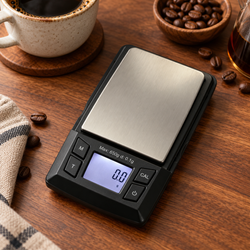
A 100g x 0.01g scale and a 600g x 0.1g scale are designed for distinctly different weighing priorities.
The 100g model provides finer readability but limited capacity. The 600g model supports six times as much weight but displays results in larger increments.
The essential tradeoff is:
-
100g x 0.01g: Lower capacity with finer 0.01g readability
-
600g x 0.1g: Higher capacity with coarser 0.1g readability
A 100g scale is generally the better choice when small weight differences matter and the entire load remains below 100g. A 600g scale is more appropriate for heavier samples, containers, grouped objects and portions for which 0.1g increments provide enough detail.
Neither specification is universally better. The right choice depends on the total load, required display increment, container weight, object dimensions and acceptable measurement tolerance.
This guide explains the differences and highlights relevant models within the American Weigh Wholesale collection of digital pocket scales.
Quick Comparison: 100g x 0.01g vs 600g x 0.1g
| Feature | 100g x 0.01g scale | 600g x 0.1g scale |
|---|---|---|
| Maximum capacity | 100g | 600g |
| Gram readability | 0.01g | 0.1g |
| Smallest displayed gram increment | 10mg | 100mg |
| Relative capacity | Lower | Six times greater |
| Relative readability | Ten times finer | Ten times coarser |
| Best for | Small objects and subtle weight differences | Heavier objects and larger portions |
| Container flexibility | Limited | Greater |
| Typical applications | Jewelry, gemstones, coins, tiny components | Food portions, hardware, grouped items, larger samples |
| Main advantage | Finer displayed detail | Larger usable range |
| Main limitation | 100g maximum | Cannot display hundredths of a gram |
The key decision is not simply which scale has the larger number. Buyers must decide whether capacity or finer readability matters more for the intended application.
Understanding Capacity and Readability
Scale specifications usually present capacity and readability together.
In the expression 100g x 0.01g:
-
100g is the maximum stated capacity.
-
0.01g is the displayed increment.
In the expression 600g x 0.1g:
-
600g is the maximum stated capacity.
-
0.1g is the displayed increment.
These numbers describe different characteristics and should not be combined into one general idea of “precision.”
What Does 100g x 0.01g Mean?
A 100g x 0.01g digital scale can accept a total load up to 100 grams and displays gram values in increments of 0.01 gram.
Possible display values include:
-
1.24g
-
1.25g
-
1.26g
-
47.83g
-
99.92g
One-hundredth of a gram equals 10 milligrams. The scale therefore displays changes in 10-milligram increments.
NIST provides additional information about the gram, kilogram and related SI units used to express mass.
The 100g limit applies to everything supported by the platform, including:
-
The object
-
A bowl or tray
-
Weighing paper
-
A protective mat
-
Any additional material
What Does 600g x 0.1g Mean?
A 600g x 0.1g scale can accept a total load up to 600 grams and displays gram values in increments of one-tenth of a gram.
Possible display values include:
-
1.2g
-
1.3g
-
1.4g
-
248.7g
-
599.8g
One-tenth of a gram equals 100 milligrams.
The 600g scale supports six times the nominal load of the 100g model, but its display increment is ten times larger.
Is 0.01g Better Than 0.1g?
A 0.01g display is finer than a 0.1g display, but that does not make it better for every task.
The 0.01g scale can show differences that the 0.1g scale cannot display.
For example, consider two objects:
-
Object A: approximately 12.34g
-
Object B: approximately 12.39g
A 0.01g scale may indicate different values for the two objects. A 0.1g scale does not display the hundredths place, so both indications may round to the same tenth-gram value, depending on the device’s response and rounding behavior.
That distinction matters when comparing:
-
Small gemstones
-
Jewelry components
-
Individual coins
-
Tiny hardware
-
Lightweight hobby parts
-
Small formulation ingredients
It may not matter when portioning an approximately 350g sample where a tenth of a gram provides more detail than the process requires.
Is the 600g Scale More Useful?
It is more useful when loads exceed the practical range of a 100g scale.
A 600g scale can accommodate:
-
Heavier containers
-
Larger portions
-
Multiple objects
-
More substantial trays
-
Larger ingredient batches
-
Wider variations in sample weight
However, it cannot display results to the nearest hundredth of a gram.
A scale is useful only when it provides enough capacity and sufficient readability for the task. If either requirement is missing, the specification may be unsuitable.
Readability Is Not the Same as Accuracy
A 0.01g display should not automatically be interpreted as guaranteed accuracy to ±0.01g. Likewise, a 0.1g display is not a complete accuracy specification.
Readability describes the scale’s displayed increment. Measurement performance can also depend on:
-
Calibration
-
Repeatability
-
Linearity
-
Minimum load
-
Environmental stability
-
Platform design
-
Load placement
-
Battery condition
-
Operating temperature
-
Manufacturing tolerances
NIST discusses the distinction between a displayed scale division and a verification scale division in its explanation of scale division “d” versus verification scale division “e”.
The number of decimal places is important, but it is not the only factor affecting whether a measurement is suitable for a particular purpose.
Capacity Difference: 100g vs 600g
The 600g scale provides 500g more nominal capacity than the 100g scale.
It can support six times the total physical load:
600g ÷ 100g = 6
This difference becomes especially important when a container is used.
Tare Does Not Restore Capacity
Tare allows a user to zero the displayed weight of a container. It does not remove the container’s physical mass from the scale.
Example With a 100g Scale
An empty bowl weighs 70g.
After the bowl is placed on the scale and the tare button is pressed, the display reads 0.00g. However, the load cell still supports 70g.
The approximate remaining capacity is:
100g − 70g = 30g
Only about 30g of material can be added before the total reaches the scale’s stated limit.
Example With a 600g Scale
The same 70g bowl is placed on a 600g scale and tared.
The approximate remaining capacity is:
600g − 70g = 530g
The higher-capacity model provides far more room for the sample.
Remaining Capacity Comparison
| Container weight | Remaining capacity on 100g scale | Remaining capacity on 600g scale |
|---|---|---|
| 5g | 95g | 595g |
| 20g | 80g | 580g |
| 40g | 60g | 560g |
| 60g | 40g | 540g |
| 80g | 20g | 520g |
| 100g | No remaining capacity | 500g |
| 200g | Over capacity | 400g |
| 300g | Over capacity | 300g |
This is one reason a 600g scale may be preferable for food portions, bowls, parts containers and grouped objects.
Readability Difference: 0.01g vs 0.1g
The 100g scale displays one additional decimal place.
| Actual weight example | Possible 0.01g display | Possible 0.1g display |
|---|---|---|
| Approximately 1.24g | 1.24g | 1.2g |
| Approximately 5.67g | 5.67g | 5.7g |
| Approximately 12.38g | 12.38g | 12.4g |
| Approximately 54.92g | 54.92g | 54.9g |
| Approximately 98.76g | 98.76g | 98.8g |
These examples illustrate displayed increments, not guaranteed readings or accuracy limits. Actual indication depends on the scale’s response and performance.
When to Choose a 100g x 0.01g Scale
Choose the 100g model when loads are lightweight and hundredths-of-a-gram display detail is useful.
Jewelry and Gemstones
A 0.01g scale is generally more appropriate than a 0.1g scale for small jewelry components and gemstones because subtle weight differences may matter.
Potential items include:
-
Loose stones
-
Rings
-
Earrings
-
Beads
-
Clasps
-
Small chains
-
Findings
Depending on the model, carat, troy-ounce, pennyweight or grain modes may also be available.
Individual Coins
A 100g x 0.01g scale can be useful for comparing individual coins and lightweight collectibles.
Weight alone does not establish authenticity, grade or value. It should be used with dimensions, composition, condition and other appropriate evaluation methods.
Small Hardware
The finer display can help compare:
-
Screws
-
Washers
-
Springs
-
Electronic components
-
Watch parts
-
Model-making hardware
The total load must remain below 100g.
Fishing and Archery Components
Individual hooks, small sinkers, points, inserts and other components may benefit from 0.01g readability.
The selected unit mode should match the application. Some users may prefer grains rather than grams.
Small Craft and Formulation Ingredients
A 0.01g scale can be useful for small portions of:
-
Pigments
-
Dyes
-
Fragrance materials
-
Beads
-
Resin additives
-
Dry blending ingredients
The suitability of the scale still depends on the process tolerance. Extremely small quantities may require finer readability and more controlled equipment.
Rechargeable Portable Weighing
The PowerBank-100 rechargeable digital pocket scale is listed as a 100g x 0.01g model and includes a 100g calibration weight.
A rechargeable format may appeal to users who want portable operation without relying exclusively on disposable batteries.
Compact Everyday Weighing
The AERO-100 digital pocket scale is another 100g x 0.01g option. Its capacity class is suited to lightweight items for which the finer displayed increment is more important than a broad weighing range.
When to Choose a 600g x 0.1g Scale
Choose the 600g model when higher capacity matters more than displaying hundredths of a gram.
Food Portioning
A 600g scale can handle moderate food portions and containers more easily than a 100g model.
Potential uses include:
-
Meal-prep portions
-
Coffee beans
-
Tea leaves
-
Snacks
-
Dry ingredients
-
Pet-food portions
A 0.1g increment is often sufficient for general portioning, although the correct readability depends on the recipe, nutrition plan or professional requirement.
Larger Coffee and Tea Batches
A 100g scale may work for a single coffee dose or small tea portion, but the container can consume much of its capacity.
A 600g model gives users more room for:
-
Dosing cups
-
Bowls
-
Multiple servings
-
Bean samples
-
Tea-blending batches
Confirm whether timing functions, liquid resistance or other specialized features are needed. Capacity and readability alone do not establish those capabilities.
Small Hardware Batches
A 600g x 0.1g scale is better for weighing groups of:
-
Screws
-
Nuts
-
Washers
-
Connectors
-
Springs
-
Small brackets
-
Repair parts
A tenth-gram display may be adequate when the goal is comparing batches rather than individual lightweight pieces.
Farmers Market and Product Samples
The higher capacity can support moderate product samples, containers and grouped goods.
If the measurement will determine a customer’s price, an ordinary pocket scale should not automatically be assumed legal for trade. Commercial use requires separate verification.
Hobby and Craft Batches
A 600g scale can accommodate:
-
Clay portions
-
Larger bead groups
-
Resin-related materials
-
Model components
-
Mixed craft ingredients
-
Storage cups
Chemical compatibility and spill protection must be considered when selecting containers.
General High-Capacity Pocket Weighing
The V2-600 digital pocket scale is listed with a 600g capacity and 0.1g readability.
This type of model suits buyers who need more range than a 100g scale but still want a compact format.
AWS-600 Series
The AWS-600 digital pocket scale series is also rated at 600g x 0.1g. Its product information describes a stainless-steel weighing platform protected by a hard plastic lid when not in use.
A protective lid can be valuable for portable storage, but buyers should confirm whether the lid also functions as a tray and account for its weight if used during weighing.
CARDV2-600
The CARDV2-600 compact digital pocket scale provides the same 600g x 0.1g capacity class in a compact card-style format.
The physical format may be attractive when storage thickness and portability matter. As with every model, platform dimensions should be compared with the objects and containers being weighed.
Practical Load Examples
| Weighing setup | Total physical load | 100g x 0.01g | 600g x 0.1g |
|---|---|---|---|
| 5g tray + 10g sample | 15g | Suitable, finer display | Suitable, coarser display |
| 20g container + 30g sample | 50g | Suitable | Suitable |
| 40g dish + 50g sample | 90g | Within capacity, limited margin | Suitable |
| 70g bowl + 55g sample | 125g | Over capacity | Suitable |
| 100g container + 200g sample | 300g | Over capacity | Suitable |
| 80g bowl + 400g sample | 480g | Over capacity | Suitable |
| 150g container + 425g sample | 575g | Over capacity | Near maximum |
| 175g container + 450g sample | 625g | Over capacity | Over capacity |
The table shows that capacity determines whether the measurement is physically possible, while readability determines how finely the result is displayed.
Which Scale Is Better for Small Quantities?
The 100g x 0.01g scale is generally the better option for small quantities when differences smaller than 0.1g matter.
For example, if a process requires distinguishing between 2.34g and 2.39g, a scale displaying only tenths of a gram is too coarse to show that difference directly.
However, 0.01g readability still may not be sufficient for every small-quantity application. A process involving only a few milligrams may require 0.001g readability or specialized equipment.
Do not determine suitability based only on the fact that the scale shows two decimal places.
Which Scale Is Better for Larger Quantities?
The 600g x 0.1g scale is the clear choice when the combined sample and container exceed 100g.
It is also preferable when regular loads approach the 100g limit. Operating with more capacity provides room for:
-
Batch variation
-
Heavier containers
-
Additional material
-
Unexpectedly heavy pieces
-
Future changes in the workflow
The 0.1g display must still be fine enough for the intended decision.
Which Scale Is Better for Counting Parts?
Count-by-weight estimates require more than capacity.
The process involves:
-
Determining an average piece weight
-
Measuring the total batch
-
Dividing the batch weight by the average
A 0.01g scale can characterize lightweight individual pieces more effectively. A 600g scale can support larger batches.
If individual pieces vary in weight, neither scale guarantees an exact count. A dedicated counting scale or validated counting process may be more appropriate for inventory control.
Platform Size Matters
A scale can have enough capacity yet still be unsuitable if the object does not fit the platform.
An oversized object can:
-
Block the display
-
Touch the surrounding housing
-
Contact the work surface
-
Shift during weighing
-
Be difficult to center
-
Apply force outside the intended loading area
Measure the object or container base before purchasing.
A 600g capacity does not guarantee a large platform, and a 100g model is not automatically smaller in every dimension.
Container Selection
Choose a container that:
-
Fits securely on the platform
-
Does not block the display
-
Remains stable while loading
-
Does not touch the work surface
-
Is compatible with the material
-
Leaves sufficient capacity for the sample
Light containers preserve more of a 100g scale’s range. A 600g model provides more flexibility to use sturdy bowls, cups and trays.
Calibration Requirements
The two capacity classes may require different calibration weights.
A 100g model may use a 100g calibration weight. A 600g model may use a different weight or calibration sequence. The requirement depends on the exact scale.
Before calibration:
-
Review the model instructions.
-
Use the specified reference weight.
-
Place the scale on a stable surface.
-
Avoid drafts and vibration.
-
Allow the scale to reach the working temperature.
-
Ensure that the platform is clean.
-
Follow the correct button sequence.
NIST’s publication Accuracy Matters: Weighing in the Balance explains the importance of suitable standards and procedures in weighing.
Household items, coins and packaged products should not be treated as calibration standards merely because they are labeled with a nominal weight.
Environmental Effects
Both scales can be affected by their surroundings. The finer 0.01g scale may make small fluctuations more visible.
NIST’s weighing and scales frequently asked questions provide additional guidance concerning weighing devices and scale divisions.
Air Movement
Fans, vents, open windows and passing movement can affect lightweight samples, weighing paper and open containers.
Vibration
Machinery, unstable tables, loud equipment and repeated contact with the work surface can cause the indication to fluctuate.
Temperature
Moving a scale between different temperatures may cause temporary instability. Allow the scale and sample to acclimate when appropriate.
Static Electricity
Dry materials and plastic containers can produce static effects, especially when samples are lightweight.
Load Placement
Center the load whenever possible. Avoid letting an object touch the scale housing or nearby surface.
Battery Condition
Weak batteries may lead to display or operating problems. Replace batteries using the type specified by the manufacturer.
Do You Need Both Scales?
Some businesses and serious hobbyists benefit from having both capacity classes.
The 100g x 0.01g model can be used for:
-
Individual lightweight items
-
Fine comparisons
-
Small components
-
Initial ingredient portions
The 600g x 0.1g model can be used for:
-
Larger batches
-
Heavier containers
-
Grouped objects
-
Final portions
This two-scale approach can provide a broader working range without forcing one scale to perform tasks outside its intended capacity or readability.
Owning two scales does not replace calibration, correct technique or application-specific validation.
Is Either Scale Suitable for Laboratory Work?
A pocket scale may support demonstrations, rough comparisons, educational use or noncritical internal work.
Laboratory applications can require:
-
Documented accuracy
-
Repeatability data
-
Linearity specifications
-
Measurement uncertainty
-
Calibration traceability
-
Environmental controls
-
Quality procedures
-
Specialized balances
-
Minimum sample-weight determinations
The capacity and readability printed on a pocket scale are not enough to establish suitability for regulated laboratory work.
Is Either Scale Legal for Trade?
Do not assume that either scale is legal for trade.
NIST explains that a legal-metrology device includes a weighing or measuring device used to determine a quantity on which a charge for goods or services is based.
If a measurement determines the amount a customer pays, verify:
-
The exact model’s certification status
-
National Type Evaluation Program requirements
-
State and local laws
-
Registration requirements
-
Inspection and sealing requirements
-
Minimum-load requirements
-
Suitability for the commodity
The 2026 edition of NIST Handbook 44 contains specifications, tolerances and technical requirements for commercial weighing and measuring devices. NIST notes that the handbook is adopted by many state, local and some federal weights-and-measures authorities.
An ordinary pocket scale may be appropriate for internal portioning or noncommercial comparisons without being approved for price-determining transactions.
How to Choose Between the Two Specifications
Step 1: Determine the Heaviest Total Load
Add the weight of:
-
The container
-
The sample
-
The tray or mat
-
Any accessories supported by the platform
-
A reasonable capacity margin
If the total can exceed 100g, the 100g scale is not suitable.
Step 2: Determine the Smallest Difference That Matters
Ask whether the process needs to distinguish:
-
0.01g changes
-
0.1g changes
-
Only whole grams
If differences smaller than 0.1g matter, the 600g x 0.1g specification is too coarse.
Step 3: Evaluate Typical, Not Just Maximum, Loads
A scale should fit normal working conditions. If nearly every load is between 150g and 400g, choose the 600g model.
If normal loads are between 2g and 40g and fine differences matter, choose the 100g model.
Step 4: Include the Container
Never evaluate sample weight alone. The container consumes capacity even after taring.
Step 5: Measure the Objects
Confirm that objects and containers fit the platform without touching adjacent surfaces.
Step 6: Verify Units
Check whether the exact model displays the required units, such as:
-
Grams
-
Ounces
-
Carats
-
Grains
-
Troy ounces
-
Pennyweight
Step 7: Review Calibration Requirements
Identify the required calibration weight and determine whether it is included.
Step 8: Consider Power and Portability
Compare:
-
Battery type
-
Rechargeable operation
-
AC-power options
-
Overall dimensions
-
Protective cover
-
Storage requirements
Simple Decision Table
| Your requirement | Better starting choice |
|---|---|
| Display hundredths of a gram | 100g x 0.01g |
| Weigh more than 100g | 600g x 0.1g |
| Individual gemstones or jewelry | 100g x 0.01g |
| Small coins and components | 100g x 0.01g |
| Moderate food portions | 600g x 0.1g |
| Larger coffee or tea batches | 600g x 0.1g |
| Heavy bowl or container | 600g x 0.1g |
| Lightweight formulation ingredients | 100g x 0.01g, if adequate |
| Need 0.001g readability | Neither |
| Need more than 600g capacity | Neither |
| Price-determining commercial use | Verify legal-for-trade equipment |
Frequently Asked Questions
Which scale is more precise: 100g x 0.01g or 600g x 0.1g?
The 100g scale has finer readability because it displays 0.01g increments instead of 0.1g increments. That does not, by itself, establish the complete accuracy of either model.
How much more capacity does the 600g scale provide?
It provides six times the nominal capacity and 500g more total range than the 100g model.
How much finer is 0.01g than 0.1g?
A 0.01g increment is ten times finer than a 0.1g increment.
Is 0.01g equal to 10mg?
Yes. A 0.01g increment equals 10 milligrams.
Is 0.1g equal to 100mg?
Yes. A 0.1g increment equals 100 milligrams.
Can a 600g x 0.1g scale weigh a 0.05g object?
A 0.1g display cannot directly show hundredths-of-a-gram detail. It is not suitable when reliable measurement of a 0.05g sample is required.
Can a 100g scale weigh 100g of material inside a bowl?
Only if the bowl contributes no weight, which is unrealistic. The bowl and material together must remain within 100g.
Does pressing tare give the scale its full capacity back?
No. Tare changes the displayed zero point but does not remove the container’s physical weight.
Is a 600g scale less accurate?
Higher capacity does not automatically mean lower accuracy. In this comparison, the 600g model has coarser readability. Actual accuracy depends on the specific model and conditions.
Which scale is better for coffee?
A 100g scale may work for individual doses when finer increments matter. A 600g scale is more practical for larger batches and heavier containers. Specialized coffee features must be evaluated separately.
Which scale is better for jewelry?
The 100g x 0.01g specification is generally more suitable for individual jewelry pieces and gemstones because it displays finer differences.
Which scale is better for meal prep?
The 600g x 0.1g scale usually provides the more practical capacity for food portions and containers.
Can household objects be used for calibration?
Use the reference weight and procedure specified for the exact model. Household objects are not reliable calibration standards.
Are these scales legal for trade?
Not automatically. Confirm the certification of the exact model and applicable weights-and-measures requirements before using it to determine a selling price.
Final Verdict
Choose a 100g x 0.01g scale when fine displayed detail matters and the object, container and accessories remain comfortably below 100g. It is the better starting point for jewelry, gemstones, individual coins, tiny hardware and other lightweight items where hundredths of a gram are useful.
Choose a 600g x 0.1g scale when the task involves heavier containers, larger portions, grouped objects or batches exceeding 100g. It provides six times the nominal capacity but displays only tenths of a gram.
The decision can be reduced to two questions:
-
Does the total physical load exceed 100g?
-
Do differences smaller than 0.1g matter?
If the load exceeds 100g, choose the 600g model unless its 0.1g readability is too coarse. If hundredths of a gram matter, choose the 100g model unless its capacity is too low.
When both high capacity and 0.01g readability are required, neither specification fully resolves the need. In that case, consider a higher-capacity 0.01g scale rather than accepting either insufficient capacity or insufficient readability.