
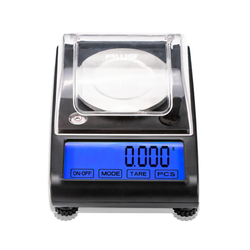
Choosing between a 200g and 500g pocket scale depends on what you plan to weigh, whether you use a container, and how much extra capacity you need for future tasks.
A 200g pocket scale is usually sufficient for jewelry, coins, spices, tea, beads, and other lightweight objects. A 500g pocket scale provides more flexibility for coffee, larger containers, grouped components, craft materials, ingredients, and heavier everyday items.
Capacity is not the same as precision, however. A 200g scale and a 500g scale can both offer 0.01g readability. The difference is the maximum total weight each scale can safely support.
This guide compares 200g and 500g digital pocket scales, explains how capacity affects everyday use, and helps you select the right model for your application.
What Does 200g Capacity Mean?
A 200g pocket scale can support a maximum total load of 200 grams.
That total includes:
- The item being weighed
- A bowl or tray
- Weighing paper
- A scoop
- A protective cover used as a container
- Any other object touching the weighing platform
Pressing the tare button resets the display to zero after a container is added, but it does not remove the container’s physical weight from the load cell.
For example, if you place a 40g container on a 200g scale and press tare, approximately 160g of usable capacity remains.
A 200g scale is appropriate when most of your items and containers remain comfortably below this limit.
What Does 500g Capacity Mean?
A 500g pocket scale can support up to 500 grams of total weight.
That is two and a half times the maximum capacity of a 200g model. The additional capacity gives users more flexibility when weighing larger objects, heavier containers, grouped components, or greater quantities of material.
For example, if a container weighs 100 grams:
- A 200g scale has approximately 100g of remaining capacity.
- A 500g scale has approximately 400g of remaining capacity.
A 500g model can reduce the likelihood of overloading the scale when the objects or containers vary substantially in weight.
200g vs. 500g Pocket Scale: Quick Comparison
| Feature | 200g Pocket Scale | 500g Pocket Scale |
|---|---|---|
| Maximum capacity | 200 grams | 500 grams |
| Best for | Small, lightweight objects | Larger objects and containers |
| Portability | Usually very compact | Compact, sometimes slightly larger |
| Container flexibility | Limited with heavier containers | Greater flexibility |
| Jewelry | Excellent | Excellent for heavier pieces |
| Coins | Individual coins and small groups | Larger groups and collections |
| Coffee | Small bean or ground portions | Larger portions and containers |
| Crafts | Beads and small components | Resin, clay and grouped materials |
| Overload headroom | Lower | Higher |
| Typical readability | Often 0.01g | Commonly 0.01g or 0.1g |
Always compare the exact specifications of an individual model. Capacity alone does not reveal the scale’s readability, platform dimensions, available units, or intended application.
The Most Important Difference Is Capacity
The primary difference between these scales is the amount of weight they can support.
A 500g scale does not automatically provide greater accuracy than a 200g scale. Likewise, a 200g scale is not necessarily more precise simply because its capacity is lower.
Consider these two hypothetical specifications:
- Scale A: 200g capacity with 0.01g readability
- Scale B: 500g capacity with 0.01g readability
Both scales display measurements in the same 0.01g increments. Scale B can simply support an additional 300 grams.
However, some 500g models use 0.1g increments instead of 0.01g. That is why both capacity and readability must be evaluated before purchasing.
Capacity vs. Readability
Capacity is the maximum amount the scale can weigh. Readability is the smallest change shown on its display.
For example:
- 200g × 0.01g means a 200g maximum capacity with readings in 0.01g increments.
- 500g × 0.01g means a 500g maximum capacity with readings in 0.01g increments.
- 500g × 0.1g means a 500g maximum capacity with readings in 0.1g increments.
A 500g × 0.01g scale provides more capacity without sacrificing hundredth-of-a-gram readability. A 500g × 0.1g scale provides greater capacity but displays less detailed measurements.
Choose capacity based on the heaviest total load and readability based on the smallest weight difference you need to see.
When Should You Choose a 200g Pocket Scale?
A 200g scale is a practical choice when portability and fine measurements are more important than handling heavier loads.
Choose a 200g model if you primarily weigh:
- Rings and earrings
- Loose gemstones
- Coins and tokens
- Small amounts of gold or silver
- Beads and jewelry findings
- Spices and tea
- Small coffee portions
- Screws and electronic components
- Fishing tackle
- Lightweight collectibles
A 200g scale is also useful when you normally place objects directly on the platform or use a very lightweight tray.
When Should You Choose a 500g Pocket Scale?
A 500g scale is better when you need more capacity or regularly use containers.
Choose a 500g model for:
- Heavier jewelry
- Watches and chains
- Groups of coins
- Larger coffee portions
- Coffee beans inside a container
- Craft materials
- Resin components
- Clay and pigments
- Small hardware collections
- Ingredients and spices
- Lightweight packages
- Multiple components weighed together
The additional capacity also provides room for applications that may expand over time. If your current items weigh close to 200 grams, a 500g scale is the safer long-term choice.
Best Capacity for Jewelry
Both capacities can work well for jewelry.
Choose 200g for:
- Rings
- Earrings
- Pendants
- Loose gemstones
- Small chains
- Jewelry findings
- Precious metal samples
Choose 500g for:
- Watches
- Heavy necklaces
- Bracelets
- Multiple pieces
- Jewelry inside containers
- Larger display or sorting trays
A 200g scale with 0.01g readability is sufficient for many individual jewelry pieces. A 500g × 0.01g model offers the same display increment with additional room for heavier items.
For extremely small gemstones or components requiring one-milligram readability, consider a 0.001g milligram scale instead.
Best Capacity for Coins
A single coin generally weighs far less than 200 grams, making a 200g scale appropriate for most individual coin measurements.
Choose a 200g scale when weighing:
- Individual coins
- Tokens
- Medals
- Small coin groups
- Coins in lightweight capsules
A 500g scale is more practical for:
- Coin rolls
- Multiple coins
- Heavier medals
- Sets in protective holders
- Grouped inventory
- Larger collecting trays
Weight can help collectors compare an object with published specifications, but it should not be used as the only method of determining authenticity or value.
Best Capacity for Coffee
A 200g scale can measure individual coffee portions, but its capacity may become restrictive when a cup, bowl, portafilter, or other container is added.
A 200g scale may be sufficient for:
- Coffee beans weighed directly on the platform
- Small espresso doses
- Grounds in a lightweight container
- Comparing individual beans
- Travel coffee kits
A 500g scale may be better for:
- Larger portions
- Heavier dosing cups
- Small mugs
- Coffee storage containers
- Multiple servings
- Ingredients added to coffee
Before choosing, add the expected coffee weight to the weight of the container. If the combined weight could exceed 200 grams, select the 500g model.
For full pour-over setups or large brewing vessels, a higher-capacity kitchen scale may be more appropriate.
Best Capacity for Crafts
Craft applications vary widely, which makes container weight particularly important.
A 200g scale works well for:
- Beads
- Jewelry findings
- Glitter
- Small pigment quantities
- Tiny hardware
- Miniature components
- Model-making supplies
A 500g scale is more suitable for:
- Resin components
- Clay
- Paint
- Larger pigment batches
- Grouped beads
- Adhesives
- Multiple pieces of hardware
- Heavier mixing containers
When measuring resin, paint, pigments, or adhesives, use an appropriate disposable container and follow the manufacturer’s mixing and safety instructions.
Best Capacity for Herbs, Spices and Tea
A 200g pocket scale offers enough capacity for many small food and ingredient measurements. It can be convenient for spices, loose-leaf tea, yeast, and recipe components.
A 500g scale provides more flexibility for:
- Larger ingredient portions
- Heavier bowls
- Multiple ingredients
- Batch preparation
- Food storage containers
Keep in mind that a pocket scale’s platform may be smaller than a kitchen scale’s platform. The container must sit securely without touching the table or surrounding scale housing.
Comparing Two AWS Pocket Scales
CARDV2-200 Compact Digital Pocket Scale
The CARDV2-200 Compact Digital Pocket Scale offers a 200g maximum capacity with 0.01g readability.
Its stainless steel weighing surface is easy to clean, and its compact design makes it suitable for food, spices, tea, yeast, jewelry, coins, and other small items.
The CARDV2-200 is a strong choice for users who want:
- 200g capacity
- 0.01g readability
- Compact storage
- Portable operation
- A stainless steel platform
- Everyday precision for small objects
SM-501-BLK 500g Pocket Scale
The SM-501-BLK Digital Pocket Scale provides a 500g maximum capacity with 0.01g readability.
This model preserves hundredth-of-a-gram readings while providing considerably more capacity than a 200g scale. It is useful for jewelry, coins, coffee, crafts, ingredients, and other applications requiring both precision and greater load capacity.
The SM-501-BLK is a strong choice for users who want:
- 500g capacity
- 0.01g readability
- Greater room for containers
- Flexibility across multiple applications
- Portable precision weighing
- More overload protection through additional capacity
Is a 500g Scale Less Accurate Than a 200g Scale?
Not necessarily.
A scale’s accuracy cannot be determined from capacity alone. Two models with different capacities may provide the same readability and comparable measurement performance.
Accuracy and repeatability depend on factors such as:
- Load-cell quality
- Calibration
- Minimum load
- Linearity
- Environmental conditions
- Platform stability
- Battery condition
- Proper operation
Compare the full specifications rather than assuming the lower-capacity model is more precise.
Does a 500g Scale Still Measure Small Items?
Yes, provided that its readability and minimum-load specifications are suitable for the item.
A 500g × 0.01g scale can display measurements in the same increments as a 200g × 0.01g model. The difference is maximum capacity.
However, an extremely lightweight object may fall below a particular model’s reliable minimum weight. Review the product specifications when your application involves very small loads.
Why You Should Leave Capacity Headroom
It is generally wise to choose a scale with more capacity than the heaviest item you expect to weigh.
If your usual total load is 180 to 195 grams, a 200g scale leaves very little margin for:
- A heavier container
- Additional ingredients
- Variations between items
- Accidental overloading
- Future applications
A 500g scale provides more usable headroom and reduces the chance of exceeding the scale’s limit.
That does not mean you should routinely place 500 grams on a 500g scale. Careful handling and reasonable operating margins can help protect the load cell.
How Container Weight Changes Your Decision
Many buyers compare only the weight of the material and forget the container.
Consider these examples:
Example 1: Jewelry Tray
- Jewelry: 85g
- Tray: 45g
- Total load: 130g
A 200g scale can handle this measurement.
Example 2: Coffee Container
- Coffee: 50g
- Container: 180g
- Total load: 230g
A 200g scale cannot safely support the total. A 500g scale is required.
Example 3: Craft Mixture
- Craft material: 160g
- Mixing cup: 75g
- Total load: 235g
The 200g model is too small, even if the display is tared after adding the cup.
Example 4: Coin Collection
- Coins: 185g
- Protective holder: 30g
- Total load: 215g
The combined load exceeds a 200g scale’s capacity. Choose a 500g model.
Is a 200g Scale More Portable?
A 200g pocket scale may be slightly slimmer or lighter, but capacity does not always determine the physical dimensions.
Some 500g models remain compact enough to fit inside a pocket, bag, desk, or travel case. Compare the actual product dimensions and platform size before buying.
A smaller scale can be convenient for travel, but a larger platform may provide better support for containers and irregularly shaped objects.
Features to Compare Beyond Capacity
Before choosing a pocket scale, review the following:
Readability
Choose 0.01g for jewelry, coins, crafts, and other detailed measurements. Choose 0.1g when one-tenth-of-a-gram increments are sufficient.
Weighing Units
Available units may include:
- Grams
- Ounces
- Troy ounces
- Pennyweights
- Carats
- Grains
Tare Function
Tare subtracts the displayed weight of a container, making it easier to measure only the contents.
Calibration
Check which calibration weight the scale requires and whether that weight is included.
Platform Size
Make sure the object or container fits securely on the platform without touching the surrounding surface.
Protective Cover
A fitted cover protects the weighing surface during storage and transportation. Some covers can also function as weighing trays.
Display
A bright backlit display improves visibility in workshops, kitchens, stores, offices, and other low-light environments.
Power Source
Most pocket scales use common batteries. Check whether batteries are included and remove them before long-term storage.
Warranty
Warranty coverage adds value and provides protection beyond the initial purchase period. Many American Weigh Scales models are backed by a 10-year manufacturer’s warranty.
How to Prevent Overloading a Pocket Scale
Overloading can damage the load cell and cause inaccurate or unstable readings.
Use these practices:
- Check the scale’s maximum capacity.
- Weigh an empty container separately when its weight is unknown.
- Add the container and material weights together.
- Leave reasonable capacity headroom.
- Never press down on the platform.
- Do not store objects on top of the scale.
- Use the protective cover during transportation.
- Remove the item immediately if an overload warning appears.
Taring changes the displayed number, not the actual load placed on the scale.
How to Obtain More Accurate Measurements
Whether you choose a 200g or 500g scale, follow these steps:
- Place the scale on a hard, flat surface.
- Keep it away from fans, vibration, and open windows.
- Turn it on and wait for a zero reading.
- Select the correct measurement unit.
- Calibrate the scale when necessary.
- Center the item on the weighing platform.
- Use tare for trays and containers.
- Wait for the display to stabilize.
- Repeat important measurements.
- Keep the platform clean and dry.
If readings become inconsistent, check the batteries, surface, calibration, temperature, and total load.
Frequently Asked Questions
Is a 200g scale enough for jewelry?
Yes. A 200g scale is sufficient for many rings, earrings, gemstones, chains, pendants, and other lightweight jewelry pieces. Choose a 500g model for heavier jewelry, watches, grouped items, or substantial containers.
Is a 500g scale better than a 200g scale?
A 500g scale is better when you need additional capacity. It is not automatically more accurate. If both models provide 0.01g readability, they display the same measurement increments.
Can a 200g scale weigh coffee?
Yes, if the combined weight of the coffee and its container remains below 200 grams. A 500g scale provides more flexibility for heavier cups and containers.
What does 500g × 0.01g mean?
It means the scale has a maximum capacity of 500 grams and displays measurements in increments of 0.01 gram.
Does using tare restore the scale’s full capacity?
No. Tare resets the display to zero but does not remove the container’s weight from the load cell.
Can a 500g scale measure 0.01g?
Yes, when the model is specifically rated as 500g × 0.01g. Some 500g scales offer only 0.1g readability, so check the exact specifications.
What happens if I put 500g on a 200g scale?
The scale may show an overload warning, produce an unreliable reading, or suffer permanent load-cell damage. Remove the object immediately and never intentionally exceed the stated capacity.
Which scale is best for coins?
A 200g × 0.01g scale is sufficient for individual coins and small groups. Choose a 500g model for coin rolls, sets, groups, and heavier containers.
Which capacity is best for crafts?
Choose 200g for beads, small findings, pigments, and miniature components. Choose 500g for resin, clay, adhesives, larger batches, and heavier mixing containers.
Should I buy more capacity than I currently need?
Additional capacity is useful if your items approach 200 grams, you regularly use containers, or you expect your applications to expand. Just make sure the higher-capacity model still provides the readability you require.
Which Pocket Scale Should You Choose?
Choose a 200g pocket scale when:
- Most items weigh substantially less than 200 grams.
- You use lightweight trays or no container.
- Portability is a priority.
- You primarily weigh jewelry, coins, tea, spices, beads, or small components.
- You want an affordable scale for everyday precision.
Choose a 500g pocket scale when:
- Items or containers may exceed 200 grams.
- You weigh coffee, crafts, ingredients, grouped coins, or heavier jewelry.
- You want greater flexibility for future applications.
- You frequently use bowls, cups, trays, or holders.
- You want more capacity without giving up 0.01g readability.
The best choice is not simply the scale with the highest capacity. It is the model that provides enough capacity for the complete load while maintaining the readability, platform size, units, and features your application requires.
Explore the full collection of American Weigh Scales digital pocket scales to compare capacities, readability, designs, and weighing features.