
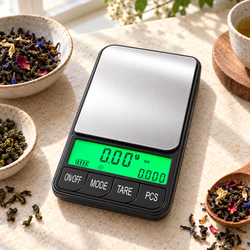
A 200g x 0.01g digital scale occupies a useful middle ground in precision weighing. It provides more capacity than a typical 50g or 100g pocket scale while retaining readability to one-hundredth of a gram.
That combination can be useful for jewelry, gemstones, coins, coffee, tea, craft ingredients, small hardware, hobby components and other objects that require more detail than a conventional 0.1g scale displays.
The specification does not mean that the scale is automatically accurate to exactly ±0.01g. It also does not mean that every sample from 0.01g through 200g can be measured with the same level of confidence.
Instead:
-
200g indicates the scale’s stated maximum capacity.
-
0.01g indicates the smallest gram increment shown on the display.
-
The container, tray and sample must remain within the 200g capacity together.
-
Readability, accuracy, repeatability and minimum usable weight are related but different concepts.
-
Platform size, calibration requirements and working conditions can matter as much as the headline specification.
This guide explains what buyers should know before choosing a model from the American Weigh Wholesale collection of digital pocket scales.
What Does 200g x 0.01g Mean?
The notation combines two specifications:
| Specification | Meaning |
|---|---|
| 200g | Maximum stated capacity |
| 0.01g | Gram readability or display increment |
| 0.01g in milligrams | 10mg |
| Display format | Typically two decimal places in gram mode |
| Total load | Sample plus container and accessories |
A 200g x 0.01g scale may display values such as:
-
0.35g
-
4.72g
-
18.26g
-
125.84g
-
199.92g
The display changes in hundredths of a gram. One-hundredth of a gram equals 10 milligrams.
The National Institute of Standards and Technology provides additional background about grams, kilograms and related SI units used for mass.
Understanding the 200g Capacity
The capacity is the largest total load the scale is designed to support under its stated conditions.
The 200g maximum includes:
-
The sample
-
The weighing container
-
A tray or bowl
-
Weighing paper
-
A silicone mat
-
Any cover used as an expansion tray
-
Anything else resting on the platform
This is important because product descriptions frequently focus on the sample weight while buyers overlook the container.
Example With a Lightweight Tray
Suppose a plastic tray weighs 15g.
The approximate remaining capacity is:
200g − 15g = 185g
The user can add up to approximately 185g of material before reaching the scale’s stated maximum.
Example With a Heavy Container
Suppose a glass container weighs 120g.
The approximate remaining capacity is:
200g − 120g = 80g
Even if the display is tared to zero, the scale is already supporting 120g.
Why Working Margin Matters
A scale should not routinely be operated at its exact maximum capacity. Leaving room below the limit helps accommodate:
-
Sample variation
-
Container variation
-
Additional material
-
Accidental loading
-
Items whose approximate weight is unknown
If normal total loads regularly exceed approximately 160g to 180g, a higher-capacity scale may be more practical.
Understanding the 0.01g Readability
Readability describes the smallest increment shown on the display.
For a 0.01g scale, the indicated weight moves through values such as:
-
12.31g
-
12.32g
-
12.33g
-
12.34g
A 0.1g scale would instead display tenths of a gram:
-
12.3g
-
12.4g
-
12.5g
The 0.01g model therefore provides ten times finer displayed increments than a 0.1g model.
That finer display can be useful when small differences matter, but it should not be confused with a complete accuracy specification.
Readability Does Not Equal Accuracy
A common mistake is describing a 200g x 0.01g scale as “accurate to 0.01g” simply because it shows two decimal places.
Readability tells you the display increment. Accuracy addresses how closely the measurement agrees with an appropriate reference value under stated conditions.
Other relevant performance concepts include:
Repeatability
Repeatability describes how closely repeated measurements of the same object agree when the test is performed under similar conditions.
If the same object produces results of 25.42g, 25.43g, 25.42g and 25.47g, the spread provides information about repeatability.
Linearity
Linearity relates to measurement performance across the scale’s range. A scale may behave differently near 10g than it does near 190g.
Minimum Load
Minimum load is not necessarily the same as the smallest displayed increment. A scale may show a number near zero without that number meeting the accuracy or repeatability needs of the application.
Measurement Uncertainty
Measurement uncertainty describes the range associated with a measurement result. It requires more information than the number of decimal places on the display.
NIST explains the distinction between scale divisions and verification scale divisions in its discussion of scale division “d” versus verification scale division “e”.
The practical takeaway is simple: a 0.01g display provides useful detail, but it should not be treated as an unconditional promise of ±0.01g accuracy.
Is 0.01g the Same as 10mg?
Yes.
The conversion is:
1g = 1,000mg
Therefore:
0.01g × 1,000 = 10mg
A scale with 0.01g readability displays mass in increments of 10 milligrams.
It does not display individual 1mg increments. A scale intended to show 1mg increments would require 0.001g readability.
Can a 200g x 0.01g Scale Weigh 0.01g?
The display may respond to a very small load, but the specification alone does not establish that 0.01g is a reliable minimum sample weight.
To determine whether a scale is appropriate near the bottom of its range, review the available information for:
-
Minimum load
-
Accuracy
-
Repeatability
-
Linearity
-
Tolerance
-
Recommended sample range
-
Environmental requirements
If a process depends on very small quantities, use equipment whose complete performance specifications support that application.
What Can You Weigh With a 200g x 0.01g Scale?
The 200g capacity and 0.01g readability make this category versatile.
Jewelry
Possible jewelry-related uses include:
-
Rings
-
Earrings
-
Pendants
-
Small chains
-
Charms
-
Clasps
-
Findings
-
Groups of lightweight pieces
Check whether the scale provides the required unit modes, such as grams, carats, troy ounces or pennyweight.
Gemstones
A 0.01g scale can support general gemstone weighing and sorting. Because one carat equals 0.2g, users working in carats may prefer a model with a direct carat mode.
Weight is only one characteristic of a gemstone. Identification and valuation can also involve dimensions, cut, clarity, color, treatments and professional assessment.
Coins and Collectibles
A 200g capacity can handle:
-
Individual coins
-
Coin capsules
-
Small coin groups
-
Medals
-
Tokens
-
Lightweight collectibles
The extra capacity over a 100g scale can be useful when holders or multiple pieces are weighed together.
Weight alone should not be used to establish authenticity or grade.
Coffee
A 200g x 0.01g scale can work well for:
-
Individual coffee doses
-
Bean samples
-
Ground-coffee portions
-
Small roasting samples
-
Comparing input and output quantities
The container must fit the platform and remain within the capacity.
Buyers interested in small-dose coffee applications can also review the AWS guide to choosing a food scale for weighing coffee beans.
A general 200g pocket scale may not include a timer, water resistance or a platform large enough for a brewing vessel. Those features must be evaluated separately.
Loose-Leaf Tea
The scale can display small tea portions in hundredths of a gram while supporting a lightweight cup or tray.
Potential applications include:
-
Individual servings
-
Sample comparison
-
Blend development
-
Small packaging portions
-
Inventory checks
The American Weigh Wholesale guide to the best kitchen scale for loose-leaf tea provides additional application-specific considerations.
Small Hardware
A 200g scale may be used for:
-
Screws
-
Nuts
-
Washers
-
Springs
-
Connectors
-
Electronic components
-
Watch parts
-
Small assemblies
For count-by-weight estimates, variation between individual parts must be considered. Dividing the batch weight by an average piece weight does not guarantee an exact count.
Crafts and Model Making
The scale may be useful for:
-
Beads
-
Pigments
-
Resin additives
-
Miniature parts
-
Clay portions
-
Small molds
-
Decorative components
-
Model-making materials
Use a compatible container and protect the platform from liquids, adhesives and uncured materials.
Fishing Tackle
Potential items include:
-
Hooks
-
Sinkers
-
Lures
-
Swivels
-
Beads
-
Small terminal-tackle sets
A grain mode may be helpful for certain components, but unit availability varies by model.
Archery Components
A 200g scale can accommodate individual or grouped:
-
Points
-
Inserts
-
Nocks
-
Vanes
-
Small accessories
Users who work primarily in grains should verify that the model includes a grain display mode.
Culinary Ingredients
A 200g x 0.01g scale may be useful for lightweight ingredients such as:
-
Spices
-
Saffron
-
Yeast
-
Salt
-
Tea
-
Coffee
-
Garnish ingredients
-
Recipe-development samples
For more examples, see the AWS guide to selecting a kitchen scale for measurements under one gram.
Use an appropriate food-safe container rather than assuming the platform itself is intended for direct food contact.
When Is 200g Capacity Not Enough?
A 200g scale may be too limited when the combined load includes:
-
Heavy glass bowls
-
Portafilters
-
Full beverage cups
-
Large ingredient batches
-
Multiple heavy coins
-
Larger metal assemblies
-
Bulky packaging
-
Substantial product samples
Capacity Examples
| Container | Sample | Total load | Suitable for 200g scale? |
|---|---|---|---|
| 5g | 20g | 25g | Yes |
| 15g | 60g | 75g | Yes |
| 30g | 100g | 130g | Yes |
| 50g | 125g | 175g | Yes, but limited margin |
| 80g | 115g | 195g | Near maximum |
| 100g | 125g | 225g | No |
| 150g | 75g | 225g | No |
If the normal total load approaches 200g, a 500g x 0.01g model may provide a more comfortable working range.
When Is 0.01g Readability Not Fine Enough?
A 0.01g scale is not the correct choice when the process requires displaying individual milligrams.
Consider a 0.001g scale when:
-
The target quantities are only a few milligrams.
-
Differences smaller than 10mg matter.
-
A validated process requires milligram readability.
-
The application’s uncertainty requirement cannot be met by a 0.01g device.
A milligram display still does not automatically make a scale suitable for laboratory, pharmaceutical or safety-critical work. Complete performance and process requirements must be evaluated.
When Is 0.01g Readability More Than You Need?
A 0.1g scale may be sufficient for:
-
General meal portions
-
Larger food batches
-
Pet-food portions
-
Shipping preparation
-
Broad hardware sorting
-
Objects measured primarily in whole grams
If no decision depends on the hundredths place, buyers may prefer a higher-capacity 0.1g model.
The best scale offers enough detail for the task without sacrificing needed capacity.
Important Features to Compare
Two 200g x 0.01g scales can have the same headline specification yet provide very different user experiences.
Platform Size
Platform size determines whether the object or container fits securely.
A platform that is too small can cause the load to:
-
Obscure the display
-
Touch the surrounding housing
-
Contact the work surface
-
Shift during weighing
-
Apply force unevenly
-
Become difficult to center
Measure the base of the container—not only the sample—before buying.
Platform Material
Stainless-steel platforms are common because they are durable and relatively easy to wipe clean.
However, “stainless steel” does not mean the entire scale is waterproof or chemically resistant. Prevent liquids and fine material from entering the controls or housing.
Tare Function
Tare allows the user to subtract the displayed weight of a container.
A typical process is:
-
Place the empty container on the platform.
-
Wait for the display to stabilize.
-
Press the tare button.
-
Confirm that the display returns to zero.
-
Add the material.
-
Read the net displayed result.
Tare does not restore capacity. A 70g container leaves approximately 130g of physical capacity on a 200g scale.
Unit Modes
Common modes include:
-
g: grams
-
oz: ounces
-
ct: carats
-
gn: grains
-
ozt: troy ounces
-
dwt: pennyweight
Not every model includes every unit.
Unit conversion changes how the result is displayed. It does not improve the scale’s physical sensitivity or accuracy.
Protective Cover or Expansion Tray
A cover can protect the platform during transport and storage. Some models allow the cover to be removed and used as a weighing tray.
If the cover is used as a tray, its mass counts toward the 200g capacity.
Bowl or Raised Edges
A bowl or raised platform edge can help contain:
-
Beads
-
Seeds
-
Small hardware
-
Loose ingredients
-
Craft components
The container must fit correctly and should not touch anything outside the platform.
Display
Evaluate:
-
Digit size
-
Backlighting
-
Viewing angle
-
Display position
-
Whether the container will block the display
-
Stability indicators, if provided
A wide object can make an otherwise suitable scale frustrating if it obscures the readout.
Power Source
Common options include:
-
AAA batteries
-
Coin-cell batteries
-
Rechargeable batteries
-
AC adapters
-
Dual battery and adapter operation
Battery-powered models are convenient for travel. Rechargeable models reduce dependence on disposable batteries. AC operation can be useful at a permanent workstation.
Automatic Shutoff
Automatic shutoff conserves battery power but may interrupt longer preparation or formulation tasks.
Look for information about:
-
Shutoff timing
-
Whether the setting is adjustable
-
Whether it can be disabled
-
How the scale behaves after inactivity
Calibration Requirements
Verify:
-
Required calibration weight
-
Whether the weight is included
-
Calibration sequence
-
Recommended conditions
-
Whether more than one reference value is used
Never assume that all 200g models calibrate in the same way.
Warranty
A warranty can provide useful protection, but buyers should review:
-
Warranty duration
-
Covered defects
-
Exclusions
-
Claim process
-
Required proof of purchase
-
Geographic limitations
The presence of a warranty does not replace correct handling, calibration or overload prevention.
Comparing Available 200g and Near-200g Models
PC-201 Price-Computing Pocket Scale
The PC-201 200g x 0.01g price-computing scale combines the core specification with a larger platform and price-calculation features.
Its current listing includes:
-
200g capacity
-
0.01g readability
-
Approximately 4.4-by-4.8-inch stainless-steel platform
-
Gram, ounce, troy-ounce, pennyweight, grain and carat modes
-
Programming for up to seven preset unit prices
-
Full numerical keypad
-
Two AAA batteries
-
Calibration using a 200g weight, not included
-
Listed operating range of 10°C to 30°C
-
Ten-year manufacturer warranty
The listing explicitly states that its price-calculation functionality is not legal for trade.
Who Should Consider It?
The PC-201 may appeal to users who want:
-
A larger platform
-
Multiple specialized units
-
Value-estimation features
-
A full keypad
-
More room for flat or irregular objects
Its price calculation can be useful for estimates, but it should not be assumed approved for determining a commercial selling price.
CARDV2-200 Compact Scale
The CARDV2-200 is identified by American Weigh Wholesale as a compact 200g x 0.01g card-style scale. The model is highlighted in the company’s guide to small kitchen measurements for buyers who prioritize compact storage and hundredth-gram readability.
Who Should Consider It?
A card-style scale may be useful for:
-
Portable kits
-
Counter drawers
-
Small-item weighing
-
Tea and coffee samples
-
Compact retail presentation
Buyers should compare the platform dimensions with their normal containers.
Blade-200
The Blade-200 appears in the current pocket-scale category with a 200g capacity configuration.
Blade-series designs are intended for portable weighing and should be evaluated according to the current model’s:
-
Readability
-
Platform dimensions
-
Included trays
-
Unit modes
-
Calibration requirement
-
Battery type
-
Accessories
Because product variants can differ, verify the exact Blade-200 listing rather than assuming that the specifications of another Blade capacity apply.
ACPro-220 as a Nearby Alternative
The ACPro-220 digital pocket scale provides a nearby alternative with a 220g capacity and 0.01g readability.
The additional 20g can provide more room for a container or slightly heavier sample. Its listing specifies calibration with a 200g weight that is not included.
A 220g model does not display more decimal places than a 200g x 0.01g scale. Its advantage is the modest increase in capacity.
How to Use a 200g x 0.01g Scale
Step 1: Select a Stable Location
Place the scale on a firm, level surface away from:
-
Fans
-
Air-conditioning vents
-
Open windows
-
Vibrating appliances
-
Unstable tables
-
Heavy foot traffic
Step 2: Inspect the Platform
Make sure the platform is clean and unobstructed. Material trapped around the platform can interfere with movement.
Step 3: Turn On the Scale
Allow the scale to initialize. If the instructions recommend a warm-up period, follow that guidance.
Step 4: Confirm the Unit
Select grams or the other required unit before recording the result.
Step 5: Add and Tare the Container
Place the empty container on the center of the platform. Press tare after the indication stabilizes.
Step 6: Add the Sample Gradually
Add material without exceeding the remaining physical capacity.
Avoid pressing down on the platform or dropping objects onto it.
Step 7: Wait for Stability
Allow the indication to settle before recording the result.
Step 8: Repeat When Appropriate
For important internal comparisons, repeat the measurement and look for consistency. Large unexplained variation may indicate environmental interference, incorrect loading, low batteries or a need for calibration or service.
Step 9: Clean and Store the Scale
Remove loose material with methods compatible with the manufacturer’s instructions. Store the scale with its platform protected.
Environmental Factors That Affect Results
NIST’s weighing and scales frequently asked questions provide additional information about weighing devices, scale divisions and related requirements.
Airflow
A draft can influence lightweight samples, weighing paper and open containers. The effect may appear as a changing display.
Vibration
Nearby equipment, speakers, unstable furniture and repeated contact with the table can disturb the measurement.
Temperature
Moving the scale between different environments may cause temporary instability. Allow the scale and sample to acclimate when appropriate.
Static Electricity
Plastic containers and dry materials can develop static charge. This may be noticeable when weighing lightweight samples.
Load Position
Place the load near the center of the platform. Avoid side contact with the housing.
Battery Condition
Weak batteries may cause operational or display problems. Replace them with the specified type.
Calibration and Reference Weights
Calibration helps relate the scale’s indication to a known reference according to the model’s procedure.
The PC-201, for example, is listed as requiring a 200g calibration weight that is not included.
A calibration weight should be:
-
The correct nominal value
-
Suitable for the required procedure
-
Clean
-
Properly stored
-
Handled carefully
-
Used according to instructions
NIST’s publication Accuracy Matters: Weighing in the Balance discusses the importance of suitable equipment, reference standards and procedures in weighing.
Household objects, packaged products and circulated coins are not proper substitutes for an appropriate calibration weight.
Choosing Between 100g, 200g and 500g
| Specification | Main strength | Main limitation | Typical fit |
|---|---|---|---|
| 100g x 0.01g | Compact with hundredth-gram display | Limited container allowance | Individual small items |
| 200g x 0.01g | Balanced capacity and readability | Still limited for heavy bowls | Small batches and grouped items |
| 500g x 0.01g | Higher capacity at same readability | May be larger or cost more | Larger batches and containers |
| 600g x 0.1g | Greater range | Coarser display | General portioning |
Choose 200g x 0.01g when a 100g scale feels restrictive but a 500g model offers more capacity than the workflow needs.
How to Choose the Right Scale
Calculate the Maximum Total Load
Use:
Container + sample + accessories + working margin
If the result exceeds 200g, select a higher-capacity scale.
Determine the Required Readability
Ask what smallest difference affects the decision.
If 0.1g changes are sufficient, a higher-capacity 0.1g model may be appropriate. If differences smaller than 0.01g matter, consider a finer-readability balance.
Measure the Container
Confirm that the base fits securely on the platform without blocking the display.
Verify Unit Modes
Select a model that directly displays the units needed for the application.
Check Calibration Requirements
Determine the correct calibration weight and whether it is included.
Review Portability
Compare:
-
Overall dimensions
-
Weight
-
Protective cover
-
Storage case
-
Battery type
-
Rechargeable capability
Evaluate Accessories
A tray, bowl, silicone mat or case can improve usability when it matches the task. Every accessory placed on the platform consumes capacity.
Confirm Commercial Requirements
If the measurement determines a customer’s price, verify legal-for-trade requirements before purchasing.
Is a 200g x 0.01g Scale Legal for Trade?
Capacity and readability alone do not determine whether a scale is legal for trade.
NIST explains that a legal-metrology device includes a device used to determine a quantity on which a charge for goods or services is based.
Before using a scale to calculate a customer’s price, confirm:
-
Certification of the exact model
-
National Type Evaluation Program requirements
-
State and local regulations
-
Registration requirements
-
Inspection and sealing requirements
-
Minimum-load requirements
-
Suitability for the commodity
The 2026 edition of NIST Handbook 44 contains specifications, tolerances and technical requirements for commercial weighing and measuring equipment. NIST notes that it is adopted by many state, local and some federal weights-and-measures authorities.
Do not describe a general-purpose pocket scale as legal for trade unless the exact model and use meet the applicable requirements.
Buying 200g x 0.01g Scales for Retail
Retailers should merchandise the specification by application and design rather than presenting every model as interchangeable.
Explain Both Numbers
Use language such as:
200g maximum capacity with 0.01g readability
Avoid calling 0.01g the scale’s “accuracy” unless that wording matches a documented accuracy specification.
Group Models by Feature
Useful categories include:
-
Compact card-style scale
-
Large-platform scale
-
Bowl or tray scale
-
Rechargeable scale
-
Accessory-focused scale
-
Price-estimation scale
Disclose Calibration Requirements
State whether the required calibration weight is included. Customers frequently assume that it comes with the scale.
Display Platform Dimensions
Platform dimensions help customers evaluate whether their objects and containers will fit.
Avoid Unsupported Claims
Do not describe a scale as:
-
Laboratory certified
-
Legal for trade
-
Accurate to exactly ±0.01g
-
Appropriate for every formulation
-
Suitable for regulated professional work
unless the exact model documentation supports the statement.
Frequently Asked Questions
What does 200g x 0.01g mean?
It means the scale has a stated maximum capacity of 200 grams and displays gram measurements in increments of 0.01 gram.
Is 0.01g equal to 10mg?
Yes. One-hundredth of a gram equals 10 milligrams.
Is a 200g x 0.01g scale accurate to 0.01g?
The 0.01g value describes readability. Accuracy must be evaluated using the model’s accuracy, repeatability, calibration and other performance information.
Can the scale weigh exactly 200g?
Its stated maximum is 200g, including the container and every accessory. Regular operation at the exact maximum leaves no working margin.
Does tare give me 200g of sample capacity?
No. Tare removes the container from the displayed result, but its physical weight still counts toward the 200g limit.
Can I weigh a 150g sample in a 75g bowl?
No. The combined load is 225g, which exceeds a 200g scale’s capacity.
What is the minimum weight for a 0.01g scale?
Minimum reliable weight cannot be determined from readability alone. Review the manufacturer’s performance specifications.
Can I use a 100g calibration weight?
Only if the exact model’s calibration instructions specify it. Many 200g scales require a 200g weight, but procedures vary.
Can I calibrate with coins?
Coins are not appropriate substitutes for specified calibration weights because their mass can vary with manufacturing tolerance, circulation wear, dirt and damage.
Is 200g enough for coffee?
It can be enough for coffee doses and lightweight containers. It may be insufficient for a portafilter, brewing vessel or heavier cup.
Is a 200g scale suitable for jewelry?
It can be useful for jewelry and gemstones when its capacity, readability, unit modes and performance meet the task.
Is it suitable for food?
It can weigh food in an appropriate container, subject to the manufacturer’s intended-use instructions and suitable hygiene practices.
Can it replace a laboratory balance?
A pocket scale should not automatically be treated as a laboratory balance. Laboratory work may require documented uncertainty, traceability, environmental controls and additional performance specifications.
Is a 200g x 0.01g scale legal for trade?
Not automatically. Verify the exact model’s approval and the requirements of the applicable jurisdiction.
Final Buying Recommendation
A 200g x 0.01g digital scale is a versatile option for buyers who need more capacity than a 100g pocket scale but still want measurements displayed in hundredths of a gram.
It is particularly useful for:
-
Jewelry and gemstones
-
Coins and collectibles
-
Coffee and tea samples
-
Small hardware
-
Fishing and archery components
-
Crafts and model making
-
Lightweight culinary ingredients
-
Small grouped objects
Before purchasing, confirm four essential details:
-
The container and sample together remain comfortably below 200g.
-
A 0.01g display is appropriate for the decision being made.
-
The object or container fits securely on the platform.
-
The exact model provides the required units, calibration method and accessories.
The notation 200g x 0.01g describes capacity and readability. It does not, by itself, establish accuracy, minimum sample weight, laboratory suitability or legal-for-trade status.
Choose the complete scale—not just the two numbers—based on platform dimensions, working environment, calibration needs and the actual objects you plan to weigh.