
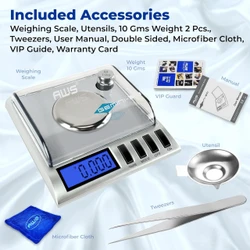
A digital scale labeled 20g x 0.001g has a maximum stated capacity of 20 grams and displays measurements in increments of 0.001 gram. Because 0.001 gram equals one milligram, this specification describes a compact milligram scale designed for small, lightweight samples.
The specification can be read as:
-
20 g: Maximum capacity
-
0.001 g: Display resolution or readability
-
0.001 g = 1 mg: Each displayed increment represents one milligram
-
20,000 displayed divisions: 20 g divided by 0.001 g
This does not automatically mean that every measurement is accurate to exactly ±0.001 gram. Readability, accuracy, repeatability, linearity and minimum practical load are separate concepts.
A 20g x 0.001g digital scale may be suitable for:
-
Jewelry components
-
Small gemstones
-
Precious-metal samples
-
Laboratory samples
-
Model-making materials
-
Tiny hardware
-
Electronic components
-
Essential-oil formulation ingredients
-
Soap and cosmetic additives
-
Specialty hobby applications
It is generally unsuitable for heavier containers, kitchen portions, packages or any load approaching or exceeding 20 grams.
This guide explains how to interpret the specification, evaluate real-world performance and decide whether a 20g x 0.001g scale matches your application.
What Does 20g x 0.001g Mean?
Scale specifications commonly use this format:
Maximum capacity × readability
Therefore:
20g x 0.001g = 20-gram capacity with 0.001-gram readability
The scale should display values in increments such as:
-
0.001 g
-
0.002 g
-
0.003 g
-
1.250 g
-
8.726 g
-
19.999 g
American Weigh Scales offers milligram scales designed for applications requiring three decimal places in gram mode.
Understanding the 20-Gram Capacity
The 20-gram figure represents the largest total load the scale is designed to support.
That load includes everything placed on the platform:
-
Sample
-
Weighing tray
-
Container
-
Paper
-
Scoop
-
Calibration accessory
-
Protective liner
If a container weighs eight grams and the sample weighs 13 grams, the combined load is 21 grams. This exceeds a 20-gram capacity even if the display is tared before the sample is added.
Capacity Is a Physical Limit
Tare changes the displayed result, not the physical load.
For example:
-
Scale capacity: 20 g
-
Empty container: 6 g
-
Display after tare: 0.000 g
-
Approximate remaining physical capacity: 14 g
This is one of the most important limitations of a low-capacity milligram scale.
Leave a Practical Capacity Margin
Do not plan to operate continuously at exactly 20 grams. A margin reduces the risk of accidental overload caused by:
-
Slightly heavier containers
-
Sample overfilling
-
Material adhering to a scoop
-
Packaging variation
-
Operator pressure
-
Sudden impact
If your routine combined load is close to 20 grams, a 50- or 100-gram milligram scale may be more appropriate.
Understanding 0.001-Gram Readability
A readability of 0.001 gram means the display changes in one-milligram increments.
The relationship is:
1 gram = 1,000 milligrams
Therefore:
0.001 gram = 1 milligram
NIST identifies the kilogram as the SI unit of mass and explains the use of gram-based submultiples in its overview of SI units for mass.
A 0.001-gram display can show much smaller changes than:
-
A 1-gram kitchen scale
-
A 0.1-gram pocket scale
-
A 0.01-gram jewelry scale
However, the ability to display one milligram does not prove that every one-milligram change represents a perfectly accurate measurement.
Readability Is Not Guaranteed Accuracy
This distinction is essential when shopping for a precision scale.
Readability
The smallest increment shown on the display.
Accuracy
How closely a measurement agrees with an accepted reference value.
Repeatability
How consistently the scale produces the same result for the same load under unchanged conditions.
Linearity
How the scale performs at different points across its capacity range.
Minimum Practical Load
The smallest quantity that can be measured dependably for the intended purpose.
A scale may display three decimal places while having a larger stated accuracy tolerance. Environmental conditions can also cause the final digit to fluctuate.
NIST explains that the displayed scale division and the verification scale division are distinct concepts in regulated weighing. A smaller displayed division does not automatically mean a scale is more accurate.
Displayed Divisions
A 20g x 0.001g scale theoretically provides:
20 g ÷ 0.001 g = 20,000 displayed divisions
This means the displayed range contains 20,000 one-milligram increments.
A large number of divisions can provide useful detail, but it also demands:
-
Stable electronics
-
Careful calibration
-
Controlled temperature
-
Protection from air movement
-
A vibration-free surface
-
Consistent load placement
The specification alone cannot reveal how well a scale performs across all 20,000 divisions.
Is a 20g x 0.001g Scale Right for You?
The scale may be appropriate when all of the following are true:
-
The total load remains comfortably below 20 grams.
-
One-milligram display increments are useful.
-
Measurements occur in a stable environment.
-
A small platform can support the sample.
-
Compatible calibration weights are available.
-
You understand that resolution is not identical to accuracy.
Choose a different scale if:
-
Samples routinely exceed 15–18 grams.
-
Containers consume most of the capacity.
-
Products are weighed outdoors.
-
The work surface vibrates.
-
A larger platform is required.
-
0.01- or 0.1-gram resolution is sufficient.
-
The measurement determines a regulated commercial charge.
Common Applications
Jewelry Components
A 20g x 0.001g scale can measure:
-
Small gemstones
-
Clasps
-
Findings
-
Beads
-
Precious-metal samples
-
Tiny chain segments
For finished jewelry weighing more than 20 grams, choose a higher-capacity precision scale.
Laboratory Samples
Possible uses include:
-
Small reference materials
-
Powder samples
-
Filter samples
-
Specimen portions
-
Formulation ingredients
A consumer milligram scale should not automatically be treated as a laboratory balance. Formal laboratory work may require documented uncertainty, traceable calibration and controlled procedures.
AWS balance scales may be better suited to applications requiring a larger platform, greater stability or bench-based operation.
Model Making and Hobbies
The scale may help measure:
-
Pigments
-
Resin additives
-
Small fasteners
-
Miniature components
-
Powdered materials
-
Specialty adhesives
Electronic Components
Potential uses include comparing:
-
Connectors
-
Tiny screws
-
Clips
-
Samples
-
Component batches
Weight alone cannot confirm component identity or electrical performance.
Cosmetic and Soap Formulation
A 0.001-gram display may be useful for very small formulation ingredients, but only when the recipe and safety procedure justify milligram-level measurement.
Do not use a general-purpose scale as a substitute for professional formulation guidance or validated manufacturing equipment.
When 0.01 Gram Is Enough
A 0.01-gram scale displays ten-milligram increments. It may be sufficient for:
-
General jewelry
-
Coins
-
Coffee
-
Tea
-
Larger hobby components
-
Most craft materials
-
Ordinary hardware
Choosing 0.01 gram instead of 0.001 gram can provide:
-
Greater capacity
-
Faster stabilization
-
Less environmental sensitivity
-
Larger platforms
-
Lower cost
-
Easier operation
AWS pocket scales include higher-capacity options for applications that do not require milligram readability.
Do not buy an extra decimal place unless it improves an actual decision.
Minimum Load and Usable Measurement Range
A scale displaying 0.001 gram may not measure every quantity above zero with equal reliability.
The minimum useful load depends on:
-
Scale design
-
Accuracy tolerance
-
Repeatability
-
Environmental conditions
-
Required uncertainty
-
Application risk
A display reading of 0.001 gram does not necessarily mean that a one-milligram sample can be quantified dependably.
When very small measurements matter:
-
Review the manufacturer’s accuracy specifications.
-
Perform repeatability tests.
-
Use appropriate reference weights.
-
Control the environment.
-
Establish an application-specific minimum load.
-
Document the procedure where necessary.
Repeatability Test
A simple repeatability test can help evaluate scale consistency.
-
Place the scale on a rigid, level surface.
-
Keep the platform empty.
-
Turn the scale on.
-
Allow it to warm up if the manual recommends it.
-
Confirm a stable zero.
-
Place a suitable reference weight in the center.
-
Record the displayed value.
-
Remove the weight.
-
Wait for the display to return to zero.
-
Repeat the process at least ten times.
-
Compare the results.
If the values vary excessively, investigate:
-
Drafts
-
Vibration
-
Static electricity
-
Temperature changes
-
Weak batteries
-
Dirty platform
-
Off-center placement
-
Improper calibration
-
Overload damage
Linearity Testing
Repeatability at one value does not establish performance across the entire range.
For a 20-gram scale, evaluation might include suitable reference values near:
-
The lower working range
-
Five grams
-
Ten grams
-
Fifteen grams
-
The upper working range
Do not exceed the rated capacity during testing.
A scale may perform well near the calibration point but show a larger deviation elsewhere. This is why accuracy, repeatability and linearity should be considered together.
Why the Environment Matters So Much
A one-milligram increment is extremely small. Environmental influences that are negligible on a kitchen scale can become visible on a 0.001-gram scale.
Air Movement
Fans, air-conditioning vents, open windows and operator movement can affect the reading.
Use:
-
A draft shield
-
A protective cover
-
A sheltered weighing area
-
Slow, deliberate movements
Vibration
Vibration may come from:
-
Foot traffic
-
Appliances
-
HVAC systems
-
Printers
-
Machinery
-
Flexible tables
-
Nearby doors
Use a stable, dedicated surface.
Temperature
A scale moved between different temperatures may drift while it acclimates.
Allow the device, sample and calibration weight to reach the same stable room environment before important measurements.
Static Electricity
Plastic containers, weighing papers and powders can develop static charges. Static can create unstable readings or cause lightweight material to cling to surfaces.
Humidity
Humidity can affect hygroscopic samples that gain or lose moisture. It can also influence static behavior.
Surface Level
Use a firm, level bench. Soft surfaces, carpet and uneven tables are unsuitable.
Draft Shields and Protective Covers
A draft shield surrounds the weighing platform and reduces the influence of moving air.
It is especially valuable for:
-
Powders
-
Lightweight samples
-
Small containers
-
Milligram readings
-
Air-conditioned rooms
A protective cover can also prevent accidental pressure on the load cell during storage, but it may not provide the same environmental control as a true draft shield.
Platform Size
A 20-gram milligram scale typically has a small platform because it is designed for small loads.
Before buying, consider:
-
Sample diameter
-
Container diameter
-
Platform material
-
Draft-shield clearance
-
Whether the display remains visible
-
Whether the container can be centered
An oversized container may:
-
Touch the scale housing
-
Lean against the draft shield
-
Block the display
-
Create off-center loading
-
Reduce stability
Any contact outside the platform can distort the result.
Choosing a Weighing Container
A good container should be:
-
Lightweight
-
Stable
-
Small enough for the platform
-
Clean
-
Nonreactive with the sample
-
Easy to handle
-
Resistant to static when possible
Possible containers include:
-
Small metal pans
-
Glass dishes
-
Anti-static weighing boats
-
Manufacturer-approved trays
The container’s weight must remain within the 20-gram capacity along with the sample.
Tare Function
Tare resets the displayed value to zero while the empty container is on the platform.
Procedure:
-
Place the empty container in the center.
-
Wait for a stable reading.
-
Press tare.
-
Confirm 0.000 g.
-
Add the sample.
-
Wait for stabilization.
-
Record the net result.
Tare improves convenience but does not remove the container’s physical load.
Calibration Versus Verification
Calibration and verification serve different purposes.
Calibration
Calibration establishes or adjusts the relationship between the applied mass and displayed value.
Verification
Verification checks the scale with a known mass to determine whether it performs acceptably.
A scale can be verified without being recalibrated. Do not enter calibration mode every time a reading appears unusual.
First check:
-
Surface stability
-
Drafts
-
Batteries
-
Temperature
-
Static
-
Platform cleanliness
-
Zero
-
Unit selection
-
Reference-weight condition
Selecting Calibration Weights
Use the calibration mass specified in the scale manual.
A suitable calibration weight should:
-
Match the required nominal value
-
Have an appropriate tolerance or class
-
Remain clean and undamaged
-
Be stored in a protective case
-
Be handled carefully
-
Have documentation when traceability matters
AWS offers calibration weights for compatible scale models.
Do not use:
-
Coins
-
Jewelry
-
Hardware
-
Packaged products
-
Improvised metal pieces
Their actual masses may vary through wear, contamination and manufacturing tolerances.
Calibration Weight Handling
At milligram readability, contamination can matter.
Good practices include:
-
Use clean tweezers or gloves.
-
Avoid touching the weight with bare fingers.
-
Store it in its case.
-
Keep it away from moisture and dust.
-
Allow it to acclimate to the weighing environment.
-
Never slide it across the platform.
-
Place it gently in the center.
Finger oils, dirt and corrosion can change the effective mass of small reference weights.
Typical Calibration Procedure
Always follow the specific manual. A general procedure may involve:
-
Place the scale on a level, vibration-free surface.
-
Protect it from drafts.
-
Allow it to reach room temperature.
-
Turn it on.
-
Allow any recommended warm-up time.
-
Confirm the platform is clean and empty.
-
Enter calibration mode.
-
Wait for the requested mass value.
-
Place the specified weight in the center.
-
Wait for confirmation.
-
Remove the weight.
-
Exit calibration mode.
-
Verify the result.
AWS provides model-specific information through its collection of scale manuals.
How Often Should You Verify the Scale?
Verification frequency depends on:
-
Measurement importance
-
Frequency of use
-
Transport
-
Environmental stability
-
History of drift
-
Overload exposure
-
Internal procedures
Check the scale:
-
When first received
-
Before important work
-
After moving it
-
After an overload
-
After a drop or impact
-
After major temperature changes
-
When readings appear unstable
-
At scheduled intervals
A verification log can record:
-
Date
-
Scale identification
-
Reference weight
-
Expected value
-
Observed value
-
Environmental conditions
-
Operator
-
Corrective action
Battery Power Versus External Power
Battery Power
Advantages include:
-
Portability
-
Electrical isolation
-
No cable pulling on the scale
-
Easy use in different locations
Potential limitations include:
-
Voltage decline
-
Unexpected shutdown
-
Battery replacement
-
Auto-off interruptions
External Power
Advantages include:
-
Continuous operation
-
Reduced battery consumption
-
Longer sessions
Potential issues include:
-
Cable movement
-
Electrical interference
-
Incompatible adapters
-
Clutter near the weighing surface
Use only the power source specified by the manufacturer.
Auto-Off
Auto-off conserves battery life but can interrupt:
-
Warm-up
-
Multi-step weighing
-
Repeated measurements
-
Calibration
-
Documentation
A scale with adjustable auto-off is helpful for longer workflows.
Stabilization Time
Do not record the first number that appears.
Wait until:
-
The display stops changing
-
The stable indicator appears, if available
-
The sample is no longer moving
-
The platform is free from vibration
-
Air movement has settled
One extra second of patience can be more valuable than an extra displayed decimal place.
Avoiding Overload Damage
A 20-gram scale has a delicate weighing mechanism.
Potential overload sources include:
-
Heavy containers
-
Pressing buttons while touching the platform
-
Dropping a calibration weight
-
Stacking objects on the scale
-
Storing equipment on the cover
-
Applying hand pressure
-
Shipping the scale without protection
Place every load gently.
Transportation and Storage
Protect the scale by:
-
Using its case
-
Installing the platform cover
-
Removing loose trays
-
Keeping weights in separate cases
-
Avoiding extreme temperatures
-
Preventing pressure on the platform
-
Removing batteries for long-term storage when recommended
For continuing care, review AWS guidance on scale maintenance.
Weight Units
A milligram scale may offer:
-
Grams
-
Ounces
-
Troy ounces
-
Pennyweight
-
Carats
-
Grains
Not every unit is suitable for every application.
The gram is generally the clearest choice for scientific and formulation work. NIST provides guidance on proper metric SI prefixes, including the relationship between grams, milligrams and micrograms.
Avoid confusing:
-
Milligrams with micrograms
-
Ounces with troy ounces
-
Grains with grams
-
Carats with grams
What 0.001 Gram Does Not Mean
The specification does not necessarily mean:
-
Every result is accurate within one milligram.
-
The minimum load is one milligram.
-
The scale is a laboratory analytical balance.
-
The scale is legal for trade.
-
Calibration is unnecessary.
-
Environmental conditions do not matter.
-
All 20,000 displayed divisions have identical performance.
-
A 20-gram sample can be weighed safely in a heavy container.
Understanding these limitations prevents unrealistic expectations.
Legal-for-Trade Considerations
A 20g x 0.001g scale marketed for general precision use is not automatically approved for regulated commercial transactions.
NIST explains scale divisions, accuracy classes and commercial applications in its weighing and scales FAQs.
Current model requirements for commercial weighing devices appear in NIST Handbook 44.
If weight determines a customer’s charge, contact the appropriate state or local weights-and-measures authority.
20g x 0.001g Versus Other Scale Specifications
| Specification | Maximum Capacity | Display Increment | Best For |
|---|---|---|---|
| 20g x 0.001g | 20 g | 1 mg | Very small precision samples |
| 50g x 0.001g | 50 g | 1 mg | Larger milligram-scale samples |
| 100g x 0.001g | 100 g | 1 mg | More container flexibility |
| 100g x 0.01g | 100 g | 10 mg | Jewelry and general precision |
| 500g x 0.01g | 500 g | 10 mg | Larger jewelry, hobbies and samples |
| 1,000g x 0.1g | 1,000 g | 100 mg | General pocket-scale applications |
A higher-capacity scale with the same readability can provide more flexibility but may cost more or require a larger footprint.
Buying Checklist
Before purchasing a 20g x 0.001g digital scale, confirm:
-
Maximum combined load
-
Container weight
-
Desired capacity margin
-
Required readability
-
Stated accuracy
-
Repeatability specifications
-
Minimum load information
-
Platform diameter
-
Draft-shield design
-
Available units
-
Tare capability
-
Stabilization time
-
Calibration procedure
-
Required calibration weight
-
Battery type
-
External-power compatibility
-
Auto-off settings
-
Protective case
-
Warranty
-
Intended commercial or noncommercial use
Frequently Asked Questions
What does 20g x 0.001g mean?
It means the scale has a maximum stated capacity of 20 grams and displays weight in increments of 0.001 gram.
Is 0.001 gram equal to one milligram?
Yes. One milligram equals 0.001 gram.
Does 0.001g readability mean ±0.001g accuracy?
Not necessarily. Readability describes the displayed increment. Accuracy must be evaluated separately.
Can the scale weigh exactly 20 grams?
Twenty grams is the stated maximum capacity, but routinely operating at the limit leaves no margin for container weight, overfilling or impact.
Does tare let me add 20 grams after placing a container on the scale?
No. The container continues to use physical capacity after tare.
What container should I use?
Choose a lightweight, stable container that fits completely on the platform and does not touch the scale housing or draft shield.
Is a draft shield necessary?
It is highly useful at 0.001-gram readability because air movement can affect milligram-level readings.
Can I calibrate the scale with a coin?
No. Use the calibration weight specified by the manufacturer. Coins vary through wear, contamination and manufacturing tolerance.
How often should the scale be calibrated?
Follow the manual. Verify it regularly and after movement, overload, impact or major environmental changes. Calibrate when verification shows an unacceptable error.
Can this scale measure one milligram accurately?
The display may show one-milligram increments, but the dependable minimum load can be higher. Review the accuracy and repeatability specifications.
Can I use it outdoors?
Outdoor wind, temperature variation and unstable surfaces make milligram measurements difficult. Use it in a controlled indoor environment.
Is a 20g x 0.001g scale legal for trade?
Not automatically. Commercial use may require an approved and inspected device.
Final Thoughts
The specification 20g x 0.001g describes a scale with a 20-gram maximum capacity and one-milligram display increments. It does not guarantee that every measurement is accurate within one milligram.
This scale type is best for very small samples when:
-
The combined container and sample remain below 20 grams.
-
Milligram-level display detail is genuinely useful.
-
The environment is protected from drafts and vibration.
-
The scale can be calibrated and verified with suitable weights.
-
The operator follows a consistent weighing procedure.
Choose a higher-capacity milligram scale if containers or samples routinely approach 20 grams. Choose a 0.01- or 0.1-gram model if milligram readability does not improve the actual decision.
By understanding the difference between capacity, readability, accuracy, repeatability and minimum load, you can select a scale based on real performance needs instead of relying on the headline specification alone.