
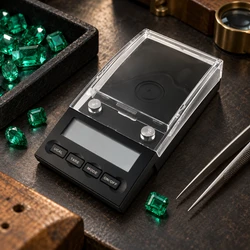
A 20g x 0.001g scale and a 100g x 0.01g scale serve different precision-weighing needs.
The 20-gram scale displays measurements in one-milligram increments, making it the better choice for very small samples and subtle weight differences. The 100-gram scale provides five times the capacity but displays weight in increments that are ten times larger.
The central tradeoff is:
-
20g x 0.001g: Finer readability and lower capacity
-
100g x 0.01g: Greater capacity and coarser readability
Neither specification is universally better. The correct choice depends on whether your application benefits more from detecting milligram-level differences or supporting heavier samples and containers.
Quick Comparison
| Specification | 20g x 0.001g Scale | 100g x 0.01g Scale |
|---|---|---|
| Maximum capacity | 20 g | 100 g |
| Gram readability | 0.001 g | 0.01 g |
| Milligram increment | 1 mg | 10 mg |
| Relative capacity | 1× | 5× |
| Relative displayed detail | 10× finer | 10× coarser |
| Displayed divisions | 20,000 | 10,000 |
| Container flexibility | Limited | Greater |
| Best for | Tiny samples and subtle differences | General precision weighing |
Choose a 20g x 0.001g scale when one-milligram display increments genuinely matter. Choose a 100g x 0.01g scale when a broader operating range and heavier containers are more useful than the third decimal place.
Understanding the Specifications
Scale specifications commonly use the following format:
Maximum capacity × readability
20g x 0.001g
-
Maximum capacity: 20 grams
-
Display increment: 0.001 gram
-
Equivalent increment: 1 milligram
-
Displayed divisions: 20,000
100g x 0.01g
-
Maximum capacity: 100 grams
-
Display increment: 0.01 gram
-
Equivalent increment: 10 milligrams
-
Displayed divisions: 10,000
The 100-gram scale has five times the capacity, but the 20-gram scale displays changes one-tenth as large.
NIST explains the relationship among kilograms, grams and smaller mass units in its guide to SI units for mass.
Capacity Difference: 20 Grams Versus 100 Grams
Capacity is the maximum physical load the scale is designed to support.
The 100-gram scale provides:
100 g ÷ 20 g = 5
Therefore, it offers five times as much capacity.
That additional range accommodates:
-
Larger samples
-
Heavier weighing dishes
-
More pieces
-
Bigger trays
-
Finished jewelry
-
Coin groups
-
Larger electronic components
-
Greater overload margin
The 20-gram scale is considerably more restrictive, especially after container weight is included.
Readability Difference: 0.001 Gram Versus 0.01 Gram
The 20-gram scale displays:
0.001 g = 1 mg
The 100-gram scale displays:
0.01 g = 10 mg
Therefore, the 20-gram model displays changes ten times smaller.
Example
Suppose a sample weighs approximately 0.026 gram.
A 20g x 0.001g scale might display:
0.026 g
A 100g x 0.01g scale can display only in hundredths of a gram, so the result might appear as:
0.03 g
The 100-gram scale cannot show the same milligram-level detail.
Which Scale Is More Precise?
If “precision” refers only to the size of the displayed increment, the 20g x 0.001g scale provides finer readability.
However, the specification alone does not establish:
-
Accuracy
-
Repeatability
-
Linearity
-
Measurement uncertainty
-
Minimum dependable load
A 0.001-gram display does not automatically mean every result is accurate within exactly one milligram.
NIST explains that the displayed scale division and verification scale division are distinct concepts. More displayed digits do not automatically prove greater verified accuracy.
Readability Versus Accuracy
Readability
The smallest change shown on the display.
Accuracy
How closely the reading agrees with an accepted reference value.
Repeatability
How consistently the same load produces the same result.
Linearity
How scale performance changes across the weighing range.
Minimum Practical Load
The smallest load that can be measured dependably for the application.
The 20-gram scale provides more display detail, but its practical advantage depends on whether it can produce repeatable, stable readings at the required level.
Capacity Includes the Container
Maximum capacity includes everything placed on the platform:
-
Sample
-
Tray
-
Weighing paper
-
Bowl
-
Container
-
Scoop
-
Protective liner
Example One: Small Gemstone
-
Tray: 2 g
-
Gemstone: 3 g
-
Total: 5 g
Both scales can support this load.
The 20-gram model provides finer displayed detail.
Example Two: Coin Group
-
Tray: 8 g
-
Coins: 45 g
-
Total: 53 g
Only the 100-gram scale can support the load.
Example Three: Jewelry Assembly
-
Container: 12 g
-
Jewelry: 15 g
-
Total: 27 g
The 20-gram scale is overloaded. The 100-gram scale has substantial capacity remaining.
Tare Does Not Restore Capacity
Tare resets the display to zero with a container on the platform. It does not remove the physical weight from the weighing mechanism.
If a container weighs 15 grams:
On a 20-Gram Scale
-
Container: 15 g
-
Remaining physical capacity: Approximately 5 g
On a 100-Gram Scale
-
Container: 15 g
-
Remaining physical capacity: Approximately 85 g
Even after the display reads zero, those remaining-capacity limits still apply.
Comparing Representative AWS Models
The GEMINI-20 Precision Milligram Scale represents the 20g x 0.001g category.
AWS offers several 100g x 0.01g pocket scales, including the CUBE-100 LED Digital Pocket Scale and Blade 100g Digital Pocket Scale.
| Feature | GEMINI-20 | CUBE-100 LED | Blade 100g |
|---|---|---|---|
| Capacity | 20 g | 100 g | 100 g |
| Readability | 0.001 g | 0.01 g | 0.01 g |
| Milligram increment | 1 mg | 10 mg | 10 mg |
| Primary advantage | Finer readability | Unit flexibility and capacity | General portable weighing |
| Calibration | 20 g weight included | 100 g weight not included | 100 g weight not included |
| Best for | Milligram-level samples | Versatile precision weighing | Jewelry, coins and hobbies |
Current product specifications should always be confirmed on the individual product page before purchase.
Best Applications for 20g x 0.001g
Tiny Gemstones
A milligram scale can display small differences among:
-
Tiny diamonds
-
Individual gemstones
-
Small parcels
-
Beads
-
Jewelry findings
Twenty grams corresponds to 100 carats before container weight is included.
Miniature Electronics
Useful examples include:
-
Small resistors
-
Capacitors
-
Diodes
-
Tiny screws
-
Lightweight connectors
-
Individual integrated circuits
Watch Components
A one-milligram display may help compare:
-
Springs
-
Screws
-
Pins
-
Gears
-
Clips
-
Small movement components
Fine Powders and Pigments
The finer display can show small additions, although static, moisture and transfer loss can affect the result.
Lightweight Laboratory-Style Samples
A consumer milligram scale may support general educational or nonregulated sample work.
It should not automatically be treated as:
-
An analytical balance
-
A medical device
-
Pharmaceutical equipment
-
A certified laboratory instrument
-
A legal-for-trade scale
Best Applications for 100g x 0.01g
Jewelry and Finished Pieces
The higher capacity can accommodate:
-
Rings
-
Bracelets
-
Necklaces
-
Jewelry parcels
-
Heavier trays
The 0.01-gram display is sufficient for many general jewelry applications that do not require milligram-level detail.
Coins
A 100-gram scale can weigh:
-
Individual coins
-
Small coin groups
-
Coin holders
-
Protective capsules
Coffee and Tea
A 0.01-gram pocket scale can measure small quantities, although many coffee workflows do not require hundredth-gram resolution.
Model Making
Useful for:
-
Miniature hardware
-
Resin additives
-
Small assemblies
-
Adhesives
-
Pigments
-
Finished components
Electronics Assemblies
The 100-gram range supports larger:
-
Connectors
-
Relays
-
Heat sinks
-
Sensors
-
Small modules
-
Component batches
General Hobby Use
The 100g x 0.01g specification provides a versatile compromise for users who need more capacity than a milligram scale.
Sample-Weight Examples
| Sample | Approximate Total Load | Better Specification |
|---|---|---|
| Tiny gemstone in 2 g tray | 2.35 g | 20g x 0.001g |
| Small electronic component | 0.028 g | 20g x 0.001g |
| Jewelry clasp | 1.46 g | 20g x 0.001g if finer detail matters |
| Ring in 10 g container | 18 g | Either |
| Coin group | 45 g | 100g x 0.01g |
| Small circuit module | 72 g | 100g x 0.01g |
| Sample plus 25 g glass dish | 38 g | 100g x 0.01g |
The better scale depends on total load and the smallest relevant weight difference.
Displayed Divisions
Displayed divisions are calculated as:
Capacity ÷ readability
20g x 0.001g
20 ÷ 0.001 = 20,000 divisions
100g x 0.01g
100 ÷ 0.01 = 10,000 divisions
The 20-gram scale shows more divisions despite having less total capacity.
This does not automatically make it more accurate. It means the display subdivides its smaller range more finely.
Why the 100-Gram Scale Is More Forgiving
The 100-gram model provides more room for:
-
Container variation
-
Overfilling
-
Multiple samples
-
Larger trays
-
Changing applications
-
Accidental load increases
If a routine load weighs 18 grams:
-
It is close to the limit of a 20-gram scale.
-
It uses only 18% of a 100-gram scale’s capacity.
Operating margin can be more valuable than an extra decimal place when the third decimal does not affect the decision.
Why the 20-Gram Scale Is More Sensitive to the Environment
The 20-gram scale displays one-milligram changes. That final digit can respond visibly to:
-
Air currents
-
Vibration
-
Static electricity
-
Temperature drift
-
Moisture changes
-
Operator movement
-
Unstable surfaces
The 100-gram scale’s 0.01-gram increments are coarser and may appear more stable in an ordinary room.
That does not mean environmental control is unnecessary. It means small disturbances are less likely to change the displayed value.
Air Movement
Fans, vents, windows and operator movement can affect milligram readings.
For 0.001-gram work, use:
-
Draft shield
-
Sheltered weighing area
-
Closed windows
-
Slow movements
-
Stable HVAC conditions
A 0.01-gram scale can also be affected when weighing very light materials, but it is generally less demanding.
Vibration
Vibration sources include:
-
Foot traffic
-
Printers
-
Machinery
-
Flexible tables
-
Doors
-
Appliances
Use a rigid, level surface for either scale. A dedicated weighing bench is preferable for milligram work.
Static Electricity
Plastic trays, weighing papers and powders can develop static charges.
Static may:
-
Cause fluctuating readings
-
Make material cling to surfaces
-
Affect transfer efficiency
-
Distort very small measurements
Use suitable anti-static containers and procedures where necessary.
Temperature and Humidity
Temperature changes can cause temporary drift. Humidity can affect:
-
Moisture-sensitive samples
-
Static behavior
-
Container mass
-
Powder flow
Allow the scale, sample and calibration weight to acclimate before precision measurements.
Platform Size Matters Separately From Capacity
A 100-gram scale does not automatically have a larger platform.
Compare:
-
Platform width
-
Platform depth
-
Container diameter
-
Protective-cover clearance
-
Draft-shield clearance
-
Display visibility
The container should not touch:
-
Scale housing
-
Table
-
Display
-
Controls
-
Draft shield
Any outside contact can change the result.
Choosing the 20g x 0.001g Scale
Choose the milligram model when:
-
One-milligram display changes matter.
-
Total loads remain well below 20 grams.
-
Containers are lightweight.
-
Samples are tiny.
-
The environment can be controlled.
-
You will use appropriate calibration weights.
-
The third decimal place improves a real decision.
Browse AWS milligram scales for additional models with 0.001-gram readability and different capacities.
Choosing the 100g x 0.01g Scale
Choose the higher-capacity pocket scale when:
-
Samples exceed 20 grams.
-
Containers are relatively heavy.
-
Several items are weighed together.
-
A 10-milligram display increment is sufficient.
-
You want greater application flexibility.
-
Simpler everyday operation matters.
-
A larger operating margin is desirable.
AWS pocket scales include multiple 100-gram and higher-capacity options.
When Neither Specification Is Ideal
Choose 50g x 0.001g When:
-
You need milligram readability.
-
A 20-gram capacity is too limiting.
-
Samples remain below 50 grams.
Choose 500g x 0.01g When:
-
You need hundredth-gram readability.
-
Samples regularly exceed 100 grams.
-
Larger containers are used.
Choose 1,000g x 0.1g When:
-
Capacity is more important than fine detail.
-
You weigh food, packages or larger components.
Choose a Laboratory Balance When:
-
Traceability is required.
-
Measurement uncertainty must be documented.
-
The work is regulated.
-
Environmental control is formalized.
Calibration Requirements
The two specifications generally require different calibration weights.
A 20g x 0.001g scale may use:
-
10 g
-
20 g
-
A model-specific value
A 100g x 0.01g scale commonly uses:
-
100 g
-
Another value specified in the manual
Do not assume the required calibration mass based only on capacity.
AWS offers compatible calibration weights for supported models.
Calibration Weight Handling
Use:
-
Clean gloves
-
Tweezers
-
Protective cases
-
Gentle placement
-
Centered loading
Avoid:
-
Bare-hand contact
-
Sliding weights
-
Dust
-
Moisture
-
Corrosion
-
Improvised objects
Contamination is particularly important for milligram-level measurements.
Calibration Versus Verification
Calibration adjusts or establishes scale response.
Verification checks the result with a known reference.
Before recalibrating an unusual reading, check:
-
Batteries
-
Surface stability
-
Temperature
-
Drafts
-
Static
-
Platform cleanliness
-
Active unit
-
Container contact
-
Reference-weight condition
Repeatability Testing
For either scale:
-
Position it on a rigid, level surface.
-
Turn it on.
-
Allow it to stabilize.
-
Confirm zero.
-
Apply a suitable reference mass.
-
Record the result.
-
Remove the mass.
-
Wait for zero.
-
Repeat at least ten times.
-
Compare the readings.
Test with reference values relevant to the actual working range.
Linearity Testing
A scale may perform differently at different loads.
For the 20-Gram Scale
Consider suitable checks near:
-
2 g
-
5 g
-
10 g
-
15 g
-
Upper working range
For the 100-Gram Scale
Consider suitable checks near:
-
10 g
-
25 g
-
50 g
-
75 g
-
Upper working range
Never exceed the rated capacity.
Minimum Practical Load
Neither 0.001 gram nor 0.01 gram necessarily represents the dependable minimum sample.
The minimum practical load depends on:
-
Repeatability
-
Accuracy
-
Environmental stability
-
Application tolerance
-
Required confidence
NIST addresses weighing terminology and commercial-device concepts in its weighing and scales FAQs.
Legal and Regulated Uses
A consumer digital scale should not automatically be considered:
-
Legal for trade
-
Laboratory-certified
-
Suitable for pharmaceuticals
-
Appropriate for medical dosing
-
Validated for regulated manufacturing
NIST discusses scale selection and accuracy concepts in its guidance on Class II scale applications.
Current model requirements for commercial weighing devices appear in NIST Handbook 44.
Use equipment approved for the intended regulated application.
Units of Measurement
A precision scale may display:
-
Grams
-
Ounces
-
Troy ounces
-
Pennyweight
-
Carats
-
Grains
NIST describes gram-based decimal units in its guide to metric SI prefixes.
Avoid confusing:
-
Milligrams and micrograms
-
Ounces and troy ounces
-
Grams and grains
-
Carats and grams
Common Buying Mistakes
Assuming Higher Capacity Is Always Better
The 100-gram model cannot show one-milligram changes.
Assuming Finer Readability Is Always Better
The 20-gram model may be too limited for the sample and container.
Ignoring Container Weight
Tare does not restore physical capacity.
Choosing No Capacity Margin
Routine loads should remain comfortably below the maximum.
Equating Readability With Accuracy
Displayed decimal places do not establish total performance.
Ignoring the Environment
Drafts and vibration can overwhelm the third decimal place.
Using the Wrong Calibration Weight
Follow the manual for the exact model.
Choosing by Capacity Alone
Platform size, units, power and accessories also matter.
Buying Checklist
Before choosing either specification, determine:
-
Lightest sample
-
Heaviest sample
-
Container weight
-
Total combined load
-
Required capacity margin
-
Smallest meaningful weight difference
-
Whether 0.001 g is necessary
-
Accuracy specification
-
Repeatability
-
Minimum practical load
-
Platform dimensions
-
Calibration weight
-
Available units
-
Power source
-
Environmental conditions
-
Intended regulated or nonregulated use
Frequently Asked Questions
Which is better: 20g x 0.001g or 100g x 0.01g?
Choose 20g x 0.001g for milligram-level display detail and very small samples. Choose 100g x 0.01g for five times the capacity and broader general-purpose use.
How much more capacity does the 100-gram scale provide?
It provides five times the capacity.
How much finer is 0.001 gram than 0.01 gram?
A 0.001-gram increment is ten times smaller than a 0.01-gram increment.
Is the 20-gram scale more accurate?
Not necessarily. It has finer readability, but accuracy, repeatability and linearity must be evaluated separately.
Is the 100-gram scale less precise?
It displays coarser increments, but it may be entirely appropriate when ten-milligram detail is sufficient.
Does tare let me weigh 20 grams plus a container on the smaller scale?
No. The combined physical load must remain within 20 grams.
Which scale is better for gemstones?
A 20g x 0.001g scale is useful for tiny stones and subtle differences. A 100g x 0.01g scale is better for larger parcels and heavier containers.
Which scale is better for coins?
The 100g x 0.01g scale is generally more practical because coins can quickly exceed 20 grams.
Which scale is better for electronics?
Use the 20-gram model for tiny components and the 100-gram model for larger components, batches and small assemblies.
Can I use the same calibration weight for both?
Only if both manuals specify it. These specifications often require different calibration masses.
Are these scales legal for trade?
Not automatically. Commercial use may require an approved and inspected device.
Final Verdict
The comparison comes down to a clear tradeoff:
-
20g x 0.001g: Ten times finer displayed increments
-
100g x 0.01g: Five times greater maximum capacity
Choose the 20-gram milligram scale when tiny differences matter and the sample plus container remains comfortably below 20 grams.
Choose the 100-gram pocket scale when you need greater container flexibility, heavier samples, multiple items and a larger operating margin—and when 0.01-gram readability is sufficient.
For many general users, the 100g x 0.01g configuration is more versatile. For specialized work involving very small gemstones, miniature electronics or lightweight samples, the 20g x 0.001g configuration provides more useful display detail.
Neither specification is inherently superior. The best scale is the one whose capacity and readability match the actual measurement decision.