
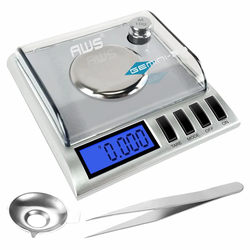
Choosing between a 20g x 0.001g scale and a 200g x 0.01g scale comes down to a fundamental tradeoff: finer measurements or greater capacity.
A 20g x 0.001g digital scale displays weight in increments of one-thousandth of a gram, equivalent to one milligram. Its maximum load is 20 grams. A 200g x 0.01g scale holds ten times as much weight but displays measurements in increments of one-hundredth of a gram, or 10 milligrams.
Neither specification is automatically better. The right scale depends on the objects you weigh, the weight of any container or tray, the smallest difference you need to observe, and the amount of extra capacity required to avoid overloading the instrument.
For very small samples and components, the 20g model provides finer readings. For coins, jewelry, collections of components, larger containers, and general-purpose weighing, the 200g model provides substantially more working room.
This guide explains the differences between these two specifications so you can choose the scale that fits your actual work.
20g x 0.001g vs 200g x 0.01g at a Glance
| Specification | 20g x 0.001g scale | 200g x 0.01g scale |
|---|---|---|
| Maximum capacity | 20 grams | 200 grams |
| Readability | 0.001 gram | 0.01 gram |
| Metric equivalent | 1 milligram | 10 milligrams |
| Displayed divisions | 20,000 | 20,000 |
| Relative capacity | 1x | 10x greater |
| Relative readability | 10x finer | 10x coarser |
| Best suited to | Very small samples and components | General-purpose precision weighing |
| Typical container allowance | Limited | Much more flexible |
| Environmental sensitivity | Higher | Lower, although proper setup still matters |
| Common form | Milligram precision scale | Digital pocket scale |
The most interesting part of this comparison is that both specifications provide 20,000 displayed divisions:
-
20g ÷ 0.001g = 20,000 divisions
-
200g ÷ 0.01g = 20,000 divisions
The difference is how those divisions are distributed. The 20g scale divides a small measuring range into very fine increments. The 200g scale distributes the same number of displayed steps across a range that is ten times larger.
What Does 20g x 0.001g Mean?
A scale marked 20g x 0.001g has:
-
A maximum capacity of 20 grams
-
A readability of 0.001 gram
-
Display changes in one-milligram increments
The first number describes how much weight the scale can support. The second describes its smallest displayed increment.
For example, the display might progress as follows:
-
2.517g
-
2.518g
-
2.519g
-
2.520g
This fine readability makes the scale useful when differences smaller than 0.01g are important.
The GEMINI-20 Precision Milligram Scale is a current AWS example with a 20g x 0.001g specification. It includes a 20g calibration weight, weighing tray, tweezers, and carrying case, and supports several weighing units.
A 20g scale’s limited capacity must be considered carefully. The combined weight of the sample, container, weighing paper, tray, and any accessories placed on the platform must remain within the scale’s capacity.
Understanding 0.001g in Other Terms
One gram contains 1,000 milligrams. Therefore:
-
1g = 1,000mg
-
0.1g = 100mg
-
0.01g = 10mg
-
0.001g = 1mg
The prefixes and relationships used in metric measurements are explained in the NIST guide to metric SI prefixes.
A 0.001g display can show smaller changes than a 0.01g display, but this specification should not be interpreted as a guarantee that every result is accurate to exactly ±0.001g.
What Does 200g x 0.01g Mean?
A scale marked 200g x 0.01g has:
-
A maximum capacity of 200 grams
-
A readability of 0.01 gram
-
Display changes in 10-milligram increments
A typical display sequence might be:
-
18.24g
-
18.25g
-
18.26g
-
18.27g
The scale does not display the third decimal place in grams. An actual change smaller than 0.01g may not cause the displayed reading to change.
The CARDV2-200 Compact Digital Pocket Scale is a current AWS model rated for 200g x 0.01g. Its listed features include a stainless-steel surface, tare function, protective lid that can serve as a tray, and gram, ounce, carat, and grain modes.
The larger capacity makes this specification suitable for a broader range of everyday objects. It also leaves more room for containers and trays.
The Main Difference: Capacity Versus Readability
The 200g scale has ten times the capacity of the 20g scale:
200g ÷ 20g = 10
The 20g scale has ten times finer readability:
0.01g ÷ 0.001g = 10
This creates a straightforward decision:
-
Select 20g x 0.001g when seeing one-milligram display changes is more important than weighing objects over 20 grams.
-
Select 200g x 0.01g when you need substantially more capacity and one-hundredth-gram readings are sufficient.
A useful scale must satisfy both requirements. Fine readability does not help if the object exceeds the scale’s capacity. Extra capacity does not help if the scale cannot display the small differences your task requires.
What Can You Weigh on a 20g x 0.001g Scale?
A 20g milligram scale is designed for light objects and small samples. Potential uses include:
-
Individual gemstones
-
Watch screws and miniature hardware
-
Small electronic components
-
Fly-tying materials
-
Tiny craft components
-
Small pigment samples
-
Very light jewelry findings
-
Individual beads
-
Seeds and botanical samples
-
Small quantities of powders where the scale is appropriate for the application
-
Lightweight parts used for sorting or comparison
The principal advantage is the ability to observe small changes. If two components differ by 0.004g, a 0.001g display can show that difference more clearly than a 0.01g display.
However, application suitability matters. A general consumer milligram scale should not automatically be treated as certified laboratory, pharmaceutical, medical, or legal-for-trade equipment. Regulated work may require a specific scale class, certification, documented uncertainty, controlled procedures, or other application-dependent safeguards.
You can browse AWS milligram scales when the priority is finer measurement rather than high capacity.
What Can You Weigh on a 200g x 0.01g Scale?
A 200g pocket scale covers a much wider range of common weighing tasks, including:
-
Coins
-
Finished jewelry
-
Precious-metal items
-
Small collections of gemstones
-
Fishing tackle
-
Archery components
-
Small hardware
-
Electronic assemblies
-
Collectibles
-
Tea leaves
-
Coffee portions
-
Craft materials
-
Small packages and contents
-
Multiple components weighed together
-
Samples placed in heavier containers
The 200g capacity is particularly valuable when you need to weigh several items at once. Ten components weighing 12g each have a combined weight of 120g, which is well within a 200g scale’s capacity but far beyond the limit of a 20g scale.
AWS offers a wider selection of digital pocket scales for portable and general-purpose weighing applications.
Why Container Weight Can Change the Decision
A common buying mistake is choosing a scale based only on the expected sample weight.
Suppose your material weighs 12 grams:
-
On a 20g scale, the sample fits if placed directly on the platform.
-
If the container weighs 10 grams, the gross load becomes 22 grams.
-
That total exceeds the 20g capacity.
The 200g scale can accommodate both the container and sample with significant capacity remaining.
Tare Does Not Create More Capacity
The tare function resets the display to zero after a container is placed on the platform. It does not remove the container’s physical weight from the scale’s load sensor.
If a container weighs 15g and the contents weigh 8g, the scale supports a gross load of 23g—even if the display shows only 8g after taring.
Therefore, a 20g x 0.001g scale cannot handle this combination safely. The display may show zero after tare, but the total physical load still exceeds the rated maximum.
Use this calculation before selecting a scale:
Required capacity = container weight + maximum sample weight + safety margin
A practical safety margin helps account for accessories, changing containers, unexpectedly heavy objects, and ordinary handling.
Is 0.001g More Accurate Than 0.01g?
Not necessarily.
A 0.001g scale has finer readability, meaning its display shows smaller increments. Accuracy describes how close a result is to an accepted reference value. These concepts are related, but they are not interchangeable.
The NIST explanation of scale division “d” and verification scale division “e” provides useful background on why a displayed division should not be confused with verified performance.
A scale’s real-world results can be affected by:
-
Calibration condition
-
Repeatability
-
Linearity
-
Temperature
-
Air currents
-
Vibration
-
Static electricity
-
Platform alignment
-
Surface stability
-
Battery condition
-
Off-center loading
-
Warm-up or stabilization time
-
Improper handling
-
Sample movement
A display that shows three decimal places is not automatically more accurate than every scale showing two decimal places. It simply provides finer displayed resolution.
Readability, Accuracy, Repeatability, and Linearity
Understanding a few basic terms makes scale specifications easier to evaluate.
Readability
Readability is the smallest increment shown on the display.
-
20g x 0.001g: readability is 0.001g
-
200g x 0.01g: readability is 0.01g
Accuracy
Accuracy describes closeness to the accepted or reference value. A proper accuracy statement normally requires defined test conditions and a known reference.
Repeatability
Repeatability describes how closely repeated measurements agree when the same object is weighed under the same conditions.
For example, repeated readings of:
-
5.127g
-
5.127g
-
5.128g
show closer repeatability than:
-
5.121g
-
5.130g
-
5.125g
Linearity
Linearity concerns performance across the weighing range. A scale might perform differently near the lower, middle, and upper parts of its capacity.
Minimum Practical Load
A scale may display very small increments without producing dependable results for every extremely light object. Readability alone does not establish an official minimum weight.
The appropriate minimum load depends on the scale’s performance, environment, procedures, and tolerance for uncertainty. Regulated applications may have formal requirements beyond the consumer specifications printed on a product page.
The NIST Weighing and Scales FAQs offer additional information about weighing terminology and commercial scale considerations.
Environmental Sensitivity
The finer the display increment, the easier it becomes to see environmental disturbances.
A 20g x 0.001g scale is generally more sensitive to its surroundings than a 200g x 0.01g scale. A small draft, minor vibration, static charge, or temperature change may affect the final digit.
Air Movement
Heating vents, fans, open windows, and even a person’s breath can disturb a milligram-level reading.
Use the scale away from direct airflow. If the model includes a cover or draft shield, close it before recording the result.
Vibration
Vibration can come from:
-
Nearby appliances
-
Foot traffic
-
Flexible tables
-
Machinery
-
Speakers
-
Typing on the same desk
Place the scale on a solid, level surface that does not flex or wobble.
Static Electricity
Plastic containers, powders, fabrics, and dry air can produce static charges. At fine readability levels, static can cause drifting or unstable readings.
A conductive or static-controlled setup may be necessary for particularly sensitive materials.
Temperature
Moving a scale between environments can cause unstable readings. Allow the instrument and the object being weighed to reach room conditions before performing precision measurements.
Avoid placing the scale in direct sunlight or beside a heating or cooling source.
Off-Center Loading
Place objects near the center of the weighing platform whenever possible. Large containers that rest unevenly, touch the surrounding housing, or extend onto the work surface can produce unreliable results.
Calibration Considerations
Calibration helps align a scale’s readings with a known reference. It does not compensate for every environmental or mechanical problem, but it is an essential part of maintaining dependable performance.
Before calibrating:
-
Place the scale on a stable, level surface.
-
Keep the platform empty.
-
Allow the scale to acclimate to the room.
-
Confirm that the batteries are in good condition.
-
Use the calibration mass specified by the manufacturer.
-
Keep air movement and vibration to a minimum.
-
Follow the exact procedure in the scale’s manual.
AWS offers calibration weights in several denominations. The correct calibration weight depends on the model; do not assume that any weight with a convenient value is suitable.
AWS also maintains a collection of scale manuals that can help users identify the correct calibration procedure and required mass for their model.
For broader technical context, NIST Handbook 44 addresses specifications, tolerances, and requirements for commercial weighing and measuring devices. Consumer pocket scales should not be assumed to meet every regulated commercial requirement merely because they can be calibrated.
Calibration Weight Differences
A 20g x 0.001g scale and a 200g x 0.01g scale commonly require different calibration masses.
For example:
-
The GEMINI-20 product specification lists a 20g calibration weight.
-
The AWS MB-200 specification calls for a 100g calibration weight, while other 200g models may require 200g or offer model-specific options.
Always follow the manual for the exact model. Using the wrong mass or calibration sequence can lead to incorrect results even if the scale appears to complete the procedure successfully.
Calibration weights should also be kept clean and handled carefully. Skin oils, debris, corrosion, and physical damage can alter a small weight enough to matter in precision applications.
Which Scale Is Better for Small Differences?
The 20g x 0.001g scale is better when the goal is to observe differences smaller than 0.01g.
Consider two objects with actual masses of approximately:
-
Object A: 3.142g
-
Object B: 3.148g
A 0.001g scale can display the difference as approximately 0.006g, subject to the scale’s actual performance and measurement conditions.
On a 0.01g scale, both objects might display as 3.14g or one might display as 3.14g and the other as 3.15g, depending on rounding, stability, and the scale’s internal behavior. The smaller difference is near or below the displayed increment, so it cannot be characterized with the same detail.
Choose 0.001g readability when that added digit changes a decision you need to make.
If you only need to know whether an item weighs approximately 18.42g rather than 18.50g, 0.01g readability may be sufficient—and the larger capacity may be much more useful.
Which Scale Is Better for Heavier Objects?
The 200g x 0.01g scale is the clear choice for any object or gross load exceeding 20g.
Examples include:
-
A 35g coin holder and coin
-
A 60g jewelry piece
-
A 120g component collection
-
A 45g container holding 25g of material
-
A small parcel weighing 175g
Attempting to weigh these loads on a 20g scale can overload or damage its sensor.
Even when an object is slightly below 20g, operating very close to maximum capacity leaves little room for a container, accidental pressure, or normal variation. A 200g scale provides a more comfortable working range.
Should You Leave Extra Capacity?
Yes. Avoid choosing a scale whose capacity barely covers your heaviest expected load.
Suppose your largest object weighs 19g. It technically falls within a 20g capacity, but there is almost no margin for:
-
A tray or weighing paper
-
Variations among objects
-
Accidental downward pressure
-
Future applications
-
Slightly heavier samples
If one-milligram readability is not essential, a 200g x 0.01g model may be the more practical option.
If both the 19g capacity requirement and 0.001g readability are essential, a higher-capacity milligram scale may be needed instead of either specification compared here.
When the 20g x 0.001g Scale Is the Better Choice
Choose the 20g model when most of the following are true:
-
Your objects and containers remain safely below 20g.
-
Differences smaller than 0.01g affect your decisions.
-
You can provide a stable, draft-free setup.
-
You are willing to allow readings to stabilize.
-
You will calibrate and verify the scale appropriately.
-
Portability is less important than finer readability.
-
You normally weigh one very small object or sample at a time.
Typical examples include sorting miniature components, comparing individual gemstones, checking tiny mechanical parts, and measuring very small nonregulated samples.
When the 200g x 0.01g Scale Is the Better Choice
Choose the 200g model when most of the following are true:
-
Objects may exceed 20g.
-
You use containers or trays.
-
You weigh multiple items together.
-
One-hundredth-gram readings are sufficient.
-
You want one scale for several everyday tasks.
-
Greater working capacity is more useful than a third decimal place.
-
You need a portable scale for coins, jewelry, components, or collectibles.
For many general-purpose users, 200g x 0.01g is the more versatile specification. It can weigh items that a 20g scale cannot accommodate while still providing hundredth-gram display increments.
When You May Need Both Scales
Some workflows contain two genuinely different types of weighing:
-
Very small components that need 0.001g readability
-
Larger objects or combined batches that may approach 200g
In that case, using two scales can be more effective than forcing one specification to cover everything.
A 20g x 0.001g scale can serve as the fine-measurement instrument, while a 200g x 0.01g scale handles containers, larger items, and grouped components.
This two-scale approach can also reduce the likelihood of overloading the milligram scale during routine work.
A Practical Selection Method
Use the following process before purchasing.
Step 1: Identify the Heaviest Object
Do not base your decision on an average item. Find the maximum expected weight.
Step 2: Include the Container
Add the weight of any tray, cup, paper, dish, holder, or protective container.
Step 3: Add a Safety Margin
Choose capacity beyond the calculated maximum rather than operating continuously at the limit.
Step 4: Identify the Smallest Meaningful Difference
Ask what weight difference would change your decision.
If a 0.005g difference matters, a 0.01g display is too coarse to show that difference reliably. If differences below 0.01g have no practical importance, the added digit may offer little value.
Step 5: Consider the Environment
A milligram scale needs more environmental control. Determine whether you can provide a stable surface and protection from drafts, vibration, static, and temperature changes.
Step 6: Check Calibration Requirements
Confirm the required calibration mass and whether it is included. Product specifications vary.
Step 7: Confirm Application Requirements
For commercial sales, scientific testing, medicine, pharmaceuticals, safety-critical work, or other regulated uses, determine the governing requirements before choosing a scale.
NIST discusses application and instrument-selection considerations in its overview of Class II scale applications. Instrument class and suitability should be evaluated separately from the number of decimal places shown on a consumer scale.
Common Buying Mistakes
Assuming More Decimal Places Always Mean Better Results
Extra digits provide finer display resolution. They do not automatically establish accuracy, repeatability, or suitability.
Ignoring the Weight of the Container
The scale senses the total physical load even after the display is tared.
Selecting Exactly Enough Capacity
A scale with no reserve capacity is easier to overload and may become unusable when a tray or heavier sample is introduced.
Using an Incorrect Calibration Weight
Calibration procedures are model-specific. Consult the manufacturer’s instructions.
Weighing on an Unstable Surface
A soft mat, flexible table, vibrating appliance, or uneven counter can undermine repeatability.
Recording a Moving Reading
Wait for the display to stabilize. If the reading continues drifting, investigate air movement, vibration, static, temperature, battery condition, or platform contact.
Treating a Pocket Scale as Certified Equipment
Commercial and regulated applications may require approved equipment, inspection, certification, documented procedures, or a particular accuracy class. Product capacity and readability alone do not establish compliance.
Frequently Asked Questions
Is 0.001g the same as one milligram?
Yes. One gram contains 1,000 milligrams, so 0.001g equals 1mg. NIST provides a useful reference on SI units of mass.
How much more capacity does a 200g scale have?
A 200g scale has ten times the maximum capacity of a 20g scale.
How much finer is 0.001g than 0.01g?
A 0.001g display increment is ten times finer than a 0.01g increment.
Do both scales have the same number of displayed divisions?
Yes. Both specifications provide 20,000 displayed divisions:
-
20g ÷ 0.001g = 20,000
-
200g ÷ 0.01g = 20,000
They distribute those divisions across different weighing ranges.
Can a 20g scale weigh a 15g container plus a 10g sample if I use tare?
No. The gross load is 25g, which exceeds the scale’s 20g capacity. Tare changes the displayed value but does not remove physical weight from the load sensor.
Is a 20g x 0.001g scale always more accurate?
No. It has finer readability, but accuracy depends on instrument performance, calibration, handling, and environmental conditions.
Can a 200g x 0.01g scale detect a 0.005g difference?
It cannot display a 0.005g increment directly because the display changes in 0.01g steps. Internal rounding and measurement variation may cause the final digit to change, but the scale should not be used to characterize a 0.005g difference as though it had 0.001g readability.
Which scale is better for coins?
A 200g x 0.01g scale is generally more practical for coins because it can accommodate heavier coins, holders, capsules, and multiple items. Weight alone should not be used to authenticate or grade a coin.
Which scale is better for gemstones?
A 20g x 0.001g scale may be useful for individual lightweight stones when finer readings are important. A 200g x 0.01g model provides more capacity for larger stones, settings, parcels, and containers.
Which scale is easier to use?
Both can be simple to operate, but the 200g x 0.01g specification is usually more forgiving of ordinary environmental conditions. The 20g x 0.001g model requires greater attention to air movement, vibration, static, and stabilization.
Can I use either scale for selling products by weight?
Do not assume so. Commercial transactions may require a legal-for-trade device and compliance with applicable local requirements. Verify the rules governing your location and application.
Final Verdict: 20g x 0.001g or 200g x 0.01g?
Choose a 20g x 0.001g scale when you primarily weigh very light objects and need to see one-milligram changes. It is the more appropriate specification for small samples, miniature components, and other tasks where a third decimal place in grams provides meaningful information.
Choose a 200g x 0.01g scale when you need more room for heavier objects, containers, multiple components, or general-purpose weighing. It offers ten times the capacity while retaining hundredth-gram readability.
The decision can be summarized in one question:
Do you need to measure below 0.01g, or do you need to weigh more than 20g?
If the smaller difference matters most, select 20g x 0.001g. If the larger working range matters most, select 200g x 0.01g. If your work regularly requires both, two purpose-matched scales—or a higher-capacity milligram model—may be the most practical solution.