
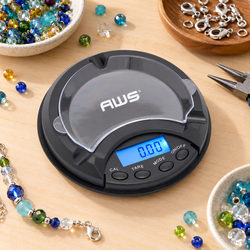
A 500g x 0.01g digital scale combines a relatively broad weighing range with readings displayed in hundredths of a gram. This balance makes the specification useful for applications that require more capacity than a traditional 50g, 100g or 200g pocket scale can provide without moving to a coarser 0.1g display.
A 500g x 0.01g scale may be suitable for coffee, tea, jewelry, coins, hardware, craft ingredients, product samples and small formulation batches. It can also accommodate heavier containers that would consume most of the available range on a lower-capacity scale.
However, the specification is frequently misunderstood.
A label of 500g x 0.01g does not automatically mean that every reading is accurate to exactly ±0.01g. It does not establish the scale’s minimum reliable weight, legal-for-trade status or suitability for laboratory work.
The specification tells you two essential facts:
- 500g is the scale’s stated maximum capacity.
- 0.01g is its readability or smallest displayed gram increment.
Everything else—including accuracy, repeatability, calibration requirements, platform size and environmental sensitivity—must be evaluated separately.
This guide explains the specification and helps buyers compare models in the American Weigh Wholesale collection of digital pocket scales.
What Does 500g x 0.01g Mean?
The two numbers describe different characteristics of the scale.
| Specification | Meaning |
|---|---|
| 500g | Maximum stated capacity |
| 0.01g | Gram readability or display increment |
| 0.01g in milligrams | 10mg |
| 500g in kilograms | 0.5kg |
| Typical gram display | Two digits after the decimal point |
| Total load | Container, sample and accessories combined |
A 500g x 0.01g scale may show gram readings such as:
- 1.25g
- 18.47g
- 125.36g
- 347.82g
- 499.91g
The display changes in increments of one-hundredth of a gram. One-hundredth of a gram equals 10 milligrams.
The National Institute of Standards and Technology provides additional information about grams, kilograms and other SI units used to express mass. www.nist.gov
Understanding the 500g Capacity
The 500g capacity represents the maximum total physical load—not merely the material being measured.
The total includes:
- The sample
- The bowl or container
- A weighing tray
- Weighing paper
- A silicone mat
- A cover used as a tray
- Any other accessory supported by the platform
This distinction is critical when using substantial containers.
Example With a Lightweight Container
Suppose a plastic weighing cup has a mass of 20g.
The approximate remaining capacity is:
500g − 20g = 480g
After taring the container, the display returns to zero, but the load cell still supports 20g.
Example With a Heavy Container
Suppose a glass bowl weighs 275g.
The approximate remaining capacity is:
500g − 275g = 225g
Even after pressing tare, only about 225g of physical capacity remains.
Why Working Margin Matters
A scale should not regularly operate at its exact maximum. Leaving room below 500g helps account for:
- Sample variation
- Container differences
- Accidental additions
- Unknown object weight
- Accessories placed on the platform
- Minor workflow changes
If normal total loads approach 450g to 500g, a higher-capacity model may be a better long-term choice.
Understanding 0.01g Readability
Readability describes the smallest increment visible on the display.
A scale with 0.01g readability indicates gram values in steps such as:
- 25.31g
- 25.32g
- 25.33g
- 25.34g
A scale with 0.1g readability would instead show:
- 25.3g
- 25.4g
- 25.5g
The 0.01g model displays changes ten times finer than a 0.1g scale. This can be useful when small differences affect sorting, portioning, comparison or formulation.
Is 0.01g the Same as 10mg?
Yes.
The conversion is:
1 gram = 1,000 milligrams
Therefore:
0.01g × 1,000 = 10mg
A 0.01g scale displays weight in 10-milligram increments.
It does not display individual milligrams. A scale that displays 1mg increments requires 0.001g readability.
Readability Is Not the Same as Accuracy
A common product-description mistake is stating that a 0.01g scale is automatically “accurate to 0.01g.”
The 0.01g value describes the display increment. Accuracy describes how closely an indicated value agrees with the appropriate reference value under stated conditions.
A scale’s practical performance may also involve:
Repeatability
Repeatability describes how closely repeated measurements of the same object agree.
For example, suppose the same reference object is weighed five times:
- 50.24g
- 50.25g
- 50.24g
- 50.29g
- 50.25g
The difference among the results provides information about repeatability. A display with two decimal places does not guarantee that repeated values will always be identical.
Linearity
Linearity relates to how a scale performs across its weighing range. A scale’s behavior near 20g may not perfectly match its behavior near 480g.
Minimum Load
The smallest displayed increment does not automatically establish the minimum reliable sample weight.
Calibration
A scale that is improperly calibrated may provide detailed but incorrect readings.
Environmental Stability
Air movement, vibration, temperature changes and static electricity can influence results.
NIST explains the distinction between a scale division and a verification scale division in its discussion of scale division “d” versus verification scale division “e”. www.nist.gov
The key buying principle is that decimal places provide only part of the performance picture.
Can a 500g x 0.01g Scale Weigh 0.01g?
The display may react to a very small load, but 0.01g readability alone does not prove that 0.01g is the minimum reliable sample weight.
A buyer evaluating very small samples should look for additional information about:
- Minimum load
- Accuracy
- Repeatability
- Linearity
- Stabilization
- Recommended working range
- Measurement uncertainty
- Environmental requirements
If the process requires dependable milligram-level measurement, a 0.001g scale or specialized balance may be more appropriate.
Why Choose 500g Capacity?
The primary advantage is the ability to use larger samples and heavier containers without sacrificing the hundredth-gram display.
A 500g x 0.01g scale provides:
- Five times the capacity of a 100g x 0.01g scale
- Two and a half times the capacity of a 200g x 0.01g scale
- The same nominal gram readability as those lower-capacity specifications
- More flexibility for bowls, cups and trays
- More room for grouped objects
- Greater capacity for moderate batches
That does not mean the 500g model is automatically better. A compact 100g scale may be preferable for very small individual objects, while a 1kg scale may be necessary for heavier containers and batches.
Tare Does Not Restore Capacity
The tare function returns the displayed value to zero after a container is placed on the platform.
It allows the user to view the net displayed mass of the material added afterward. It does not remove the container’s physical mass from the weighing mechanism.
Remaining Capacity Examples
| Empty container weight | Approximate remaining capacity |
|---|---|
| 5g | 495g |
| 20g | 480g |
| 50g | 450g |
| 100g | 400g |
| 150g | 350g |
| 200g | 300g |
| 250g | 250g |
| 350g | 150g |
| 450g | 50g |
If a 350g glass bowl is tared on the scale, the display may read 0.00g, but only approximately 150g of physical range remains.
What Can You Weigh With a 500g x 0.01g Scale?
This specification supports a wide range of lightweight and moderate-load applications.
Coffee
A 500g capacity provides more flexibility than a 100g or 200g pocket scale for:
- Coffee-bean portions
- Ground-coffee doses
- Green-coffee samples
- Small roasting batches
- Comparing bean input and output
- Weighing with a dosing cup
- Lightweight espresso cups
The 0.01g display can show small differences in coffee dose, although many coffee workflows only require 0.1g readability.
A general pocket scale may not include a timer, water protection or an espresso-friendly platform. Those features must be evaluated separately.
Tea
Potential applications include:
- Loose-leaf tea portions
- Blend development
- Sample packaging
- Comparing varieties
- Small-batch preparation
- Measuring multiple servings
The additional capacity allows users to work with a more substantial cup or tray while preserving room for the tea.
Jewelry
A 500g scale can accommodate:
- Individual pieces
- Larger chains
- Bracelets
- Multiple rings
- Jewelry sets
- Display trays
- Grouped inventory samples
Confirm whether the scale offers carats, troy ounces or pennyweight if those units are required.
Gemstones
A 0.01g display can support general gemstone weighing and comparison.
Weight should be considered alongside:
- Dimensions
- Cut
- Clarity
- Color
- Treatments
- Material identification
- Professional evaluation
A scale alone cannot authenticate or value a gemstone.
Coins and Collectibles
A 500g capacity is useful for:
- Individual coins
- Multiple coins
- Capsules and holders
- Small coin sets
- Medals
- Tokens
- Lightweight artifacts
Compared with a 100g scale, the 500g model allows more objects to be grouped in a single measurement.
Weight alone does not establish authenticity, grade or value.
Small Hardware
A 500g x 0.01g scale can be used for:
- Screws
- Nuts
- Washers
- Springs
- Electronic parts
- Connectors
- Small assemblies
- Watch components
- Groups of fasteners
For count-by-weight estimates, determine the variation among individual pieces. A calculated count may not be exact if the pieces have inconsistent mass.
Crafts and Model Making
Potential uses include:
- Beads
- Pigments
- Resin additives
- Clay portions
- Miniature parts
- Decorative components
- Mold-making ingredients
- Model hardware
Use compatible containers and protect the scale from spills, adhesives, resin and fine material entering the housing.
Soap, Cosmetics and Fragrance Materials
A 500g x 0.01g scale may support moderate batches and ingredients that fall within its capacity and readability range.
Possible materials include:
- Fragrance oils
- Essential oils
- Colorants
- Dry powders
- Wax samples
- Soap additives
- Cosmetic ingredients
The correct scale depends on the formula and acceptable tolerance. Very small quantities may require finer readability, while full batches may exceed 500g.
Fishing Tackle
A 500g scale can accommodate individual or grouped:
- Sinkers
- Lures
- Hooks
- Swivels
- Leaders
- Small tackle sets
A grain mode may be useful, depending on the application and model.
Archery Components
Potential items include:
- Points
- Inserts
- Nocks
- Vanes
- Component sets
- Small accessories
If grains are the preferred unit, verify that the exact scale includes a grain mode.
Culinary Ingredients
A 500g x 0.01g model can support:
- Spices
- Yeast
- Salt
- Saffron
- Garnish ingredients
- Tea
- Coffee
- Recipe-development portions
- Small baking ingredients
Use an appropriate food-safe container. Do not assume the platform itself is approved for direct food contact.
Comparing 500g x 0.01g Scale Designs
Several scale designs may share the same core capacity and readability.
SM-501-BLK Scale Mate
The SM-501-BLK 500g x 0.01g digital pocket scale is listed within the current pocket-scale collection. Digital Gram & Precision Mini Scale
This model should not be confused with similarly named 500g x 0.1g variants. Buyers should verify the complete SKU and readability before ordering because a one-decimal-place model serves a different purpose from a two-decimal-place model.
Who Should Consider It?
A 500g pocket scale is useful for buyers who want:
- Higher capacity in a portable format
- Hundredth-gram display increments
- A protective scale design
- Small-batch flexibility
- Multi-application use
SC501 Precision Scale
The SC501 500g x 0.01g precision digital scale offers the specification in a compact but sturdy format.
Its design may appeal to users who want a scale that can remain at a workstation while still being easy to store.
Before purchase, confirm:
- Current platform dimensions
- Included accessories
- Power options
- Unit modes
- Calibration requirements
- Package contents
SC501A With AC Adapter
The SC501A precision digital scale is listed with a 500g capacity and 0.01g readability. The model adds an AC-adapter option for fixed-workstation use. awscales.com
Its current specifications indicate calibration using a 200g or 500g weight, with the weight not included.
Why AC Power Matters
An adapter may be useful for:
- Repeated daily weighing
- A permanent workbench
- Craft or formulation stations
- Retail demonstrations
- Long sessions where battery conservation matters
Buyers should still confirm whether batteries are supported and included if portable use is also required.
AWS-501 Series
The AWS-501 500g digital pocket scale is listed with 500g x 0.01g capacity, tare and calibration functions, color-changing weighing modes, a collapsible silicone cup and a microfiber cloth. americanweighwholesale.com
Why the Collapsible Cup Matters
A cup helps contain:
- Loose tea
- Coffee beans
- Beads
- Hardware
- Craft ingredients
- Small components
Because it collapses, it may be easier to store than a rigid bowl.
The cup’s weight still counts toward the scale’s 500g capacity.
LB-501 Bowl Scale
The LB-501 500g x 0.01g digital bowl scale combines the specification with a bowl-style design. americanweighwholesale.com
This format can be useful when loose ingredients or components are weighed regularly.
Who Should Consider It?
A bowl scale may fit:
- Coffee and tea preparation
- Craft ingredients
- Loose hardware
- Beads
- Food portions
- Small formulation batches
The bowl consumes part of the physical capacity, even when tared.
CDV2-500G x 0.01g
The current pocket-scale category also lists a CDV2 500g x 0.01g compact scale. The product-page text references the CDV2-500 for food, spices, tea, yeast and other small items and describes a cover that can function as a weighing tray. americanweighwholesale.com
Because the page address and displayed model information may include multiple capacity variants, confirm the exact SKU, capacity and readability before ordering.
Important Features to Compare
Platform Dimensions
Capacity does not tell you whether the object will fit.
A 500g scale may still have a compact platform. Measure the base of the intended bowl, cup or tray.
An oversized object may:
- Block the display
- Touch the scale housing
- Touch the work surface
- Shift during use
- Be difficult to center
- Apply force outside the intended area
Platform Material
Stainless steel is commonly used because it is durable and easy to wipe.
A stainless-steel platform does not mean the entire scale is waterproof. Prevent liquids and fine powders from entering:
- Buttons
- Platform gaps
- Battery compartment
- Display area
- Power connector
Container Design
Useful container options include:
- Rigid bowl
- Collapsible cup
- Removable tray
- Cover that doubles as a tray
- Weighing paper
- Silicone mat
Select the format that best matches the material being handled.
Tare Function
A practical tare sequence is:
- Place the scale on a firm surface.
- Turn it on.
- Select the required unit.
- Place the empty container on the platform.
- Wait for the display to settle.
- Press tare.
- Confirm that the display returns to zero.
- Add the sample.
- Record the net indicated weight.
Remember that the container continues to consume capacity.
Unit Modes
Common unit modes include:
- g: grams
- oz: ounces
- ct: carats
- gn: grains
- ozt: troy ounces
- dwt: pennyweight
Not every model includes every unit.
A different unit mode changes the displayed representation. It does not change the underlying sensitivity of the weighing mechanism.
Display Visibility
Evaluate:
- Digit size
- Backlighting
- Viewing angle
- Display location
- Stability indication
- Whether the container blocks the screen
A scale can have suitable capacity but still be inconvenient if normal containers cover the display.
Power Options
Possible power configurations include:
- AAA batteries
- Coin-cell batteries
- Rechargeable battery
- AC adapter
- Battery and adapter operation
Battery power supports portability. AC power can be useful at a permanent station. Rechargeable models can reduce disposable-battery use.
Automatic Shutoff
Automatic shutoff preserves battery life but may interrupt longer preparation or formulation processes.
Check:
- Shutoff interval
- Whether it is programmable
- Whether it can be disabled
- Whether activity resets the timer
Protective Cover
A protective cover can reduce platform damage during storage. Some covers double as trays.
If the cover is used as a tray, include its mass when calculating remaining capacity.
Accessories
Accessories may include:
- Calibration weight
- Bowl
- Expansion trays
- Silicone mat
- Storage sleeve
- Carrying case
- Microfiber cloth
- AC adapter
Do not assume that an accessory shown in a photograph is included. Verify the current package contents.
Calibration Requirements
A 500g scale may calibrate with:
- A 500g weight
- A 200g weight
- More than one reference value
- A model-specific calibration sequence
Follow the instructions for the exact model.
Before calibration:
- Use the specified reference weight.
- Place the scale on a stable surface.
- Avoid airflow and vibration.
- Make sure the platform is clean.
- Allow the scale to acclimate when temperatures change.
- Confirm that batteries are adequately charged.
- Follow the correct button sequence.
NIST’s publication Accuracy Matters: Weighing in the Balance explains why reference standards, suitable equipment and correct procedures all contribute to dependable weighing. tsapps.nist.gov
Can You Calibrate With Household Objects?
Household objects are not appropriate substitutes for specified calibration weights.
A coin, packaged item or object labeled 500g can vary because of:
- Manufacturing tolerance
- Wear
- Dirt
- Moisture
- Packaging differences
- Damage
- Material loss
Use the reference weight and procedure required for the scale.
Environmental Factors
A scale that displays hundredths of a gram can reveal disturbances that may be invisible on a coarser scale.
NIST’s weighing and scales frequently asked questions provide additional information about scale divisions and weighing-device requirements. www.nist.gov
Air Movement
Fans, air-conditioning vents, open windows and passing movement can influence lightweight samples and open containers.
Vibration
Potential vibration sources include:
- Appliances
- Machinery
- Speakers
- Unstable furniture
- Foot traffic
- Contact with the table
Use a firm, level work surface.
Temperature
Moving a scale from a cold vehicle into a warm room can cause temporary instability. Allow the scale and sample to reach the working environment when appropriate.
Static Electricity
Plastic containers, dry material and low humidity can create static effects. These may be especially noticeable with lightweight samples.
Load Placement
Place the load near the center of the platform. Avoid letting the container touch the surrounding housing or work surface.
Battery Condition
Weak batteries may produce display or operating problems. Replace or recharge them according to the manufacturer’s instructions.
How to Use a 500g x 0.01g Scale
Step 1: Verify the Expected Load
Estimate the combined weight of the container and sample before placing them on the scale.
Step 2: Choose a Stable Surface
Avoid flexible, tilted or vibrating work surfaces.
Step 3: Inspect the Platform
Remove debris and confirm that the platform moves freely.
Step 4: Turn On the Scale
Allow the device to initialize. Follow any warm-up guidance in the manual.
Step 5: Select the Unit
Choose grams or the required alternative unit before recording results.
Step 6: Tare the Container
Place the empty container centrally and press tare after the reading stabilizes.
Step 7: Add the Sample Gradually
Avoid dropping objects onto the platform or pressing downward.
Step 8: Wait for the Display to Settle
Record the result only after the indication stabilizes.
Step 9: Repeat When Necessary
Repeated measurements can help identify obvious instability. Unexpected variation may indicate:
- Airflow
- Vibration
- Poor load positioning
- Weak batteries
- Contamination
- Calibration issues
- An unsuitable scale for the process
Step 10: Clean and Store the Scale
Follow the manufacturer’s cleaning instructions and protect the platform when the scale is not in use.
When 500g Capacity Is Too Low
A 500g scale may be inadequate for:
- Full recipe batches
- Heavy mixing bowls
- Large coffee vessels
- Portafilters combined with cups and beverages
- Large hardware assemblies
- Postal packages
- Farmers market produce
- Heavy product containers
Capacity Examples
| Container | Sample | Combined load | Suitable for 500g scale? |
|---|---|---|---|
| 10g | 25g | 35g | Yes |
| 50g | 150g | 200g | Yes |
| 100g | 250g | 350g | Yes |
| 175g | 275g | 450g | Yes, with limited margin |
| 250g | 240g | 490g | Near maximum |
| 300g | 225g | 525g | No |
| 400g | 150g | 550g | No |
When typical loads exceed approximately 400g to 450g, consider a higher-capacity model.
When 0.01g Readability Is Too Coarse
A 0.01g scale does not display individual milligrams.
Consider 0.001g readability when:
- Differences smaller than 10mg affect the decision.
- Target samples are only a few milligrams.
- The process has validated milligram-level requirements.
- The uncertainty requirement cannot be met by a 0.01g scale.
A milligram display alone does not establish laboratory or professional suitability. Review the complete performance documentation.
When 0.01g Readability Is More Than Necessary
A 0.1g scale may be sufficient for:
- General meal portions
- Pet-food portions
- Large coffee batches
- Broad hardware sorting
- Shipping preparation
- Objects measured mainly in whole grams
A coarser scale may offer more capacity, a larger platform or a lower purchase price.
Select readability based on the smallest difference that affects the task.
Comparing Common Capacity Classes
| Specification | Relative advantage | Primary limitation |
|---|---|---|
| 100g x 0.01g | Highly portable, fine display | Limited capacity |
| 200g x 0.01g | Balanced range and readability | Heavy containers can consume the range |
| 500g x 0.01g | Higher capacity with fine display | Still limited for large bowls and batches |
| 600g x 0.1g | More capacity | Ten times coarser readability |
| 1kg x 0.1g | Broad general-purpose range | No hundredths-of-a-gram display |
| 50g x 0.001g | Milligram display | Very limited capacity |
The 500g x 0.01g specification is most attractive when buyers need both moderate capacity and a hundredth-gram display.
Is a 500g x 0.01g Scale Suitable for Laboratory Work?
A general-purpose pocket or bowl scale may support:
- Educational demonstrations
- Rough comparisons
- Product development
- Noncritical internal measurements
- Preliminary sorting
Laboratory work may require:
- Documented accuracy
- Repeatability specifications
- Linearity data
- Measurement uncertainty
- Calibration traceability
- Environmental controls
- Minimum sample-weight determination
- Quality procedures
- Specialized balances
Do not assume that the 500g x 0.01g specification alone establishes laboratory suitability.
Is It Legal for Trade?
A fine display does not make a scale legal for trade.
NIST explains that a legal-metrology device is a measuring device used to determine a quantity on which a charge for goods or services is based. www.nist.gov
If a scale will determine the price charged to a customer, verify:
- Approval of the exact model
- National Type Evaluation Program requirements
- State and local regulations
- Registration requirements
- Inspection requirements
- Sealing requirements
- Minimum-load rules
- Suitability for the commodity
The current NIST Handbook 44 contains specifications, tolerances and technical requirements for commercial weighing and measuring devices. Its current version is the 2026 edition. www.nist.gov
A scale may be appropriate for internal estimates without being approved for determining a customer’s price.
How to Choose the Right 500g x 0.01g Scale
Calculate the Maximum Total Load
Use this formula:
Container + sample + accessories + working margin
If the total regularly approaches 500g, choose a higher-capacity model.
Measure the Container
Compare the base dimensions with the platform. The container should fit securely without touching the housing or blocking the display.
Determine Whether 0.01g Is Necessary
If the process only requires 0.1g differences, a higher-capacity 0.1g scale may provide better value.
If differences smaller than 0.01g matter, consider a 0.001g model.
Choose the Physical Format
Common options include:
- Pocket scale
- Bowl scale
- Collapsible-cup scale
- Large-platform scale
- AC-powered precision scale
Verify Unit Modes
Make sure the exact scale displays the required units.
Review Calibration
Confirm:
- Required calibration weight
- Whether it is included
- Calibration procedure
- Recommended conditions
Compare Power Sources
Select battery, rechargeable or AC operation according to where and how often the scale will be used.
Evaluate Accessories
A bowl, tray or mat is valuable only when it fits the workflow and leaves sufficient capacity.
Confirm Commercial Requirements
If the measurement will determine a selling price, verify legal-for-trade status before purchasing.