
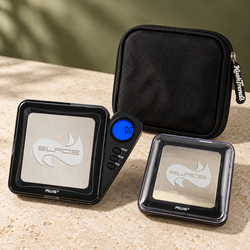
When comparing a 500g x 0.01g scale with a 1000g x 0.1g scale, the choice is not simply between a smaller model and a larger one. You are deciding which limitation is easier to live with: a lower maximum load or a coarser displayed increment.
A 500g x 0.01g digital scale can display changes as small as one hundredth of a gram, but the combined weight of the item and its container must remain within the scale's rated capacity. A 1000g x 0.1g scale doubles the maximum load to one kilogram, but it displays weight in tenths of a gram. That makes the 500g model better for fine measurement and the 1000g model better for heavier objects, larger containers and bigger batches.
For jewelers, collectors, hobbyists, resellers, food preparers and retailers, the right answer depends on the lightest change that needs to be seen and the heaviest complete load that needs to be weighed. This guide explains both specifications, shows where each type performs best and provides a practical method for choosing the right scale.
Quick Comparison: 500g x 0.01g vs 1000g x 0.1g
| Specification | 500g x 0.01g scale | 1000g x 0.1g scale |
|---|---|---|
| Maximum capacity | 500 grams | 1,000 grams |
| Displayed increment | 0.01 gram | 0.1 gram |
| Capacity in kilograms | 0.5 kg | 1 kg |
| Relative display resolution | 1 part in 50,000 | 1 part in 10,000 |
| Best strength | Fine measurement | Greater load capacity |
| Typical load size | Small items and controlled portions | Medium items, larger portions and containers |
| Container allowance | More limited | More generous |
| Good fit for | Jewelry, coins, small hardware, ingredients and detailed sorting | Coffee, food, parcels, collections and general-purpose weighing |
| Main tradeoff | Easier to overload | Cannot show hundredth-gram changes |
The 500g x 0.01g scale provides ten times finer readability. The 1000g x 0.1g scale provides twice the capacity. Neither specification is universally better because each optimizes a different part of the weighing range.
What Does 500g x 0.01g Mean?
The first number is capacity. A 500g scale is designed to weigh a total load of up to 500 grams. The second number is readability, also called the scale division or displayed increment. A readability of 0.01g means the display changes in steps of one hundredth of a gram.
For example, the display may progress from 24.36g to 24.37g to 24.38g. That fine increment is helpful when small differences affect sorting, portioning, formulation or documentation.
It is important to separate readability from accuracy. A display that shows two decimal places does not automatically guarantee that every result is within 0.01g of the true mass. Accuracy is affected by calibration, repeatability, linearity, temperature, drafts, vibration, surface stability, load placement and the condition of the scale. The National Institute of Standards and Technology explains the distinction between a scale's displayed division and its verification scale division in its discussion of scale division d versus verification scale division e.
In practical terms, 0.01g readability gives the operator a finer view of changes in the load. Whether those displayed changes are reliable must still be checked under actual operating conditions.
Where a 500g x 0.01g scale excels
A scale in this class is useful when the individual items are light but meaningful differences may be smaller than 0.1g. Common examples include:
- Comparing small coins, beads, stones or jewelry components
- Sorting screws, washers, electronic parts and other small hardware
- Measuring tea, coffee, spices, yeast or other concentrated ingredients
- Checking craft materials, pigments and sample quantities
- Portioning lightweight goods that benefit from two decimal places
- Counting uniform pieces by weight when a model includes a counting function
The SM-501 500g x 0.01g digital pocket scale illustrates the compact end of this category, with a removable protective cover that can also serve as an expansion tray. The SC-501 precision digital pocket scale offers the same capacity and readability with expansion trays and a larger platform. For users who prefer a bowl and benchtop-style setup, the LB-501 digital bowl scale combines 500g capacity and 0.01g readability with a removable bowl and dual power options.
The main limitation of 500g capacity
Capacity applies to everything resting on the weighing platform. If an empty cup weighs 180g and the material inside it weighs 350g, the physical load is 530g. Pressing tare can make the display read zero before the material is added, but it does not remove the cup's weight from the load cell. The scale is still carrying 530g and is therefore beyond a 500g rating.
This is one of the most common reasons to choose a higher-capacity scale. A larger bowl, tray, mailer or product container can consume much of a 500g scale's capacity before the material is added.
What Does 1000g x 0.1g Mean?
A 1000g x 0.1g scale can accept a total load up to 1,000 grams, or one kilogram, and displays weight in 0.1g increments. Its readings may progress from 248.6g to 248.7g to 248.8g.
The specification sacrifices one decimal place compared with a 0.01g model, but it provides twice the total capacity. That extra 500g can make a large practical difference when weighing filled containers, bulk ingredients, small parcels, collections or objects that regularly exceed half a kilogram.
The CD1000 compact digital pocket scale is a 1000g x 0.1g option with a protective lid that doubles as a tray, a stainless-steel platform and several weighing units. The AWS 1kg digital pocket scale provides the same core capacity and readability in a compact form with a flip-open protective lid.
Where a 1000g x 0.1g scale excels
A one-kilogram scale is often the more forgiving general-purpose choice when loads vary. Typical uses include:
- Weighing larger batches of coffee, tea, food or craft material
- Using cups, bowls and trays that would consume too much of a 500g limit
- Checking lightweight parcels and packaged products
- Weighing groups of coins, hardware pieces or collectibles together
- Portioning products where a tenth of a gram is sufficient
- Handling inventory with item weights spread across a broader range
For many daily tasks, 0.1g is already a useful increment. If a product is normally portioned to the nearest gram or half gram, a 0.1g display supplies adequate detail while the higher capacity reduces overload risk.
The main limitation of 0.1g readability
A 0.1g scale cannot display hundredth-gram differences. Two objects that weigh 8.24g and 8.28g may produce the same displayed result, depending on rounding and the instrument's response. If the difference between those objects matters, the 1000g scale is too coarse for the task even though both items are far below its maximum capacity.
The decisive question is therefore not whether the object fits within the capacity. It is whether the scale can visibly separate the smallest differences relevant to the work.
Capacity and Readability Solve Different Problems
Capacity and readability are sometimes treated as if they rise and fall together, but they address separate requirements.
Capacity answers: What is the heaviest complete load the scale can safely accept?
Readability answers: What is the smallest change the display can show?
A buyer who focuses only on capacity may end up with a scale that cannot distinguish important small differences. A buyer who focuses only on decimal places may select a scale that overloads as soon as a normal container is used.
The right scale must satisfy both conditions at the same time:
- The heaviest anticipated item, plus its container, must remain below the scale's capacity.
- The displayed increment must be fine enough for the smallest difference the user needs to observe.
If either condition fails, the specification is wrong for the application.
How Much More Precise Is 0.01g Than 0.1g?
In terms of displayed increments, 0.01g is ten times finer than 0.1g. A 0.01g display has ten steps within each tenth of a gram. A 0.1g display has one.
Consider a sequence of small additions:
| Actual amount added | Possible change shown on 0.01g display | Possible change shown on 0.1g display |
|---|---|---|
| 0.01g | One division | May show no change |
| 0.03g | Three divisions | May show no change |
| 0.05g | Five divisions | May round or transition |
| 0.10g | Ten divisions | One division |
| 0.50g | Fifty divisions | Five divisions |
This does not mean a 0.01g pocket scale should be used for any process that demands certified hundredth-gram accuracy. It means the display can resolve smaller changes. Users should evaluate the manufacturer's tolerances and verify performance with suitable reference weights.
NIST describes mass as an SI quantity and explains the relationship between kilograms and grams in its overview of SI units for mass. One kilogram equals 1,000 grams, so the capacity difference in this comparison is 500g, while the readability difference is 0.09g per displayed division.
Do Not Confuse Resolution, Accuracy and Repeatability
Three terms matter when assessing a digital scale:
Resolution or readability
This is the smallest displayed increment. In this comparison, the values are 0.01g and 0.1g.
Accuracy
Accuracy describes how close a result is to the accepted value of the load. It cannot be established merely by counting decimal places.
Repeatability
Repeatability describes how closely repeated measurements of the same unchanged item agree under the same conditions. If the reading jumps noticeably each time the object is removed and replaced, the scale may have a setup, environmental, power or performance problem.
A useful purchasing evaluation includes all three. Readability tells you what the display can show. Test results and specifications tell you how much confidence to place in that display. Repeated checks tell you how stable the setup is in daily use.
Tare Weight Can Decide the Winner
The tare function subtracts the displayed weight of a container so the user can read the net weight of the contents. It is convenient, but it does not create additional physical capacity.
Use this calculation before selecting a scale:
Maximum expected gross load = heaviest container + heaviest contents + reasonable safety margin
Suppose a bowl weighs 220g and the largest planned batch weighs 420g. The combined load is 640g. A 500g x 0.01g scale is not suitable, even if the desired net reading is only 420g. A 1000g x 0.1g scale has sufficient capacity, assuming 0.1g readability is adequate.
Now consider a small tray weighing 35g and a sample weighing no more than 120g. The gross load is only 155g. If changes of 0.02g or 0.03g matter, the 500g x 0.01g scale is the clear fit.
For purchasing, measure the actual containers employees or customers will use. Guessing container weight is an easy way to choose too little capacity.
Which Scale Is Better for Common Applications?
Jewelry and precious-metal sorting
For small pieces, stones, chains, findings and other lightweight components, 0.01g readability is usually more useful than a one-kilogram ceiling. The 500g model can show smaller differences and still offers generous capacity for individual items and small lots.
If the job involves larger grouped lots, heavy trays or packaged inventory, the 1000g model may be more convenient. However, do not assume a general-purpose pocket scale is approved for commercial transactions. Commercial buying and selling by weight may require a legal-for-trade device under applicable rules.
Coins and collectibles
Individual coins often benefit from the finer display of a 0.01g model. It can help document and compare small weight differences, although weight alone never establishes authenticity, grade or value.
For rolls, groups, holders or boxed collections, the extra capacity of a 1000g scale becomes more important. A retailer serving both use cases may stock both specifications because they answer different customer needs.
Coffee and tea
The better choice depends on batch size and process. A 500g x 0.01g model is helpful for small ingredient additions, recipe development or detailed comparisons. A 1000g x 0.1g model is better for larger brewing containers, green or roasted coffee batches and everyday portions where tenth-gram readings are sufficient.
Remember that water and the brewing vessel count toward capacity if they sit on the platform. A server or bowl can quickly push a load past 500g.
Food preparation
For spices, yeast, salt and small recipe components, 0.01g readability provides more detail. For general meal preparation, larger servings and containers, a 1000g x 0.1g scale is often more practical.
Neither should automatically be treated as a replacement for a multi-kilogram kitchen scale. If a normal bowl plus ingredients exceeds one kilogram, a higher-capacity kitchen model is the correct tool.
Small hardware and parts
The 500g scale is well suited to lightweight fasteners, electronic components and small uniform parts. Fine readability can also improve piece-count estimates when the scale supports counting and the parts have consistent individual weights.
The 1000g model is better for larger handfuls, heavier components and containers. For counting very light pieces, verify that the average piece weight is large enough relative to the displayed increment. A 0.1g scale may not distinguish one additional piece if each piece weighs less than or close to one division.
Postal mail and packaged goods
A 1000g x 0.1g scale is generally more useful for mailers and small packaged goods because packaging contributes to gross weight. Still, one kilogram may be insufficient for many parcels. Buyers should choose capacity based on their actual shipping range, not on the dimensions of the platform alone.
A 500g x 0.01g model is more specialized in this setting. Its finer display may be useful for lightweight contents or packaging analysis, but it offers less room for envelopes, boxes and packing material.
Educational, workshop and sample use
A 500g x 0.01g scale can support demonstrations and non-critical measurements where fine displayed increments are useful. A 1000g x 0.1g scale is more forgiving when students or staff use larger containers.
For regulated laboratory, pharmaceutical, safety-critical or validated work, selection requires more than a consumer specification. Suitability should be established through the applicable quality system, procedures, tolerances, calibration program and instrument qualification requirements.
Environmental Conditions Affect Both Scales
The finer the displayed increment, the more visible small disturbances can become. A 0.01g model may react more noticeably to drafts, vibration, static, an uneven surface or temperature changes. That does not make the finer scale defective; it means the weighing environment needs greater control.
For more consistent results:
- Place the scale on a firm, level, vibration-resistant surface.
- Keep it away from fans, vents, open windows and moving machinery.
- Allow the scale and objects to reach a stable room temperature.
- Center the load on the platform.
- Keep the platform clean and dry.
- Use fresh batteries or the approved power source.
- Avoid leaning on or bumping the work surface.
- Wait for a stable indication before recording the result.
- Stay within the specified operating temperature.
Static electricity can matter when weighing lightweight powders, films or plastic containers. Drafts can also create fluctuating readings. If the last decimal changes continually, improve the environment before assuming the scale needs calibration.
Calibration and Performance Checks
Calibration compares an instrument's indication with a reference and, depending on the procedure, may establish corrections or confirm whether the scale meets a defined tolerance. It should not be confused with casually placing any object of a claimed weight on the platform.
Use the mass specified by the manufacturer for the calibration routine. Keep the weight clean, handle it carefully and store it so that it is not damaged or contaminated. A 500g model may require a different calibration load than a 1000g model, and requirements can vary even among scales with the same nominal capacity.
NIST provides detailed guidance on the selection, calibration and use of laboratory balances in NISTIR 6969. Users can also consult NIST's weighing and scales frequently asked questions for explanations relevant to weighing devices and legal metrology.
Between calibrations, a simple performance-check routine can help identify problems:
- Inspect the platform and confirm the scale is clean and undamaged.
- Place the scale on its normal stable surface.
- Turn it on and allow any recommended warm-up time.
- Confirm that it returns to zero without an applied load.
- Test it with suitable known reference masses across the working range.
- Repeat a test load several times to evaluate consistency.
- Record the date, result and action taken if the reading is outside the user's tolerance.
The acceptance tolerance should come from the application, not from the number of decimal places on the screen.
Legal-for-Trade Considerations
A scale used for internal sorting, hobbies or recipe preparation is not necessarily subject to the same requirements as a scale used to determine the price in a commercial transaction. If money changes hands based on the displayed weight, confirm the applicable federal, state and local requirements before using the device.
NIST describes a legal metrology device as one used in trade or law-enforcement applications where measurements affect transactions or regulatory decisions. Its overview of legal metrology devices is a useful starting point. NIST also publishes Handbook 44 specifications and tolerances for weighing and measuring devices, but device approval and use requirements should be confirmed with the relevant weights-and-measures authority.
Do not assume that a scale is legal for trade because it looks professional, has a calibration mode or displays multiple decimal places. Look for the required approval and suitability for the intended commercial application.
Buying Checklist
Before ordering either specification, answer these questions:
1. What is the heaviest gross load?
Add the container, product and any accessories that rest on the platform. If the result approaches 500g, the 1000g model provides more usable headroom.
2. What is the smallest meaningful difference?
If differences below 0.1g affect the task, choose 0.01g readability. If results are normally used to the nearest gram or tenth of a gram, 0.1g may be sufficient.
3. How large is the item or container?
Capacity alone does not guarantee a good physical fit. Compare the platform dimensions with the container base. An oversized object can hide the display, touch the surrounding surface or create an unstable load.
4. Will the scale travel?
For mobile use, look for a protective cover, durable controls, battery power and a shape that packs easily. Browse the current range of digital pocket scales to compare formats as well as specifications.
5. Which weighing units are required?
Check the exact model. Common units may include grams, ounces, troy ounces, pennyweights, carats and grains, but unit availability is not identical across all scales.
6. What calibration weight is needed?
Confirm both the required mass and whether it is included. Budgeting for the correct reference weight at the time of purchase makes setup and later checks easier.
7. Is battery or adapter power preferable?
Battery power favors portability. Adapter power can suit a fixed workstation with frequent use. Some models support both; others use only one power method.
8. Does the application require documentation or regulatory approval?
Internal process control, commercial transactions and formal laboratory work can have very different requirements. Define the use before choosing the instrument.
Decision Table
| If your priority is… | Better starting choice | Reason |
|---|---|---|
| Seeing changes below 0.1g | 500g x 0.01g | Ten times finer displayed increment |
| Weighing up to one kilogram | 1000g x 0.1g | Twice the maximum capacity |
| Using a heavy bowl or tray | 1000g x 0.1g | More capacity remains after container weight |
| Comparing individual small parts | 500g x 0.01g | Better differentiation of light items |
| General-purpose portable weighing | 1000g x 0.1g | Broader usable load range |
| Detailed ingredient additions | 500g x 0.01g | Finer displayed changes |
| Larger food or coffee portions | 1000g x 0.1g | More room for product and container |
| Maximum versatility across fine and heavy work | Two-scale setup | Each scale covers the other's weakness |
When Owning Both Makes Sense
For retailers, workshops, preparation areas and serious hobby users, a two-scale setup may be more efficient than forcing one instrument to cover incompatible jobs.
Use the 500g x 0.01g scale for small items, detailed portions and fine comparisons. Use the 1000g x 0.1g scale when containers or loads move beyond the smaller model's comfortable range. If the business also handles multi-kilogram loads, add a higher-capacity kitchen or bench scale rather than overloading either pocket model.
This approach creates overlapping coverage:
- Fine scale: small-load detail
- One-kilogram scale: medium-load flexibility
- Optional higher-capacity scale: large batches and parcels
The result is usually better than buying one scale with an impressive specification that does not match the full workflow.
Frequently Asked Questions
Is a 500g x 0.01g scale more accurate than a 1000g x 0.1g scale?
It has finer readability, but that alone does not prove greater accuracy. Compare manufacturer specifications, repeatability, calibration requirements and performance under actual conditions. The 500g scale can display smaller changes; the accuracy of those readings is a separate question.
Can a 500g scale weigh exactly 500g plus a container?
No. The capacity includes everything on the platform. If the contents weigh 500g and the container adds any weight, the load exceeds a 500g rating.
Does pressing tare restore the full 500g capacity?
No. Tare changes the displayed reference point but does not remove physical weight from the sensor. Always calculate gross load.
Is 0.1g precise enough for coffee?
For many brewing and portioning tasks, yes. For very small ingredient additions, experiments or applications where hundredth-gram differences matter, a 0.01g scale may be preferable. Remember to include the brewing container in the capacity calculation.
Is 0.01g necessary for jewelry?
It is useful for comparing small pieces and documenting fine weight differences. The required device ultimately depends on the material, item size, workflow and whether the weight is used in a regulated commercial transaction.
Which scale is better for coins?
Choose 500g x 0.01g for individual coins and small groups when fine differences matter. Choose 1000g x 0.1g for rolls, holders and larger lots when capacity matters more. Weight should be only one part of identification or evaluation.
Can either scale be used for laboratory work?
They may be useful for non-critical demonstrations or general measurements, but suitability for formal laboratory work depends on required uncertainty, calibration traceability, environmental control, documentation and applicable procedures. Capacity and readability alone are not enough to qualify an instrument.
Which model is easier to use with a bowl?
The 1000g scale generally provides more tare allowance, but platform size and bowl stability also matter. A purpose-built bowl scale can be preferable when loose ingredients are weighed frequently.
Why does a 0.01g reading drift?
Possible causes include air movement, vibration, static, temperature change, an unstable surface, low battery power, contamination or a load placed off center. Improve the setup and repeat the check before recalibrating.
Should I buy extra capacity as a safety margin?
Yes, provided the higher-capacity model still has adequate readability. Operating with some capacity headroom is more practical than routinely working close to overload. However, moving to a higher capacity should not sacrifice the detail required by the task.
Final Verdict
Choose a 500g x 0.01g scale when small differences matter more than maximum load. It is the stronger option for individual jewelry pieces, coins, small hardware, concentrated ingredients, detailed sorting and other work that benefits from hundredth-gram display increments. Make sure the item and container together remain comfortably below 500g.
Choose a 1000g x 0.1g scale when the load, container or batch may exceed 500g and tenth-gram readability is sufficient. It is the more flexible option for larger food portions, coffee or tea batches, grouped items, light parcels and general-purpose weighing.
The best specification is the one that covers the heaviest gross load and still shows the smallest difference that matters. Capacity protects the scale from being undersized; readability protects the measurement from being too coarse. Evaluate both before comparing style, accessories or price.