
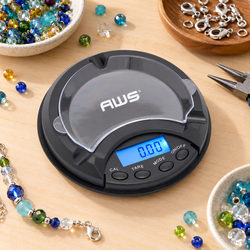
Choosing between a 500g x 0.01g scale and a 750g x 0.1g scale requires deciding which matters more: finer displayed measurements or additional capacity.
The specifications involve two clear tradeoffs:
-
A 500g x 0.01g scale displays weight in hundredths of a gram.
-
A 750g x 0.1g scale supports 250g more weight but displays only tenths of a gram.
-
The 750g model provides 50% more nominal capacity.
-
The 500g model provides ten-times-finer readability.
A 500g x 0.01g scale is generally the better choice for jewelry, coins, coffee doses, tea, small hardware, craft ingredients and other applications where differences below 0.1g matter.
A 750g x 0.1g scale is more practical for heavier containers, larger portions, grouped objects and general-purpose weighing where tenth-gram readability provides enough detail.
Neither specification is universally better. The right selection depends on the total physical load, smallest meaningful weight difference, container size and intended workflow.
This guide explains those differences and helps buyers compare available options in the American Weigh Wholesale collection of digital pocket scales.
Quick Comparison: 500g x 0.01g vs 750g x 0.1g
| Feature | 500g x 0.01g scale | 750g x 0.1g scale |
|---|---|---|
| Maximum capacity | 500g | 750g |
| Gram readability | 0.01g | 0.1g |
| Smallest displayed gram increment | 10mg | 100mg |
| Capacity difference | Baseline | 250g more |
| Relative capacity | Lower | 50% greater |
| Relative readability | Ten times finer | Ten times coarser |
| Typical gram display | Two decimal places | One decimal place |
| Best for | Fine comparison and moderate batches | General weighing and larger loads |
| Main advantage | Finer displayed detail | More container and sample capacity |
| Main limitation | Cannot support loads over 500g | Cannot display hundredths of a gram |
The decision is not simply about choosing the larger capacity. Capacity only helps if it is needed, while readability only helps if the additional displayed detail affects the task.
What Does 500g x 0.01g Mean?
A 500g x 0.01g scale has:
-
A stated maximum capacity of 500 grams
-
A gram readability of 0.01 gram
-
A displayed increment equivalent to 10 milligrams
Possible displayed values include:
-
3.27g
-
18.64g
-
152.39g
-
426.71g
-
499.82g
The display changes in one-hundredth-of-a-gram increments.
This specification is useful when the load requires more capacity than a 100g or 200g pocket scale but the user still wants measurements displayed to two decimal places.
What Does 750g x 0.1g Mean?
A 750g x 0.1g scale has:
-
A stated maximum capacity of 750 grams
-
A gram readability of 0.1 gram
-
A displayed increment equivalent to 100 milligrams
Possible displayed values include:
-
3.2g
-
18.6g
-
152.4g
-
426.7g
-
749.8g
The scale can support an additional 250g of total load, but it does not display the hundredths place.
NIST provides more information about grams, kilograms and related SI units for mass.
How Much More Capacity Does the 750g Scale Provide?
The difference is:
750g − 500g = 250g
Relative to the 500g model:
250g ÷ 500g = 0.5
The 750g scale therefore provides 50% more nominal capacity.
That additional range can accommodate:
-
Heavier containers
-
Larger ingredient batches
-
More hardware pieces
-
Bigger craft portions
-
Multiple objects
-
Loads that vary significantly
-
A larger working margin
The extra capacity is valuable when total loads may exceed 500g. If every load remains below 200g, it may offer little practical benefit.
How Much Finer Is 0.01g Than 0.1g?
The calculation is:
0.1g ÷ 0.01g = 10
The 0.01g display increment is ten times finer.
In milligrams:
-
0.01g equals 10mg.
-
0.1g equals 100mg.
A 500g x 0.01g scale can display differences that a 750g x 0.1g scale cannot show directly.
Display Comparison
The following examples illustrate the difference in displayed increments. They are not accuracy guarantees.
| Approximate mass | Possible 0.01g display | Possible 0.1g display |
|---|---|---|
| 1.24g | 1.24g | 1.2g |
| 5.67g | 5.67g | 5.7g |
| 18.43g | 18.43g | 18.4g |
| 126.78g | 126.78g | 126.8g |
| 473.92g | 473.92g | 473.9g |
If the process needs to distinguish 18.43g from 18.47g, the 0.1g specification is too coarse to show that difference.
Readability Is Not the Same as Accuracy
A scale displaying 0.01g increments is not necessarily accurate to exactly ±0.01g under all conditions.
Readability describes the display interval. Accuracy concerns how closely a result agrees with an appropriate reference value.
Other important characteristics include:
-
Repeatability
-
Linearity
-
Calibration
-
Minimum load
-
Stabilization time
-
Environmental sensitivity
-
Corner-load behavior
-
Operating temperature
-
Measurement uncertainty
NIST explains that a scale division and verification scale division have distinct meanings in its discussion of scale division “d” versus verification scale division “e”.
The 500g model has finer readability. That does not automatically prove that it is more accurate than every 750g model.
Total Load Includes the Container
Capacity applies to everything physically supported by the platform:
-
Sample
-
Bowl
-
Tray
-
Cup
-
Weighing paper
-
Silicone mat
-
Protective cover used as a tray
-
Other accessories
A sample weighing 480g does not fit on a 500g scale if its container weighs 60g.
The combined load would be:
480g + 60g = 540g
That exceeds the 500g capacity but remains within the 750g range.
Tare Does Not Restore Capacity
The tare function subtracts container weight from the displayed result. It does not remove that weight from the load cell.
Example With a 500g Scale
A bowl weighs 180g.
After taring, the display returns to zero, but the approximate remaining physical capacity is:
500g − 180g = 320g
Example With a 750g Scale
The same bowl leaves:
750g − 180g = 570g
The 750g model provides 250g more room for the sample.
Remaining Capacity Comparison
| Empty container weight | Remaining capacity on 500g scale | Remaining capacity on 750g scale |
|---|---|---|
| 10g | 490g | 740g |
| 25g | 475g | 725g |
| 50g | 450g | 700g |
| 100g | 400g | 650g |
| 150g | 350g | 600g |
| 200g | 300g | 550g |
| 250g | 250g | 500g |
| 300g | 200g | 450g |
A heavy container can make the 750g capacity substantially more useful.
When to Choose a 500g x 0.01g Scale
Choose the 500g model when loads remain below 500g and hundredth-gram differences matter.
Jewelry and Gemstones
The finer display is useful for comparing:
-
Rings
-
Earrings
-
Chains
-
Gemstones
-
Findings
-
Beads
-
Small precious-metal items
Depending on the model, unit modes may include carats, troy ounces, pennyweight and grains.
Weight is only one factor in identifying or valuing jewelry and gemstones.
Coins and Collectibles
A 500g capacity can handle:
-
Individual coins
-
Coin capsules
-
Small groups
-
Tokens
-
Medals
-
Lightweight collectibles
The 0.01g display supports finer comparisons than a 0.1g model.
Weight alone does not establish authenticity or grade.
Coffee
A 500g x 0.01g scale can support:
-
Coffee-bean doses
-
Ground-coffee portions
-
Grinder-retention checks
-
Roasting samples
-
Dosing cups
-
Input-and-output comparisons
Platform dimensions remain important. A scale may provide sufficient capacity but still be too small for a portafilter or brewing vessel.
Tea, Spices and Fine Ingredients
A hundredth-gram display may be useful for:
-
Loose-leaf tea portions
-
Spice measurements
-
Saffron
-
Yeast
-
Recipe development
-
Blend comparison
-
Small packaging quantities
Use an appropriate container and account for its weight.
Soap and Cosmetic Ingredients
Potential applications include:
-
Fragrance oils
-
Colorants
-
Botanical ingredients
-
Dry additives
-
Formula samples
-
Small test batches
Very small or safety-critical ingredients may require 0.001g readability or specialized equipment. A 0.01g pocket scale should not automatically be treated as appropriate for every formulation.
Small Hardware
The finer display can help compare:
-
Screws
-
Washers
-
Springs
-
Connectors
-
Electronic components
-
Watch parts
-
Small assemblies
A 500g capacity also supports moderate component batches.
Craft and Model-Making Materials
Possible uses include:
-
Pigments
-
Beads
-
Clay
-
Miniature components
-
Model hardware
-
Resin-related materials
-
Decorative pieces
Use compatible containers and protect the scale from liquid, adhesive and fine-particle intrusion.
Current 500g Scale Options
The SC501A precision digital pocket scale combines a 500g capacity and 0.01g readability with an AC-adapter option for repeated workstation use.
Its published information identifies calibration with a 200g or 500g weight, not included.
The AWS-501 digital pocket scale is listed with a 500g x 0.01g specification and a collapsible silicone cup for containing loose materials.
The SM-501-BLK Scale Mate provides another compact option. Because its listing describes a dual-range format, buyers should confirm whether 0.01g readability applies across the entire capacity or changes above a specified load.
When to Choose a 750g x 0.1g Scale
Choose the 750g model when the load may exceed 500g and a tenth-gram display is sufficient.
Meal Preparation
A 750g capacity provides more room for:
-
Food containers
-
Meal-prep portions
-
Snacks
-
Dry ingredients
-
Pet-food portions
-
Moderate produce portions
For general portioning, 0.1g is often more detail than needed. The correct specification depends on the nutrition plan or recipe.
Larger Coffee and Tea Batches
The higher capacity can accommodate:
-
Larger bean batches
-
Heavier cups
-
Tea-blending bowls
-
Sample-roasting containers
-
Several portions at once
Choose the 500g scale if fine dose differences matter. Choose the 750g scale if the vessel and contents may exceed 500g.
Hardware Batches
A 750g scale is more practical for:
-
Larger screw batches
-
Nuts and washers
-
Metal connectors
-
Repair components
-
Small brackets
-
Parts bins
A 0.1g display may be sufficient when comparing batch weight rather than individual lightweight pieces.
Crafts and Hobbies
The additional capacity can accommodate:
-
Larger clay portions
-
Bead batches
-
Multiple model parts
-
Heavier containers
-
Combined craft materials
-
General hobby equipment
General-Purpose Portable Weighing
A 750g pocket scale can provide more working capacity without moving to a large kitchen or bench scale.
The MS-750 digital pocket scale is a portable 750g x 0.1g model with a protective-cover format. Published descriptions identify it as a compact scale designed for everyday portable weighing.
The DZ3-750 digital pocket scale provides another 750g x 0.1g option in a compact design.
Product details and availability can change, so verify current platform dimensions, accessories, unit modes and calibration requirements before ordering.
Practical Load Comparison
| Weighing setup | Total load | 500g x 0.01g | 750g x 0.1g |
|---|---|---|---|
| 10g tray + 20g sample | 30g | Suitable, finer display | Suitable |
| 50g bowl + 100g sample | 150g | Suitable, finer display | Suitable |
| 100g container + 250g sample | 350g | Suitable | Suitable |
| 150g bowl + 300g sample | 450g | Suitable, limited margin | Suitable |
| 125g container + 400g sample | 525g | Over capacity | Suitable |
| 175g bowl + 450g sample | 625g | Over capacity | Suitable |
| 150g container + 550g sample | 700g | Over capacity | Suitable, limited margin |
| 200g bowl + 575g sample | 775g | Over capacity | Over capacity |
If total loads stay below 500g, the finer readability becomes the stronger differentiator. If loads exceed 500g, the 750g model becomes necessary unless another higher-capacity 0.01g model is selected.
Which Scale Is Better for Small Quantities?
The 500g x 0.01g model is usually better for small quantities.
For example, consider a target weight of 2.35g:
-
A 0.01g scale can display 2.35g.
-
A 0.1g scale can display only a nearby tenth, such as 2.3g or 2.4g.
If the task requires distinguishing between 2.34g and 2.39g, the 750g x 0.1g specification is too coarse.
However, a 0.01g display is not suitable for every extremely small sample. If individual milligrams matter, a 0.001g model may be required.
Which Scale Is Better for Larger Loads?
The 750g x 0.1g model is better when:
-
Total loads exceed 500g.
-
Containers are heavy.
-
Sample weight varies widely.
-
Additional working margin is valuable.
-
A tenth of a gram is sufficient.
The 250g difference is more substantial than the 100g difference between 500g and 600g scales. It can accommodate many moderate bowls and batches that clearly exceed the 500g range.
Which Scale Is Better for Coffee?
Choose 500g x 0.01g when:
-
Comparing small dose adjustments
-
Measuring individual bean doses
-
Evaluating grinder retention
-
Conducting small roast tests
-
Using lightweight dosing containers
Choose 750g x 0.1g when:
-
Weighing larger bean batches
-
Using a heavy cup or bowl
-
Combining several portions
-
The complete setup exceeds 500g
-
Tenth-gram readability is sufficient
Neither capacity specification confirms the presence of a timer, water resistance or espresso-specific platform dimensions.
Which Scale Is Better for Meal Prep?
The 750g x 0.1g scale is usually the better choice for meal preparation.
Food portions and containers can easily exceed 500g, while hundredth-gram detail is rarely necessary for general meal prep.
The 500g x 0.01g scale may be preferable for:
-
Recipe development
-
Fine ingredients
-
Spices
-
Yeast
-
Small nutrition-focused portions
Which Scale Is Better for Jewelry?
The 500g x 0.01g scale is generally more appropriate.
Jewelry pieces and gemstones rarely require 750g capacity, while the finer display can provide more meaningful comparisons.
Verify that the exact model supports the required units.
Which Scale Is Better for Small Hardware?
Choose 500g x 0.01g for:
-
Individual components
-
Lightweight parts
-
Fine comparison
-
Average-piece-weight analysis
-
Small assemblies
Choose 750g x 0.1g for:
-
Larger batches
-
Heavier parts
-
General sorting
-
Parts containers
-
Combined hardware sets
Which Scale Is Better for Crafts?
Choose the 500g model for:
-
Pigments
-
Dyes
-
Small additives
-
Miniature components
-
Fine formulation work
Choose the 750g model for:
-
Clay
-
Larger bead batches
-
Heavier molds
-
Grouped model components
-
General material portions
Platform Size Can Be More Important Than Capacity
Capacity tells you how much weight the scale can support. It does not tell you whether the object fits.
An oversized object can:
-
Cover the display
-
Touch the housing
-
Contact the work surface
-
Shift during weighing
-
Be difficult to center
-
Apply force outside the intended weighing area
Measure:
-
Object length and width
-
Container diameter
-
Container base
-
Available workstation space
-
Display position
A 500g scale with a larger platform may be easier to use than a particular 750g model for wide but lightweight objects.
Choosing Between a Flat Platform, Tray or Bowl
Flat Platform
Best for:
-
Coins
-
Jewelry
-
Hardware
-
Solid components
-
Flat collectibles
Protective Cover Used as a Tray
Best for:
-
Portable weighing
-
Grouped small objects
-
Loose components
-
Protecting the platform during storage
Collapsible Cup
Best for:
-
Coffee beans
-
Tea leaves
-
Beads
-
Seeds
-
Small hardware
Bowl
Best for:
-
Larger ingredient batches
-
Meal-prep portions
-
Craft materials
-
Repeated loose-material weighing
The container’s weight always counts toward capacity.
Calibration Requirements
The correct calibration procedure depends on the exact model.
A 500g scale may calibrate with:
-
200g weight
-
500g weight
-
Multiple reference points
A 750g model may use:
-
500g weight
-
Another manufacturer-specified value
-
A model-specific sequence
Never assume that two scales with similar specifications use the same procedure.
NIST’s publication Accuracy Matters: Weighing in the Balance discusses the importance of suitable equipment, reference standards and weighing procedures.
Household objects, coins and packaged products are not dependable calibration standards.
Environmental Conditions Affect Both Scales
NIST’s weighing and scales frequently asked questions provide additional information about scale divisions and weighing-device requirements.
Air Movement
Fans, vents, open windows and nearby movement can disturb lightweight samples.
Vibration
Potential sources include:
-
Machinery
-
Appliances
-
Speakers
-
Unstable tables
-
Foot traffic
-
Touching the work surface
Temperature
A scale moved between environments may need time to acclimate before use.
Static Electricity
Plastic containers, dry materials and low humidity can create static effects.
Load Placement
Center the load whenever possible. Do not allow the container to touch the housing or nearby surface.
Battery Condition
Use fresh batteries of the type specified by the manufacturer.
Which Scale Is More Portable?
Both specifications are available in compact formats.
Portability depends on:
-
Overall dimensions
-
Scale weight
-
Protective-cover design
-
Platform protection
-
Battery type
-
Accessory storage
-
Whether a bowl or cup is included
A 750g capacity does not necessarily mean the scale is much larger. Check the exact dimensions rather than assuming based on capacity.
Which Scale Offers Better Value?
The 500g x 0.01g scale offers better value when:
-
All loads remain below 500g.
-
Fine displayed differences matter.
-
The scale is used for multiple precision-oriented tasks.
-
Jewelry, coins or small ingredients are common.
-
The platform fits the intended containers.
The 750g x 0.1g scale offers better value when:
-
Loads can exceed 500g.
-
Heavy containers are common.
-
Larger portions are weighed.
-
Tenth-gram readability is sufficient.
-
Extra capacity prevents the need for another scale.
Unused capacity does not improve a measurement. Insufficient capacity can make the scale unusable.
Should You Buy Both?
Some users may benefit from keeping both capacity classes.
Use the 500g x 0.01g scale for:
-
Fine ingredient portions
-
Jewelry
-
Coins
-
Coffee doses
-
Small hardware
-
Precision comparisons
Use the 750g x 0.1g scale for:
-
Larger food portions
-
Heavy containers
-
Hardware batches
-
General craft materials
-
Grouped objects
-
Loads above 500g
A two-scale setup can cover a wider range without forcing one device to handle an unsuitable task.
Is Either Scale Suitable for Laboratory Work?
A general pocket scale may support noncritical internal comparison, education or demonstrations.
Laboratory work may require:
-
Documented accuracy
-
Repeatability data
-
Linearity information
-
Traceable calibration
-
Measurement uncertainty
-
Minimum sample-weight analysis
-
Draft protection
-
Environmental monitoring
-
Quality-system documentation
Capacity and readability alone do not establish laboratory suitability.
Is Either Scale Legal for Trade?
Do not assume that either model is legal for trade.
NIST explains that a legal-metrology device includes a device used to determine a quantity on which a charge for goods or services is based.
Before using a scale to determine a customer’s price, verify:
-
Certification of the exact model
-
National Type Evaluation Program requirements
-
State and local regulations
-
Registration requirements
-
Inspection and sealing requirements
-
Minimum-load rules
-
Suitability for the commodity
The current NIST Handbook 44 contains specifications, tolerances and technical requirements for commercial weighing and measuring equipment. NIST notes that it is adopted by many state, local and some federal weights-and-measures authorities.
A general-purpose scale may be suitable for internal comparisons while remaining inappropriate for price-determining transactions.
How to Choose Between 500g x 0.01g and 750g x 0.1g
Step 1: Calculate the Maximum Total Load
Add:
-
Heaviest container
-
Heaviest sample
-
Tray or liner
-
Accessories
-
Working margin
If the total may exceed 500g, the 750g scale is the better option unless 0.1g readability is too coarse.
Step 2: Identify the Smallest Meaningful Difference
Ask whether a change smaller than 0.1g affects the decision.
If yes, choose the 500g x 0.01g scale or locate a higher-capacity model that preserves 0.01g readability.
Step 3: Review Typical Loads
If most loads are below 200g, capacity should not dominate the decision.
If most loads fall between 450g and 700g, the 750g model is more practical.
Step 4: Include the Container
Tare does not eliminate physical container weight.
Step 5: Measure the Platform
Confirm that the object or container fits securely and leaves the display visible.
Step 6: Verify Unit Modes
Check whether the model provides the required gram, ounce, carat, grain, troy-ounce or pennyweight modes.
Step 7: Review Calibration
Determine which weight is required and whether it is included.
Step 8: Compare Other Features
Evaluate:
-
Display size
-
Backlighting
-
Protective cover
-
Expansion tray
-
Platform material
-
Battery type
-
Auto-off timing
-
Overall dimensions
-
Warranty
Simple Decision Table
| Requirement | Better starting choice |
|---|---|
| Need hundredth-gram display | 500g x 0.01g |
| Total load exceeds 500g | 750g x 0.1g |
| Jewelry and gemstones | 500g x 0.01g |
| Coins and collectibles | 500g x 0.01g |
| Coffee-dose comparison | 500g x 0.01g |
| Larger food portions | 750g x 0.1g |
| Heavy bowl or container | 750g x 0.1g |
| Small hardware comparison | 500g x 0.01g |
| Larger hardware batches | 750g x 0.1g |
| General craft portions | 750g x 0.1g |
| Fine pigments or additives | 500g x 0.01g |
| Need 0.001g readability | Neither |
| Need more than 750g capacity | Neither |
| Price-determining use | Verify legal-for-trade equipment |
Frequently Asked Questions
Which scale is more precise?
The 500g x 0.01g scale has finer readability because it displays hundredths rather than tenths of a gram.
Which scale has more capacity?
The 750g x 0.1g scale provides 250g more capacity.
How much more capacity does the 750g scale offer?
It provides 50% more nominal capacity than the 500g model.
How much finer is 0.01g than 0.1g?
The 0.01g display increment is ten times finer.
Is 0.01g equal to 10mg?
Yes. One-hundredth of a gram equals 10 milligrams.
Is 0.1g equal to 100mg?
Yes. One-tenth of a gram equals 100 milligrams.
Is the 500g scale more accurate?
Not necessarily. It has finer readability. Actual accuracy depends on the exact scale, calibration and operating conditions.
Can a 750g scale weigh lightweight items?
It can weigh items within its range, but 0.1g readability may be too coarse when small differences matter.
Can a 500g scale weigh a 500g sample in a bowl?
No. The sample and bowl together must remain within 500g.
Does pressing tare give the scale its full capacity back?
No. Tare changes the displayed zero point but does not remove the container’s physical weight.
Which scale is better for coffee?
Choose 500g x 0.01g for fine dose comparison. Choose 750g x 0.1g for larger batches or heavier vessels.
Which scale is better for meal preparation?
The 750g model generally provides more practical capacity for meal portions and containers.
Which scale is better for jewelry?
The 500g x 0.01g model generally provides more useful detail for jewelry and gemstones.
Can I use household objects for calibration?
Use the calibration weight and procedure specified for the exact model. Household objects are not appropriate calibration standards.
Are either of these scales legal for trade?
Not automatically. Verify the exact model’s certification and applicable local requirements.
Final Verdict
Choose a 500g x 0.01g scale when the entire load remains below 500g and differences smaller than 0.1g matter.
It is generally the better choice for:
-
Jewelry and gemstones
-
Coins and collectibles
-
Coffee doses
-
Tea and spices
-
Fine craft materials
-
Small hardware
-
Product-development samples
Choose a 750g x 0.1g scale when the additional 250g of capacity is more important than displaying hundredths of a gram.
It is generally the better choice for:
-
Larger food portions
-
Heavier containers
-
Coffee or tea batches
-
Hardware groups
-
Craft materials
-
Loads between 500g and 750g
The decision comes down to two questions:
-
Can the total physical load exceed 500g?
-
Do differences smaller than 0.1g matter?
If the load can exceed 500g and a tenth-gram display is sufficient, choose the 750g scale. If fine displayed differences matter and the load stays below 500g, choose the 500g x 0.01g model.
If you need both more than 500g of capacity and 0.01g readability, neither specification fully solves the problem. In that situation, choose a higher-capacity scale that retains 0.01g readability.