
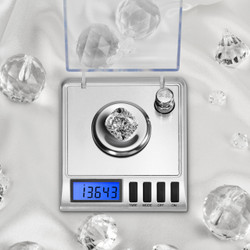
A digital scale labeled 50g x 0.001g combines a maximum capacity of 50 grams with a readability of one-thousandth of a gram. In everyday terms, it can display weight changes as small as one milligram while supporting a total physical load of up to 50 grams.
This specification is useful for weighing small objects and samples that require more detail than a conventional 0.01g pocket scale can display. Possible applications include gemstones, jewelry components, electronic parts, miniature hardware, coins, pigments, craft materials, and other lightweight items.
However, choosing a precision scale involves more than selecting the model with the most decimal places. Buyers must consider container weight, calibration, environmental sensitivity, platform size, repeatability, and whether the instrument is appropriate for the intended application.
A 50g x 0.001g digital scale offers an attractive middle ground: substantially more capacity than many 20g milligram scales while retaining one-milligram readability.
This guide explains exactly what the specification means, what a 50g milligram scale can and cannot do, and which features matter when comparing models.
What Does 50g x 0.001g Mean?
The specification contains two separate measurements:
-
50g is the scale’s maximum capacity.
-
0.001g is its readability or display increment.
The capacity tells you the greatest total physical load the weighing mechanism is designed to support. The readability tells you the smallest weight increment shown on the display.
A 50g x 0.001g scale might display results such as:
-
2.417g
-
2.418g
-
2.419g
-
2.420g
Each step represents 0.001 gram.
Because 0.001 gram equals one milligram, scales with this readability are commonly called milligram scales.
50g Capacity Explained
A maximum capacity of 50 grams means that everything placed on the weighing platform must remain within that limit.
The total load includes:
-
The object being weighed
-
A cup or container
-
A weighing tray
-
Weighing paper
-
Any holder or accessory resting on the platform
If a container weighs 18g and the sample weighs 35g, the total physical load is 53g. That combination exceeds a 50g scale’s rated capacity even when the container has been tared.
0.001g Readability Explained
A readability of 0.001g means the display changes in increments of one-thousandth of a gram.
The relationship between grams and milligrams is:
-
1g = 1,000mg
-
0.1g = 100mg
-
0.01g = 10mg
-
0.001g = 1mg
The NIST guide to metric SI prefixes explains the decimal relationships used in metric measurements.
A scale that reads to 0.001g provides ten times finer displayed increments than one that reads to 0.01g. It provides 100 times finer increments than a scale that reads to 0.1g.
That does not mean it has ten or 100 times greater accuracy. Readability and accuracy are related concepts, but they are not the same specification.
50g x 0.001g Specifications at a Glance
| Feature | Meaning |
|---|---|
| Maximum capacity | 50 grams |
| Readability | 0.001 gram |
| Readability in milligrams | 1 milligram |
| Number of displayed divisions | 50,000 |
| Typical scale category | Milligram or precision scale |
| Best for | Lightweight objects and small samples |
| Main advantage | Fine readings with more capacity than a 20g model |
| Main limitation | Cannot support gross loads over 50g |
| Environmental sensitivity | High |
| Recommended setup | Stable, level, draft-protected surface |
The number of displayed divisions can be calculated as follows:
50g ÷ 0.001g = 50,000 displayed divisions
This means the scale divides its complete range into 50,000 display increments.
Is 0.001g the Same as 1mg?
Yes. One milligram is one-thousandth of a gram:
1mg = 0.001g
A 50g x 0.001g scale can therefore display its result in one-milligram increments when operating in gram mode.
For example:
| Grams | Milligrams |
|---|---|
| 0.001g | 1mg |
| 0.005g | 5mg |
| 0.010g | 10mg |
| 0.025g | 25mg |
| 0.100g | 100mg |
| 1.000g | 1,000mg |
| 50.000g | 50,000mg |
The NIST reference on SI units of mass provides additional information about grams, kilograms, and related mass units.
What Can You Weigh With a 50g x 0.001g Digital Scale?
A 50g milligram scale is best suited to lightweight items for which small differences matter.
Potential uses include:
-
Loose gemstones
-
Jewelry findings
-
Precious-metal components
-
Watch parts
-
Small screws and washers
-
Electronic components
-
Seeds and botanical samples
-
Beads and charms
-
Fly-tying materials
-
Model-building components
-
Small pigment samples
-
Tiny craft materials
-
Individual coins
-
Lightweight collectibles
-
Small nonregulated powder samples
-
Educational experiments
-
Product-development samples
-
Small mechanical components
The combination of 50g capacity and 0.001g readability makes this specification more flexible than a 20g x 0.001g scale. It can accommodate heavier components, larger containers, or groups of small items while retaining the same displayed increment.
American Weigh Scales offers several models in its milligram scales collection, including multiple 50g x 0.001g configurations.
Current AWS 50g x 0.001g Scale Options
Several AWS scales currently carry this capacity and readability specification.
GEMINI-50 Precision Milligram Scale
The GEMINI-50 Precision Milligram Scale combines a 50g capacity with 0.001g readability.
Its current specifications include:
-
50g x 0.001g capacity and readability
-
Gram, ounce, troy ounce, pennyweight, carat, and grain modes
-
1.3 x 1.3-inch platform
-
Two AAA batteries
-
A 20g calibration weight
-
Tweezers
-
Weighing pan or funnel
-
Microfiber cloth
The listed operating temperature is 50°F to 86°F, or 10°C to 30°C.
This model is a practical choice when portability and a compact accessory set are priorities.
ZEO-50 High-Precision Digital Milligram Scale
The ZEO-50 High-Precision Digital Milligram Scale also provides a 50g x 0.001g specification.
Its listed features include:
-
50g capacity
-
0.001g readability
-
50g calibration weight
-
Weighing tray
-
Scoop
-
Tweezers
-
Six weighing units
-
2.6 x 2.6-inch platform
-
Four AAA batteries
The larger platform may be useful when weighing containers or objects that do not fit comfortably on a very small platform.
MINIPRO50 Compact Precision Balance Scale
The MINIPRO50 Compact Precision Balance Scale is another current 50g x 0.001g option. The AWS listing includes a hard plastic cover, weighing tray, multiple weighing units, and a 50g calibration weight.
The best model depends on platform size, portability, included accessories, calibration procedure, controls, and the environment in which the scale will be used.
Why Choose 50g Instead of 20g Capacity?
Both a 20g x 0.001g scale and a 50g x 0.001g scale display one-milligram increments. The primary difference is capacity.
A 50g model provides 2.5 times the capacity:
50g ÷ 20g = 2.5
That additional capacity can make a major practical difference.
Consider this example:
-
Container: 14g
-
Sample: 18g
-
Gross load: 32g
A 20g scale cannot support the complete load. A 50g scale can accommodate it with 18g of nominal capacity remaining.
The 50g model is generally the more flexible choice when:
-
You use a tray or container
-
Some objects weigh more than 20g
-
You weigh several components together
-
You want additional overload protection
-
Your applications may expand in the future
A 20g model may still be appropriate when every object and container remains comfortably below 20g and compact size is the overriding priority.
Why Choose 0.001g Instead of 0.01g?
The decision between 0.001g and 0.01g should be based on the smallest weight difference that matters in your work.
Suppose two components weigh approximately:
-
Component A: 4.127g
-
Component B: 4.134g
The difference is:
4.134g − 4.127g = 0.007g
A 0.001g scale can display this difference with greater detail. A 0.01g scale cannot display a 0.007g increment directly because its display changes only in hundredths of a gram.
Choose 0.001g readability when:
-
Differences smaller than 0.01g affect a decision
-
You need one-milligram display increments
-
Your objects are sufficiently light
-
Your working environment supports sensitive measurements
-
You can follow careful calibration and handling procedures
Choose 0.01g readability when:
-
One-hundredth-gram readings provide enough detail
-
You need greater capacity
-
Your work environment is less controlled
-
Speed and convenience matter more than a third decimal place
More decimal places are useful only when the additional information has practical value.
Readability Is Not the Same as Accuracy
A common misconception is that a scale reading to 0.001g must be accurate to exactly ±0.001g under every condition.
The 0.001g specification normally describes readability—the smallest displayed increment. It does not, by itself, provide a complete accuracy statement.
Accuracy describes how close a measured value is to an accepted reference value. Evaluating accuracy may involve:
-
Calibration condition
-
Test weights
-
Repeatability
-
Linearity
-
Hysteresis
-
Corner-load performance
-
Temperature
-
Measurement uncertainty
-
Defined operating conditions
The NIST explanation of scale division “d” versus verification scale division “e” illustrates why the displayed division should not be treated as a complete statement of verified accuracy.
A scale may display 5.127g, but the third decimal place is useful only when the instrument is correctly calibrated, properly positioned, environmentally stable, and suitable for the intended measurement.
Other Performance Terms Buyers Should Understand
Repeatability
Repeatability describes how closely repeated results agree when the same item is weighed under the same conditions.
For example, these readings show relatively close agreement:
-
8.415g
-
8.415g
-
8.416g
-
8.415g
Readings that vary widely indicate that the setup, environment, object, or scale needs attention.
Linearity
Linearity describes how a scale performs throughout its capacity range. Performance near 5g may differ from performance near 45g.
Calibration at one point does not automatically reveal every possible performance difference across the entire range.
Stability
Stability describes whether the reading settles and remains reasonably consistent. A constantly changing last digit may be caused by drafts, vibration, static electricity, temperature changes, an unstable surface, or sample movement.
Measurement Uncertainty
No real measurement is perfectly exact. Measurement uncertainty expresses the range within which the true value is reasonably expected to fall under defined conditions.
For casual comparison tasks, users may not calculate formal uncertainty. Scientific, regulated, or safety-critical work may require documented methods and appropriately characterized equipment.
Minimum Practical Load
The presence of a 0.001g digit does not mean that every 0.001g object can be measured reliably.
A scale’s useful minimum load depends on its performance, repeatability, environment, and the tolerance of the application. Readability alone does not establish a guaranteed minimum sample weight.
The Importance of Tare Weight
Tare allows you to place an empty container on the scale and reset the display to zero. You can then add material and view its net weight.
This is convenient, but tare does not restore physical capacity.
Consider the following example:
-
Container weight: 22g
-
Material weight: 31g
-
Display after taring and adding material: 31g
-
Actual load on the sensor: 53g
The scale is physically supporting 53g, even though the display shows 31g. That exceeds the capacity of a 50g scale.
Use this formula when selecting capacity:
Gross load = container weight + sample weight
Then include additional working room:
Required capacity = maximum gross load + reasonable safety margin
If the gross load approaches or exceeds 50g, choose a higher-capacity scale.
Should You Use the Full 50g Capacity?
Avoid planning to operate at the absolute maximum during every measurement.
If your normal gross load is 49g, a 50g scale leaves almost no room for:
-
Variations between samples
-
A heavier container
-
Additional material
-
Handling errors
-
Accidental downward pressure
A model with greater capacity may provide a more practical working range.
The correct safety margin depends on the application, but regularly operating near maximum capacity is usually less convenient than choosing a scale with room to spare.
Environmental Factors Affecting a 0.001g Scale
A one-milligram display is sensitive enough to reveal disturbances that may go unnoticed on a conventional kitchen or pocket scale.
Air Currents
Fans, air-conditioning vents, open windows, and a person’s breath can cause the reading to move.
Operate the scale away from direct airflow. Use a cover or draft shield when available, and avoid leaning directly over the platform while recording a result.
Vibration
Sources of vibration include:
-
Foot traffic
-
Washing machines
-
Refrigerators
-
Speakers
-
Workshop equipment
-
Flexible desks
-
Typing on the same table
-
Nearby road traffic
Place the scale on a rigid, level surface isolated from unnecessary movement.
Static Electricity
Plastic containers, weighing paper, dry powders, clothing, and low humidity can generate static electricity. Static forces may cause drifting or inconsistent readings.
If static is a recurring problem, consider appropriate antistatic controls and avoid rubbing plastic containers immediately before weighing.
Temperature
Rapid temperature changes can affect scale performance. Allow the scale, container, calibration weight, and sample to acclimate to the room before making precision measurements.
Keep the scale away from:
-
Direct sunlight
-
Heating vents
-
Air-conditioning outlets
-
Hot equipment
-
Cold windows
-
Rapidly changing environments
Uneven Surfaces
An uneven or flexible surface can interfere with stable readings. Use a firm table or bench and confirm that the scale sits flat without rocking.
Electromagnetic Interference
Phones, motors, power supplies, and other electronic devices can sometimes contribute to unstable operation. If readings become erratic, move potential interference sources away and retest.
Object Placement
Place the object near the center of the platform. Avoid containers that touch the scale housing, table, draft cover, or surrounding objects.
How to Use a 50g x 0.001g Scale
Follow the instructions for the specific model, but a general precision-weighing workflow looks like this:
-
Place the scale on a stable, level surface.
-
Keep it away from drafts, vibration, and temperature extremes.
-
Allow the scale and sample to acclimate.
-
Confirm that the platform is empty and clean.
-
Turn on the scale.
-
Allow the display to stabilize.
-
Select the desired weighing unit.
-
Calibrate if required by the manual or workflow.
-
Place an empty container on the platform.
-
Press tare and wait for the display to return to zero.
-
Add the object or material carefully.
-
Avoid touching the table or breathing over the platform.
-
Wait for the reading to stabilize.
-
Record the result.
-
Repeat the measurement when consistency matters.
-
Remove everything from the platform after use.
-
Clean and protect the scale before storage.
Never press down on the platform or use it as a work surface.
Calibration: What Buyers Need to Know
Calibration compares or adjusts the scale using a reference mass and the manufacturer’s specified procedure.
Before calibration:
-
Confirm the scale is level
-
Remove all objects from the platform
-
Eliminate drafts and vibration
-
Allow the scale to reach room conditions
-
Verify that the batteries are strong
-
Use the required calibration mass
-
Follow the model-specific sequence
AWS offers individual and bundled calibration weights for scale maintenance. The correct weight must match the model’s requirements.
Different 50g x 0.001g scales do not necessarily use the same calibration mass. For example, current AWS specifications list a 20g calibration weight for the GEMINI-50 and a 50g weight for the ZEO-50.
Consult the AWS scale manuals before attempting calibration.
How Often Should a Scale Be Calibrated?
There is no universal schedule for every application. Calibration or performance verification may be appropriate:
-
Before important measurement sessions
-
After moving the scale
-
After a significant temperature change
-
When readings appear inconsistent
-
After replacing batteries
-
After storage or transportation
-
After suspected overloading
-
According to the organization’s quality procedure
For casual tasks, users may perform periodic checks. Professional or regulated work may require documented intervals and traceable standards.
Calibration Is Not the Same as Verification
Calibration aligns or compares the instrument with a reference. Verification checks whether performance meets defined requirements.
A scale can complete its calibration routine and still produce poor results if it is damaged, overloaded, unstable, contaminated, or used in an unsuitable environment.
The NIST Weighing and Scales FAQs provide additional background on weighing equipment and commercial applications.
Calibration Weight Care
A calibration weight should be treated as a measuring reference, not as an ordinary piece of metal.
Good handling practices include:
-
Store it in its protective case
-
Keep it clean and dry
-
Avoid dropping it
-
Do not file, sand, or polish it
-
Handle it with tweezers or gloves when appropriate
-
Avoid unnecessary direct contact
-
Keep it away from corrosive materials
-
Let it acclimate before use
Fingerprints, debris, corrosion, and physical damage can change a small weight enough to matter when working at milligram readability.
Formal reference weights may be classified according to defined metrological standards. The OIML R 111-1 recommendation covers requirements for weights in nominal values from 1mg to 5,000kg.
Key Features to Compare Before Buying
Two scales with the same 50g x 0.001g headline specification may provide different user experiences.
Platform Size
A larger platform can support broader containers and irregular objects more comfortably. However, the object must remain centered and must not touch the surrounding housing.
Draft Protection
A cover or draft shield can improve stability by reducing air movement around the sample.
Included Calibration Weight
Check whether the required weight is included. Also confirm its nominal value rather than assuming every 50g scale calibrates with a 50g mass.
Weighing Tray
A tray helps contain loose objects and small samples. Remember that its physical weight counts toward the 50g capacity.
Tweezers and Scoop
Tweezers can make it easier to position tiny components without touching them. A scoop or funnel may assist with transferring suitable dry materials.
Unit Selection
Common precision-scale modes include:
-
Grams
-
Ounces
-
Troy ounces
-
Pennyweights
-
Carats
-
Grains
Select a scale that supports the units relevant to your application. Conversion modes should not be confused with the gram readability specification because each unit has its own displayed increment.
Display
Look for:
-
Clear digits
-
Useful backlighting
-
A stable reading indicator
-
Controls that are easy to operate
-
Good visibility from the normal viewing angle
Power Source
Battery-powered scales are portable. Check the battery type, expected availability, auto-off behavior, and whether low power may affect stability.
Protective Case or Cover
A protective cover can prevent dust, scratches, and accidental platform pressure during storage. Some covers also serve as weighing trays, although their weight still counts toward total capacity.
Auto-Off Settings
Auto-off conserves battery power but can interrupt longer sessions. Review the model’s instructions to understand whether the setting can be adjusted or disabled.
50g x 0.001g Compared With Common Alternatives
| Scale specification | Capacity | Readability | Best general use |
|---|---|---|---|
| 20g x 0.001g | 20g | 1mg | Extremely light samples |
| 30g x 0.001g | 30g | 1mg | Portable milligram weighing |
| 50g x 0.001g | 50g | 1mg | Balanced capacity and milligram readability |
| 100g x 0.001g | 100g | 1mg | Larger containers and heavier precision samples |
| 100g x 0.01g | 100g | 10mg | General small-object weighing |
| 200g x 0.01g | 200g | 10mg | Coins, jewelry, and broader pocket-scale use |
| 500g x 0.01g | 500g | 10mg | Larger components and small batches |
A 50g x 0.001g scale is a strong choice when 20g is too restrictive but 100g of capacity is unnecessary.
If your complete load will exceed 50g, select a higher-capacity instrument instead of trying to work at or beyond the limit.
Applications That Require Additional Caution
A consumer milligram scale should not automatically be treated as laboratory-certified, legal-for-trade, pharmaceutical, medical, or safety-critical equipment.
Additional requirements may apply to:
-
Commercial transactions based on weight
-
Pharmaceutical compounding
-
Medication or supplement dosing
-
Clinical work
-
Scientific reporting
-
Industrial quality control
-
Controlled substances
-
Hazardous chemicals
-
Safety-critical formulations
-
Regulatory compliance testing
The number of decimal places on the display does not determine legal or professional suitability.
NIST Handbook 44 discusses technical requirements for commercial weighing and measuring devices. Applicable requirements depend on the jurisdiction and intended use.
Use properly approved equipment and qualified procedures for regulated, medical, commercial, or safety-sensitive applications.
Common Buying and Usage Mistakes
Buying Based Only on Decimal Places
A third decimal place is useful only if the scale’s capacity, performance, environment, and application are appropriate.
Forgetting Container Weight
Tare changes the displayed value but does not reduce the physical load on the sensor.
Working Too Close to 50g
Choose greater capacity when your normal gross load approaches the scale’s limit.
Assuming 0.001g Means Perfect 1mg Accuracy
The specification describes display readability. It is not a universal guarantee of ±1mg accuracy.
Using the Wrong Calibration Weight
Different models may require different masses and procedures.
Weighing Near a Fan or Vent
Air movement can destabilize the final digit.
Touching the Table During Measurement
Even small movements may affect a milligram-scale reading.
Placing Hot or Cold Objects on the Platform
Temperature differences can create drifting readings and air currents.
Overloading the Scale
Overloading can produce errors or permanently damage the load sensor.
Using a Container That Touches the Housing
The container must rest entirely on the platform. Contact with surrounding surfaces can interfere with the result.
Trusting One Reading Without Checking Repeatability
When the measurement matters, remove the object, allow the display to return to zero, and measure again.
Frequently Asked Questions
How precise is a 50g x 0.001g scale?
It displays readings in 0.001g, or one-milligram, increments. This is its readability. Precision, repeatability, and accuracy must be evaluated separately.
Can it weigh exactly 50 grams?
Its rated maximum capacity is 50g, but routinely working at the limit leaves no practical margin. A higher-capacity scale is preferable when the gross load regularly approaches 50g.
Does tare let me add 50g after placing a container on the scale?
No. The combined physical load must remain within 50g. If the container weighs 10g, only 40g of nominal capacity remains—even after taring.
How many milligrams can a 50g scale hold?
Fifty grams equals 50,000 milligrams.
Can a 0.001g scale detect a one-milligram change?
The display is designed to change in one-milligram increments. Whether a specific one-milligram difference can be established reliably depends on repeatability, calibration, environment, minimum practical load, and overall instrument performance.
Is 0.001g better than 0.01g?
It provides finer readings, but it is not automatically better for every task. A 0.01g scale may offer greater capacity and more stable everyday operation.
What calibration weight does a 50g scale need?
It depends on the model. Some 50g scales calibrate with 20g, while others use 50g or offer more than one calibration option. Follow the exact manual.
Can I weigh coins on a 50g x 0.001g scale?
Many individual coins fall below 50g, but include the weight of any holder or capsule. Weight alone cannot establish authenticity or condition.
Can I weigh gemstones?
Yes, this specification can be useful for loose gemstones and small jewelry components. Confirm that the platform, unit modes, and capacity fit the item and container.
Can I use it as a laboratory balance?
A consumer milligram scale should not automatically be treated as a certified analytical or laboratory balance. Laboratory work may require documented uncertainty, traceable calibration, environmental controls, or a specified balance class.
Why does the last digit keep changing?
Possible causes include drafts, vibration, static electricity, temperature change, weak batteries, an uneven surface, sample movement, or inadequate stabilization time.
Should I calibrate the scale every time?
Follow the manufacturer’s instructions and the requirements of your application. Calibration or verification is especially important after moving the scale, changing environments, replacing batteries, or observing inconsistent results.
Final Buying Checklist
Before purchasing a 50g x 0.001g digital scale, confirm the following:
-
The maximum gross load stays comfortably below 50g.
-
The container or tray is included in the capacity calculation.
-
One-milligram readability is genuinely useful.
-
The platform is large enough for the intended objects.
-
The required calibration weight is identified.
-
You know whether the calibration weight is included.
-
The available weighing units match your workflow.
-
The scale includes suitable draft protection or a cover.
-
You have a stable, level location for use.
-
The environment can be protected from drafts and vibration.
-
The scale is appropriate for the intended nonregulated or regulated application.
-
The warranty, instructions, power source, and accessories meet your needs.
Final Verdict
A 50g x 0.001g digital scale provides 50 grams of maximum capacity and one-milligram displayed increments. It is a versatile specification for users who need more capacity than a 20g milligram scale but still need finer readings than a conventional 0.01g pocket scale provides.
Its main strengths are:
-
One-milligram readability
-
50,000 displayed divisions
-
More working capacity than 20g or 30g models
-
Suitability for many small objects and samples
-
Availability in compact, portable designs
Its primary limitations are:
-
A strict 50g gross-load ceiling
-
Sensitivity to drafts, vibration, static, and temperature
-
The need for careful calibration and handling
-
Inappropriateness for some regulated applications without additional certification
The best purchasing decision comes from matching the scale to your complete workflow—not simply choosing the smallest display increment.
Calculate the combined weight of the container and heaviest sample. Decide whether changes below 0.01g influence your work. Confirm that you can provide a stable environment and follow the correct calibration procedure.
When all three conditions are satisfied, a 50g x 0.001g scale can provide an effective balance of practical capacity, portability, and milligram readability.