
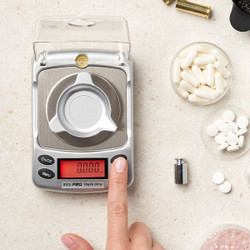
Choosing between a 50g x 0.001g scale and a 200g x 0.01g scale comes down to a clear tradeoff: finer readability versus greater capacity.
A 50g x 0.001g scale displays weight in one-milligram increments but can hold no more than 50 grams. A 200g x 0.01g scale provides four times the capacity, but it displays weight in larger 10-milligram increments.
Neither specification is universally better.
The 50g model is generally the stronger choice for extremely small samples and tasks where fine changes matter. The 200g model is usually more versatile for larger objects, heavier containers and everyday precision weighing.
The correct scale depends on:
-
The lightest change you need to observe
-
The heaviest total load you will place on the platform
-
The weight of your tray or container
-
The physical size of the objects
-
The operating environment
-
Your calibration requirements
-
Whether the device will be used for personal or regulated commercial purposes
This guide explains the practical differences so you can choose confidently.
Quick Comparison
| Feature | 50g x 0.001g scale | 200g x 0.01g scale |
|---|---|---|
| Maximum capacity | 50 grams | 200 grams |
| Displayed increment | 0.001 gram | 0.01 gram |
| Equivalent increment | 1 milligram | 10 milligrams |
| Capacity advantage | — | Four times greater |
| Readability advantage | Ten times finer | — |
| Best for | Very small samples and components | Larger objects and general precision weighing |
| Container flexibility | Limited | Greater |
| Environmental sensitivity | Generally higher | Generally easier for everyday use |
| Typical scale category | Milligram scale | Pocket or compact precision scale |
| Primary limitation | Low maximum capacity | Cannot display single-milligram changes |
The core decision is simple:
-
Choose 50g x 0.001g when observing extremely small changes matters more than weighing heavier loads.
-
Choose 200g x 0.01g when usable capacity and everyday flexibility matter more than milligram-level display resolution.
What Does 50g x 0.001g Mean?
The specification has two parts.
50g capacity
The scale is designed for a maximum total load of 50 grams.
That limit includes:
-
The object
-
The weighing tray
-
A cup or container
-
Any lid or accessory resting on the platform
If the combined load exceeds 50 grams, the scale may display an overload warning. Continued overloading can damage the load cell or permanently affect performance.
0.001g readability
The display changes in increments of 0.001 gram.
Because one gram contains 1,000 milligrams:
0.001 gram = 1 milligram
The display may therefore show readings such as:
-
1.001g
-
1.002g
-
1.003g
-
1.004g
This fine readability makes a 50g milligram scale useful when changes smaller than 0.01 gram need to be visible.
Retailers and buyers can review currently available models in the wholesale milligram scale category.
What Does 200g x 0.01g Mean?
A 200g x 0.01g scale also combines maximum capacity and displayed readability.
200g capacity
The scale can handle a total load of up to 200 grams.
That is four times the capacity of a 50-gram scale:
200g ÷ 50g = 4
The additional capacity creates more flexibility for containers, trays, larger jewelry pieces, hardware, coins, collectibles and other objects.
0.01g readability
The display changes in increments of 0.01 gram.
Because 0.01 gram equals 10 milligrams, the scale may display:
-
1.00g
-
1.01g
-
1.02g
-
1.03g
It will not show separate readings for 1.001g and 1.002g. Both values may be represented by the same displayed hundredth of a gram, depending on the scale’s measurement and rounding behavior.
Buyers can compare multiple capacities and compact designs within the wholesale pocket scale selection.
The Most Important Difference: Readability
The 50g scale has ten times finer readability.
To see why, compare the displayed increments:
0.01g ÷ 0.001g = 10
The 50g model displays one-milligram increments, while the 200g model displays 10-milligram increments.
Practical example
Suppose a sample changes from 2.000 grams to 2.006 grams.
A properly functioning 50g x 0.001g scale can display the six-milligram change as:
-
Initial reading: 2.000g
-
Final reading: 2.006g
A 200g x 0.01g scale cannot display 2.006g because it only shows hundredths of a gram. Depending on its internal measurement and rounding behavior, the final display may read 2.01g.
The 200g model can still be useful, but it cannot communicate the same level of detail.
Readability Is Not the Same as Accuracy
Readability describes the smallest increment shown on the display. Accuracy describes how close a measurement is to the accepted value of the object being measured.
A scale that displays three decimal places is not automatically accurate to exactly 0.001 gram under every condition.
Performance can be affected by:
-
Calibration
-
Repeatability
-
Linearity
-
Temperature
-
Air movement
-
Vibration
-
Electromagnetic interference
-
Static electricity
-
Surface level
-
Corner loading
-
Battery condition
-
Warm-up time
-
Container placement
-
Mechanical wear
NIST distinguishes the displayed scale division from other concepts used to evaluate weighing instruments. Its explanation of scale division and verification scale division helps illustrate why the last displayed digit should not be treated as a universal accuracy guarantee.
When comparing products, look beyond the number of decimal places. Consider repeatability, calibration, operating conditions and the quality of the entire device.
The Second Major Difference: Capacity
The 200g x 0.01g scale provides four times more capacity.
That advantage becomes important when weighing:
-
Larger jewelry pieces
-
Multiple coins
-
Small hardware
-
Larger containers
-
Packaged collectibles
-
Fishing tackle
-
Archery components
-
Groups of small objects
-
Heavier trays
-
Postal items within the scale’s physical limits
Container-weight example
Suppose you want to weigh 40 grams of material in a container weighing 25 grams.
The total load is:
40g + 25g = 65g
A 50g scale cannot safely handle this load.
A 200g scale can handle it with substantial capacity remaining.
The tare function can remove the container’s displayed weight, but it does not remove the physical load from the weighing mechanism. After taring a 25-gram container, the load cell is still supporting those 25 grams.
This is one of the most important factors when choosing a scale.
Usable Capacity After Taring
The practical sample capacity can be expressed as:
Usable sample capacity = Maximum capacity − Container weight
Example with a 50g scale
If the container weighs 18 grams:
50g − 18g = 32g usable capacity
Example with a 200g scale
With the same container:
200g − 18g = 182g usable capacity
The 200g model offers substantially more room for the object or material.
If you regularly use glass bottles, metal pans, large trays or heavy sample containers, weigh the empty container before selecting the scale.
Theoretical Displayed Intervals
Another way to compare the specifications is to divide capacity by readability.
50g x 0.001g
50 ÷ 0.001 = 50,000 displayed intervals
200g x 0.01g
200 ÷ 0.01 = 20,000 displayed intervals
This calculation describes the number of nominal display steps across the capacity range. It does not prove accuracy, repeatability or measurement quality.
The 50g model has finer displayed segmentation, while the 200g model extends the weighing range.
Which Scale Is Better for Jewelry?
The answer depends on the jewelry.
Choose 50g x 0.001g for:
-
Loose gemstones
-
Small precious-metal pieces
-
Lightweight findings
-
Tiny jewelry components
-
Fine comparison work
-
Objects where milligram-level changes matter
Many milligram scales support carats, troy ounces, pennyweights and grains in addition to grams.
The GEMINI-50 precision milligram scale provides 50g x 0.001g specifications and supports grams, ounces, troy ounces, pennyweights, carats and grains. Its listed accessories include a calibration weight, tweezers, weighing pan or funnel and microfiber cloth.
Choose 200g x 0.01g for:
-
Finished jewelry
-
Larger bracelets
-
Chains
-
Watches
-
Multiple items
-
Heavier display trays
-
General inventory checks
The 200g scale sacrifices the third decimal place but provides more room for larger pieces and containers.
Which Scale Is Better for Gemstones?
For loose gemstones, 50g x 0.001g is usually the more useful specification because of its finer readability.
One carat equals 0.2 gram, so small weight differences can matter when comparing stones. However, the actual suitability of a scale depends on more than its gram display.
Check:
-
Carat mode
-
Calibration
-
Repeatability
-
Draft protection
-
Platform size
-
Included tweezers
-
Stable placement
-
Maximum stone and container weight
A 200g x 0.01g model may still be suitable for larger mineral specimens, groups of stones or less detailed sorting.
Which Scale Is Better for Coins?
A 200g x 0.01g scale is often the more practical choice for general coin weighing.
It can accommodate:
-
Multiple coins
-
Coin holders
-
Slabs
-
Small groups
-
Heavier medals
-
Larger tokens
A 50g x 0.001g model can be useful when examining very small weight differences in lightweight coins or components, but its lower capacity may become restrictive.
For coin identification, weight should be considered alongside dimensions, composition and other characteristics. A displayed weight alone does not authenticate a coin.
Which Scale Is Better for Reloading Components?
Different stages can require different tools.
A 50g x 0.001g scale may be attractive for very small components where fine readability is desired. However, a scale should not be used for safety-critical reloading work solely because it displays several decimal places.
Users should:
-
Follow equipment and component manufacturers’ instructions
-
Use the correct measurement units
-
Verify calibration
-
Confirm repeatability
-
Avoid drafts and vibration
-
Use equipment specifically suitable for the procedure
-
Apply appropriate safety practices
A general-purpose consumer scale should not be marketed as approved for a safety-critical activity without supporting evidence.
A 200g model provides greater capacity for assembled items and groups of components but displays larger increments.
Which Scale Is Better for Fragrance Formulation?
A 50g x 0.001g scale can be useful for small fragrance concentrates and low-mass ingredients because it displays single-milligram increments.
A 200g x 0.01g scale can be more practical for:
-
Heavier bottles
-
Larger formula batches
-
Larger mixing containers
-
Alcohol additions
-
General production work
Many formulators use more than one scale:
-
A milligram scale for low-mass ingredients
-
A higher-capacity scale for larger additions and finished batches
Before buying a 50-gram scale, weigh the empty bottle, beaker or tray. A substantial container can consume most of the available capacity.
Which Scale Is Better for Essential Oils?
For small blends, a 50g x 0.001g scale offers finer displayed changes. It may help when measuring small ingredient additions by mass.
For larger containers or batches, a 200g x 0.01g model provides more usable capacity.
Important considerations include:
-
Container weight
-
Spill protection
-
Platform material
-
Cleaning procedure
-
Draft protection
-
Formula size
-
Required repeatability
Do not place oils directly on the weighing mechanism. Use an appropriate container and protect the scale from spills.
Which Scale Is Better for Tea?
A 200g x 0.01g scale is generally more versatile for tea portions because typical serving quantities do not always require 0.001-gram readability.
The higher capacity also accommodates:
-
Bowls
-
Dishes
-
Scoops
-
Multiple servings
-
Larger tea samples
A 50g milligram scale may be useful for very small research samples or precise blending, but it is usually more sensitive than necessary for ordinary tea preparation.
Which Scale Is Better for Coffee?
For weighing roasted beans or brewing doses, a 200g x 0.01g scale is generally more practical than a 50g milligram scale.
The 50g model may be too limited once the cup, tray or dosing container is included.
For full pour-over brewing, even 200 grams may not be enough when the brewer, vessel and water are all placed on the scale. A kitchen or coffee scale with kilogram-level capacity may be more appropriate.
Neither specification should be chosen simply because it has more decimal places. Capacity must fit the entire brewing setup.
Which Scale Is Better for Small Hardware?
The 200g x 0.01g model is usually the more useful general-purpose choice for:
-
Screws
-
Nuts
-
Washers
-
Fasteners
-
Small electronic parts
-
Groups of components
-
Packaged hardware
The 50g x 0.001g model can be useful for extremely lightweight components when small differences are meaningful.
Consider whether the platform is physically large enough. An object may weigh less than 50 grams but still be awkward to center on a small milligram-scale platform.
Platform Size Matters
Capacity describes weight, not physical fit.
Some 50g milligram scales use very compact platforms. The GEMINI-50, for example, lists a platform of approximately 1.3 by 1.3 inches.
The MINIPRO50 compact precision balance provides the same 50g x 0.001g specification with a larger listed platform of approximately 2.7 by 2.7 inches. It also includes a weighing tray, calibration weight, hard case, AAA batteries and an AC adapter.
A 200g model may provide a larger platform. The PC-201, for example, lists a platform of approximately 4.4 by 4.8 inches.
Before choosing, compare:
-
Object dimensions
-
Container base dimensions
-
Platform dimensions
-
Display visibility
-
Centering requirements
-
Whether the container could touch the scale housing
A container that touches the housing or surrounding surface can interfere with the measurement.
Calibration Differences
A scale should be calibrated using the procedure and weight specified by its manufacturer.
Examples among current AWS models include:
-
GEMINI-50: listed with a 20g calibration weight
-
MINIPRO50: can be calibrated with a 20g or 50g weight and includes a 50g weight
-
ZEO-50: listed with an included 50g calibration weight
-
PC-201: lists calibration with a 200g weight that is not included
The ZEO-50 high-precision milligram scale combines 50g x 0.001g specifications with a calibration weight, tray, scoop and tweezers.
The calibration procedure, required weight and included accessories vary by model. Do not assume that one calibration weight works appropriately for every scale.
NIST notes that accurate measurement depends on suitable standards, methods and evaluation of uncertainty. Its resources on mass and weight calibration services provide broader information about measurement traceability and calibration.
For ordinary consumer use, follow the product manual and use the specified calibration weight. Applications requiring formal traceability may need different equipment and procedures.
How Frequently Should You Calibrate?
There is no single schedule appropriate for every user.
Consider checking or calibrating the scale:
-
Before an important weighing session
-
After moving it
-
After a significant temperature change
-
After battery replacement
-
After storage
-
After an overload
-
After a drop or impact
-
When repeat readings appear inconsistent
-
According to the manufacturer’s instructions
Calibration should take place on a stable, level surface away from drafts and vibration.
A successful calibration does not repair a damaged load cell or eliminate environmental effects.
Environmental Sensitivity
The 50g x 0.001g scale generally requires more careful operating conditions because it is displaying smaller changes.
Potential sources of variation include:
Air movement
A fan, air vent, open window or nearby movement can influence lightweight objects and sensitive readings.
Vibration
Speakers, appliances, footsteps and unstable tables can cause the display to drift.
Temperature
Moving a scale from a cold vehicle into a warm room may affect performance. Allow it to reach the appropriate operating environment before use.
Static electricity
Plastic containers and dry conditions can create static effects that interfere with small measurements.
Uneven placement
A tilted or flexible surface can reduce consistency.
Object temperature
A container significantly warmer or cooler than the surrounding air can create air currents around a sensitive measurement.
A 200g x 0.01g scale is not immune to these factors, but its coarser displayed increment may make minor environmental variation less visible.
Power Options
Power configuration affects portability and workstation use.
A small milligram scale may use:
-
Two AAA batteries
-
Four AAA batteries
-
Rechargeable lithium-ion power
-
Batteries plus an AC adapter
The MINIPRO50 supports both AAA batteries and an included AC adapter, making it useful for portable or fixed-workstation operation.
Many 200g pocket scales run on two AAA batteries, supporting compact portable use.
Compare:
-
Battery type
-
Battery availability
-
Included batteries
-
Rechargeable capability
-
Charging connection
-
AC-adapter option
-
Auto-off behavior
-
Low-battery indication
A scale with rechargeable power is not always the best option. Replaceable batteries may be more practical for customers who need immediate field replacement.
Comparing Two AWS Examples
The following table illustrates how actual models can differ beyond capacity and readability.
| Feature | GEMINI-50 | PC-201 |
|---|---|---|
| Capacity | 50g | 200g |
| Readability | 0.001g | 0.01g |
| Listed calibration | 20g weight | 200g weight |
| Calibration weight included | Yes | No |
| Units | g, oz, ozt, dwt, ct, gn | g, oz, ozt, dwt, gn, ct |
| Platform | Approx. 1.3 x 1.3 in | Approx. 4.4 x 4.8 in |
| Overall dimensions | Approx. 3.5 x 4.0 x 0.8 in | Approx. 5.0 x 6.4 x 0.9 in |
| Power | Two AAA batteries | Two AAA batteries |
| Primary advantage | Finer readability | Greater capacity and larger platform |
The PC-201 200g x 0.01g scale provides an example of the higher-capacity specification. Its product information lists six weighing units, a large platform and a 200-gram calibration requirement.
The PC-201 product listing specifically indicates that the price-computing function is not legal for trade. That distinction matters: a scale can perform calculations without being approved to determine prices in regulated commercial transactions.
Accuracy, Repeatability and Resolution
These terms should not be used interchangeably.
Readability or resolution
The smallest change shown on the display.
Repeatability
How closely repeated measurements of the same item agree under the same conditions.
Accuracy
How close the measurement is to an accepted reference value.
Linearity
How consistently the scale performs at different points across its capacity range.
Calibration
The process of adjusting or checking the scale using an appropriate reference weight.
A 50g x 0.001g scale has finer stated readability, but the buyer should still evaluate repeatability and performance for the intended use.
NIST publishes guidance concerning uncertainty in balance and scale calibration. Its technical guide on measurement uncertainty in scale calibration demonstrates that calibration quality involves more than the displayed decimal places.
What Is the Minimum Weight?
Maximum capacity and readability do not automatically identify the minimum reliable sample weight.
A scale may display a value near zero, but that does not mean every extremely small reading meets a specific accuracy requirement.
The minimum usable weight depends on:
-
Required uncertainty
-
Scale performance
-
Environmental conditions
-
Repeatability
-
Application tolerance
-
Manufacturer guidance
For casual comparative work, a user may accept more uncertainty than a laboratory, regulated business or safety-critical process.
Do not advertise readability as the guaranteed minimum accurate weight unless the manufacturer provides appropriate supporting specifications.
Legal-for-Trade Considerations
Neither “50g x 0.001g” nor “200g x 0.01g” proves that a scale is legal for trade.
When weight determines the price charged in a commercial transaction, the device may need:
-
An applicable NTEP Certificate of Conformance
-
Correct device classification
-
State or local approval
-
Inspection
-
Registration
-
Proper installation
-
Required markings
-
Periodic testing
NIST explains that a legal-metrology device is used to determine a quantity on which a charge is based. Its overview of legal-metrology devices provides additional context for commercial weighing.
NIST Handbook 44 contains specifications and tolerances used by many weights-and-measures authorities. Consult the current edition of NIST Handbook 44 and the relevant jurisdiction before using a scale to establish a sale price.
A calibration button or included weight does not make an ordinary consumer scale legal for trade.
When to Choose 50g x 0.001g
Choose the lower-capacity milligram scale when:
-
You need to see changes smaller than 0.01 gram.
-
Your total load remains safely below 50 grams.
-
Your container is very light.
-
The objects fit comfortably on the platform.
-
You can provide a stable environment.
-
You are weighing gemstones or tiny components.
-
You want single-milligram displayed increments.
-
You understand the difference between readability and accuracy.
-
You are prepared to calibrate and handle the scale carefully.
The strongest reason to choose this specification is the finer readability.
When to Choose 200g x 0.01g
Choose the higher-capacity scale when:
-
Your total load may exceed 50 grams.
-
You use a heavier container.
-
You weigh finished jewelry or multiple coins.
-
You need a larger platform.
-
Hundredth-of-a-gram increments are sufficient.
-
You want a more versatile general-purpose scale.
-
You weigh small hardware or groups of components.
-
You do not need to observe single-milligram changes.
-
You want additional capacity for future uses.
The strongest reason to choose this specification is greater practical flexibility.
When You May Need Both
A single scale does not always cover every task efficiently.
A two-scale setup can include:
-
50g x 0.001g for extremely small additions
-
200g x 0.01g for larger containers and finished items
This approach avoids forcing one scale to operate outside its most useful range.
For example, a fragrance maker may use the 50g scale for low-mass aroma materials and the 200g scale for heavier formula components. A jewelry business may use the milligram scale for gemstones and the 200g model for finished pieces.
Buying Checklist
Before choosing, answer these questions:
-
What is the heaviest object?
-
What does the empty container weigh?
-
What is the combined total load?
-
What is the smallest meaningful weight change?
-
Is 0.01g readability sufficient?
-
Do I genuinely need 0.001g readability?
-
Will the object fit on the platform?
-
Which weighing units are required?
-
Is a calibration weight included?
-
What calibration weight is required?
-
Will the scale remain on a desk or travel?
-
Is battery or AC power preferable?
-
Can I control drafts and vibration?
-
Is the intended use personal or commercial?
-
Does the application require legal-for-trade approval?
Common Buying Mistakes
Choosing by decimal places alone
More decimal places do not automatically make a scale better for your application.
Ignoring the container
Tare resets the display but does not restore physical capacity.
Forgetting platform size
An object can be within the weight limit but too large to sit correctly on the platform.
Assuming readability equals accuracy
A 0.001g display is not a promise of perfect accuracy under all conditions.
Buying too little capacity
Operating near the maximum limit leaves little room for containers or future needs.
Buying unnecessary sensitivity
A milligram scale may be more sensitive to environmental disturbances than the task requires.
Using an incorrect calibration weight
Follow the instructions for the specific model.
Assuming every scale is legal for trade
Consumer scales should not be used to establish commercial prices unless the exact device is approved for that application.
Frequently Asked Questions
Is a 50g x 0.001g scale more accurate than a 200g x 0.01g scale?
It has finer readability, but that specification alone does not establish overall accuracy. Accuracy also depends on calibration, repeatability, linearity, construction and operating conditions.
How much more precise is 0.001g than 0.01g?
The displayed increment is ten times finer. A 0.001g scale displays one-milligram increments, while a 0.01g scale displays 10-milligram increments.
How much more capacity does the 200g scale provide?
It provides four times the maximum capacity of a 50g scale.
Can a 50g scale weigh a 20g sample in a 35g container?
No. The total physical load is 55 grams, which exceeds the 50-gram capacity. Taring the container does not change that fact.
Is 0.01g enough for jewelry?
It is often sufficient for finished jewelry and general inventory work. Loose gemstones or extremely small components may benefit from 0.001g readability.
Is 0.001g necessary for coffee?
Usually not for ordinary brewing or roasted-bean portions. A higher-capacity coffee scale is generally more practical.
Which specification is better for coins?
A 200g x 0.01g scale is generally more flexible for individual or grouped coins. A 50g x 0.001g model may help with extremely small comparative differences.
Can I calibrate both scales with the same weight?
Not necessarily. Each model specifies its own calibration procedure and reference weight. Follow the manual.
Does a 200g x 0.01g scale measure from zero to 200 grams?
It displays within that range, but the manufacturer may specify a minimum practical load, accuracy tolerance or other limitations. Maximum capacity and readability do not describe every aspect of performance.
Which one is better for a first-time buyer?
For general-purpose weighing, the 200g x 0.01g model is often more forgiving because it offers more capacity. Choose the 50g x 0.001g model when you have a defined need for milligram readability.
Final Verdict
The choice between a 50g x 0.001g scale and a 200g x 0.01g scale is a choice between finer displayed increments and greater usable capacity.
Choose 50g x 0.001g when:
-
Single-milligram changes matter
-
Samples are genuinely small
-
Containers are lightweight
-
Conditions are stable
-
Fine readability is the priority
Choose 200g x 0.01g when:
-
Loads may exceed 50 grams
-
Containers are heavier
-
A larger platform is useful
-
Hundredth-of-a-gram readings are sufficient
-
Everyday versatility is the priority
The 50g scale displays weight ten times more finely. The 200g scale holds four times more weight.
Before purchasing, weigh the empty container, estimate the heaviest total load and decide what smallest change actually matters. Those three answers will usually reveal which specification is right for your work.