
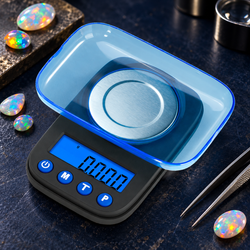
Choosing between a 50g x 0.001g scale and a 200g x 0.01g scale means deciding whether finer displayed measurements or greater capacity matter more.
A 50g x 0.001g scale displays weight in increments of one-thousandth of a gram, equivalent to one milligram. A 200g x 0.01g scale displays weight in increments of one-hundredth of a gram, equivalent to 10 milligrams.
The 200g model can support four times as much weight. The 50g model provides display increments that are ten times finer.
This makes the 50g scale appropriate for small gemstones, miniature electronic parts, watch components, jewelry findings, pigments, and other lightweight objects when differences below 0.01g matter.
The 200g scale is more practical for coins, finished jewelry, small hardware batches, collectibles, containers, multiple components, and general-purpose precision weighing.
Neither specification is automatically better. The best choice depends on your heaviest gross load, smallest meaningful weight difference, container requirements, and operating environment.
50g x 0.001g vs 200g x 0.01g at a Glance
| Specification | 50g x 0.001g scale | 200g x 0.01g scale |
|---|---|---|
| Maximum capacity | 50 grams | 200 grams |
| Readability | 0.001 gram | 0.01 gram |
| Metric equivalent | 1 milligram | 10 milligrams |
| Displayed divisions | 50,000 | 20,000 |
| Relative capacity | 1x | 4x greater |
| Relative readability | 10x finer | 10x coarser |
| Typical category | Milligram scale | Digital pocket scale |
| Best for | Tiny objects and fine comparisons | General-purpose precision weighing |
| Container flexibility | Limited to moderate | Substantially greater |
| Environmental sensitivity | Higher | Lower |
| Common applications | Gemstones, miniature parts, electronics | Coins, jewelry, components, small batches |
The number of displayed divisions is calculated by dividing capacity by readability:
-
50g ÷ 0.001g = 50,000 divisions
-
200g ÷ 0.01g = 20,000 divisions
The 50g scale therefore provides 2.5 times as many displayed divisions, but across a range that is only one-quarter as large.
What Does 50g x 0.001g Mean?
The first number describes the maximum capacity:
50g = maximum rated physical load
The second number describes readability:
0.001g = smallest displayed increment
A typical reading sequence may look like this:
-
6.214g
-
6.215g
-
6.216g
-
6.217g
Each display change represents one milligram.
The GEMINI-50 Precision Milligram Scale is a current AWS example. It combines 50g capacity and 0.001g readability with six weighing units, a 20g calibration weight, tweezers, a weighing pan or funnel, and a microfiber cloth.
The AWS-ULTRA-50G Milligram Scale provides the same capacity and readability while adding a piece-counting function for estimating quantities of uniform components.
Converting 0.001g to Milligrams
One gram contains 1,000 milligrams:
-
1g = 1,000mg
-
0.1g = 100mg
-
0.01g = 10mg
-
0.001g = 1mg
The NIST guide to metric SI prefixes explains how prefixes such as milli- represent decimal relationships.
The third decimal place provides greater displayed detail, but it should not be interpreted as a universal guarantee of perfect one-milligram accuracy.
What Does 200g x 0.01g Mean?
A 200g x 0.01g scale has:
-
A maximum capacity of 200 grams
-
A readability of 0.01 gram
-
Display increments equivalent to 10 milligrams
A typical display sequence may look like:
-
46.21g
-
46.22g
-
46.23g
-
46.24g
The CARDV2-200 Compact Digital Pocket Scale is a current AWS model with this specification. Its listed features include a stainless-steel platform, protective lid that can serve as a tray, tare function, backlit display, four weighing units, and two AAA batteries.
The MB-200 Matchbox Digital Pocket Scale is another 200g x 0.01g option. It has a compact matchbox-style design, a stainless-steel platform, six weighing modes, and a flip-top cover that can serve as an expansion tray.
The 200g specification is designed for users who need hundredth-gram readings but require substantially more capacity than a milligram scale provides.
The Main Tradeoff: Capacity Versus Readability
The comparison can be reduced to two calculations.
Capacity Difference
200g ÷ 50g = 4
The 200g scale supports four times as much total weight.
Readability Difference
0.01g ÷ 0.001g = 10
The 50g scale displays increments ten times finer.
The central buying question is:
Do you need to see differences below 0.01g, or do you need to weigh more than 50g?
If small differences are the priority, choose 50g x 0.001g. If greater capacity is the priority, choose 200g x 0.01g.
What Can You Weigh on a 50g x 0.001g Scale?
A 50g milligram scale is suitable for lightweight objects and small samples, including:
-
Loose gemstones
-
Jewelry findings
-
Watch screws
-
Small electronic components
-
Miniature hardware
-
Seeds
-
Beads and charms
-
Fly-tying materials
-
Small fishing tackle components
-
Model-building parts
-
Individual lightweight coins
-
Precious-metal components
-
Small pigment samples
-
Craft materials
-
Small nonregulated powder samples
-
Groups of very lightweight components
Its main advantage is the ability to display small differences that may disappear when rounded to 0.01g.
For example, if two components weigh approximately 3.124g and 3.129g, their difference is 0.005g. A 0.001g scale can show that difference with more detail.
What Can You Weigh on a 200g x 0.01g Scale?
A 200g pocket scale accommodates a much broader range of everyday objects:
-
Coins and coin holders
-
Finished jewelry
-
Larger gemstones
-
Precious-metal items
-
Fishing tackle
-
Archery components
-
Small hardware batches
-
Electronic modules
-
Compact assemblies
-
Small collectibles
-
Tea leaves
-
Coffee portions
-
Craft materials
-
Multiple components
-
Small packages and contents
-
Objects placed in heavier containers
The larger capacity makes a 200g scale particularly useful when several objects must be weighed together.
For example, eight components weighing approximately 18g each have a combined weight of about 144g. That load fits on a 200g scale but greatly exceeds a 50g scale’s capacity.
Why Container Weight Matters
A common buying mistake is selecting capacity based only on the sample.
Suppose you need to weigh 38g of material in a container weighing 19g:
38g + 19g = 57g gross load
The material alone fits within a 50g capacity. The complete load does not.
A 200g scale can accommodate the combination with 143g of nominal capacity remaining.
Tare Does Not Restore Capacity
Pressing tare resets the display to zero after placing a container on the platform. It does not remove the container’s physical weight from the scale.
If the container weighs 30g and the contents weigh 35g:
-
Display after taring: 35g
-
Physical load on the sensor: 65g
The 65g gross load exceeds the capacity of a 50g scale.
Use this formula before selecting a scale:
Required capacity = container weight + maximum sample weight + safety margin
If the complete load could exceed 50g, the 200g model is the safer and more practical option.
Should You Leave Extra Capacity?
Yes. Avoid choosing a scale that barely accommodates the expected load.
Suppose your heaviest gross load is 49g. It technically falls below a 50g maximum, but it leaves almost no room for:
-
Variation among samples
-
A heavier container
-
Additional components
-
Accidental downward pressure
-
Future weighing needs
If 0.001g readability is essential, consider a higher-capacity milligram scale. If it is not essential, the 200g x 0.01g specification provides much more working room.
Is 0.001g More Accurate Than 0.01g?
Not necessarily.
A 0.001g scale has finer readability, meaning its display changes in smaller increments. Accuracy describes closeness to an accepted reference value.
The NIST explanation of scale division “d” and verification scale division “e” illustrates why displayed resolution should not be treated as a complete statement of verified accuracy.
Scale performance depends on factors such as:
-
Calibration
-
Repeatability
-
Linearity
-
Temperature
-
Air movement
-
Vibration
-
Static electricity
-
Battery condition
-
Platform alignment
-
Sample placement
-
Mechanical condition
-
Measurement procedure
A 50g x 0.001g scale used beside a fan on a flexible table may produce less useful results than a properly calibrated 200g x 0.01g scale on a stable surface.
Readability, Accuracy, Repeatability, and Linearity
Readability
Readability is the smallest displayed increment.
-
50g scale: 0.001g
-
200g scale: 0.01g
Accuracy
Accuracy describes closeness to a reference value under defined conditions.
Repeatability
Repeatability describes agreement among repeated measurements of the same object under the same conditions.
For example:
-
8.416g
-
8.416g
-
8.417g
-
8.416g
These readings show closer agreement than a series that varies across several hundredths of a gram.
Linearity
Linearity concerns performance across the weighing range. A scale may behave differently near the bottom, middle, and top of its capacity.
Stability
Stability refers to whether the reading settles. A moving last digit may indicate drafts, vibration, static, temperature change, weak batteries, or sample movement.
Minimum Practical Load
A 0.001g display does not prove that every one-milligram object can be measured reliably.
The practical minimum depends on repeatability, calibration, instrument performance, environmental conditions, and the uncertainty allowed by the application.
The NIST Weighing and Scales FAQs provide additional background on weighing devices and commercial requirements.
Which Scale Is More Sensitive to the Environment?
The 50g x 0.001g scale is generally more sensitive because it displays changes ten times smaller.
Air Movement
Fans, HVAC vents, open windows, and even breathing near the platform can affect a milligram-scale reading.
Keep the scale away from direct airflow and use a protective cover or draft shield when available.
Vibration
Possible vibration sources include:
-
Foot traffic
-
Appliances
-
Workshop equipment
-
Speakers
-
Flexible furniture
-
Typing on the same table
-
Nearby road traffic
Both scales should be placed on a rigid surface, but small disturbances are more likely to appear on the 0.001g display.
Static Electricity
Plastic containers, dry powders, clothing, and low humidity can produce static charges. At milligram readability, static may cause drifting or unstable readings.
Temperature
Rapid temperature changes can affect performance. Allow the scale, sample, container, and calibration weight to reach room conditions before use.
Uneven Placement
The scale must rest flat without rocking. The object should sit near the center of the platform, and its container should not touch the housing or work surface.
Calibration Requirements Compared
A 50g x 0.001g scale and a 200g x 0.01g scale commonly require different calibration masses.
Examples from current AWS product specifications include:
-
GEMINI-50: 20g calibration weight included
-
CARDV2-200: consult its model instructions for calibration requirements
-
MB-200: 100g calibration weight required but not included
AWS offers individual and bundled calibration weights for compatible scale models.
Before calibration:
-
Position the scale on a stable, level surface.
-
Remove everything from the platform.
-
Allow the scale to acclimate.
-
Eliminate drafts and vibration.
-
Check the batteries.
-
Select the correct unit.
-
Use the manufacturer-specified calibration weight.
-
Keep the weight centered.
-
Follow the exact procedure.
-
Wait for confirmation before removing the weight.
AWS maintains a collection of scale manuals with model-specific instructions.
Calibration Weight Care
Handle calibration weights as measuring references rather than ordinary metal objects.
Good practices include:
-
Store weights in protective cases.
-
Keep them clean and dry.
-
Avoid dropping or scratching them.
-
Do not sand, polish, or modify them.
-
Use tweezers or gloves when appropriate.
-
Allow them to acclimate before calibration.
-
Replace damaged or corroded weights.
-
Keep them away from debris and chemicals.
The OIML R 111-1 recommendation describes metrological and technical requirements for reference weights.
Which Scale Is Better for Gemstones?
The 50g x 0.001g scale is usually more appropriate for individual lightweight gemstones when small weight differences matter.
It provides:
-
One-milligram increments
-
Finer comparison among similar stones
-
More detail when sorting lightweight items
-
Carat conversion when supported by the model
The 200g x 0.01g scale is better for:
-
Larger stones
-
Multiple gemstones
-
Heavier gem trays
-
Finished jewelry
-
Broader collections
-
General-purpose weighing
The best choice depends on the total weight and whether the third decimal place affects your decision.
Which Scale Is Better for Jewelry?
Choose the 50g scale for:
-
Small findings
-
Clasps
-
Lightweight chains
-
Individual stones
-
Tiny precious-metal components
-
Comparing similar parts
Choose the 200g scale for:
-
Finished jewelry
-
Larger bracelets and necklaces
-
Multiple pieces
-
Heavier containers
-
Small jewelry batches
Weight alone cannot verify metal purity, gemstone identity, authenticity, or value.
Which Scale Is Better for Coins?
The 200g x 0.01g scale is generally more versatile for coins because it can handle:
-
Individual coins
-
Coin capsules
-
Holders
-
Multiple coins
-
Small sets
-
Heavier collectibles
A 50g x 0.001g scale provides finer readings for lightweight individual coins, but the additional decimal place may be unnecessary for routine collection management.
Coin weight should be used alongside dimensions, composition, visual examination, and professional authentication when needed.
Which Scale Is Better for Electronics?
Choose the 50g x 0.001g scale for:
-
Surface-mount components
-
Lightweight integrated circuits
-
Tiny connectors
-
Small screws
-
Individual component comparison
-
Uniform parts requiring piece-count estimates
Choose the 200g x 0.01g scale for:
-
Relays
-
Sensors
-
Larger connectors
-
Heat sinks
-
Small motors
-
Component groups
-
Compact printed circuit board assemblies
A mixed electronics workspace may benefit from both scales.
Which Scale Is Better for Small Hardware?
The 50g scale is useful for weighing individual miniature screws, washers, bearings, and similar parts.
The 200g scale is more practical for:
-
Groups of fasteners
-
Larger components
-
Inventory batches
-
Heavier containers
-
Finished assemblies
-
Mixed hardware collections
If you estimate quantity by total weight, consider natural variation between individual pieces.
Which Scale Is Better for Tea and Coffee?
A 200g x 0.01g scale is generally more practical for tea leaves, coffee beans, and small portions because:
-
Containers may be relatively heavy.
-
Portions can exceed 50g.
-
One-hundredth-gram readability is already finer than many recipes require.
-
The larger capacity supports broader everyday use.
A 50g x 0.001g scale may be unnecessarily sensitive for routine beverage preparation unless the user has a specialized measurement need.
Neither specification replaces an appropriate high-capacity brewing scale when water, cups, brewers, or larger containers must also be weighed.
Which Scale Is Easier to Use?
The 200g x 0.01g scale is generally more forgiving.
Its advantages include:
-
Four times the capacity
-
More room for containers
-
Less visible response to tiny environmental changes
-
Greater suitability for general-purpose work
The 50g x 0.001g scale requires more careful control of:
-
Drafts
-
Vibration
-
Static
-
Temperature
-
Platform movement
-
Stabilization time
The extra care is worthwhile when one-milligram display increments provide information the user actually needs.
When the 50g x 0.001g Scale Is the Better Choice
Choose 50g x 0.001g when:
-
Every gross load remains comfortably below 50g.
-
Differences smaller than 0.01g matter.
-
You need one-milligram display increments.
-
Objects are lightweight.
-
You can provide a stable environment.
-
You are willing to calibrate carefully.
-
You normally weigh one small item at a time.
-
Fine comparison matters more than general versatility.
When the 200g x 0.01g Scale Is the Better Choice
Choose 200g x 0.01g when:
-
Objects or containers may exceed 50g.
-
Hundredth-gram readings provide enough detail.
-
You weigh multiple items together.
-
You need capacity for trays and containers.
-
You want a general-purpose precision scale.
-
Your working environment is not highly controlled.
-
Ease of use and flexibility matter most.
When You May Need Both Scales
Some workflows genuinely require two measuring ranges:
-
A fine scale for lightweight objects requiring 0.001g readability
-
A higher-capacity scale for containers, grouped objects, and loads approaching 200g
Using two purpose-matched scales may be more effective than repeatedly pushing one scale toward its limitations.
The 50g scale handles detailed comparisons. The 200g scale handles general weighing and heavier loads.
This arrangement can also protect the more sensitive milligram scale from accidental overloading.
Practical Selection Process
Step 1: Identify Your Heaviest Object
Use the heaviest expected object rather than the average.
Step 2: Include the Container
Add the tray, cup, paper, capsule, holder, or other accessory.
Step 3: Calculate Gross Load
Gross load = container + sample
Step 4: Add a Safety Margin
Leave working room rather than selecting a scale whose capacity barely covers the expected load.
Step 5: Identify the Smallest Important Difference
Ask what weight change would alter your decision.
If 0.005g matters, a 0.01g display is too coarse to show that change directly.
If differences below 0.01g do not matter, the 200g scale is likely more useful.
Step 6: Evaluate Your Environment
Choose milligram readability only if you can provide a stable, draft-protected surface.
Step 7: Check Calibration Requirements
Confirm the required weight and whether it is included.
Step 8: Confirm Application Suitability
Regulated, commercial, medical, pharmaceutical, scientific, or safety-critical work may require equipment with specific approvals and documented performance.
Common Buying Mistakes
Choosing More Decimal Places Automatically
Extra digits are valuable only if they support the application.
Forgetting Container Weight
The container consumes capacity even after tare.
Assuming Tare Creates More Capacity
Tare changes the display, not the physical load.
Operating Near Maximum Capacity
A scale with no working margin is easier to overload.
Confusing Readability With Accuracy
A 0.001g display does not guarantee perfect ±0.001g accuracy.
Using an Incorrect Calibration Weight
Calibration requirements vary by model.
Ignoring Environmental Conditions
Drafts, vibration, static, and temperature can affect readings.
Treating a Consumer Scale as Certified Equipment
Capacity and readability alone do not establish legal-for-trade, laboratory, medical, or pharmaceutical suitability.
Regulated and Commercial Applications
Commercial transactions based on weight may require:
-
An approved legal-for-trade device
-
Inspection
-
Sealing
-
Defined verification procedures
-
Compliance with local regulations
Laboratory or safety-critical applications may require:
-
Documented uncertainty
-
Traceable calibration
-
Environmental monitoring
-
Validated methods
-
Formal quality-control records
-
A specific balance class
NIST Handbook 44 addresses requirements for commercial weighing and measuring devices.
NIST also discusses equipment selection in its guidance concerning Class II scale applications.
A consumer milligram or pocket scale should not be used as a substitute for application-approved equipment.
Frequently Asked Questions
Is 0.001g equal to one milligram?
Yes. One gram contains 1,000 milligrams, so 0.001g equals 1mg. The NIST reference on SI units of mass provides additional information about metric mass units.
How much more capacity does a 200g scale provide?
A 200g scale provides four times the capacity of a 50g scale.
How much finer is 0.001g than 0.01g?
A 0.001g display increment is ten times finer.
Which scale has more displayed divisions?
The 50g x 0.001g scale has 50,000 displayed divisions. The 200g x 0.01g scale has 20,000.
Can a 50g scale weigh a 40g sample in a 15g container?
No. The gross load is 55g, which exceeds the 50g capacity.
Can I tare a container and then add 50g?
Only if the container weighs nothing, which practical containers do not. The combined physical load must remain within 50g.
Is a 50g x 0.001g scale always more accurate?
No. It has finer readability, but accuracy depends on calibration, instrument performance, environment, and technique.
Can a 200g x 0.01g scale show a five-milligram difference?
It cannot display 0.005g directly because its display changes in 0.01g increments.
Which scale is more versatile?
For general-purpose weighing, 200g x 0.01g is more versatile. For measurements requiring one-milligram increments, 50g x 0.001g is more suitable.
Which scale is better for travel?
Both are available in portable designs. Compare the model’s dimensions, cover, battery type, platform protection, and accessory case.
Can either scale be used for commercial sales?
Do not assume so. Commercial transactions may require a legal-for-trade scale approved for the jurisdiction.
Can either scale be used for medication?
Do not rely on a general consumer scale for medical or pharmaceutical dosing unless it is specifically approved for the application and used under qualified professional guidance.
Final Verdict: 50g x 0.001g or 200g x 0.01g?
Choose a 50g x 0.001g scale when fine displayed detail matters most. It is appropriate for lightweight objects, individual components, and comparisons in which differences below 0.01g influence the result.
Choose a 200g x 0.01g scale when capacity and flexibility matter most. It can support four times as much total weight, accommodate heavier containers, and handle a much broader range of everyday objects.
The decision can be summarized in one question:
Do you need individual milligram increments, or do you need to weigh loads between 50 and 200 grams?
If you need individual milligram display increments and your gross load stays below 50g, choose the 50g x 0.001g scale.
If your loads may exceed 50g and hundredth-gram readability is sufficient, choose the 200g x 0.01g scale.
If your workflow regularly includes both tiny components and heavier objects, using one scale for milligram-level work and another for higher-capacity weighing may provide the most practical solution.