
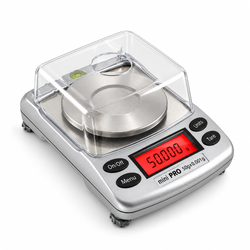
A 50g x 0.001g scale and a 500g x 0.01g scale are designed for different priorities.
The 50-gram model displays weight in extremely fine one-milligram increments. The 500-gram model provides ten times as much capacity but displays weight in larger 10-milligram increments.
The comparison can be summarized in one sentence:
A 50g x 0.001g scale offers ten times finer readability, while a 500g x 0.01g scale offers ten times greater capacity.
That does not make either scale universally better.
Choose the 50g model when the objects and containers are very light and observing tiny changes is essential. Choose the 500g model when you need more room for containers, larger objects, multiple components or more general-purpose weighing.
This guide compares the two specifications by:
-
Maximum capacity
-
Displayed readability
-
Usable capacity
-
Platform size
-
Container weight
-
Calibration
-
Operating environment
-
Common applications
-
Portability
-
Legal-for-trade considerations
Quick Comparison
| Feature | 50g x 0.001g scale | 500g x 0.01g scale |
|---|---|---|
| Maximum capacity | 50 grams | 500 grams |
| Displayed increment | 0.001 gram | 0.01 gram |
| Equivalent increment | 1 milligram | 10 milligrams |
| Capacity advantage | — | 10 times greater |
| Readability advantage | 10 times finer | — |
| Typical scale type | Milligram scale | Pocket or compact precision scale |
| Container flexibility | Limited | Substantially greater |
| Typical platform | Small | Small to medium |
| Environmental sensitivity | Generally higher | Generally easier for routine use |
| Best for | Tiny samples and lightweight components | Larger objects and broader everyday use |
| Main limitation | Low maximum capacity | Cannot display single-milligram changes |
Understanding the Specification Format
Digital-scale specifications commonly follow this format:
Maximum capacity x readability
The first number tells you the heaviest total load the scale is designed to support. The second tells you the smallest increment shown on the display.
50g x 0.001g
-
Maximum capacity: 50 grams
-
Displayed increment: 0.001 gram
-
Equivalent displayed increment: 1 milligram
500g x 0.01g
-
Maximum capacity: 500 grams
-
Displayed increment: 0.01 gram
-
Equivalent displayed increment: 10 milligrams
According to NIST’s table of SI units for mass, one gram equals 1,000 milligrams. Therefore, 0.001 gram is one milligram and 0.01 gram is 10 milligrams.
What Does 50g x 0.001g Mean?
A 50g x 0.001g scale is commonly classified as a milligram scale because it displays measurements in increments of one milligram.
The display may show readings such as:
-
1.001g
-
1.002g
-
1.003g
-
1.004g
This specification is useful when changes smaller than 0.01 gram need to be visible.
Potential uses include:
-
Loose gemstones
-
Small jewelry components
-
Fine hardware
-
Fragrance ingredients
-
Essential-oil formulations
-
Lightweight laboratory samples
-
Precision hobby components
-
Small collectibles
-
Model-making materials
-
Other low-mass samples
The main limitation is the 50-gram maximum. The sample, weighing tray and container must all fit within that capacity.
Buyers can compare current options in the wholesale milligram scale category.
What Does 500g x 0.01g Mean?
A 500g x 0.01g scale can handle up to half a kilogram while displaying weight in hundredths of a gram.
The display may show:
-
1.00g
-
1.01g
-
1.02g
-
1.03g
It cannot separately display every one-milligram change, but it provides substantially more weighing capacity.
Potential uses include:
-
Finished jewelry
-
Coins and coin holders
-
Small hardware
-
Watch components
-
Collectibles
-
Craft materials
-
Fishing tackle
-
Archery components
-
Tea portions
-
Coffee samples
-
Small parcels
-
Groups of lightweight objects
The larger capacity also provides more flexibility when a bowl, bottle, tray or other container must be placed on the platform.
The wholesale pocket scale collection includes several models designed for portable general-purpose weighing.
Capacity: The 500g Scale Holds Ten Times More
The capacity difference is straightforward:
500g ÷ 50g = 10
A 500-gram scale can support ten times the maximum load of a 50-gram scale.
That difference becomes important when weighing objects such as:
-
Larger jewelry pieces
-
Multiple coins
-
Heavier bottles
-
Glass containers
-
Groups of fasteners
-
Larger mineral samples
-
Packaged collectibles
-
Several components together
Example
Suppose an item weighs 120 grams.
A 50g scale cannot weigh it because the item exceeds the maximum capacity by 70 grams.
A 500g scale can accommodate the item with 380 grams of capacity remaining.
Why overload protection matters
Placing excessive weight on a digital scale can damage the load cell, affect calibration or create permanently unstable readings.
Even when a scale displays an overload warning, the user should remove the item immediately. The warning is not permission to continue weighing above capacity.
Readability: The 50g Scale Displays Ten Times More Finely
The readability comparison is equally direct:
0.01g ÷ 0.001g = 10
A 50g x 0.001g scale displays changes that are ten times smaller than those shown by a 500g x 0.01g scale.
Example
Suppose a sample changes from 3.000 grams to 3.007 grams.
A 50g x 0.001g scale can display:
-
Initial weight: 3.000g
-
Final weight: 3.007g
-
Displayed change: 0.007g
A 500g x 0.01g scale cannot show 3.007g exactly because it displays hundredths rather than thousandths. Depending on the device’s internal measurement and rounding behavior, it may show 3.01g.
The 500g scale still communicates that the sample weighs about three grams, but it does not provide the same displayed detail.
Precision, Readability and Accuracy Are Not Identical
Consumers often describe the 50g model as “more accurate” because it shows an extra decimal place. The more precise wording is that it has finer readability.
Readability
The smallest increment shown on the display.
Accuracy
How close a result is to an accepted reference value.
Repeatability
How closely repeated measurements of the same item agree under unchanged conditions.
Linearity
How consistently the scale performs at different points within its weighing range.
Calibration
The process of comparing or adjusting the scale using a specified reference weight.
NIST describes the scale division as the incremental size between consecutive indications on a digital display. Its explanation of scale division versus verification scale division demonstrates why displayed resolution and verified device performance should not be treated as identical concepts.
A scale can display 0.001 gram without guaranteeing that every reading is accurate to exactly one milligram in every environment.
The Weight of the Container Changes the Decision
The most common capacity mistake is considering only the material being weighed.
The scale supports the total load:
Total load = Container weight + Sample weight
The tare function resets the displayed reading to zero after the container is placed on the platform. It does not remove the container’s physical weight from the load cell.
Example with a 50g scale
Suppose the container weighs 22 grams and the sample weighs 35 grams.
22g + 35g = 57g
The total exceeds the scale’s capacity even though the sample alone weighs only 35 grams.
Example with a 500g scale
The same 57-gram combination uses only 11.4% of the scale’s maximum capacity.
Usable sample capacity
A helpful calculation is:
Usable sample capacity = Maximum scale capacity − Container weight
With a 22-gram container:
-
50g scale: 50g − 22g = 28g available for the sample
-
500g scale: 500g − 22g = 478g available for the sample
If you use glass bottles, metal trays or other heavy containers, the 500g scale may be much more practical.
Theoretical Display Intervals
Dividing capacity by readability provides the nominal number of display increments across the range.
50g x 0.001g
50 ÷ 0.001 = 50,000 displayed intervals
500g x 0.01g
500 ÷ 0.01 = 50,000 displayed intervals
Both specifications therefore have the same theoretical ratio of capacity to displayed increment.
This does not mean the scales perform identically. It means each provides 50,000 nominal display steps across its specified capacity:
-
The 50g scale covers a smaller range in finer steps.
-
The 500g scale covers a larger range in coarser steps.
This is a useful illustration of why scale selection is a tradeoff rather than a simple ranking.
Comparing Current AWS Models
American Weigh Wholesale offers several products within both specification groups.
ZEO-50: 50g x 0.001g
The ZEO-50 high-precision milligram scale provides:
-
50g capacity
-
0.001g readability
-
Six weighing units
-
Included 50g calibration weight
-
Weighing tray
-
Scoop
-
Tweezers
-
Approximately 2.6-by-2.6-inch platform
-
Four-AAA-battery operation
Its accessory set makes it suited to customers who want a complete milligram-weighing kit.
MINIPRO50: 50g x 0.001g
The MINIPRO50 compact precision balance also offers 50g x 0.001g specifications.
Its listed features include:
-
Approximately 2.7-by-2.7-inch platform
-
Included 50g calibration weight
-
Weighing tray
-
Hard plastic cover
-
Four AAA batteries
-
Included AC adapter
-
Six weighing units
The AC adapter makes it a useful option for a fixed workstation, while battery operation maintains portability.
SM-501: 500g x 0.01g
The SM-501 500g pocket scale provides:
-
500g capacity
-
0.01g readability
-
Six weighing units
-
Approximately 2.86-by-2.6-inch platform
-
Two included AAA batteries
-
Calibration using a 500g weight, which is not included
-
Compact pocket-scale construction
This model provides ten times the capacity of the milligram models while maintaining a compact footprint.
CDV2-500: 500g x 0.01g
The CDV2-500 compact digital scale also provides 500g x 0.01g specifications.
Its published details include:
-
Approximately 4-by-4-inch platform
-
Gram, ounce, carat and grain modes
-
Two included CR2032 batteries
-
Calibration using a 500g weight, which is not included
-
Slim compact design
The larger platform can be useful for containers or objects that would be awkward on a smaller pocket scale.
Model Comparison Table
| Feature | ZEO-50 | MINIPRO50 | SM-501 | CDV2-500 |
|---|---|---|---|---|
| Capacity | 50g | 50g | 500g | 500g |
| Readability | 0.001g | 0.001g | 0.01g | 0.01g |
| Calibration weight | 50g included | 50g included | 500g not included | 500g not included |
| Platform | Approx. 2.6 x 2.6 in | Approx. 2.7 x 2.7 in | Approx. 2.86 x 2.6 in | Approx. 4 x 4 in |
| Power | Four AAA batteries | Four AAA or AC adapter | Two AAA batteries | Two CR2032 batteries |
| Accessories | Tray, scoop, tweezers | Tray and hard cover | Compact cover design | Compact protective design |
| Best advantage | Complete milligram kit | Desktop power flexibility | Portable higher capacity | Larger platform |
Specifications and availability should be verified on the individual product pages when purchasing.
Which Scale Is Better for Jewelry?
The right specification depends on what type of jewelry is being weighed.
Choose 50g x 0.001g for:
-
Loose gemstones
-
Lightweight precious-metal pieces
-
Small findings
-
Tiny clasps
-
Fine chain segments
-
Individual jewelry components
-
Detailed comparative work
Choose 500g x 0.01g for:
-
Finished necklaces
-
Watches
-
Bracelets
-
Multiple rings
-
Larger pendants
-
Jewelry trays
-
Groups of inventory items
A finished watch may exceed the capacity of a 50g scale. A loose gemstone may benefit from finer readability than the 500g model provides.
Many businesses can justify having both specifications available.
Which Scale Is Better for Gemstones?
A 50g x 0.001g scale is generally the better choice for loose gemstones because the finer readability helps distinguish smaller changes.
Useful features include:
-
Carat mode
-
Tweezers
-
Weighing pan
-
Draft shield or cover
-
Included calibration weight
-
Stable platform
A 500g x 0.01g scale may be more appropriate for:
-
Larger mineral specimens
-
Groups of stones
-
Heavy storage containers
-
Packaged collections
-
General sorting
Weight alone does not authenticate or grade a gemstone. It should be used with other appropriate examination methods.
Which Scale Is Better for Coins?
A 500g x 0.01g scale is usually more versatile for coin collecting.
It can accommodate:
-
Multiple coins
-
Coin slabs
-
Protective holders
-
Medals
-
Tokens
-
Small groups
-
Heavier collectibles
A 50g x 0.001g scale can show finer differences for lightweight objects, but the capacity can become restrictive when holders or multiple coins are involved.
Coin identification should also consider dimensions, composition, design and provenance. Weight alone does not prove authenticity.
Which Scale Is Better for Perfume Ingredients?
A 50g x 0.001g scale is generally preferable for very small fragrance ingredients because it displays single-milligram increments.
It may suit:
-
Small concentrates
-
Low-mass aroma ingredients
-
Experimental formulas
-
Tiny test batches
-
Fine ingredient adjustments
A 500g x 0.01g scale is generally better for:
-
Heavier bottles
-
Larger formulas
-
Carrier additions
-
Finished batches
-
Larger mixing containers
Many fragrance workspaces use a two-scale system: a milligram scale for low-mass materials and a larger scale for higher-mass ingredients.
Protect either scale from spills. Liquids should remain inside an appropriate container and should not contact the weighing mechanism.
Which Scale Is Better for Essential Oils?
The answer depends on batch size.
For very small blends, the 50g x 0.001g scale offers finer control over displayed ingredient changes.
For larger blends or heavier bottles, the 500g x 0.01g scale provides more usable capacity.
Before choosing, calculate:
Empty container + all ingredients = Maximum expected total load
If the final bottle and formula may weigh 120 grams, the 50g scale cannot complete the batch even if each individual ingredient is light.
Which Scale Is Better for Tea Leaves?
A 500g x 0.01g scale is usually more practical for tea.
It offers enough capacity for:
-
Bowls
-
Scoops
-
Multiple servings
-
Larger samples
-
Storage containers
-
Blending work
A 50g x 0.001g model can be useful for extremely small research samples or fine blending experiments, but most routine tea portions do not require milligram readability.
Which Scale Is Better for Coffee?
A 500g x 0.01g scale is more suitable for coffee beans, ground coffee and small sample roasting tasks.
Its additional capacity provides room for:
-
Dosing cups
-
Bean trays
-
Multiple portions
-
Sample-roast batches
-
Small containers
However, 500 grams may still be insufficient for some full brewing setups once the brewer, server and water are included. A higher-capacity kitchen or coffee scale may be necessary for complete pour-over brewing.
A 50g milligram scale is usually more sensitive than needed for everyday coffee preparation.
Which Scale Is Better for Small Hardware?
The 500g x 0.01g model is the more versatile option for:
-
Screws
-
Nuts
-
Bolts
-
Washers
-
Electronic components
-
Watch parts
-
Fasteners
-
Groups of small items
Choose 50g x 0.001g only when the individual components are extremely light and very small differences matter.
When weighing hardware, place objects gently. Dropping dense metal pieces onto the platform can cause impact loading even when the final static weight is within capacity.
Which Scale Is Better for Fishing Tackle?
A 500g x 0.01g scale is generally better for:
-
Sinkers
-
Hooks
-
Lures
-
Swivels
-
Packaged tackle
-
Groups of components
A 50g x 0.001g scale may be useful for very lightweight fly-tying materials or tiny components.
The larger capacity is usually more valuable for a broad fishing-tackle assortment.
Which Scale Is Better for Archery Components?
A 500g x 0.01g model is better suited to larger components and assemblies, while a 50g x 0.001g model may be useful for extremely small component comparisons.
Check the units required. Archery components may be described in grains, so a scale supporting grain mode can simplify use.
Do not assume that a finer gram display is automatically sufficient for a safety-sensitive equipment decision. Follow component and equipment manufacturers’ requirements.
Which Scale Is Better for Laboratory Samples?
The term “laboratory scale” covers a broad range of equipment.
A consumer 50g x 0.001g scale may be useful for educational demonstrations, preliminary work or nonregulated sample measurements. It should not automatically be treated as an analytical balance suitable for validated laboratory procedures.
A 500g x 0.01g scale may be more practical when:
-
Containers are heavy
-
Samples exceed 50 grams
-
Hundredth-of-a-gram readability is sufficient
-
The work is general rather than highly analytical
Laboratories should establish the required uncertainty, calibration traceability, documentation and quality-control procedures before selecting equipment.
NIST explains in its publication Accuracy Matters that measurement results and associated uncertainties must be communicated appropriately.
Platform Size Can Be as Important as Capacity
An object may be below the maximum capacity but still be too large for the platform.
If an oversized container:
-
Touches the surrounding housing
-
Rests on the table
-
Covers the display
-
Prevents centered loading
-
Becomes unstable
the reading may be unreliable or difficult to use.
The current examples illustrate this difference:
-
GEMINI-50 platform: approximately 1.3 x 1.3 inches
-
ZEO-50 platform: approximately 2.6 x 2.6 inches
-
MINIPRO50 platform: approximately 2.7 x 2.7 inches
-
SM-501 platform: approximately 2.86 x 2.6 inches
-
CDV2-500 platform: approximately 4 x 4 inches
Choose based on the actual dimensions of the object and container—not capacity alone.
Calibration Requirements
Calibration needs vary by model.
The ZEO-50 and MINIPRO50 include calibration weights. The SM-501 and CDV2-500 specify a 500-gram calibration weight that is not included.
This difference affects total purchase cost and setup convenience.
Before buying, confirm:
-
Required calibration weight
-
Whether it is included
-
Calibration procedure
-
Recommended calibration frequency
-
Required weight class or tolerance for the application
-
Whether formal traceability is needed
Do not use a random object as a substitute for a calibration weight.
Environmental Effects
A 0.001g scale generally requires more careful handling because it displays smaller changes.
Drafts
Fans, air-conditioning vents and open windows can affect lightweight samples.
Vibration
Speakers, machinery, footsteps and flexible tables can cause fluctuating readings.
Temperature
Allow the scale, sample and calibration weight to acclimate to the operating environment.
Static electricity
Plastic containers and dry conditions can produce static effects that matter at very small measurement levels.
Surface stability
Use a rigid, level work surface.
Air currents from warm objects
A warm or cold container can create small air movements around a sensitive measurement.
The 500g x 0.01g scale is still affected by environmental conditions, but minor disturbances may be less visible because its display changes in larger increments.
Portability and Power
Both specifications are available in portable formats, but power options differ by model.
Battery-powered designs
Advantages include:
-
Portability
-
No nearby outlet required
-
Compact storage
-
Field use
AC-powered or dual-power designs
Advantages include:
-
Continuous workstation operation
-
Reduced dependence on disposable batteries
-
Convenient fixed placement
The MINIPRO50 supports batteries and AC power, while the SC501A 500g model is designed for AC-adapter operation.
Choose the power system that matches the actual workflow.
Legal-for-Trade Considerations
Capacity and readability do not determine whether a scale is approved for commercial transactions.
A scale used to determine a price may be subject to:
-
Type evaluation
-
NTEP requirements
-
Accuracy-class requirements
-
State or local inspection
-
Registration
-
Sealing
-
Installation standards
-
Marking requirements
-
Periodic testing
NIST describes legal metrology as the system of laws and regulations governing measuring instruments subject to legal control. Its explanation of legal metrology includes devices used in trade and commerce.
NIST also provides weighing and scales FAQs explaining that commercial scales must comply with the laws of the state where they are used.
Technical requirements used by many jurisdictions are published in the current NIST Handbook 44.
Do not advertise either scale as legal for trade unless the exact model and configuration have been verified for that purpose.
When to Choose 50g x 0.001g
Choose the 50g milligram scale when:
-
You need to observe changes smaller than 0.01 gram.
-
The total load will remain below 50 grams.
-
The container is lightweight.
-
The object fits on the platform.
-
You can control drafts and vibration.
-
You are weighing gemstones or tiny components.
-
Fine formulation adjustments are required.
-
An included calibration weight is valuable.
-
You understand the limitations of milligram readability.
Its greatest advantage is the ability to display single-milligram increments.
When to Choose 500g x 0.01g
Choose the 500g precision scale when:
-
Your load may exceed 50 grams.
-
You use bottles, trays or bowls.
-
You weigh multiple objects together.
-
You need a larger platform.
-
Hundredth-of-a-gram readability is sufficient.
-
You want one scale for several everyday tasks.
-
You weigh finished jewelry, coins or hardware.
-
You need more room for future applications.
-
You prefer less restrictive capacity.
Its greatest advantage is practical versatility.
When You Should Own Both
The specifications complement each other well.
A two-scale setup can use:
-
50g x 0.001g for very small samples and precise ingredient additions
-
500g x 0.01g for larger objects, containers and completed batches
This approach is useful for:
-
Fragrance formulators
-
Jewelers
-
Gemstone dealers
-
Collectors
-
Model makers
-
Precision hobbyists
-
Small laboratories
-
Component retailers
Using the appropriate scale for each step can be more effective than forcing one instrument to cover every task.
Buying Checklist
Before ordering, answer the following:
-
What is the heaviest expected sample?
-
What does the empty container weigh?
-
What is the final combined load?
-
What is the smallest change I need to observe?
-
Is 0.01g readability sufficient?
-
Do I genuinely need 0.001g readability?
-
Will the object fit on the platform?
-
Which units are required?
-
Is the calibration weight included?
-
What calibration weight does the model require?
-
Will the scale remain on a workstation?
-
Is battery or AC power preferable?
-
Can I control drafts, vibration and temperature?
-
Is the use personal, educational, industrial or commercial?
-
Does the application require legal-for-trade approval?
Common Buying Mistakes
Selecting by the number of decimal places
A 0.001g display is not useful if the load exceeds 50 grams.
Choosing capacity without considering readability
A 500g scale may hold the object but fail to show the small changes needed for the task.
Ignoring container weight
Tare removes the displayed container value, not its physical load.
Ignoring platform size
Weight capacity does not guarantee that the object fits correctly.
Confusing readability with accuracy
The last displayed digit is not a universal accuracy guarantee.
Operating near maximum capacity
Leave enough capacity for containers, additions and normal variation.
Using an incorrect calibration weight
Follow the instructions for the exact model.
Weighing in an unstable environment
Drafts, vibration and temperature changes can affect readings, particularly on a milligram scale.
Assuming consumer scales are legal for trade
Commercial approval must be verified independently.
Frequently Asked Questions
Is 50g x 0.001g more precise than 500g x 0.01g?
It has ten times finer displayed readability. That does not automatically mean it is ten times more accurate under all conditions.
How much more weight can the 500g scale hold?
It provides ten times the maximum capacity of the 50g scale.
What is 0.001 gram in milligrams?
It is one milligram.
What is 0.01 gram in milligrams?
It is 10 milligrams.
Can a 50g scale weigh 40 grams in a 20-gram container?
No. The combined load is 60 grams, which exceeds the scale’s capacity.
Is 0.01g sufficient for jewelry?
It is usually suitable for finished jewelry and many general weighing tasks. Loose gemstones and extremely small components may benefit from 0.001g readability.
Which is better for coins?
A 500g x 0.01g scale is generally more versatile because it can handle multiple coins and holders.
Which is better for perfume ingredients?
Use 50g x 0.001g for low-mass ingredients and small concentrates. Use 500g x 0.01g for larger bottles and batches.
Does a 500g x 0.01g scale need a 500g calibration weight?
Many models do, but calibration requirements are model-specific. Check the manufacturer’s instructions.
Does calibration make a scale legal for trade?
No. Calibration and legal-for-trade approval are different matters.
Final Verdict
A 50g x 0.001g scale and a 500g x 0.01g scale provide the same theoretical number of display steps across very different ranges.
The 50g scale concentrates those steps into a small range, producing one-milligram readability. The 500g scale spreads them across ten times more capacity, producing 10-milligram readability.
Choose 50g x 0.001g when:
-
Milligram-level display changes matter
-
Samples and containers are very light
-
The operating environment is stable
-
Fine readability is the priority
Choose 500g x 0.01g when:
-
You need substantially more capacity
-
Containers or finished objects are heavier
-
A larger platform is helpful
-
General-purpose flexibility is the priority
The best decision comes from three numbers:
-
The heaviest total load
-
The weight of the empty container
-
The smallest change that must be visible
If the total may exceed 50 grams, choose the 500g model. If the total remains below 50 grams and changes smaller than 0.01 gram matter, choose the milligram scale.