
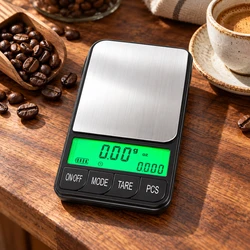
A 600g x 0.1g scale and a 1500g x 0.1g scale display weight in the same one-tenth-gram increments, but they are designed for substantially different load ranges. The 1500g model supports 900 grams more than the 600g model. That gives it 150% more capacity, or 2.5 times the total range.
The larger scale is not automatically more precise. Both have the same nominal readability. Its advantage is the ability to handle heavier containers, larger ingredient batches, grouped inventory, packaged goods and loads that would quickly overload a 600g pocket scale.
The smaller model remains useful when portability, minimum size and everyday light loads are more important. This guide compares capacity, readability, tare allowance, platform size, calibration and common applications so buyers can choose the correct class.
Quick Comparison: 600g x 0.1g vs 1500g x 0.1g
| Specification | 600g x 0.1g scale | 1500g x 0.1g scale |
|---|---|---|
| Maximum capacity | 600g | 1500g |
| Capacity in kilograms | 0.6 kg | 1.5 kg |
| Readability | 0.1g | 0.1g |
| Displayed divisions | 6,000 | 15,000 |
| Additional capacity | Baseline | 900g more |
| Relative increase | Baseline | 150% more capacity |
| Capacity multiple | 1x | 2.5x |
| Approximate ounces | 21.16 oz | 52.91 oz |
| Best strength | Compact light-load weighing | Larger batches and heavier containers |
| Precision advantage | None | None |
The decision is not a choice between less precision and more precision. It is a choice between a compact 600g working range and a substantially broader 1.5kg working range.
What Does 600g x 0.1g Mean?
The first number is capacity. A 600g scale is designed to support a total load up to 600 grams. The second number is readability, or the smallest displayed increment. A 0.1g scale shows weight in steps of one tenth of a gram.
Its display may progress from 36.2g to 36.3g to 36.4g. It will not show 36.27g because hundredths are beyond the displayed resolution.
NIST explains the gram and kilogram within the International System of Units in its overview of SI units for mass. Six hundred grams equals 0.6 kilogram, and dividing 600 by 0.1 yields 6,000 nominal displayed divisions.
Where 600g works well
This specification suits many portable tasks:
- Coffee and tea portions
- Individual coins and small collectible lots
- Finished jewelry and craft pieces
- Herbs, spices and recipe ingredients
- Small screws, connectors and components
- Beads, pigments and resin additives
- Compact product samples
Its main advantage is that a useful everyday capacity can fit in a very small body. It is a good option when normal gross loads stay below roughly 400g to 500g and containers are lightweight.
What Does 1500g x 0.1g Mean?
A 1500g x 0.1g scale supports up to 1,500 grams, or 1.5 kilograms, while displaying the same tenth-gram increments. Dividing 1,500 by 0.1 produces 15,000 nominal divisions across the full range.
The extra 900g accommodates loads that are impossible on the smaller scale:
- Heavy ceramic or glass containers
- Larger food and ingredient batches
- Full groups of coins or hardware
- Small parcels and retail packages
- Larger coffee or tea quantities
- Multiple products weighed together
- Workflows with widely varying loads
One and a half kilograms is approximately 3.31 pounds. That is still far below the capacity of many kitchen, postal and bench scales, but it is unusually versatile for a portable pocket-style format.
Capacity Difference: 900g, 150% More, or 2.5 Times
The capacity comparison can be expressed three ways:
1500g − 600g = 900g additional capacity
900g ÷ 600g = 1.5, or 150% more capacity
1500g ÷ 600g = 2.5 times the total capacity
| Gross load | 600g scale | 1500g scale |
|---|---|---|
| 100g | Suitable | Suitable |
| 400g | Suitable | Suitable |
| 550g | Suitable with limited headroom | Suitable |
| 650g | Over capacity | Suitable |
| 900g | Over capacity | Suitable |
| 1200g | Over capacity | Suitable with 300g remaining |
| 1400g | Over capacity | Near the upper limit |
| 1500g | Over capacity | At maximum; no headroom |
The larger class covers all loads that the 600g model can handle and continues for another 900g. That does not mean it is always the better purchase. It may be physically larger, require a heavier calibration reference or provide capacity the user never needs.
Precision Comparison: Both Read to 0.1g
The readability is identical. Both displays advance in tenth-gram steps. If each scale is functioning correctly and a 245.6g item is placed on the platform, both may show 245.6g.
Higher capacity does not guarantee better accuracy
Readability is the smallest displayed change. Accuracy is closeness to an accepted value. Repeatability is agreement between repeated measurements. Linearity describes performance across the range.
These qualities cannot be determined from “0.1g” alone. NIST discusses the distinction between displayed scale divisions and verification scale divisions in its explanation of scale division d versus verification scale division e.
A buyer should evaluate the complete model, its calibration needs and its performance in the intended environment.
More divisions do not mean finer divisions
The 1500g scale has 15,000 nominal displayed divisions, compared with 6,000 on the 600g scale. It has more divisions because its range is longer. Each division is still 0.1g.
Tare Weight Makes the Capacity Difference Obvious
Tare resets the displayed value after a container is placed on the platform. It allows the user to see net contents, but the container continues to consume physical capacity.
Suppose a mixing bowl weighs 350g:
| Contents | Gross load | 600g scale | 1500g scale |
|---|---|---|---|
| 100g | 450g | Suitable | Suitable |
| 200g | 550g | Suitable, limited headroom | Suitable |
| 250g | 600g | At maximum | Suitable |
| 500g | 850g | Over capacity | Suitable |
| 900g | 1250g | Over capacity | Suitable with 250g remaining |
On the 600g model, the 350g bowl leaves only 250g for contents. On the 1500g model, it leaves 1,150g before reaching maximum capacity.
Calculate requirements with:
Maximum gross load = heaviest container + heaviest contents + all other items supported by the platform
Then include a safety margin. Routine operation at exactly 600g or 1500g leaves no room for variations or accidental additions.
Representative 600g x 0.1g Scales
American Weigh Wholesale offers several compact models in the 600g class. Their designs show how the same core specification can support different preferences.
CARDV2-600 compact digital pocket scale
The CARDV2-600 compact digital pocket scale uses a slim card-style format. Its removable cover protects the stainless-steel surface and serves as an expansion tray. The listed platform is approximately 1.9 x 3.5 inches. It supports grams, ounces, troy ounces and pennyweights and specifies a 500g calibration weight that is not included.
This model is best for users who prioritize a long, narrow platform and easy storage.
AWS-600 digital pocket scale
The AWS-600 digital pocket scale has a traditional pocket-scale body with a hinged protective cover. Its platform measures approximately 1.9 x 3.3 inches, and its backlit display changes colors between unit modes. It operates on two AAA batteries and calibrates with a 500g reference.
This model is a practical all-purpose option when an attached lid is preferable to a removable tray.
V2-600 digital pocket scale
The V2-600 digital pocket scale is especially compact, with a platform of approximately 1.9 x 2.1 inches. Its removable cover can be used as a tray, and the model is offered in multiple colors. It supports common weighing units and uses a 500g calibration reference.
This is a useful value-oriented choice for travel, small drawers and retail color assortments.
Representative 1500g x 0.1g Scale
CHROME-1500 digital pocket scale
The CHROME-1500 is listed in the AWS pocket-scale catalog as a 1500g model. Current manufacturer specifications identify 0.1g readability, a 4 x 4-inch stainless-steel platform, a flip-top cover that can serve as an expansion tray, and six unit modes: grams, ounces, troy ounces, pennyweights, carats and grains.
It uses two AAA batteries and specifies a 1kg calibration weight that is not included. Its larger platform is a major practical advantage over very small 600g pocket models, particularly when using bowls, packages or wide objects.
The CHROME-1500 is a logical choice for users who need substantially more load range but still want tenth-gram readability and portable storage.
Higher-capacity alternatives
If a normal gross load approaches 1,500g, move to a higher rating. The PC-2000 price-computing pocket scale offers a two-kilogram class option with 0.1g readability for users who need more headroom. For broader format comparisons, browse the complete digital pocket scale collection.
Model and Format Comparison
| Feature | CARDV2-600 | AWS-600 | V2-600 | CHROME-1500 |
|---|---|---|---|---|
| Capacity | 600g | 600g | 600g | 1500g |
| Readability | 0.1g | 0.1g | 0.1g | 0.1g |
| Platform | 1.9 x 3.5 in | 1.9 x 3.3 in | 1.9 x 2.1 in | 4 x 4 in |
| Cover | Removable tray | Hinged | Removable tray | Flip-top expansion tray |
| Calibration | 500g | 500g | 500g | 1000g |
| Power | 2 AAA | 2 AAA | 2 AAA | 2 AAA |
| Best strength | Slim profile | Everyday format | Small size and colors | Large range and platform |
The CHROME-1500 is not merely a higher-capacity version of the same body. Its larger platform and expanded unit list may materially improve usability. Conversely, the smaller 600g models take less space and may be easier to carry.
Real-World Capacity Planning Examples
Specifications become easier to compare when they are applied to complete working loads rather than isolated products.
Lightweight dosing cup
If a plastic cup weighs 25g and the largest portion is 100g, the gross load is only 125g. Both scales have ample capacity, so the smaller body, cover design and price should guide the decision. The 1500g ceiling adds no measurement detail.
Ceramic bowl and ingredients
If a bowl weighs 420g and a normal recipe addition weighs 300g, the gross load is 720g. The 600g model cannot support it. The 1500g model can, with 780g remaining before maximum capacity.
Grouped coin collection
A tray weighing 90g plus 450g of coins creates a 540g gross load. The 600g scale can handle it, but only 60g remains. If the collection may grow, the 1500g model avoids splitting it into several batches.
Packaged retail product
A product weighing 800g plus 140g of packaging creates a 940g shipment. Only the 1500g scale fits the current comparison, leaving 560g of capacity. The user must still make sure the package sits securely on the platform and does not block the display.
These examples show why the gross load and expected variation matter more than the typical net amount. Buying for an average load can lead to overload on the busiest or heaviest day. Buying with realistic headroom makes the scale easier to use and helps protect the load cell.
Which Scale Is Better for Coffee?
A 600g model is sufficient for beans, grounds and lightweight dosing cups. Most individual coffee doses use only a small fraction of its capacity.
A 1500g model is more useful for larger batches, ceramic mugs, servers and some brewing systems. It has room for water and a heavier vessel that would overload a 600g pocket scale.
Platform area matters. The 4 x 4-inch CHROME-1500 platform is better suited to wider equipment than a platform under two inches wide. Still, confirm the full brewer, water and container weight because some setups exceed 1.5kg.
Which Scale Is Better for Tea and Food Ingredients?
Both provide the same tenth-gram display detail for loose-leaf tea, spices, yeast, salt and small ingredients. A 600g scale is compact and sufficient for small portions.
The 1500g scale is better for bowls, larger recipes and cumulative ingredient additions. Its extra 900g creates far more usable tare allowance.
Neither scale can display hundredth-gram changes. Choose 0.01g readability when a recipe or process requires finer measurement.
Which Scale Is Better for Meal Preparation?
The 1500g model is the stronger option because meal-prep containers and complete portions often exceed 600g. A glass container alone can consume much of the smaller scale's range.
One and a half kilograms may still be insufficient for a large family-size bowl or several portions. For general kitchen use, a multi-kilogram kitchen scale may offer a better platform and more headroom.
Which Scale Is Better for Coins and Collectibles?
For individual coins, tokens and small sets, the 600g model is usually enough. Both capacities provide identical 0.1g readability.
The 1500g scale is better for rolls, slabs, holders, boxed sets and grouped collections. The larger platform can also accommodate display cases more securely.
Weight should be treated as supporting information rather than proof of authenticity, grade or value. Fine identification differences may require 0.01g readability.
Which Scale Is Better for Jewelry?
Individual finished pieces rarely require 1.5kg capacity. A 600g model is easier to carry and sufficiently capable for many jewelry lots.
The 1500g scale is useful for heavy chains, grouped inventory, presentation trays and larger collections. Its support for carats and grains may also be convenient, depending on the exact model.
For gemstones and fine components, higher capacity does not replace finer readability. Choose a 0.01g or milligram scale when needed.
Which Scale Is Better for Small Hardware?
A 600g scale handles light batches of screws, washers, electronic components and craft pieces. A 1500g scale handles larger containers and more items per batch.
If the scale includes a counting mode, count quality depends on uniform piece weight and a sufficiently large sample. Very light parts may not register one at a time on a 0.1g display.
Which Scale Is Better for Postage and Packaging?
The 1500g model is clearly more versatile because envelopes, boxes, labels and packing material all contribute to gross weight. Its larger platform is also more useful for compact packages.
However, parcel weights vary widely. A dedicated postal scale with several kilograms of capacity and a larger surface is preferable for regular shipping work.
Platform Size and Load Placement
Capacity tells you how much mass the scale supports. Platform dimensions tell you whether the object will sit correctly.
A bulky 300g object may be easier to weigh on the 1500g model's wider platform than on a narrow 600g scale. A tiny 50g object may be equally easy on both.
Before buying:
- Measure the container base.
- Compare the dimensions with the platform.
- Make sure the object will sit flat and centered.
- Confirm it will not touch the countertop.
- Check that it will not hide the display.
- Decide whether a cover or expansion tray improves stability.
An object touching another surface transfers some force away from the scale and can produce an incorrect result.
Portability and Storage
The 600g class is the better choice when minimum size is a top priority. Models such as the V2-600 fit small drawers and travel kits easily.
The CHROME-1500 remains portable, but its 4 x 4-inch platform requires more storage space. The extra size is a useful tradeoff when wider containers and heavier loads are common.
Always store a pocket scale with its cover in place and nothing pressing on the platform. Shock and prolonged loading can damage the sensor.
Calibration Requirements
The required calibration mass differs between these classes and even between individual models. The highlighted 600g scales specify a 500g weight. The CHROME-1500 specifies a 1kg weight.
NIST provides detailed guidance on balance selection and calibration in NISTIR 6969. Its weighing and scales frequently asked questions provide further background on weighing devices.
Calibration preparation
- Use the exact mass required by the model.
- Place the scale on a firm, level surface.
- Keep it away from fans and vibration.
- Let the scale and weight reach room conditions.
- Clean the platform.
- Install fresh batteries.
- Follow the current manual's button sequence.
- Verify performance afterward.
Do not assume that a 1500g scale must use a 1500g calibration weight. The CHROME-1500 specifies 1kg, while other 1500g models may require something different.
Environmental Effects
Both scales display small changes, so their final digit can respond to the environment.
Air movement
Drafts can act on lightweight materials, broad trays and tall containers. Avoid vents and open windows.
Vibration
Appliances, machinery, foot traffic and flexible tables can cause fluctuation. Use a rigid surface.
Temperature
Moving the scale between hot and cold locations can produce temporary instability. Allow it to acclimate and stay within the specified operating range.
Static electricity
Plastic containers and powders can develop charge, especially in dry air. Static may appear as drift or inconsistent readings.
Off-center loading
Center the object. A wide bowl on a narrow platform is more likely to rock or contact another surface.
Weak batteries
Replace low batteries promptly. Power problems can cause erratic behavior.
Accuracy, Repeatability and Linearity
A good buying decision considers more than the display increment.
Accuracy describes closeness to an accepted reference.
Repeatability describes agreement between repeated measurements of the same item.
Linearity describes performance across the capacity range.
Readability is simply the smallest displayed step.
The 1500g scale must cover a wider range, so checks at several loads are useful. A correct reading at 100g does not establish performance at 1200g.
Practical Performance Checks
- Inspect the scale for damage or residue.
- Place it on its normal stable surface.
- Confirm the unloaded display returns to zero.
- Apply a suitable known mass.
- Remove and replace the mass several times.
- Test another point in the normal working range.
- Record results when the process requires documentation.
- Stop using the scale if results exceed the application's tolerance.
The acceptable tolerance should come from the application, not from the number of decimal places.
Legal-for-Trade Considerations
A general pocket scale used for hobbies, internal inventory or portioning is not automatically approved for determining a customer's price.
NIST explains the role of a legal metrology device. NIST Handbook 44 provides specifications and tolerances used by weights-and-measures programs.
Commercial requirements vary by jurisdiction and application. Confirm approval and inspection needs with the relevant authority. Calibration capability does not make a scale legal for trade.
Choose 600g x 0.1g When…
Choose the smaller scale when:
- Gross loads stay comfortably below 600g.
- Most items weigh less than 400g to 500g.
- Containers are light.
- Minimum size and portability matter.
- A narrow platform fits the items.
- The user prefers a specific 600g color or cover.
- Extra capacity would remain unused.
It is the efficient choice for coffee doses, tea, individual coins, jewelry, ingredients and small hardware.
Choose 1500g x 0.1g When…
Choose the larger scale when:
- Gross loads can exceed 600g.
- Bowls and trays are heavy.
- Larger batches are common.
- Grouped inventory approaches one kilogram.
- Packaging contributes significant weight.
- A wider platform improves stability.
- One scale must cover both small and medium loads.
The 1500g model offers far more flexibility without sacrificing tenth-gram readability.
When Neither Specification Fits
Choose a 0.01g scale if the task requires hundredth-gram changes.
Choose a milligram scale for suitably controlled milligram-level measurements.
Choose a scale above 1.5kg when routine loads approach 1,400g or containers are especially heavy.
Choose a dedicated kitchen, postal or bench scale when a large platform is more important than pocket portability.
Choose an approved legal-for-trade device when price is determined by weight.
Wholesale and Retail Positioning
Retailers can merchandise these capacities as distinctly different use cases.
Position 600g as the compact everyday option
Emphasize travel, coffee doses, tea, small ingredients, coins, jewelry and crafts.
Position 1500g as expanded portable capacity
Explain that it offers 2.5 times the capacity and a larger platform while retaining 0.1g readability.
Ask about the container
Many customers report only product weight. Staff should ask for the combined weight of product, bowl, tray and packaging.
Avoid calling 1500g more precise
Both display 0.1g increments. The larger model is more capable in load range, not finer in display resolution.
Stock neighboring specifications
Offer 0.01g models for finer work and two-kilogram or higher scales for users who need more headroom.
Buyer’s Checklist
Before purchasing, confirm:
- Heaviest gross load
- Container weight
- Desired capacity headroom
- Smallest meaningful difference
- Platform dimensions
- Display visibility
- Cover or tray preference
- Required unit modes
- Calibration mass
- Whether calibration weights are included
- Battery and power needs
- Operating environment
- Commercial-use requirements
If both capacities satisfy the load requirement, choose based on platform, portability, accessories and price. If the gross load can exceed 600g, choose 1500g or another higher-capacity model.
Frequently Asked Questions
Is a 1500g x 0.1g scale more precise than a 600g x 0.1g scale?
No. Both display weight in 0.1g increments. The 1500g scale has more capacity, not finer readability.
How much more capacity does the 1500g scale provide?
It provides 900g more capacity. That is 150% more, or 2.5 times the capacity of a 600g scale.
How many displayed divisions does each scale have?
The 600g scale has 6,000 nominal divisions. The 1500g scale has 15,000. Each division remains 0.1g.
Can a 600g scale weigh 600g inside a bowl?
Only if the bowl has no weight. The bowl and contents together must remain within 600g.
Does tare restore capacity?
No. Tare subtracts the container from the displayed result but does not remove its physical weight.
Which is better for coffee?
Choose 600g for beans, grounds and light dosing cups. Choose 1500g for servers, larger batches and brewing setups that exceed 600g.
Which is better for meal prep?
The 1500g scale is more useful because bowls and full portions frequently exceed 600g. A multi-kilogram kitchen scale may still be better for large meals.
Which is better for coins?
Use 600g for individual coins and small lots. Use 1500g for rolls, holders and grouped collections.
Which is better for jewelry?
Choose based on total load and platform size. If hundredth-gram differences matter, choose 0.01g readability instead.
What calibration weight is required?
The highlighted 600g models specify 500g. The CHROME-1500 specifies a 1kg weight. Always follow the exact manual.
Is 0.1g the same as 0.01g?
No. A 0.01g display is ten times finer and shows hundredths of a gram.
Is the CHROME-1500 still portable?
Yes, it is designed as a pocket scale, but its 4 x 4-inch platform makes it larger than very compact 600g models.
Are these scales legal for trade?
Not automatically. Verify approval and suitability with the relevant weights-and-measures authority.
Why choose 600g when 1500g holds more?
The smaller model may be easier to carry, store and merchandise. Extra capacity provides no benefit when all normal loads stay well below 600g.
Final Verdict
Choose a 600g x 0.1g scale when loads are light, containers are small and maximum portability matters. It offers the same tenth-gram readability as the larger scale in a more compact form.
Choose a 1500g x 0.1g scale when heavier containers, larger batches, grouped products or wider objects are part of the normal workflow. It adds 900g of capacity—150% more than the smaller scale—and may provide a substantially larger platform.
Neither specification is more precise based solely on readability. Both display 0.1g steps. The correct choice comes from calculating gross load, adding headroom and comparing physical platform size, unit modes, calibration needs and portability.