
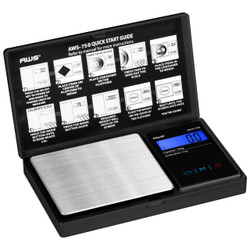
A 750g x 0.1g digital scale offers a practical balance between portable size, moderate capacity and tenth-gram readability. It can support a total load of up to 750 grams while displaying weight in increments of 0.1 gram.
That combination suits coffee, tea, food ingredients, coins, jewelry lots, collectibles, craft materials, small hardware and lightweight packaged goods. It provides more capacity than common 500g or 600g pocket scales without giving up the convenient tenth-gram display used for many everyday tasks.
The specification is not appropriate for every application. A user who needs to see hundredth-gram changes needs a finer scale, while someone weighing large bowls, full meal-prep containers or parcels may need one kilogram or more. This guide explains the numbers, the tradeoffs and the features that separate current 750g models.
Quick Answer: What Does 750g x 0.1g Mean?
In the specification 750g x 0.1g:
- 750g is the maximum capacity. The combined load on the platform must not exceed 750 grams.
- 0.1g is the readability. The display changes in increments of one tenth of a gram.
The display may progress from 24.6g to 24.7g to 24.8g. It does not show hundredths such as 24.67g.
The capacity applies to everything on the platform, including the product, bowl, cup, tray, packaging and accessories. Pressing tare can reset the displayed value to zero, but it does not remove the container's physical load from the sensor.
750g x 0.1g at a Glance
| Specification | Meaning | Practical effect |
|---|---|---|
| 750g capacity | Maximum total load is 750 grams | Handles moderate portable-weighing tasks |
| 0.1g readability | Display changes in tenth-gram steps | Useful where hundredths are unnecessary |
| 7,500 displayed divisions | 750 ÷ 0.1 = 7,500 | Broad range for a compact scale |
| 0.75kg capacity | Three quarters of a kilogram | More range than 500g or 600g models |
| Approx. 26.46 oz | Capacity expressed in ounces | Useful for visualizing overall range |
| Tare function | Subtracts a displayed container value | Shows net contents without restoring capacity |
| Portable format | Commonly battery powered with a cover | Convenient for drawers, bags and counters |
A 750g scale is not a milligram balance and is not a replacement for a multi-kilogram kitchen or postal scale. It is a compact general-purpose instrument for medium-light loads.
Understanding the 750-Gram Capacity
Capacity is the maximum total mass the scale is designed to support. Seven hundred fifty grams equals 0.75 kilogram. NIST explains the gram, kilogram and related SI relationships in its overview of SI units for mass.
The rating includes the complete gross load. A user cannot place a 200g bowl on the platform, press tare and then add 750g of ingredients. That would create a 950g physical load and exceed the scale's capacity.
Calculate gross load before choosing
Use this formula:
Maximum gross load = heaviest container + heaviest contents + all other items supported by the platform
If a cup weighs 180g and the largest portion weighs 450g, the gross load is 630g. A 750g scale has 120g of remaining capacity. If the portion increases to 600g, the gross load becomes 780g and the scale is undersized.
Do not plan to work exactly at 750g
Operating at the maximum leaves no room for variations. Containers from the same set may have slightly different weights, portions can be overfilled and objects can be placed down with more force than their resting mass.
Choose a capacity that provides sensible headroom. If routine loads reach 700g or more, a one-kilogram model is usually more appropriate.
What fits within 750g?
Common compatible loads include:
- Coffee beans or grounds in a small container
- Loose-leaf tea and compact food ingredients
- Individual jewelry pieces and grouped lots
- Coins, tokens and compact collectibles
- Screws, nuts, washers and electronic components
- Beads, pigments and craft materials
- Small samples and packaged products
- Lightweight envelopes or mail items
Physical fit matters as much as mass. A large but light item can overhang the platform, hide the display or touch the counter.
Understanding 0.1-Gram Readability
Readability is the smallest change the display can show. With a 0.1g scale, the final digit represents tenths of a gram.
A 0.03g addition may not create any visible change. A 0.10g addition corresponds to one displayed division. The exact point at which the display advances depends on the instrument's response and rounding behavior.
Readability is not guaranteed accuracy
The fact that the screen shows one decimal place does not prove that every measurement is within 0.1g of the accepted value. Accuracy depends on calibration, repeatability, linearity, temperature, load placement, vibration, airflow and other factors.
NIST explains the distinction between a displayed scale division and a verification scale division in its discussion of scale division d versus verification scale division e.
Treat 0.1g as the displayed increment, not as a universal error limit.
Is 0.1g fine enough?
It is fine enough when decisions are made in tenths of a gram or larger increments. It works for many coffee recipes, food portions, general sorting tasks and grouped inventory.
It is not fine enough when differences of 0.01g, 0.02g or 0.05g matter. Choose 0.01g readability for those applications, provided the scale also has enough capacity for the complete load.
Resolution, Accuracy, Precision and Repeatability
These terms describe different qualities.
Resolution or readability
This is the smallest displayed increment: 0.1g in this case.
Accuracy
Accuracy is closeness to an accepted reference value. It cannot be established by counting decimal places.
Precision
In measurement terminology, precision concerns closeness among repeated results. Consumer marketing sometimes uses the word more loosely, so review actual specifications where available.
Repeatability
Repeatability describes how closely repeated measurements agree when the same object is removed and replaced under the same conditions.
Linearity
Linearity concerns performance throughout the range. A scale can appear correct near 100g and show a different error near 700g.
The best buying decision considers all five concepts rather than selecting a device solely because its display includes a decimal point.
Who Should Buy a 750g x 0.1g Scale?
This specification is best for users who need a compact scale but sometimes exceed the comfortable range of a 500g or 600g model.
Coffee and tea users
Tenth-gram readability is useful for many coffee doses and loose-leaf tea portions. The additional capacity accommodates heavier dosing cups and larger batches. If a complete brewing vessel and water will rest on the scale, calculate their combined mass because many setups exceed 750g.
Home cooks and bakers
A 750g scale can handle spices, salt, yeast and smaller ingredient batches. It can also weigh compact portions in light containers. Large mixing bowls and full recipes usually require a higher-capacity kitchen scale.
Coin and collectible users
The capacity suits individual coins, holders, rolls and grouped lots. A 0.1g display supports general sorting, although finer identification differences may require 0.01g. Weight alone does not establish authenticity or grade.
Jewelry and craft users
The scale can accommodate finished jewelry, chains, grouped pieces, beads and craft supplies. Gemstones and tiny components may require finer readability.
Hardware and electronics users
The range suits batches of screws, washers, connectors and small parts. If piece counting is important, verify that the exact model includes the feature and that each item is sufficiently heavy relative to a 0.1g division.
Retailers and resellers
The 750g class creates a useful step between 600g and one-kilogram models. It can be positioned for customers who want additional headroom without moving to a larger general-purpose scale.
When You Need a Different Specification
Choose a finer scale when:
- Hundredth-gram changes affect the task
- Individual objects weigh close to or below 0.1g
- Very light parts must be counted by weight
- A procedure specifically requires 0.01g or 0.001g readability
- Formal uncertainty requirements exceed the scale's capability
Choose a higher-capacity scale when:
- The container and contents may exceed 750g
- Full brewing vessels are weighed
- Meal-prep portions use glass containers
- Parcels vary widely
- Larger hardware batches are common
- A larger platform is needed
Choose an approved or specialized instrument when:
- Weight determines a retail price
- The work is regulated or safety critical
- Formal laboratory traceability is required
- The method requires documented uncertainty
- Medical or pharmaceutical procedures apply
Current 750g x 0.1g Models to Compare
American Weigh Wholesale offers several portable models with this capacity and readability. They share the same headline specification but differ in platform dimensions, cover style and calibration information.
MS-750 digital pocket scale
The MS-750 digital pocket scale is a compact Fast Weigh model with a removable protective cover that doubles as an expansion tray.
Key specifications include:
- Capacity: 750g
- Readability: 0.1g
- Units: g, oz, ozt and dwt
- Platform: approximately 2.2 x 2.8 inches
- Display: backlit LCD
- Power: two AAA batteries
- Calibration: 500g weight, not included
- Surface: stainless steel
The MS-750 is a strong option when value, portability and a removable tray matter. Its platform is broader than some narrow card-style designs but remains compact.
DZ3-750 digital pocket scale
The DZ3-750 digital pocket scale uses a flip-open protective lid and a larger body.
Key specifications include:
- Capacity: 750g
- Readability: 0.1g
- Units: g, oz, ozt and dwt
- Platform: approximately 2.99 x 2.54 inches
- Dimensions: approximately 5.04 x 3.06 x 0.80 inches
- Power: two AAA batteries
- Calibration: 500g, 200g and 50g weights, not included
- Cover: flip-open protective lid
The DZ3-750 is a good choice for users who prefer an attached lid and a wider platform footprint. Its calibration routine is more involved than the single 500g reference listed for the MS-750.
TR-750 digital pocket scale
The TR-750 digital pocket scale is positioned as a budget-conscious portable model.
Key specifications include:
- Capacity: 750g
- Readability: 0.1g
- Units: g, oz, ozt and dwt
- Platform: approximately 2.0 x 3.0 inches
- Display: blue backlit LCD
- Power: two AAA batteries
- Cover: removable and usable as a tray
The TR-750 suits users who want the core specification in a simple, compact form. Confirm current calibration instructions in the product manual.
Adjacent capacity options
Customers who need less capacity can consider the CARDV2-600 compact pocket scale. Those who need more headroom can consider the AWS 1kg digital pocket scale. Browse the full digital pocket scale collection to compare capacity, readability and platform formats.
750g Model Comparison
| Feature | MS-750 | DZ3-750 | TR-750 |
|---|---|---|---|
| Capacity | 750g | 750g | 750g |
| Readability | 0.1g | 0.1g | 0.1g |
| Platform | 2.2 x 2.8 in | 2.99 x 2.54 in | 2.0 x 3.0 in |
| Cover | Removable tray | Flip-open lid | Removable tray |
| Units | g, oz, ozt, dwt | g, oz, ozt, dwt | g, oz, ozt, dwt |
| Power | 2 AAA | 2 AAA | 2 AAA |
| Calibration | 500g | 500g + 200g + 50g | Check current manual |
| Best fit | Compact tray use | Wider platform and attached lid | Portable value |
None is universally best. Select according to the object footprint, cover preference and calibration setup.
How to Compare Models With the Same Specification
Platform dimensions
Capacity does not guarantee physical compatibility. Measure the base of the normal container and compare it with the platform. A round bowl may sit better on the wider DZ3-750, while a long narrow item may fit the TR-750 platform more naturally.
Cover style
A removable cover can serve as a tray but can also be misplaced. A hinged lid stays attached but may not provide the same separate container function.
Display visibility
Large containers can hide a front-mounted screen. Check digit size, backlighting and the display's position relative to the planned load.
Unit modes
The highlighted models support grams, ounces, troy ounces and pennyweights. If carats or grains are required, verify those modes on the exact product rather than assuming they are included.
Calibration method
The MS-750 lists a 500g weight. The DZ3-750 lists 500g, 200g and 50g references. This difference affects accessory cost and calibration preparation.
Power and auto-off
AAA battery power supports portability. Auto-off conserves batteries but may interrupt a slow workflow. Review the manual if timeout behavior matters.
Cleaning and materials
Stainless-steel platforms are easy to wipe, but the scale body should not be immersed. Use a suitable container for loose or wet materials.
Warranty and support
Review the current warranty and documentation before purchasing, especially when buying inventory in volume.
Tare: Useful but Often Misunderstood
The tare function simplifies container-based measurement:
- Place the empty container on the platform.
- Wait for the reading to stabilize.
- Press tare to reset the display.
- Add the material.
- Read the net displayed amount.
The container remains part of the physical load. If a tray weighs 125g, no more than 625g of additional material can be added before reaching 750g. For practical headroom, the working contents limit should be lower.
Repeated taring between ingredients can hide how close the total physical load is to capacity. Track the cumulative gross load.
Real-World Capacity Examples
| Container | Contents | Gross load | Suitability |
|---|---|---|---|
| 30g | 100g | 130g | Ample headroom |
| 100g | 400g | 500g | Suitable |
| 180g | 450g | 630g | Suitable with 120g remaining |
| 250g | 450g | 700g | Near upper range |
| 300g | 500g | 800g | Over capacity |
These examples show that net contents can be below 750g while the gross load still exceeds the rating.
Calibration and Performance Checks
Calibration compares the scale's indication with a known reference under specified conditions. Some pocket scales include a user adjustment routine, but the required mass and sequence vary.
NIST provides technical guidance on balance selection, calibration and use in NISTIR 6969. NIST's weighing and scales frequently asked questions provide additional context.
Before calibration
- Place the scale on a firm, level surface.
- Keep it away from drafts and vibration.
- Allow the instrument and weights to reach room conditions.
- Clean the platform.
- Install fresh batteries.
- Confirm the exact required masses.
- Follow the model's manual.
After calibration
Check the scale with suitable known masses. Remove and replace the same mass several times to examine repeatability. Test more than one point in the normal working range when practical.
Calibration cannot repair overload damage or correct an unstable table.
Environmental Factors That Affect Results
Air movement
Fans, HVAC vents and open windows can affect lightweight objects and broad containers.
Vibration
Appliances, machinery, foot traffic and flexible furniture can cause fluctuating readings.
Temperature
Let a scale moved from a cold vehicle to a warm room stabilize before important measurements.
Static electricity
Plastic trays, films and powders can develop static charge, particularly in dry conditions.
Off-center loading
Place the load near the platform center. An object touching the counter can transfer force away from the scale.
Low batteries
Replace batteries when the indicator appears or behavior becomes unusual.
Shock loads
Lower objects gently. Dropping an item applies more force than its resting mass and can damage the sensor.
Counting Pieces by Weight
When a model includes a counting function, it estimates quantity using the average mass of a reference sample. Results depend on uniform piece weight, a large enough sample and an individual piece weight that is meaningful relative to 0.1g.
If each part weighs 0.04g, a one-piece change may not register. A finer or purpose-built counting scale is more suitable. Always verify important counts manually.
Application-by-Application Selection Guide
The same 750g x 0.1g specification can be an excellent fit in one workflow and a poor fit in another. Use the following examples to test whether it matches the real task.
Coffee preparation
For weighing beans or grounds, capacity is rarely the limiting factor. A 750g model offers ample room for a dosing cup and a normal batch, while 0.1g readability supports common brewing ratios. The potential problem appears when the brewer, server and water are placed on the platform together. Weigh the complete setup before assuming it will fit.
Loose-leaf tea
Many tea portions are only a few grams, so tenth-gram increments provide useful control. A removable cover that doubles as a tray can make loose leaves easier to contain. If a recipe calls for extremely small additions below 0.1g, choose finer readability.
Baking ingredients
The scale works well for yeast, salt, spices and other concentrated ingredients. It is less suitable for a full bowl of flour or dough because the container and batch may exceed 750g. Many bakers benefit from owning both a small tenth-gram scale and a larger kitchen scale.
Coins and tokens
The range can accommodate numerous individual coins or a moderate grouped lot. A wider platform is useful for holders and trays. If the purpose is identification, confirm that 0.1g is fine enough for the differences being evaluated.
Jewelry and gemstones
Finished pieces, chains and grouped findings may fit well. Tiny gemstones and lightweight components often require 0.01g or 0.001g. Capacity should never be substituted for the readability the appraisal or sorting process actually needs.
Small hardware
The scale can reduce manual counting effort when parts are consistent and heavy enough. Test a known quantity, build an adequate reference sample and compare the estimated count with a manual count. Very small weight variation among individual pieces can accumulate across a large batch.
Craft formulations
Pigments, beads, resin additives and other craft materials may suit the specification. Keep liquids and sticky products in compatible containers, and remember that repeated taring does not prevent the gross load from increasing.
Farmers market or commercial sales
A portable format may be convenient, but convenience does not establish legal-for-trade approval. If customer price depends on the result, use a device approved for that transaction and jurisdiction.
Care, Storage and Long-Term Reliability
A scale that is appropriate on paper can perform poorly if it is handled carelessly. Simple maintenance protects the load cell and improves consistency.
Keep loads within capacity
Avoid using the scale as temporary storage. A container left on the platform for hours still applies force to the sensor. Remove all items when weighing is complete.
Lower objects gently
An object dropped from even a short distance can briefly apply force far beyond its static mass. Place objects smoothly near the platform center.
Use the protective cover
Close or replace the cover before putting the scale in a drawer or bag. Do not pack heavy objects on top of it.
Clean without flooding the electronics
Wipe the stainless-steel surface with an appropriate soft cloth. Do not pour cleaner directly onto the scale or immerse the body unless the instructions explicitly permit it.
Remove batteries for long storage
If the scale will not be used for an extended period, follow the manufacturer’s storage guidance. Removing batteries can reduce the risk of leakage.
Recheck after transport
Travel, vibration and temperature changes can affect setup. After moving the scale, let it stabilize, check zero return and test it with a suitable reference mass before important work.
Keep a simple check record
Businesses can record the date, reference mass, observed reading and any corrective action. This does not replace formal calibration documentation, but it can reveal gradual changes before they become obvious in daily use.
Legal-for-Trade Considerations
A scale used for internal sorting, recipes or hobbies is not automatically approved for determining a customer's price.
NIST explains the role of a legal metrology device. NIST Handbook 44 contains specifications and tolerances used by weights-and-measures programs.
Requirements vary by jurisdiction and application. Confirm approval, suitability and inspection requirements with the relevant authority. A calibration mode and 0.1g display do not make a scale legal for trade.
Wholesale and Retail Buying Considerations
Position 750g between 600g and 1000g
The capacity gives customers more headroom than common 600g models without necessarily moving to the footprint of a larger scale.
Merchandise by task
Use examples such as coffee, tea, coins, jewelry, crafts and hardware. Avoid unsupported medical, laboratory or trade claims.
Display both capacity and readability
“750g x 0.1g” communicates the range and the displayed detail. The phrase “precision scale” alone is too vague.
Explain calibration accessories
State which reference masses are required and whether they are included. The needs differ among models in the same capacity class.
Stock adjacent options
Offer a 600g model for compact everyday work, a one-kilogram model for heavier containers and 0.01g scales for finer measurement.
Buying Checklist
Before purchasing, confirm:
- The heaviest gross load stays below 750g.
- The scale has reasonable capacity headroom.
- A 0.1g displayed increment is fine enough.
- The container fits securely on the platform.
- The display remains visible.
- The cover style fits the workflow.
- Required unit modes are included.
- The calibration masses are known.
- Calibration weights are included or budgeted separately.
- Battery and auto-off behavior are suitable.
- The operating environment is stable.
- Commercial or regulated-use requirements have been checked.
Frequently Asked Questions
What does 750g x 0.1g mean?
It means the scale can support a maximum total load of 750 grams and displays weight in 0.1-gram increments.
Is 0.1g the same as 0.01g?
No. A 0.01g display is ten times finer and shows hundredths of a gram. A 0.1g display shows tenths.
Can a 750g scale weigh 750g inside a bowl?
Only if the bowl has no mass. In practice, the bowl and contents together must remain within 750g.
Does tare restore the full capacity?
No. Tare resets the displayed reference but does not remove physical weight from the load cell.
How many displayed divisions does the scale have?
Seven hundred fifty divided by 0.1 equals 7,500 nominal displayed divisions.
Is it good for coffee?
Yes, for many doses, bean batches and lightweight containers. A complete brewer and water may require more capacity.
Is it good for jewelry?
It suits finished pieces and grouped lots when tenth-gram readability is adequate. Choose 0.01g or finer when smaller differences matter.
Can it weigh coins?
Yes. It works for individual coins, rolls and grouped lots within capacity. Weight alone does not establish authenticity.
Is it good for postage?
It can handle lightweight mail, but many parcels need a larger platform and higher-capacity postal scale.
Which calibration weight does it need?
The correct mass is model-specific. The MS-750 lists 500g, while the DZ3-750 lists 500g, 200g and 50g references.
Why does the last digit fluctuate?
Drafts, vibration, static, temperature change, an unstable container or weak batteries can affect the final digit.
Is a 750g scale legal for trade?
Not automatically. The exact model must have the required approval and be suitable for the intended transaction.
Can it measure liquids?
It measures mass, not volume. Liquid can be weighed in a container, but the container counts toward capacity.
Is this a laboratory balance?
The specification alone does not establish laboratory suitability. Formal work may require traceability, uncertainty evaluation, qualification and documentation.
Final Verdict
A 750g x 0.1g digital scale is a strong middle-range portable option. It provides more capacity than 500g or 600g models while retaining useful tenth-gram readability.
Choose it when the complete load—including the container—stays comfortably below 750g and the smallest meaningful difference is 0.1g or larger. Choose a 0.01g model for finer measurement, a one-kilogram model for heavier containers or a multi-kilogram scale for large food and shipping tasks.
Once the specification fits, compare platform shape, lid design, unit modes, calibration requirements, power and warranty. Those details determine which 750g model will be easiest to use day after day.