
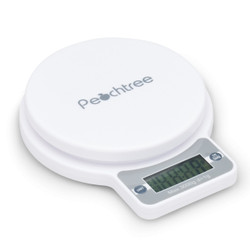
A 750g x 0.1g scale and a 3000g x 0.1g scale display weight in the same tenth-gram increments, but they accommodate very different total loads. The 3000g specification provides four times the capacity, making it more practical for larger ingredient batches, heavier containers, and bulk supplies.
The 750g specification can be sufficient for lighter work, especially when the individual model offers the portability and platform design you need.
The important distinction is that greater capacity does not automatically mean greater accuracy. Both specifications describe a display increment of 0.1g. Neither establishes the complete measurement performance of the scale.
This comparison explains how to choose between the two capacities, calculate the space available after adding a container, and assess actual American Weigh Scales options.
What Does 750g x 0.1g Mean?
The specification contains two separate numbers:
- 750g: The maximum rated load.
- 0.1g: The smallest displayed increment in gram mode.
A scale with this specification can display readings such as 18.2g, 105.7g, or 624.3g. Its gram display does not show hundredths of a gram, such as 18.24g.
The 750g limit applies to the complete load supported by the platform. That includes your material, its container, and any supported accessories.
For example, a 100g tray holding 500g of supplies creates a total load of 600g. A 100g tray holding 700g of supplies creates an 800g load, exceeding the rated capacity.
Buyers who primarily weigh lighter items can explore the American Weigh Scales pocket scale collection and compare individual models by capacity, readability, platform dimensions, and protective features.
What Does 3000g x 0.1g Mean?
A 3000g x 0.1g scale has a maximum rated load of 3000 grams and a displayed increment of 0.1 gram in gram mode.
Three thousand grams equals 3 kilograms. The lower-capacity specification, 750g, equals 0.75kg. The BIPM International System of Units brochure provides the international reference for SI units and prefixes. www.bipm.org
Compared with the 750g specification, a 3000g scale provides:
- Four times the maximum capacity.
- An additional 2250g of capacity.
- The same stated tenth-gram display increment.
That extra capacity can change how you work. Instead of splitting a larger batch into multiple portions, you may be able to weigh it in one container.
However, capacity alone does not reveal platform size, response speed, repeatability, or suitability for very small samples.
750g x 0.1g vs 3000g x 0.1g: Comparison Table
| Consideration | 750g x 0.1g scale | 3000g x 0.1g scale |
|---|---|---|
| Maximum rated load | 750g | 3000g |
| Capacity in kilograms | 0.75kg | 3kg |
| Display increment in gram mode | 0.1g | 0.1g |
| Capacity divided by display increment | 7,500 | 30,000 |
| Remaining capacity with a 250g container | 500g | 2750g |
| Can accommodate a 1000g total load? | No | Yes, within its stated rating |
| Can accommodate a 2500g total load? | No | Yes, within its stated rating |
| Accuracy established by this specification? | No | No |
| Platform dimensions | Model dependent | Model dependent |
| Practical fit | Lighter portions and smaller loads | Larger batches and heavier containers |
The calculated division counts describe the relationship between capacity and readability. They do not establish commercial approval, accuracy, or a legal weighing classification.
Does Equal Readability Mean Equal Precision?
Equal readability means that both scales display gram readings in 0.1g steps. It does not establish equal precision or accuracy.
Three concepts help explain the difference:
Readability is the displayed increment.
Repeatability describes how closely repeated measurements agree when the same item is weighed under the same conditions.
Accuracy concerns agreement between a measured result and the relevant reference value.
The International Vocabulary of Metrology provides standardized terminology for evaluating measurements and instrument performance. www.bipm.org
For a simplified example, imagine weighing the same reference object several times:
| Measurement | Scale A | Scale B |
|---|---|---|
| First reading | 100.0g | 100.2g |
| Second reading | 100.0g | 100.4g |
| Third reading | 100.0g | 100.1g |
Both displays use one decimal place, but their readings behave differently. These illustrative results show why display resolution alone cannot settle a buying decision.
To compare actual models, review their stated tolerances, calibration instructions, and operating requirements.
Container Weight Changes the Capacity You Need
The container often determines whether a 750g scale is sufficient.
Pressing tare subtracts the container’s weight from the displayed result. It does not remove that weight from the physical load.
Example 1: A lightweight cup
Suppose you weigh:
- Cup: 60g.
- Dry ingredients: 300g.
- Total load: 360g.
Both specifications provide sufficient capacity for this example.
If your work consistently involves loads of this size, a 3000g scale may offer unused capacity rather than a meaningful improvement.
Example 2: A mixing bowl
Suppose you weigh:
- Bowl: 400g.
- Ingredients: 700g.
- Total load: 1100g.
A 750g scale cannot accommodate this complete load. A 3000g scale can, provided the bowl sits securely and the model suits the task.
Example 3: A larger batch
Suppose you weigh:
- Container: 550g.
- Material: 2200g.
- Total load: 2750g.
This is within a 3000g capacity, leaving 250g before the rated maximum.
If you expect to add more material or use a heavier container, a capacity above 3000g may be more practical.
The calculation to use before buying
Total expected load = container + contents + supported accessories
Choose capacity around the heaviest complete load you expect to use. Include room for normal variations in your process.
When a 750g x 0.1g Scale Is a Good Choice
A 750g scale can be useful when your complete load stays comfortably below the maximum and tenth-gram readings meet your needs.
Small coffee and tea portions
Dry coffee beans and loose tea often involve relatively light loads. A small cup or tray may leave ample available capacity.
For brewing directly on a scale, include the vessel and liquid in your calculation. Platform stability, moisture protection, and timer requirements also matter.
Individual collectibles
Coins, small decorative objects, and other collectibles may fit within a 750g capacity.
However, some identification tasks require finer readings than 0.1g. More capacity would not resolve that limitation.
Small hardware and craft supplies
A compact tray can hold modest quantities of fasteners, beads, or findings.
As the quantity increases, container size and total mass become more important than the individual weight of each piece.
Portable work
For a scale carried between locations, compare dimensions, protective covers, and power requirements.
A verified example is the MS-750 digital pocket scale. Its specifications list 750g capacity, 0.1g readability, a 2.2 x 2.8-inch platform, and power from two AAA batteries. Its removable cover can also serve as an expansion tray. AWScales
This format may suit lighter tasks where a compact device is convenient. A larger bowl or tray still needs to sit securely without touching nearby surfaces.
When a 3000g x 0.1g Scale Is a Better Fit
A 3000g scale becomes more useful when complete loads exceed 750g or when larger containers are part of the routine.
Baking and ingredient preparation
A mixing bowl can use a substantial portion of a 750g capacity before any ingredients are added.
A 3000g specification provides more flexibility for weighing flour, sugar, grains, and other ingredients in one vessel.
Before choosing a model, check whether its platform supports your bowl and whether the display remains visible. Explore the AWS kitchen scale selection with both capacity and readability in mind.
Larger coffee batches
A 750g scale may accommodate a smaller batch of beans, but a larger batch plus its container can exceed the rating.
For example:
- Tray: 180g.
- Beans: 1000g.
- Total load: 1180g.
A 3000g scale provides sufficient capacity for this illustrative setup.
Let roasted material cool before placing it on a scale unless the equipment is specifically designed for the temperature involved.
Candle and craft materials
Larger quantities of wax or other craft materials can make additional capacity useful.
If a recipe includes very small additions, assess those measurements separately. A scale suitable for the main batch may not provide sufficiently fine readings for every ingredient.
Workshop supplies
A 3000g capacity can accommodate heavier groups of hardware, parts, and materials.
Check whether you need simple mass measurements or an actual parts-counting function. Counting features are model specific and cannot be inferred from capacity.
Comparing an MS-750 With an LB-3000
The MS-750 and LB-3000 illustrate how the two specifications can correspond to different working formats.
The MS-750 is a pocket-scale example. The LB-3000 is identified in its manual as part of a compact bench-scale series.
The official AWS LB-Series manual lists the LB-3000 at 3000g x 0.1g, with a circular platform approximately 5.2 inches in diameter and power from four AA batteries. It also describes tare and parts-counting functions. awscales.com
| Model characteristic | MS-750 | LB-3000 |
|---|---|---|
| Listed capacity | 750g | 3000g |
| Listed readability | 0.1g | 0.1g |
| Platform | 2.2 x 2.8 inches | Approximately 5.2-inch diameter |
| Battery power | Two AAA batteries | Four AA batteries |
| General format | Pocket scale | Compact bench scale |
These dimensions apply to the specific models cited. They should not be treated as universal dimensions for all 750g or 3000g scales.
For buyers using larger vessels, the platform difference may be as important as the fourfold increase in capacity.
Platform Fit Can Affect the Measurement
A container should sit securely and transfer its complete load to the scale.
Potential problems include:
- A tray touching the countertop.
- A container resting against a nearby object.
- A bowl hiding the display.
- A tall vessel becoming unstable.
- Material extending awkwardly beyond the weighing area.
A container can overhang a platform without necessarily invalidating a measurement, but it must remain stable and free from outside contact. Follow the model’s loading instructions.
Before ordering, measure the base of the container you intend to use. Compare that measurement with the platform rather than assuming that sufficient capacity guarantees a good fit.
Calibration Requirements Are Model Specific
The required calibration weight is not necessarily equal to the scale’s capacity.
The MS-750 listing specifies a 500g calibration weight, not included. The LB-Series manual specifies a 1000g calibration weight for the LB-3000 and identifies a recommended weight class. AWScales
Follow the instructions supplied for your exact model and version.
NIST’s balance and scale calibration guidance addresses reference-standard selection, measurement errors, uncertainty, and minimum sample quantities. These factors help explain why calibration involves more than matching a number on the display. www.nist.gov
Checking a scale between adjustments
A suitable reference weight can help reveal changes in performance.
Place it on the platform under consistent conditions, record the reading, remove it, and repeat. A change from your usual result may indicate that the scale or its environment needs attention.
This check does not establish performance at every point across the weighing range.
Understanding traceability
For work requiring documented measurement quality, reference weights and calibration records become more important.
NIST’s policy on metrological traceability explains traceability through a documented calibration chain with associated measurement uncertainty. A nominal mass printed on a weight does not independently establish traceability for your weighing results. www.nist.gov
Is 0.1g Readability Suitable for Small Quantities?
A tenth-gram display may be useful for many everyday measurements. Its suitability depends on the amount being weighed and the tolerance your task allows.
Consider the size of one displayed increment relative to different sample masses:
| Sample mass | 0.1g as a percentage of the sample |
|---|---|
| 0.5g | 20% |
| 1g | 10% |
| 5g | 2% |
| 10g | 1% |
| 100g | 0.1% |
| 1000g | 0.01% |
These calculations describe the display increment. They do not represent the scale’s accuracy or complete uncertainty.
The practical lesson is that a scale suitable for a large batch may not be suitable for a tiny addition.
If your task requires displaying hundredths or thousandths of a gram, neither of these specifications provides that detail in gram mode. Consider finer-readability equipment with performance appropriate to the required sample size.
How to Improve Weighing Consistency
Both capacities benefit from careful setup and handling.
Use a stable surface
Choose a firm, level location away from vibration. A flexible table or a surface shared with moving equipment can make readings harder to interpret.
Allow temperature adjustment
After moving the scale from a hot or cold location, let it adjust to the room before use.
The AWS scale maintenance guide explains that temperature differences can cause drifting readings and recommends allowing the scale to acclimate. awscales.com
Keep the platform clear
Remove debris and confirm that no packaging or residue obstructs movement. Clean according to the manufacturer’s instructions.
Add material gently
Avoid dropping heavy objects onto the platform. Stay within capacity even when adding material in stages.
Wait for a stable reading
Allow the display to settle before recording a result. For repeated work, use the same loading and waiting procedure.
NIST’s discussion of analytical balance use covers weighing vessels, procedures, and methods for reducing sample losses. Although analytical balances are a different instrument class, careful handling remains a useful principle for routine weighing. www.nist.gov
Can You Weigh a Large Batch in Several Smaller Portions?
Yes, when the process permits it, you can weigh separate portions within a 750g scale’s capacity and add their recorded masses.
However, this introduces extra handling and additional measurements. Each portion has its own measurement uncertainty, and material may remain in containers or be lost during transfer.
Splitting a batch also may be inconvenient when ingredients need to be added sequentially to one vessel.
If your normal process repeatedly requires dividing loads to stay under 750g, a 3000g capacity may provide a more efficient workflow.
Remember that a memory or summation function does not increase physical capacity. It can add recorded results while each individual loading must remain within the scale’s rating.
Can These Scales Be Used for Commercial Sales by Weight?
Neither specification establishes that the equipment is approved for transactions where weight determines price.
A scale can be useful for internal preparation or inventory work without being appropriate for regulated commercial weighing.
NIST Handbook 44 provides specifications, tolerances, and technical requirements for weighing and measuring devices. Confirm the requirements that apply to your intended commercial use and the approval status of the exact equipment. www.nist.gov
Common Mistakes When Comparing These Specifications
Assuming four times the capacity means four times the accuracy
The 3000g scale supports four times the rated load. Accuracy requires separate evidence.
Forgetting the container
A 600g bowl leaves only 150g of capacity on a 750g scale.
Assuming tare restores capacity
Tare changes the displayed reference point. The physical load remains.
Choosing capacity without checking platform fit
A larger rating does not guarantee a suitable platform or visible display.
Using 0.1g readability for every ingredient
A main batch and a very small addition may require different equipment.
Treating all 3000g scales as equivalent
A 3000g x 1g scale displays whole grams. A 3000g x 0.1g scale displays tenths. Capacity alone does not distinguish them.
Frequently Asked Questions
How much more can a 3000g scale weigh than a 750g scale?
It provides 2250g of additional rated capacity and supports four times the maximum total load.
Are both scales equally accurate because they display 0.1g?
No. They have equal stated readability, but accuracy and repeatability depend on the individual models and operating conditions.
Can a 750g scale weigh 750g of material after I tare a bowl?
The bowl still contributes to the total load. If the material alone weighs 750g, adding a bowl exceeds the rated capacity.
Is a 3000g scale better for baking?
It is generally more practical when bowls and ingredients together exceed 750g. Confirm that 3000g is sufficient for your heaviest complete recipe load.
Can a 3000g x 0.1g scale weigh small items?
Its display supports tenth-gram increments, but the minimum useful sample depends on the model’s performance and your required tolerance. Capacity and readability alone do not establish that minimum.
Does changing to ounces increase capacity?
No. Changing units changes the displayed expression of the measurement, not the maximum physical load.
Is the LB-3000 a 3000g x 0.1g scale?
Yes. The official LB-Series manual lists that specification. Follow the manual supplied with your unit for its operating and calibration instructions. awscales.com
Which Specification Should You Choose?
Choose a 750g x 0.1g scale when your complete loads remain comfortably below 750g and a compact model fits your containers and routine.
Choose a 3000g x 0.1g scale when larger batches, heavier vessels, or bulk supplies require more capacity while tenth-gram readability remains suitable.
Start with your heaviest container-and-contents combination, then identify the smallest measurement difference your task needs to resolve. Finally, compare platform fit, calibration requirements, and documented performance.
For help selecting equipment around those requirements, contact American Weigh Scales product support.