
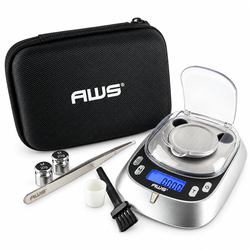
A 100g x 0.01g digital scale is a practical choice when small differences in mass matter more than high capacity. These compact scales are commonly used for jewelry, gemstones, coins, herbs, craft materials, small hardware, hobby parts and other lightweight items.
However, the numbers printed on the scale are only the beginning of the buying decision.
Every scale in this category may offer a maximum capacity of 100 grams and display measurements in 0.01-gram increments, but the models can differ significantly in platform size, enclosure design, weighing modes, accessories, power source and overall handling.
The best scale is therefore not necessarily the model with the longest list of features. It is the model whose platform, controls, accessories and physical design fit the objects you plan to weigh.
This guide compares several 100g x 0.01g models available from American Weigh Wholesale. It also explains what the specification means, where these scales work well and what buyers should verify before ordering.
Quick Comparison of 100g x 0.01g Digital Scales
The following comparison provides a starting point for selecting among the available 100g precision pocket scales.
| Model | Capacity | Readability | Notable characteristic | Best suited for |
|---|---|---|---|---|
| Digitz DZ2-100 | 100g | 0.01g | Straightforward pocket-scale format | General compact weighing |
| AXIS-100 | 100g | 0.01g | Round scale with removable bowl | Loose or difficult-to-contain materials |
| Fast Weigh ES-100 | 100g | 0.01g | Compact rectangular design | Portable everyday weighing |
| CDV2-100 | 100g | 0.01g | Approximately 4-by-4-inch platform | Objects needing more surface area |
| Blade-100 Special Edition | 100g | 0.01g | Silicone mat, trays and sleeve | Buyers wanting an accessory package |
All five models share the same nominal capacity and display increment. That does not make them interchangeable. Platform dimensions, container options and portability can have a greater effect on everyday usefulness than the basic specification alone.
Product specifications and availability can change. Confirm the current product listing before placing a wholesale or retail order.
What Does 100g x 0.01g Mean?
The notation describes two separate characteristics:
-
100g is the scale’s stated maximum capacity.
-
0.01g is its readability, display increment or scale division.
A scale with this specification displays weight in steps of one-hundredth of a gram:
-
0.01g
-
0.02g
-
0.03g
-
0.04g
One hundredth of a gram is equal to 10 milligrams. The specification therefore indicates that the display changes in 10-milligram increments.
The gram is an SI unit used to express mass. The National Institute of Standards and Technology provides additional information about SI units for mass.
Readability Is Not the Same as Accuracy
A frequent purchasing mistake is treating 0.01g readability as a promise that every result will be accurate to exactly ±0.01g.
Readability tells you the smallest increment shown on the display. Accuracy describes how closely a result agrees with the relevant reference value under stated conditions. Repeatability, linearity, calibration, environmental stability and operator technique can all affect actual results.
NIST distinguishes between a scale division, commonly represented by “d,” and a verification scale division, represented by “e.” These terms are related but should not automatically be treated as equivalent. Its explanation of scale division versus verification scale division is useful for buyers comparing weighing specifications.
A 0.01g display should consequently be understood as a resolution specification—not an all-purpose accuracy guarantee.
The Container Counts Toward the 100g Limit
The stated capacity applies to the total physical load placed on the platform. That includes:
-
The sample
-
A weighing tray
-
A bowl or cup
-
Weighing paper
-
Any other container
For example, if an empty container weighs 28g, the remaining physical capacity is approximately 72g. Pressing the tare button can return the display to zero, but it does not restore the capacity consumed by the container.
This distinction becomes especially important when the samples approach the upper portion of the scale’s range.
Best 100g x 0.01g Digital Scales by Use Case
Rather than naming one universal winner, the following selections match each model to the situations in which its design may be most useful.
1. Digitz DZ2-100: Best for Straightforward General Weighing
The Digitz DZ2-100 digital pocket scale is a conventional option for buyers who want a compact 100g x 0.01g scale without a highly specialized platform design.
According to the current product information, it supports the following weighing units:
-
Grams
-
Ounces
-
Carats
-
Grains
The scale is designed to calibrate with a 100g calibration weight, although the required weight is not listed as included with the model.
Why Choose the DZ2-100?
Its straightforward form makes it suitable for a broad range of lightweight objects, including:
-
Coins
-
Small jewelry items
-
Beads
-
Gemstones
-
Craft materials
-
Hobby components
-
Small hardware
The available unit modes also support users working in different fields. Carats may be helpful for gemstone-related applications, while grains may be useful when comparing certain small components or collectible materials.
Possible Limitations
Like most pocket scales, the DZ2-100 has limited capacity and platform space. Large containers or oversized objects can overhang the platform, obscure the display or place force outside the intended weighing area.
It is therefore a better match for small items than for bulky objects that happen to weigh less than 100g.
Best Fit
Choose the DZ2-100 when you need a simple, portable scale for general small-item weighing and do not require an integrated bowl, oversized platform or extensive accessory kit.
2. AXIS-100: Best for Loose Materials
The AXIS-100 digital bowl pocket scale combines the 100g x 0.01g specification with a round design and a removable weighing bowl.
The published specifications list:
-
100g maximum capacity
-
0.01g readability
-
Approximately 2.9-inch-diameter platform
-
Gram, ounce, troy-ounce, pennyweight, carat and grain modes
-
Two included AAA batteries
-
An operating-temperature range of 10°C to 30°C
-
A 100g calibration requirement, with the calibration weight not included
-
A ten-year manufacturer warranty
The scale is listed at approximately 3.5 inches in diameter and 0.9 inches tall.
Why Choose the AXIS-100?
The bowl is the principal advantage. Flat platforms work well for individual solid objects, but loose pieces can roll, scatter or extend beyond the weighing surface. A bowl helps contain materials such as:
-
Beads
-
Seeds
-
Small fasteners
-
Crystals
-
Tea leaves
-
Craft embellishments
-
Small collections of components
The bowl can also reduce the need to find a separate container whose weight and dimensions fit the scale.
Additional Weighing Modes
The AXIS-100 offers more displayed unit modes than several basic pocket scales. Troy ounces and pennyweight may be helpful in precious-metal or jewelry-related contexts, while carats and grains support other specialized comparisons.
Unit selection does not change the physical sensitivity of the weighing mechanism. It converts the result into a different displayed unit.
Possible Limitations
A bowl adds convenience, but it still consumes part of the scale’s physical capacity. Users should weigh the empty bowl or container before loading the sample and confirm that the combined mass will remain safely within the 100g limit.
The round form may also be less convenient for long, rectangular or irregularly shaped objects.
Best Fit
Choose the AXIS-100 when loose materials are common and an included containment solution is more useful than a large flat platform.
3. Fast Weigh ES-100: Best Compact Everyday Option
The Fast Weigh ES-100 digital pocket scale offers the same 100g capacity and 0.01g readability in a compact rectangular body.
Its listed specifications include:
-
Gram, ounce, carat and grain modes
-
An approximately 2.4-by-2.18-inch platform
-
Overall dimensions of approximately 4.05 by 2.91 by 0.79 inches
-
Two included AAA batteries
-
A recommended operating range of 10°C to 30°C
-
Calibration using a 100g weight, not included
-
A ten-year manufacturer warranty
Why Choose the ES-100?
The ES-100 is a practical candidate when portability is a priority. Its compact rectangular profile can fit into:
-
Counter drawers
-
Tool cases
-
Craft kits
-
Collector storage areas
-
Retail demonstration kits
It is well suited to businesses that want an approachable pocket scale for customers weighing small, solid items.
Objects That Fit the ES-100 Well
Potential applications include:
-
Individual coins
-
Small gemstones
-
Rings and other compact jewelry
-
Beads
-
Watch components
-
Model-making parts
-
Small screws and washers
The platform is large enough for many common pocket-scale tasks, but buyers should still compare the dimensions with the typical objects and containers they plan to use.
Possible Limitations
The compact platform may not properly support large envelopes, long pieces or wide containers. Overhang can make a scale harder to use even when the total load remains under 100g.
The model is best treated as a portable small-object scale—not as a miniature substitute for a larger bench scale.
Best Fit
Choose the ES-100 when compact dimensions, simple controls and a conventional rectangular format are more important than an included bowl or expanded platform.
4. CDV2-100: Best for a Larger Weighing Surface
The CDV2-100 digital scale stands out because its published platform measures approximately four inches by four inches.
The listed specifications include:
-
100g maximum capacity
-
0.01g readability
-
Gram, ounce, carat and grain modes
-
Approximately 4-by-4-inch platform
-
Overall dimensions of approximately 4.9 by 5.5 by 0.5 inches
-
Two included CR2032 batteries
-
Calibration using a 100g weight, not included
-
A ten-year manufacturer warranty
Why Choose the CDV2-100?
Platform size is often overlooked. Buyers may focus entirely on capacity and readability, only to discover that their normal objects do not sit securely on the weighing surface.
The CDV2-100’s larger platform can be useful for:
-
Small trays
-
Weighing paper
-
Flat collectible items
-
Multiple small components
-
Wider craft materials
-
Lightweight objects with irregular shapes
A larger platform does not increase the 100g capacity, but it can improve positioning and visibility.
When a Larger Platform Matters
An object should ideally sit securely and centrally on the platform without contacting the surrounding housing, work surface or other objects. A platform that is too small can result in unstable placement or make the display difficult to read.
The CDV2-100 may therefore be preferable when the objects are lightweight but not particularly compact.
Possible Limitations
The larger form is less pocket-oriented than the smallest models. Buyers seeking maximum portability may prefer a smaller rectangular scale.
Its use of CR2032 batteries also differs from models powered by AAA batteries. Retailers should clearly communicate the battery type so customers know what replacement batteries to purchase.
Best Fit
Choose the CDV2-100 when usable surface area matters more than minimum exterior dimensions.
5. Blade-100 Special Edition: Best Accessory Package
The Blade-100 Special Edition Chrome digital pocket scale combines a 100g x 0.01g specification with several accessories.
The current product information lists:
-
A silicone weighing mat
-
Two expansion trays
-
A leather sleeve
-
Gram, ounce, carat and grain modes
-
An approximately 2.7-by-2.7-inch platform
-
Overall dimensions of approximately 3.8 by 3.8 by 0.8 inches
-
Two included AAA batteries
-
A stated operating range of 10°C to 30°C
-
Calibration using a 100g weight, not included
Why Choose the Blade-100 Special Edition?
Accessories can make a compact scale more adaptable. The expansion trays can help contain small items or provide a more convenient loading surface. The silicone mat can help protect the weighing area during appropriate uses, while the sleeve supports storage and transport.
This package can appeal to:
-
Collectors
-
Hobbyists
-
Jewelry sellers
-
Craft users
-
Mobile buyers
-
Gift-oriented retail customers
Use the Accessories Carefully
Any mat, tray or container placed on the scale contributes to the total load. Taring removes its displayed weight, but the physical mass still counts toward the 100g capacity.
Accessories should also be positioned so they do not touch the surrounding housing or work surface. External contact can interfere with the transfer of force to the load cell.
Possible Limitations
A feature-rich package is not automatically necessary for every buyer. Customers who only weigh individual solid objects may prefer a simpler model.
The chrome appearance may be attractive for retail presentation, but finish and accessories should remain secondary to platform fit, capacity and weighing requirements.
Best Fit
Choose the Blade-100 Special Edition when trays, a protective mat and a storage sleeve add genuine value to the intended workflow.
Which 100g x 0.01g Scale Is Best?
The answer depends primarily on what will be placed on the platform.
| Buyer priority | Recommended model |
|---|---|
| Straightforward general weighing | Digitz DZ2-100 |
| Loose items requiring containment | AXIS-100 |
| Compact rectangular pocket scale | Fast Weigh ES-100 |
| Larger flat weighing surface | CDV2-100 |
| Included trays, mat and sleeve | Blade-100 Special Edition |
These recommendations are based on physical design and published features. They should not be interpreted as laboratory performance rankings or certification claims.
Important Features to Compare
Platform Size and Shape
A platform must support the actual item or container—not merely its weight.
Before ordering, measure the length and width of representative objects. If a container will be used, measure its base as well. A platform that is too small may lead to awkward placement, display obstruction or contact with the surrounding scale housing.
Platform shape matters too:
-
Round platforms can work well with bowls and cups.
-
Square platforms can accommodate small trays and weighing paper.
-
Narrow rectangular platforms are suited to compact individual objects.
-
Larger flat platforms are easier to use with irregular shapes.
Tare Function
The tare function subtracts the displayed weight of a container.
A typical process is:
-
Place the empty container on the platform.
-
Allow the display to settle.
-
Press the tare button.
-
Confirm that the display returns to zero.
-
Add the material.
-
Read the net displayed mass.
Remember that tare changes the displayed zero point but does not increase the load cell’s capacity.
If the container weighs 35g, a 100g scale does not suddenly have room for 100g of material after taring. The remaining physical capacity is approximately 65g.
Calibration
Calibration helps relate the scale’s indication to a known reference under appropriate conditions. The models covered here specify calibration with a 100g weight, but the calibration weight is not listed as included.
A calibration weight should not be selected solely because an ordinary object is labeled as weighing 100g. Coins, packaged products and household objects are not substitutes for an appropriate calibration standard.
NIST’s publication Accuracy Matters: Weighing in the Balance discusses why accurate measurements depend on suitable equipment, procedures and reference standards.
Follow the instructions for the exact scale model. Calibration procedures can differ even among scales with identical capacity and readability specifications.
Unit Modes
Common unit modes on 100g pocket scales include:
-
g: grams
-
oz: ounces
-
ct: carats
-
gn: grains
-
ozt: troy ounces
-
dwt: pennyweight
Not every model includes every mode. Buyers should verify the required unit before ordering.
It is generally preferable to record results directly in the needed unit rather than repeatedly converting values by hand. However, unit conversions do not improve the underlying precision of the measurement.
Power Source
AAA-powered models may be convenient because replacement batteries are widely available. Coin-cell batteries allow a thinner housing but may be less likely to be stocked in every workplace.
For retail buyers, battery type affects:
-
Customer expectations
-
Replacement convenience
-
Packaging information
-
Demonstration procedures
-
Long-term ownership experience
Batteries should be removed or checked according to the manufacturer’s storage recommendations if a scale will remain unused for an extended period.
Protective Cover, Bowl or Tray
A cover can help protect the platform during storage. On some scales, the cover may also function as a tray.
A bowl is useful for loose materials, while a flat tray may work better for parts, jewelry or craft components. The right accessory can improve handling, but it must fit within the scale’s available capacity.
Display Visibility
The display should remain visible after the item or container is placed on the scale. A wide object can block the display even if it fits within the platform’s general footprint.
When comparing models, consider:
-
Display position
-
Character size
-
Backlighting
-
Viewing angle
-
Whether containers will obscure the readout
This is especially important for retail counters, demonstrations and repeated packing workflows.
Stability and Working Environment
A scale displaying to 0.01g can respond to influences that are easy to overlook.
For more consistent results:
-
Use a firm, level surface.
-
Keep the scale away from fans and ventilation outlets.
-
Avoid unstable folding tables.
-
Do not place it beside vibrating machinery.
-
Keep the platform clean.
-
Allow objects to reach the surrounding room temperature where appropriate.
-
Center the load.
-
Wait for the indication to settle.
-
Avoid touching the table while reading the display.
Drafts can disturb light objects and open containers. Vibration can cause fluctuating readings. Temperature changes can also affect the weighing system or create air movement around the sample.
NIST’s weighing and scales frequently asked questions provide additional background on weighing devices and their use.
What Can You Weigh on a 100g x 0.01g Scale?
These scales are suited to lightweight objects for which 0.1g resolution would be too coarse but milligram-level 0.001g readability is unnecessary.
Potential applications include:
Jewelry and Gemstones
A 100g scale may be useful for loose stones, beads, rings, small chains and components. Buyers should check whether carat, troy-ounce or pennyweight modes are required.
Coins and Collectibles
Collectors can use a compact scale as one part of a broader inspection process. Weight alone does not establish authenticity, condition or value.
Crafts and Model Making
Small pieces of clay, resin additives, beads, miniature components and other craft materials may fall within the scale’s range.
The scale should not be exposed to adhesives, uncured resin or liquids unless a suitable container or protective method is used.
Small Hardware
Screws, washers, springs and other lightweight components can be compared or counted by weight when the process has been properly validated.
Variation between individual parts can affect count-by-weight estimates, so a scale should not be assumed to provide exact piece counts without testing.
Tea, Herbs and Dry Ingredients
A 0.01g display can be useful for small amounts of dry material. If a scale will contact materials intended for consumption, use appropriate containers and follow suitable hygiene and cross-contamination procedures.
Hobby Components
Fishing tackle, archery components, model parts and other small hobby items may fit this capacity class. Users should consider both the individual item weight and the combined weight of any container.
When Is 100g Capacity Too Low?
A 100g scale is not the right choice when containers and samples regularly approach the maximum limit.
Consider a higher-capacity scale if you expect to weigh:
-
Containers heavier than 30g to 40g
-
Batches near 100g
-
Large trays
-
Multiple objects at once
-
Bulky packages
-
Items with unpredictable weight
Operating close to maximum capacity leaves little room for variation. If most normal loads exceed approximately 70g to 80g after including the container, a 200g or 500g model may offer a more practical working range.
The tradeoff is that higher capacity does not automatically preserve the same readability. Always compare both numbers in the specification.
For example:
-
100g x 0.01g and 500g x 0.01g have the same stated display increment but different capacities.
-
100g x 0.01g and 600g x 0.1g differ in both capacity and readability.
-
100g x 0.01g and 50g x 0.001g involve a tradeoff between capacity and a finer displayed increment.
Is a 100g x 0.01g Scale Suitable for Commercial Transactions?
Do not assume that a pocket scale is legal for trade merely because it has a digital display or fine readability.
A legal-for-trade device is evaluated and used within a regulatory framework. Requirements may involve device certification, installation, inspection, sealing and jurisdiction-specific rules.
NIST explains that legal metrology applies measurement requirements to commercial and regulatory activities.
If a scale will determine the price charged to a customer, verify:
-
The exact model’s legal-for-trade status
-
Applicable National Type Evaluation Program requirements
-
State and local weights-and-measures rules
-
Registration or inspection requirements
-
Suitability for the intended commodity and transaction
The current edition of NIST Handbook 44 contains specifications, tolerances and other technical requirements for weighing and measuring devices used in regulated applications.
For ordinary sorting, formulation, hobby work or internal comparisons, legal-for-trade status may not be required. Commercial price determination is different and should be reviewed with the appropriate local authority.
How to Choose the Right Model
Use the following process before purchasing.
Step 1: Determine the Heaviest Total Load
Add together:
-
The heaviest expected sample
-
The container
-
Any tray, liner or mat
-
A reasonable margin for variation
If that combined value approaches 100g, select a higher-capacity scale.
Step 2: Measure the Objects and Containers
Compare their dimensions with the published platform dimensions. Capacity alone does not tell you whether an object will fit.
Step 3: Identify the Required Unit
Confirm whether you need grams, ounces, carats, grains, troy ounces or pennyweight. Do not assume that every 100g model offers the same modes.
Step 4: Decide Whether You Need a Bowl or Tray
Loose materials benefit from containment. Flat or irregular objects may work better on a larger square platform.
Step 5: Consider Portability
For a scale carried between locations, compare:
-
Exterior dimensions
-
Cover or sleeve
-
Battery type
-
Accessory storage
-
Platform protection
For a scale that stays at one workstation, platform size and display visibility may be more important.
Step 6: Plan for Calibration
Check the calibration procedure and obtain the appropriate calibration weight if it is not included. Store the weight carefully and avoid unnecessary handling or contamination.
Step 7: Verify Regulatory Requirements
If the result will be used to determine a selling price, confirm legal-for-trade requirements before purchasing.
Buying 100g x 0.01g Scales for Retail or Wholesale Programs
Retailers should evaluate more than the scale itself. The right assortment depends on customer needs and merchandising strategy.
Offer Models With Clear Differences
Stocking several nearly identical scales can confuse customers. A more useful assortment might include:
-
One straightforward entry-level model
-
One bowl scale
-
One large-platform model
-
One accessory-focused model
This allows sales staff and product descriptions to explain why each option exists.
Merchandise by Application
Useful merchandising categories include:
-
Jewelry and gemstones
-
Coins and collectibles
-
Crafts and hobbies
-
Small hardware
-
Portable precision weighing
Application-based descriptions help customers choose according to workflow rather than appearance alone.
State Capacity and Readability Clearly
Product titles and shelf labels should show both values:
100g capacity x 0.01g readability
Avoid describing 0.01g only as “accuracy” unless the manufacturer provides an accuracy specification and the wording precisely reflects it.
Explain That Calibration Weights May Be Separate
If a model requires a 100g calibration weight and the weight is not included, disclose that fact clearly. This reduces customer confusion and creates an opportunity to offer a compatible calibration accessory.
Avoid Unsupported Claims
Do not promise that a general-purpose pocket scale is:
-
Laboratory certified
-
Legal for trade
-
Accurate to exactly ±0.01g
-
Suitable for every formulation
-
Appropriate for regulated professional work
Marketing language should match the published specifications and intended use of the exact model.
Frequently Asked Questions
What is the best 100g x 0.01g digital scale?
The best model depends on the object being weighed. The DZ2-100 is a straightforward general option, the AXIS-100 includes a bowl, the ES-100 emphasizes compact portability, the CDV2-100 provides a larger platform and the Blade-100 Special Edition includes multiple accessories.
How precise is a 100g x 0.01g scale?
It displays weight in 0.01g increments, equivalent to 10mg. That is its readability. Actual measurement performance also depends on calibration, repeatability, load placement, environmental conditions and the scale’s other specifications.
Can a 100g x 0.01g scale weigh 1mg?
No. One milligram is 0.001g, which is smaller than the scale’s 0.01g display increment. A scale designed to display 0.001g increments would be required for milligram-level readability, along with suitable performance and environmental control.
What is the minimum weight for a 0.01g scale?
The minimum reliable load cannot be determined from readability alone. Consult the manufacturer’s specifications for minimum load, accuracy, tolerance or recommended operating range. Do not assume that 0.01g is automatically a validated minimum sample weight.
Does pressing tare increase capacity?
No. Tare changes the displayed zero point but does not change the load cell’s physical capacity. The container and sample together must remain within 100g.
Do these scales include a calibration weight?
The models compared in this guide specify calibration using a 100g weight, but their current product information does not list that calibration weight as included. Verify package contents before ordering.
Can I use coins to calibrate a scale?
Coins are not recommended substitutes for an appropriate calibration weight. Their mass can vary because of manufacturing tolerances, circulation wear, dirt, corrosion or damage.
Is a larger platform more accurate?
Not necessarily. Platform size affects how easily an object can be positioned and supported. It does not by itself establish accuracy. A larger platform may simply be more convenient for wide or irregularly shaped items.
Are 100g x 0.01g scales suitable for food?
They may be used with appropriate containers for small quantities, subject to the manufacturer’s intended-use instructions. Avoid direct contact when the platform or scale is not designed for food-contact use, and maintain suitable sanitation and cross-contamination controls.
Can a pocket scale be used for laboratory work?
A pocket scale may support informal comparisons, demonstrations or noncritical measurements. It should not automatically be treated as a substitute for a laboratory balance with documented performance, calibration, traceability and environmental controls.
Are these scales legal for trade?
Do not assume so. Legal-for-trade suitability depends on the exact model, certification and applicable jurisdictional requirements. Contact the relevant weights-and-measures authority before using a scale to determine a customer’s price.
Should I choose 100g x 0.01g or 200g x 0.01g?
Choose 100g capacity when all containers and samples remain comfortably below 100g and compact size is desirable. Choose 200g capacity when normal loads may exceed the practical working range of a 100g model. If both have 0.01g readability, the main specification difference is capacity, although platform, construction and performance details may also differ.
Final Recommendation
The best 100g x 0.01g digital scale is the model that matches the physical characteristics of the items being weighed.
For straightforward small-object weighing, the Digitz DZ2-100 is a practical starting point. For loose materials, the AXIS-100’s bowl is the more useful feature. The Fast Weigh ES-100 suits buyers prioritizing a compact rectangular design, while the CDV2-100 is better for objects needing a larger platform. The Blade-100 Special Edition offers the most complete accessory package among the models compared here.
Regardless of model, remember the three most important rules:
-
The 100g limit includes the container and accessories.
-
The 0.01g increment describes readability, not guaranteed accuracy.
-
Platform dimensions and object shape matter as much as capacity.
Compare the entire workflow—not just the two numbers printed in the specification—to select a scale that will be convenient, suitable and easy to use.