
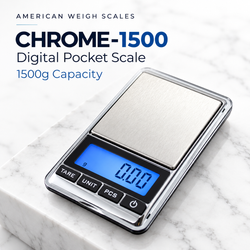
The best 1500g x 0.1g digital scale is one that accommodates your complete load, supports your container securely, and provides measurement performance suitable for your task.
For buyers shopping this specification at American Weigh Scales, the CHROME-1500 is an option to consider. Its listed features include a 1500g weighing range, tenth-gram readability, a broad square platform, and a cover that can serve as an expansion tray.
The specification offers a useful middle ground: more capacity than a one-kilogram scale while retaining 0.1g displayed increments. That can suit ingredient portions, coffee, grouped collectibles, craft materials, and hardware.
This guide explains where the CHROME-1500 fits, which features deserve attention, and when a different scale specification would serve you better.
What Does 1500g x 0.1g Mean?
The specification contains two separate numbers:
- 1500g capacity: The maximum rated total load.
- 0.1g readability: The displayed increment in gram mode.
The maximum includes the contents, container, and any accessories supported by the platform.
A tenth-gram display can show readings such as 35.4g, 248.9g, or 1200.6g. It does not display hundredths of a gram, such as 35.42g.
One thousand five hundred grams equals 1.5 kilograms. The BIPM SI Brochure provides the international reference for SI units and prefixes. Changing unit modes does not increase physical capacity. www.bipm.org
Recommended AWS Option: CHROME-1500
The CHROME-1500 Digital Pocket Scale Series combines this capacity and readability with a listed 4.0 x 4.0-inch platform.
Its product information also lists:
- A backlit display.
- A stainless-steel weighing surface.
- A cover that can serve as an expansion tray.
- Two AAA batteries.
- A 1kg calibration weight requirement, with that weight not included.
- Gram, ounce, troy-ounce, pennyweight, carat, and grain modes. AWScales
These features make it worth considering for buyers who need more load capacity and platform area than some smaller pocket models provide.
The recommendation concerns listed features and suitability. It does not establish a tested accuracy advantage over other models.
CHROME-1500 at a Glance
| Listed characteristic | Specification |
|---|---|
| Model | CHROME-1500 |
| Capacity | 1500g |
| Readability in gram mode | 0.1g |
| Platform | 4.0 x 4.0 inches |
| Power | Two AAA batteries |
| Calibration weight | 1kg, not included |
| Listed unit modes | g, oz, ozt, dwt, ct, gn |
| Protective feature | Cover that can serve as an expansion tray |
Always follow the instructions supplied with the exact unit for operation, calibration, and loading.
What Makes a 1500g Scale a Good Purchase?
The right choice depends on the work, rather than the number of features.
Sufficient capacity
Your heaviest expected container-and-contents combination should remain comfortably within 1500g.
Suitable displayed detail
Tenth-gram increments should match the measurement differences you need to distinguish.
Stable container fit
The vessel must sit securely and remain clear of surrounding objects.
Accessible display and controls
A bowl that hides the screen or blocks buttons can make routine weighing inconvenient.
Appropriate calibration support
Check the required reference mass and whether the necessary weight is included.
Practical storage
If the scale travels between locations, consider its cover, storage space, and protection from pressure on the platform.
Browse the AWS digital pocket scale collection to compare formats alongside the capacity specification.
Capacity Includes the Container
Tare resets the displayed reference. It does not remove the container’s physical load.
Use this calculation:
Total supported load = container + contents + supported accessories
| Container mass | Capacity remaining for contents |
|---|---|
| 100g | 1400g |
| 250g | 1250g |
| 400g | 1100g |
| 600g | 900g |
| 900g | 600g |
Example: A suitable batch
A tray weighs 150g and holds 1000g of material.
150g + 1000g = 1150g
The complete load fits within the rating.
Example: A batch needing more capacity
A bowl weighs 500g and holds 1200g of ingredients.
500g + 1200g = 1700g
This exceeds a 1500g capacity, even after taring the bowl.
Choose around your heaviest expected setup. If normal loads nearly reach the maximum, additional capacity may be more practical.
Best Fit for Coffee and Tea
A 1500g x 0.1g scale can suit dry coffee beans and loose tea when the complete load and required tolerance fit.
For small portions, the main benefit may be the displayed detail rather than the full capacity.
For larger dry batches, the additional range can accommodate more material in one container.
Brewing requires additional checks
Include the vessel, ingredients, and liquid in the supported load.
Also consider:
- Timer requirements.
- Response behavior.
- Display visibility.
- Platform stability.
- Moisture protection.
A scale suitable for dry portions is not automatically the best brewing scale. Choose around the complete process.
Best Fit for Ingredients and Smaller Recipes
A 1.5kg range may accommodate bowls and batches that exceed one kilogram together.
For example:
- Bowl: 300g.
- Ingredients: 900g.
- Total load: 1200g.
This fits within a 1500g rating and leaves 300g before the maximum.
Larger recipes may require more capacity. Very small additions may require finer readability.
For workflows centered on bowls and ingredient preparation, compare the formats available in the AWS kitchen scale selection.
Best Fit for Collectibles and Craft Supplies
Grouped coins, small decorative objects, beads, findings, and similar materials can benefit from a suitable tray and sufficient capacity.
However, 0.1g readability is not appropriate for every identification or inspection task.
If small mass differences matter, assess the required tolerance before choosing. Weighing also cannot independently establish authenticity.
For mixtures, follow the material manufacturer’s instructions. Ratios by mass and volume are not automatically interchangeable.
Readability Does Not Establish Accuracy
A scale that displays one decimal place does not automatically measure every load within ±0.1g.
Three concepts matter:
Readability describes the displayed increment.
Accuracy concerns agreement with the relevant reference value.
Repeatability concerns agreement between repeated measurements under the same conditions.
The International Vocabulary of Metrology provides standardized terminology for these distinctions. www.bipm.org
A scale can repeatedly produce the same reading while differing from a reference value. Consistency alone does not establish accuracy.
Review documented performance when your task has a defined measurement tolerance.
Is 0.1g Enough for Your Smallest Sample?
The same display increment represents a larger proportion of a small sample than a large batch.
| Sample mass | One 0.1g increment relative to the sample |
|---|---|
| 1g | 10% |
| 5g | 2% |
| 10g | 1% |
| 100g | 0.1% |
| 500g | 0.02% |
These percentages describe display increments. They are not estimates of accuracy or measurement uncertainty.
If you need displayed differences below 0.1g, consider finer-readability equipment with suitable documented performance.
The minimum useful sample cannot be established from capacity and readability alone.
Platform Fit Can Matter More Than Capacity
A wide, lightweight container may need substantial platform area even when its total load is modest.
Before buying:
- Measure the container’s base.
- Compare it with the listed platform.
- Check whether the display remains visible.
- Confirm that the controls remain accessible.
- Ensure the vessel cannot touch nearby surfaces.
A container touching the countertop or another object can transfer some of its load away from the scale.
Overhang is not automatically a problem, but stability and clearance matter. Follow the model’s loading guidance.
Calibration Requirements and Accessories
The CHROME-1500 listing specifies a 1kg calibration weight, not included. The required reference mass is therefore different from its maximum capacity.
Use the model’s specified procedure and an appropriate weight.
NIST’s balance and scale calibration guidance addresses reference standards, weighing errors, uncertainty, and minimum sample quantities. These considerations help determine whether equipment fits the task. www.nist.gov
For documented measurement work, NIST’s policy on metrological traceability explains the role of a documented calibration chain with associated uncertainty. A nominal mass label alone does not establish traceability for your results. www.nist.gov
Use the AWS manuals directory to locate model instructions and confirm the correct operating procedure.
How to Obtain More Consistent Readings
Good setup and handling support useful measurements.
- Use a firm, level surface.
- Avoid drafts and vibration.
- Allow temperature adjustment after moving the scale.
- Keep the platform clean and unobstructed.
- Position the container securely.
- Add material gently.
- Wait for a stable reading.
- Stay within total capacity.
The AWS scale maintenance guide explains that temperature differences can cause drifting readings and recommends allowing equipment to adjust to room temperature. It also addresses batteries and calibration. awscales.com
NIST’s Use of Analytical Balances discusses weighing vessels, procedures, and methods for reducing sample losses. Although analytical balances are a different instrument class, careful handling remains relevant to routine weighing. www.nist.gov
When Another Specification Would Be Better
| Your requirement | Specification to consider |
|---|---|
| Complete loads comfortably below 1000g | A suitable lower-capacity model |
| Complete loads above 1500g | Higher capacity |
| Displayed differences below 0.1g | Finer readability |
| Large batches and tiny additions | Two complementary scales |
| Commercial transactions by weight | Equipment meeting applicable approval requirements |
A higher capacity does not replace finer readability. A finer display does not solve overloading.
For commercial weighing, NIST Handbook 44 provides specifications, tolerances, and technical requirements for weighing and measuring devices. Confirm applicable requirements and the approval status of the exact equipment. www.nist.gov
Frequently Asked Questions
Which AWS 1500g x 0.1g scale should I consider?
The CHROME-1500 is an option with a listed 4.0 x 4.0-inch platform, expansion-tray cover, and multiple unit modes.
Is a 1500g scale more accurate than a 1000g scale?
Capacity alone does not establish accuracy. Compare the performance of the individual models.
Can I weigh 1500g of material in a bowl?
The bowl adds physical load. If the material alone weighs 1500g, adding a bowl exceeds the rating.
Does tare restore capacity?
No. It resets the displayed reference while the physical load remains.
What calibration weight does the CHROME-1500 require?
Its product listing specifies a 1kg weight, not included.
Is tenth-gram readability enough for tiny quantities?
Not necessarily. Suitability depends on sample size, required tolerance, and documented instrument performance.
Should I choose a larger scale for recipes?
Choose around the complete load. Some bowls and recipes exceed 1500g and require more capacity.
Choosing the Best Scale for Your Routine
The CHROME-1500 deserves consideration when you need a 1500g range, tenth-gram displayed detail, and a platform suited to wider trays.
Before ordering, calculate your heaviest complete load and identify the smallest measurement difference that matters. Then compare platform fit, display access, calibration accessories, and storage requirements.
Contact American Weigh Scales product support for help selecting equipment around those needs.