
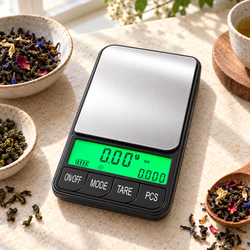
The best 600g x 0.1g digital scale is not necessarily the model with the longest feature list. The right choice is the one whose platform, cover, display, unit modes and physical format match the way the scale will actually be used.
All scales in this class share two headline specifications: a maximum capacity of 600 grams and a displayed increment of 0.1 gram. That combination is useful for coffee, tea, food portions, jewelry lots, coins, collectibles, craft supplies, dry ingredients and small hardware. It offers more working capacity than many fine-resolution pocket scales while retaining tenth-gram detail.
American Weigh Wholesale currently offers several compact models in this range, including the CARDV2-600, AWS-600, V2-600 and ES-600. Each is designed for portable weighing, but the shapes, covers, platform dimensions, brand positioning and display details differ. This guide compares those models and explains how to select the best one for a specific user or retail assortment.
Best 600g x 0.1g Digital Scales: Quick Picks
| Model | Best for | Standout feature | Platform | Calibration reference |
|---|---|---|---|---|
| CARDV2-600 | Slim, card-style portability | Removable cover doubles as tray | 1.9 x 3.5 in | 500g, not included |
| AWS-600 | Familiar all-purpose pocket format | Hinged cover and color-changing unit display | 1.9 x 3.3 in | 500g, not included |
| V2-600 | Value and color assortment | Compact body with removable tray cover | 1.9 x 2.1 in | 500g, not included |
| ES-600 | Lightweight everyday use | Flip-top cover becomes expansion tray | 2.4 x 2.18 in | 500g, not included |
Our overall recommendation
The CARDV2-600 is the strongest choice when a slim profile and longer rectangular platform matter. The AWS-600 is an excellent general-purpose option for shoppers who prefer a hinged protective cover. The V2-600 makes sense for value-focused retail assortments and buyers who want more color choices. The ES-600 is a straightforward lightweight alternative with a wider, shorter platform.
There is no universal winner because all four models provide the same nominal capacity and readability. The best choice depends on the object's footprint, the preferred cover style and the working environment.
What 600g x 0.1g Actually Means
The notation describes capacity and readability:
- 600g capacity: The heaviest total load the scale is designed to support is 600 grams.
- 0.1g readability: The display changes in increments of one tenth of a gram.
A display may progress from 18.2g to 18.3g to 18.4g. It does not display hundredths of a gram, such as 18.24g.
Six hundred grams equals 0.6 kilogram. NIST explains the kilogram, gram and related SI relationships in its overview of SI units for mass. Dividing the 600g capacity by the 0.1g display increment gives 6,000 displayed divisions across the nominal range.
Readability is not guaranteed accuracy
The display's last digit tells you the size of the displayed step. It does not, by itself, establish how close every result is to the true mass. Accuracy also depends on calibration, repeatability, linearity, temperature, vibration, air movement, load placement and the instrument's design.
NIST discusses the difference between a displayed scale division and a verification scale division in its explanation of scale division d versus verification scale division e. Buyers should avoid treating “0.1g” as a promise that every measurement is accurate within exactly 0.1g.
Capacity includes the container
A tare button can reset the display after a cup or tray is placed on the platform, but it cannot remove that container's physical weight from the load cell.
If a bowl weighs 160g and its contents weigh 390g, the scale is supporting 550g. Only 50g remains before reaching the rated maximum, even if the display shows a net value of 390.0g. A 160g bowl plus 460g of contents creates a 620g load and exceeds the rating.
This matters when selecting any of the recommended models. Platform shape may accommodate a container physically, but the container and contents must also remain within the total capacity.
1. CARDV2-600: Best Slim 600g x 0.1g Scale
The CARDV2-600 compact digital pocket scale is our leading option for buyers who want a thin, card-style scale with a comparatively long platform.
Key specifications
- Capacity: 600g
- Readability: 0.1g
- Units: g, oz, ozt and dwt
- Platform: 1.9 x 3.5 inches
- Overall dimensions: 4.1 x 3.0 x 0.8 inches
- Display: backlit LCD, approximately 0.4 x 1.1 inches
- Power: two AAA batteries
- Calibration: 500g weight, not included
- Operating temperature: 50°F to 86°F, or 10°C to 30°C
- Cover: removable and usable as an expansion tray
Why it stands out
Its 3.5-inch platform length is useful for narrow objects and small rectangular containers. The removable cover protects the stainless-steel weighing surface in storage and can hold loose items during use. The shape slips into a drawer or travel kit without requiring much vertical space.
The four supported units cover many common food, jewelry and general-purpose applications. A user who needs carats or grains should select a model that explicitly includes those modes, because they are not listed for this scale.
Best uses
The CARDV2-600 is a strong fit for tea, coffee portions, compact collectibles, coins, jewelry lots and narrow trays. It also works well as a retail choice for customers who prioritize portability and a clean card-style design.
Potential limitations
The platform is narrow, so a round container with a wider base may be less stable. An oversized item can also hide the display or extend beyond the body. As with other models in this group, the specified calibration weight is normally purchased separately.
2. AWS-600: Best All-Purpose Pocket Scale
The AWS-600 digital pocket scale is a classic portable option with a hinged protective cover and an interface designed for quick everyday operation.
Key specifications
- Capacity: 600g
- Readability: 0.1g
- Units: g, oz, ozt and dwt
- Platform: 1.9 x 3.3 inches
- Overall dimensions: 5 x 3 x 0.9 inches
- Display: backlit LCD
- Power: two AAA batteries
- Calibration: 500g weight, not included
- Cover: hinged protective lid
- Color options: black and silver listed
Why it stands out
The hinged cover stays attached to the scale, which reduces the chance of misplacing a separate lid. The display changes colors for different weighing modes, giving users an additional visual signal when switching units. Its overall format is familiar to shoppers looking for a conventional pocket scale.
The 3.3-inch platform is long enough for many small objects while the hinged cover provides protection during storage. One-touch calibration and a backlit display contribute to straightforward daily use.
Best uses
The AWS-600 is the best general-purpose choice in the group. It suits coffee, herbs, coins, grouped jewelry pieces, hardware, craft materials and routine household weighing. It is also easy for retailers to position as an all-around portable model.
Potential limitations
A hinged cover is protective, but it cannot always serve as a separate expansion tray the way a removable lid can. Users who frequently need a tray may prefer the CARDV2-600, V2-600 or ES-600. The platform remains compact, so larger bowls require careful fit checks.
3. V2-600: Best Value and Color Selection
The V2-600 digital pocket scale combines the 600g x 0.1g specification with a small footprint, removable tray cover and broad color selection.
Key specifications
- Capacity: 600g
- Readability: 0.1g
- Units: g, oz, ozt and dwt
- Platform: 1.9 x 2.1 inches
- Overall dimensions: 4.2 x 2.1 x 0.6 inches
- Display: backlit LCD, approximately 0.4 x 1.2 inches
- Power: two AAA batteries
- Calibration: 500g weight, not included
- Cover: removable and usable as a tray
- Colors: offered in multiple choices
Why it stands out
The V2-600 has the smallest platform and narrowest body among the four highlighted models. That makes it particularly easy to carry and store. The range of colors allows retailers to create a more varied display and lets users distinguish scales assigned to different tasks.
Its removable cover increases usefulness without adding a separate accessory. The cover protects the weighing surface between uses and can contain small or loose items while weighing.
Best uses
This model is well suited to travel kits, small drawers, individual users and retail assortments that benefit from varied colors. It is useful for coffee doses, tea, coins, jewelry, beads and other compact objects.
Potential limitations
The 1.9 x 2.1-inch platform provides less support for broad containers. A bowl can technically hold a light load but still be unstable if its base is much wider than the platform. Buyers should prioritize the CARDV2-600 or another format when platform area matters more than minimum size.
4. ES-600: Best Lightweight Alternative
The ES-600 digital pocket scale is a Fast Weigh model designed for portable everyday measurement with a flip-top cover that detaches for use as a tray.
Key specifications
- Capacity: 600g
- Readability: 0.1g
- Units: g, oz, ozt and dwt
- Platform: 2.4 x 2.18 inches
- Overall dimensions: 4.05 x 2.91 x 0.79 inches
- Display: backlit LCD, approximately 0.4 x 1.1 inches
- Power: two AAA batteries
- Calibration: 500g weight, not included
- Cover: removable expansion tray
- Colors: black, blue and silver listed
Why it stands out
The platform is shorter than those on the CARDV2-600 and AWS-600 but wider. That proportion may support small round containers more naturally. The controls follow a familiar three-button layout, and the removable cover gives users a tray for loose materials.
Its combination of compact dimensions, multiple colors and simple operation makes it a good alternative for customers who do not need a long rectangular platform.
Best uses
The ES-600 works well for compact bowls, food portions, coffee beans, coins, herbs, craft pieces and general portable weighing. Its wider platform shape can be helpful for containers with a small round base.
Potential limitations
Like the other models, it supports a maximum gross load of 600g, including the tray. Customers who need a larger platform or heavier tare allowance should move to a higher-capacity scale rather than placing an oversized container on this compact body.
Detailed Comparison of the Best 600g x 0.1g Scales
| Feature | CARDV2-600 | AWS-600 | V2-600 | ES-600 |
|---|---|---|---|---|
| Capacity | 600g | 600g | 600g | 600g |
| Readability | 0.1g | 0.1g | 0.1g | 0.1g |
| Gram mode | Yes | Yes | Yes | Yes |
| Ounce mode | Yes | Yes | Yes | Yes |
| Troy ounce mode | Yes | Yes | Yes | Yes |
| Pennyweight mode | Yes | Yes | Yes | Yes |
| Platform shape | Narrow rectangle | Narrow rectangle | Very compact rectangle | Wider compact rectangle |
| Cover style | Removable tray | Hinged protective lid | Removable tray | Removable tray |
| Batteries | 2 AAA | 2 AAA | 2 AAA | 2 AAA |
| Calibration mass | 500g | 500g | 500g | 500g |
| Best reason to choose | Slim profile | General-purpose design | Compact value and colors | Wider short platform |
The specification row does not reveal a large performance hierarchy. The meaningful differences are ergonomic. Choose the shape and cover that reduce friction in the intended workflow.
How We Chose the Best Models
The rankings focus on practical suitability rather than claiming that a single scale is objectively superior in every setting.
Correct capacity and readability
Every featured model is listed at 600g x 0.1g. This matters because similar-looking product families may include several capacities and resolutions.
Platform usefulness
The platform must support the item without rocking or touching another surface. We considered both dimensions rather than treating surface area as the only factor. A narrow, long platform and a shorter, wider one solve different problems.
Cover design
A cover protects the weighing surface from scratches and storage damage. Removable covers add tray functionality, while hinged covers reduce the chance that the lid gets separated from the scale.
Display and controls
All highlighted models include backlit displays and simple controls. Ease of reading and mode selection matter because an otherwise accurate measurement is useless if a user records the wrong unit.
Calibration clarity
Each model identifies a 500g calibration reference. Clear instructions reduce the risk of using the wrong mass or assuming a weight is included when it is not.
Portability
The selected scales are small enough for drawers, bags and compact workspaces. Portability is a central reason to choose this capacity class over a larger bench or kitchen scale.
Warranty
The product listings describe ten-year manufacturer warranties for these models, adding confidence for both individual and wholesale buyers. Warranty terms should still be reviewed at the time of purchase.
Which 600g Scale Is Best for Your Application?
Best for coffee and tea: CARDV2-600 or AWS-600
Both provide longer platforms that can support narrow cups or trays. The CARDV2-600 offers a removable tray, while the AWS-600 provides an attached cover. Tenth-gram readability is appropriate for many brewing doses and loose-leaf portions.
Do not assume 600g is enough for a complete brewing setup. A server, dripper and water can quickly exceed capacity. For weighing a full vessel during extraction, select a higher-capacity coffee scale.
Best for coins and collectibles: AWS-600
The familiar layout, protective hinged cover and portable format make it convenient for routine checks. A 0.1g display can support general sorting, but collectors who need to distinguish hundredth-gram differences should choose a 0.01g model.
Weight is only one indicator and should not be treated as conclusive evidence of authenticity, grade or value.
Best for jewelry lots: CARDV2-600
Its slim design and removable tray help contain chains, findings and grouped pieces. For individual gemstones or fine jewelry components where hundredth-gram differences matter, a finer-resolution model is more appropriate.
Commercial transactions priced by weight may require an approved legal-for-trade device. A general pocket scale should not be assumed suitable.
Best for crafts and beads: V2-600
The removable cover is useful for loose pieces, and multiple colors can help organize tools by workstation or material type. For very small or nearly weightless pieces, verify that 0.1g resolution provides enough sensitivity for the task.
Best for small round containers: ES-600
The wider platform proportion may provide a more natural base for a compact cup. The container and contents must still remain below 600g, and the container should not press against the surrounding surface.
Best for retail variety: Mix all four
Wholesale buyers can offer a slim card model, a familiar hinged-cover model, a compact value model and a wider-platform alternative. This creates meaningful customer choice without changing the core capacity and readability.
Explore the broader pocket scale collection to merchandise these models alongside 0.01g precision scales and higher-capacity options. The current AWS top sellers can also help retailers identify popular formats for a balanced assortment.
When a 600g x 0.1g Scale Is the Wrong Choice
Even the best model cannot overcome a specification mismatch.
You need to see less than 0.1g
Choose 0.01g readability if the workflow depends on changes of a few hundredths of a gram. For milligram-level tasks, use a suitable milligram scale and evaluate more than the number of decimal places.
Your container consumes too much capacity
If a normal cup weighs 250g and the largest contents weigh 400g, the required gross capacity is at least 650g before adding headroom. A one-kilogram model is a more appropriate starting point.
Your objects are physically large
A bulky but lightweight item can block the display, overhang the platform or touch the counter. Choose a larger platform even if 600g capacity is numerically sufficient.
You need transaction approval
Commercial use that determines price may require a legal-for-trade scale. The pocket models listed here should not be marketed as approved for that purpose unless their documentation specifically states it.
You need formal laboratory performance
Readability alone does not establish uncertainty, traceability or suitability for a controlled method. Laboratory work may require qualification, environmental controls, documented calibration and a balance designed for the required performance.
Calibration and Verification
All four highlighted models specify a 500g calibration weight, typically not included. Users should follow the manual for the exact scale because button sequences and preparation instructions can differ.
NIST provides technical guidance on the selection, calibration and use of balances in NISTIR 6969. Its weighing and scales FAQ provides additional context for weighing devices and measurement requirements.
Before calibration
- Place the scale on a firm, level surface.
- Keep it away from fans, vents and vibration.
- Allow the scale and weight to reach room conditions.
- Check that the platform is clean and unloaded.
- Use fresh batteries.
- Confirm the required calibration mass in the manual.
After calibration
Apply a suitable known mass and observe whether the result is stable and acceptable for the intended task. Remove and replace the load several times to evaluate repeatability. When practical, check more than one point in the working range.
Calibration is not a cure for overload damage, a flexible table, strong drafts or a failing battery. Fix environmental and mechanical problems first.
How to Get Better Results From a Pocket Scale
Use a stable surface
A rigid counter is better than a soft mat, lap, moving vehicle or flexible tray. Even small movement can affect the final digit.
Center the load
Place the item near the middle of the platform. An off-center container can create unstable readings and may tip.
Avoid drafts
Airflow affects lightweight materials and containers. Move away from open windows, fans and HVAC vents.
Let the reading stabilize
Do not record the first flashing value. Wait for a stable indication, especially after adding material gradually.
Keep the platform clean
Residue adds weight and can prevent a container from sitting flat. Wipe the platform according to the care instructions and never immerse the scale unless specifically permitted.
Track gross weight while using tare
Tare shows net contents but does not restore capacity. Add container and contents mentally or record the empty container weight before beginning.
Prevent shock loading
Lower items gently. Dropping a 300g object can briefly apply much more force than its resting mass and damage the load cell.
Store it with the cover in place
The protective cover reduces scratches and prevents other objects from pressing directly on the platform in a drawer or bag.
Understanding Measurement Quality
The best scale is one that performs consistently within the tolerance required by the application.
Readability
The 0.1g figure is the smallest display step.
Repeatability
Repeated measurements of the same unchanged item should agree closely under the same conditions. Remove and replace the object rather than leaving it on the platform.
Accuracy
Accuracy describes closeness to an accepted reference value. It cannot be inferred solely from the number of digits on the display.
Linearity
Linearity describes performance across the range. A scale can show one reference mass correctly while displaying a different error at another point.
Minimum practical load
Although a scale may react to a small amount, the smallest dependable net quantity for a particular task can be larger than one display division. Users should determine a minimum working amount based on repeatability, environment and required tolerance.
Legal-for-Trade and Commercial Use
Internal inventory, portioning and hobby use differ from determining a customer's price by weight. NIST explains the role of a legal metrology device, and NIST Handbook 44 provides specifications and tolerances used in weights-and-measures programs.
Requirements vary with jurisdiction and application. Confirm approval, inspection and device suitability with the relevant authority before using any scale in a commercial transaction. A calibration feature, stainless-steel platform or tenth-gram display does not automatically make a scale legal for trade.
Retail and Wholesale Buying Strategy
Stock by use case, not just color
Color variety can attract attention, but platform shape and cover style provide more meaningful differentiation. Explain why a customer might choose a card-style platform, hinged lid or removable tray.
Put both numbers on merchandising materials
Display “600g x 0.1g,” not simply “precision scale.” Customers need to know both the load limit and displayed increment.
State that calibration weights are separate
The recommended models specify a 500g calibration weight that is not included. Clear labeling prevents avoidable dissatisfaction.
Offer adjacent specifications
A shopper may arrive asking for 600g capacity and then reveal a need to measure 0.02g differences or use a 300g bowl with 500g of contents. Train staff to ask about gross load and smallest meaningful change.
Avoid unsupported claims
Do not claim laboratory, medical, legal-for-trade or certified performance based solely on capacity and readability. Accurate product descriptions improve trust and reduce returns.
Buyer’s Checklist
Before choosing a model, confirm:
- The heaviest item plus container remains comfortably below 600g.
- A 0.1g display increment is fine enough.
- The platform shape supports the usual object.
- The display will remain visible with the object in place.
- The preferred cover is hinged or removable.
- A removable tray is important, if needed.
- Required unit modes are listed.
- Two AAA batteries suit the workflow.
- A compatible 500g calibration weight is available.
- The scale will operate within its stated temperature range.
- Portability is more important than a large platform.
- The application does not require a different approved or specialized instrument.
Frequently Asked Questions
What is the best overall 600g x 0.1g digital scale?
The CARDV2-600 is our best slim option, while the AWS-600 is the strongest conventional all-purpose choice. The better model depends on whether you prefer a removable tray or hinged cover.
Which model has the longest platform?
Among the four models compared, the CARDV2-600 has the longest listed platform at 3.5 inches. The AWS-600 follows at 3.3 inches.
Which model has the widest platform?
The ES-600 has the widest listed platform at 2.4 inches. Its shorter, wider shape may suit compact round containers.
Is 0.1g accurate enough for coffee?
Tenth-gram readability is suitable for many coffee doses. If you weigh a full brewing vessel and water, capacity is likely the bigger concern; calculate the complete load before choosing a 600g scale.
Is 0.1g good for jewelry?
It is useful for many finished pieces and grouped lots. Choose 0.01g or finer readability when smaller differences affect the decision.
Can these scales count pieces?
The highlighted specifications emphasize standard weighing and tare functions. Confirm a counting mode on the exact product page or manual before purchasing for inventory counts.
Do these scales include a calibration weight?
The current listings specify a 500g calibration weight and state that it is not included.
Does the cover count toward capacity when used as a tray?
Yes. Everything resting on the platform contributes to the gross load, even after tare resets the display.
Can a 600g scale weigh 600g inside a container?
Only if the container has no mass, which is not realistic. The container and contents together must remain within 600g.
What is the difference between 0.1g and 0.01g?
A 0.01g display is ten times finer. It shows hundredths of a gram, while a 0.1g display shows tenths.
Why does the final digit fluctuate?
Air movement, vibration, static, temperature changes, low batteries, unstable containers and an uneven surface can cause fluctuation. Improve the environment before recalibrating.
Are these scales legal for trade?
Do not assume so. A legal-for-trade application requires the appropriate approved device and compliance with applicable rules.
Can they be used in a laboratory?
They may support general non-critical measurements, but formal laboratory suitability depends on method requirements, uncertainty, traceability, calibration, documentation and environmental controls.
Final Verdict
The CARDV2-600 is the best choice for slim portability and a long removable-tray platform. The AWS-600 is the best all-purpose pocket scale for users who prefer a conventional hinged cover. The V2-600 is the best value-oriented choice for compact storage and color variety. The ES-600 is the best lightweight alternative for users who prefer a wider, shorter platform.
All four share the same essential capability: up to 600g of gross load displayed in 0.1g increments. Choose among them based on platform fit, cover style, portability and presentation—not on the assumption that identical headline specifications create identical user experiences.
If the complete load stays comfortably below 600g and tenth-gram detail meets the task, any of these models can be a practical portable weighing tool. If the job requires hundredth-gram differences, larger containers or regulated transaction use, select a different specification rather than forcing a 600g x 0.1g pocket scale beyond its intended role.