
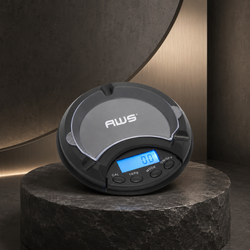
For epoxy pigments, the best digital scale is usually not the same scale you would choose for a large resin pour.
Pigments, mica powders, dyes, metallic powders, and other resin additives can be used in quantities far smaller than the main resin-and-hardener batch. That means fine readability and repeatability become especially important.
For many resin pigment applications, a useful starting range is:
100–500g capacity × 0.01g readability
A scale in this range can provide enough capacity for a small container or weighing tray while displaying changes in hundredths of a gram.
For example:
0.25g
0.50g
1.15g
2.37g
That level of detail can be useful when testing color concentration, recreating a successful mica blend, developing a repeatable resin formula, or comparing small changes in pigment loading.
However, more decimal places do not automatically make a scale better.
Capacity, accuracy specifications, minimum usable load, repeatability, calibration, platform size, and your actual pigment quantities should all be considered together.
This guide explains how to choose the best digital scale for epoxy pigments, why 0.01g readability can be useful, when 0.1g is sufficient, whether 0.001g is necessary, and which American Weigh Scales models fit this type of precision work.
Quick Recommendation: What Scale Is Best for Epoxy Pigments?
For many resin pigment and color-formulation applications, start with:
100–500g × 0.01g
This range can work well for:
- Mica powder
- Resin pigments
- Concentrated colorants
- Metallic powders
- Glitter
- Small additives
- Color tests
- Resin jewelry formulas
- Small experimental batches
If the amount of pigment you normally measure is several grams or more and differences of 0.1g are acceptable for your formulation, a 0.1g scale may be sufficient.
If you routinely need to measure quantities below the practical range of a 0.01g scale, then a 0.001g milligram scale may be worth considering.
Do not automatically choose 0.001g simply because it displays another decimal place.
Why Epoxy Pigments Need a Different Type of Scale
A typical resin project may involve hundreds or thousands of grams of resin and hardener.
Pigment quantities can be dramatically smaller.
For example, a maker might weigh:
100.00g resin mixture
and then add:
0.75g pigment
or perhaps:
0.25g Pigment A + 0.40g Pigment B
A main resin scale that displays only whole grams would provide very little useful detail for measurements this small.
Even a 0.1g scale would display:
0.2g
0.3g
0.4g
while a 0.01g precision scale can distinguish:
0.21g
0.22g
0.23g
For repeatable color development, that additional displayed detail can be useful.
This is why many resin makers benefit from using one scale for resin and hardener and another precision scale for pigments and additives. A two-scale setup of approximately 2–5kg × 0.1g for the main resin batch plus 100–500g × 0.01g for pigment work provides much greater flexibility than asking one scale to cover everything.
Best Overall Scale Range for Epoxy Pigments: 500g × 0.01g
For many resin makers, 500g × 0.01g is an especially useful specification for pigment work.
The specification means:
500g = maximum capacity
0.01g = displayed readability
That gives you enough capacity for many:
- Pigment cups
- Small mixing containers
- Weighing trays
- Mica jars
- Resin jewelry batches
- Color-development samples
while still displaying measurements in hundredths of a gram.
American Weigh Scales explains the specification in greater detail in What Does 500g × 0.01g Mean on a Digital Scale? Read the AWS 500g × 0.01g guide
Importantly, 0.01g readability does not mean that every possible quantity beginning at 0.01g can automatically be measured with guaranteed ±0.01g accuracy. Capacity, readability, minimum usable load, accuracy, and tolerance are separate concepts.
Best AWS Digital Scales for Epoxy Pigments
American Weigh Scales currently offers several 500g × 0.01g models that fit the general measurement range useful for pigments, mica, colorants, and other lightweight craft materials.
SC501g Precision Digital Pocket Scale — Strong All-Around Choice
The SC501g Precision Digital Pocket Scale provides:
Capacity: 500g
Readability: 0.01g
It also includes:
- 3.9 × 3.7-inch platform
- Stainless-steel weighing surface
- Backlit LCD
- Tare function
- Expansion trays
- Battery operation
- Multiple weighing units
For resin pigment work, the combination of a relatively generous platform and 500g × 0.01g specification makes it particularly useful for small containers and pigment formulation.
AWS specifies calibration with a 500g weight, which is not included with this model.
View the AWS SC501g Precision Scale
SM-501-BLK — Best for a Compact Portable Setup
Another option is the AWS SM-501-BLK Digital Pocket Scale.
Its specifications include:
Capacity: 500g
Readability: 0.01g
It also provides:
- Stainless-steel weighing surface
- Backlit LCD
- Magnetic protective cover
- Cover that doubles as an expansion tray
- Battery operation
- Compact dimensions
- Protective vinyl pouch
The weighing platform is smaller than the SC501g platform, so the SC501g may be preferable when using wider pigment containers.
The SM-501, however, is especially compact and portable.
SC501A — Best for an AC-Powered Workstation
For someone who primarily weighs pigments at a fixed workstation, the SC501A Precision Digital Pocket Scale provides another useful option.
It offers:
500g × 0.01g
along with:
- 3.9 × 3.7-inch platform
- Stainless-steel construction
- Backlit LCD
- Tare
- Expansion trays
- Anti-slip padding
- AC power
AWS specifies calibration using either a 200g or 500g calibration weight, with the weight not included.
An AC-powered model can be convenient for a dedicated resin-color workstation where portability is less important.
View the AWS SC501A Precision Scale
Why 0.01g Readability Is Useful for Resin Pigments
A 0.01g scale displays weight in increments of one hundredth of a gram.
Examples include:
0.25g
0.78g
1.34g
4.27g
This can be particularly useful for:
- Pigment testing
- Mica powder
- Concentrated colorants
- Small additives
- Resin jewelry
- Color-development experiments
- Repeatable formulations
The existing AWS resin guidance identifies 0.01g as particularly useful for pigment tests, mica powder, concentrated colorants, tiny additive trials, and formula development.
0.1g vs. 0.01g for Epoxy Pigments
This is one of the most important decisions when selecting a pigment scale.
Choose 0.1g When:
- Pigment quantities are relatively large
- You normally measure several grams or more
- Hundredth-of-a-gram differences are unnecessary
- The scale will also be used for larger resin batches
- Higher capacity is more important than finer readability
Choose 0.01g When:
- Pigments frequently weigh below 1g
- You develop repeatable color formulas
- You make small jewelry batches
- You combine several pigments in one formula
- 0.1g increments are too coarse for your workflow
For pigment-focused resin work, 0.01g is often the more useful choice.
AWS's broader resin guidance similarly recommends 0.01g when pigments frequently fall below 1g or when the maker is developing repeatable color formulas.
Do You Need a 0.001g Scale for Epoxy Pigments?
Usually not.
A 0.001g scale displays thousandths of a gram, or milligrams.
For example:
0.251g
instead of:
0.25g
That sounds attractive, but there is a tradeoff.
Very fine-resolution scales are generally more sensitive to:
- Air movement
- Vibration
- Static
- Temperature changes
- Surface movement
- Placement of the sample
Unless your pigment formulation genuinely requires milligram-level quantities, 0.01g is generally more practical for ordinary resin-color development. Your existing resin guide makes the same distinction and notes the increased environmental sensitivity of 0.001g measurement.
For a deeper comparison, see AWS's 0.001g vs. 0.01g Scales: Which Precision Do You Need?
Read the AWS 0.001g vs. 0.01g guide
Readability Is Not the Same as Accuracy
Do not assume:
0.01g readability = guaranteed ±0.01g accuracy
These specifications describe different things.
Readability
The smallest displayed increment.
Accuracy
How closely the measured value corresponds with a reference value under the manufacturer's specified conditions.
Repeatability
How consistently the scale measures the same stable load under similar conditions.
Minimum Load
The lower end of the scale's usable measurement range.
When selecting a pigment scale, compare all four rather than simply counting decimal places.
AWS's resin guidance specifically recommends evaluating readability, accuracy specification, repeatability, minimum usable load, capacity, calibration requirements, and operating environment together.
Why Repeatability Matters for Pigment Formulas
Suppose you create exactly the shade of blue you wanted.
Your notes say:
Resin mixture: 50.00g
Blue mica: 0.62g
White pigment: 0.18g
Metallic additive: 0.15g
If your scale produces stable, repeatable measurements, you have a much better chance of reproducing that formulation later.
This matters for:
- Product batches
- Matching jewelry pieces
- Repeating customer colors
- Resin art collections
- Prototype development
- Pigment testing
- Production records
A useful pigment scale is therefore not simply about measuring something once.
It is about helping you repeat the measurement later.
Create Pigment Formulas by Weight
A digital scale can make resin color development much more systematic.
Instead of recording:
“two scoops of blue”
or:
“a small amount of gold”
you can record actual weights.
For example:
| Component | Mass |
|---|---|
| Mixed resin | 100.00g |
| Blue mica | 0.80g |
| Pearl pigment | 0.35g |
| Metallic additive | 0.15g |
| Total pigment/additive | 1.30g |
That gives you a numerical formula you can reference when making the color again.
Always stay within the pigment and resin manufacturers' recommended loading ranges. Different pigments and resin systems can have different usage instructions.
Pigment Percentage Formula
If you are intentionally developing a formulation by mass, you can calculate pigment percentage as:
Pigment mass ÷ relevant resin-system mass × 100
For example, if your chosen formulation basis is 100g and you use 1g of pigment:
1 ÷ 100 × 100 = 1%
However, make sure you define your formulation basis consistently.
More importantly, follow the instructions supplied with the pigment and resin system rather than assuming that any arbitrary pigment percentage is appropriate.
Some colorants can have very different concentration levels.
Why a 500g Capacity Is Useful
A pigment itself may weigh less than one gram.
So why choose a 500g scale?
Because the scale supports more than the pigment.
The physical load may include:
Container + resin sample + pigment + additional colorants
Suppose:
Container: 45g
Resin sample: 100g
Pigments: 2g
The scale is physically supporting:
147g
A 100g scale would already be too small.
A 500g scale provides substantially more flexibility.
This is one reason 500g × 0.01g can be such a useful combination for resin pigment work.
Remember That Tare Does Not Restore Capacity
Suppose you put a 50g cup on a 500g scale.
Press tare.
The display returns to:
0.00g
The scale is still physically supporting 50g.
That means approximately 450g of nominal physical capacity remains.
Tare changes the display.
It does not make the container physically weightless.
This becomes especially important when weighing resin samples directly in the same container as pigments.
Why Tare Is Essential for Pigment Work
Tare makes pigment formulation much easier.
A typical workflow might be:
- Place the empty pigment container on the scale.
- Allow the reading to stabilize.
- Press tare.
- Confirm 0.00g.
- Add the first pigment to the target.
- Record the measurement.
- Tare again if your formulation method requires it.
- Add the next component.
- Record each amount.
This reduces the need to manually subtract container weights.
It also makes sequential formulation easier.
Minimum Usable Load Matters
A scale labeled:
500g × 0.01g
displays in 0.01g increments.
That does not necessarily mean 0.01g is the ideal minimum quantity to weigh.
When measuring extremely small amounts of concentrated pigment, review the manufacturer's specifications for:
- Minimum usable load
- Accuracy
- Tolerance
- Repeatability
AWS emphasizes this distinction in its 500g × 0.01g guidance.
If your actual pigment quantity falls below the usable range of the scale, moving to a different precision range may be appropriate.
Platform Size Matters
Pigment scales need more than appropriate capacity.
The weighing container must fit properly.
Look for a platform that allows the container to:
- Sit securely
- Remain centered
- Stay fully supported
- Avoid touching the counter
- Leave the display visible
This is one reason the SC501g and SC501A can be particularly attractive for craft work: AWS currently specifies a 3.9 × 3.7-inch platform on both models.
The smaller SM-501 provides more portability but has a 2.86 × 2.6-inch platform.
Use a Hard, Stable Surface
A 0.01g scale should be placed on a stable surface.
Use:
A hard, level, rigid work surface
Avoid:
- Fabric
- Towels
- Foam
- Flexible mats
- Unstable tables
- Wobbly workbenches
Fine-resolution measurements are more sensitive to environmental conditions than coarse measurements.
Keep the Scale Away From Drafts
A small quantity of lightweight mica powder combined with a 0.01g scale is a particularly good reason to avoid strong airflow.
Keep the scale away from:
- Fans
- Open windows
- HVAC vents
- Strong air-conditioning airflow
Allow the display to stabilize before recording the measurement.
Avoid Vibration
Workshop vibration can come from:
- Sanders
- Rotary tools
- Compressors
- Drills
- Speakers
- Nearby machinery
- Movement on an unstable table
If you are measuring a small pigment quantity, perform the measurement while nearby equipment is off whenever practical.
AWS covers these and other causes of inconsistent measurements in Why Does My Digital Scale Give Different Readings?
Read the AWS scale troubleshooting guide
Calibration Matters
For repeatable pigment formulas, your scale should provide clear calibration instructions.
The exact calibration procedure and required reference weight vary by model.
For example:
- The SC501g specifies a 500g calibration weight
- The SM-501-BLK specifies a 500g calibration weight
- The SC501A specifies a 200g or 500g calibration weight
The calibration weights are not listed as included with these current products.
Follow the instructions for your exact model.
AWS provides a broader guide in How to Calibrate a Digital Scale for Accurate Results.
Read the AWS calibration guide
Don't Calibrate With Random Household Objects
Do not substitute:
- Coins
- Resin bottles
- Pigment containers
- Jewelry
- Tools
- Cured resin
for the calibration reference specified by the scale manufacturer.
For technical context, NIST explains that mass calibration establishes a mass value with an appropriate uncertainty using suitable standards.
NIST Calibration of Mass Standards
A resin workshop does not need to operate like a metrology laboratory, but the underlying principle is useful: calibration depends on an appropriate reference, not a random object whose mass is assumed.
Protect the Scale From Pigment and Resin
Mica powder is lightweight and can spread easily.
Liquid pigment and uncured resin can also migrate into:
- Buttons
- Platform gaps
- Display seams
- Battery compartments
- Electronics
Use trays or containers where appropriate.
The SC501g and SC501A, for example, include expansion trays that can be useful for containing small materials.
Follow the scale manufacturer's cleaning recommendations.
Should You Weigh Pigment Directly Into Resin?
There are two common approaches.
You can weigh pigment in a separate lightweight container and then transfer it.
Or you can place the resin container on the scale, tare it, and add pigment directly.
The better method depends on:
- Container size
- Scale capacity
- Pigment type
- Required quantity
- Risk of spills
- Your formulation workflow
If the main resin container is large, it may be easier to use a separate small pigment scale and tray.
One Scale or Two for Resin Pigments?
For many makers, two scales are the most practical solution.
Main Resin Scale
Consider approximately:
2–5kg × 0.1g
Use it for:
- Resin
- Hardener
- Mixing cups
- Coasters
- Molds
- General batches
Pigment Precision Scale
Consider approximately:
100–500g × 0.01g
Use it for:
- Mica
- Pigment
- Dyes
- Metallic powders
- Additives
- Formula development
This avoids forcing a low-capacity precision scale to hold a multi-kilogram resin batch.
The original AWS resin guide makes the same recommendation: a higher-capacity 0.1g main scale plus a smaller 0.01g fine scale provides greater flexibility for makers who work across very different measurement ranges.
Pocket Scale vs. Kitchen Scale for Pigments
For epoxy pigments, a precision pocket scale usually makes more sense than a standard kitchen scale.
Pocket scales commonly offer:
- Finer readability
- Compact platforms
- Small-capacity measurement ranges
- Portability
- Protective covers or trays
Kitchen scales generally prioritize:
- Larger containers
- Higher capacity
- Larger platforms
AWS discusses these differences in its Pocket Scale vs. Kitchen Scale guide.
Read Pocket Scale vs. Kitchen Scale
For large resin batches, a kitchen or bench-style scale may be preferable.
For pigment measurement, a 0.01g precision pocket scale often makes more sense.
Epoxy Ratio and Pigment Measurement Are Different Issues
Do not confuse measuring pigment with determining how to mix the epoxy itself.
A scale can measure:
- Resin
- Hardener
- Pigment
- Additives
But it cannot determine the correct ratio.
When resin and hardener are being measured by weight, use the exact weight ratio specified for that epoxy system.
Do not assume a ratio given by volume uses the same numerical ratio by weight.
TotalBoat explains that resin and hardener can have different densities and therefore provides product-specific weight ratios for its epoxy systems.
TotalBoat: How to Mix Epoxy by Weight
TotalBoat: Measuring Epoxy by Weight vs. Volume
This matters because an extremely precise pigment measurement cannot compensate for an incorrect resin-to-hardener ratio.
Common Mistakes When Weighing Epoxy Pigments
Choosing 0.001g Just Because It Has More Decimals
Use the resolution your actual pigment quantities require.
Assuming 0.01g Readability Means ±0.01g Accuracy
Readability and accuracy are different specifications.
Ignoring Minimum Load
Very tiny pigment amounts may fall outside the scale's ideal usable range.
Buying Too Little Capacity
Remember the pigment container and resin sample also count.
Forgetting Container Weight After Tare
Tare does not restore physical capacity.
Using a Large Mixing Cup on a Tiny Platform
Make sure the container is fully supported.
Weighing Beside a Fan
Fine scales can react to airflow.
Running Workshop Equipment While Measuring
Vibration can affect fine measurements.
Failing to Record the Formula
A scale is most valuable for repeatability when you actually document the result.
Assuming All Pigments Use the Same Loading Percentage
Follow the pigment and resin manufacturers' instructions.
Using Random Objects for Calibration
Use the calibration reference specified for the scale.
Best Scale for Mica Powder
For mica powder and similar lightweight pigments, a useful starting range is:
100–500g × 0.01g
This provides fine displayed increments while maintaining practical capacity for a tray or small container.
A 500g × 0.01g scale can be particularly versatile if the same instrument will also be used for:
- Jewelry batches
- Larger pigment tests
- Small resin samples
- Additive formulation
Best Scale for Resin Dyes and Concentrated Colorants
Highly concentrated colorants may be used in smaller quantities than bulk mica powder.
If your actual measurements regularly fall well below one gram, 0.01g readability can provide significantly more useful detail than 0.1g.
If your quantities are so small that even a 0.01g scale's usable range is inappropriate, consider whether a milligram scale is actually required.
Check the manufacturer's minimum-load and accuracy specifications before making that decision.
Best Scale for Metallic Powder and Glitter
Metallic powders and glitter vary dramatically in particle size and typical usage quantity.
Do not choose a scale solely according to the material name.
Instead, determine:
What is the smallest quantity I actually need to reproduce?
If your formula uses:
5.0g
of glitter, 0.1g may provide sufficient detail.
If it uses:
0.35g
of metallic pigment, 0.01g may be much more useful.
The measurement range should determine the scale.
Best Digital Scale for Resin Jewelry Pigments
Resin jewelry often involves small total batches and small quantities of pigment.
A:
500g × 0.01g
precision scale can therefore be particularly useful because the same scale may be able to handle:
- Small resin samples
- Pigments
- Mica
- Jewelry color formulas
- Additives
while maintaining hundredth-of-a-gram readability.
For larger jewelry resin batches, a separate 500g–1kg × 0.1g scale may also be useful.
Epoxy Pigment Scale Buying Checklist
Before buying, check:
- What is the smallest pigment amount I normally measure?
- Do I need 0.1g or 0.01g readability?
- Do I genuinely need 0.001g?
- What capacity do my containers require?
- Is 100g enough?
- Would 200g work?
- Is 500g more flexible?
- What is the minimum usable load?
- What accuracy does the manufacturer specify?
- Is repeatability appropriate?
- Does the scale have tare?
- Does it measure grams?
- Is the platform large enough?
- Will my pigment cup fit securely?
- Is the display visible?
- Is the display backlit?
- Can the scale be calibrated?
- What calibration weight is required?
- Is that weight included?
- Does the scale include a tray?
- Can it be protected from pigment dust?
- Can it be protected from uncured resin?
- Is battery or AC power better for my workspace?
- Is the scale stable on my workbench?
- Would a separate main resin scale be more practical?
Frequently Asked Questions
What is the best digital scale for epoxy pigments?
For many resin makers, a 100–500g scale with 0.01g readability is a practical range for pigments, mica, colorants, and small additives.
A 500g × 0.01g model provides particularly useful capacity flexibility.
Is 0.01g good for resin pigments?
Yes. It can be useful when pigment quantities regularly fall below one gram or when precise color formulas need to be reproduced.
Is 0.1g enough for mica powder?
It can be when your normal mica quantities are relatively large.
For smaller pigment quantities or controlled color development, 0.01g may be more useful.
Do I need a 0.001g scale for pigment?
Usually not for ordinary resin pigment work.
Choose 0.001g only when your actual measurement quantities require milligram-level readability.
Is 500g enough capacity?
For many pigment applications, yes.
A 500g scale provides significantly more room than a 100g or 200g scale for containers, trays, and small resin samples.
What does 500g × 0.01g mean?
It means the scale has a maximum capacity of 500 grams and displays measurements in 0.01g increments.
Does 0.01g mean the scale is accurate to ±0.01g?
Not automatically.
Readability and accuracy are different specifications.
Check the manufacturer's stated accuracy, tolerance, minimum load, and repeatability.
Should I weigh mica by weight instead of using a scoop?
Weight measurement can make a formulation easier to document and reproduce.
However, follow the pigment and resin manufacturers' usage instructions.
Can I make repeatable resin colors using a digital scale?
A digital scale can help you record consistent masses for resin, pigment, and additives, making numerical formulas easier to reproduce.
Other process variables can still affect the final appearance.
Does tare increase scale capacity?
No.
The container remains part of the physical load even after the display is reset to zero.
Should I calibrate my pigment scale?
Follow the manufacturer's calibration and performance-check instructions.
Use the specified reference weight.
Why does my 0.01g scale fluctuate?
Possible causes include:
- Airflow
- Vibration
- Weak batteries
- Static
- Temperature changes
- Unstable surfaces
- Off-center loading
- Overloading
- Calibration issues
Which AWS scale is good for epoxy pigments?
Current AWS options in the 500g × 0.01g range include the SC501g, SM-501-BLK, and SC501A.
The SC501g provides a larger 3.9 × 3.7-inch platform and battery operation. The SM-501 is more compact, while the SC501A uses AC power for a fixed workstation.
Final Verdict: Best Digital Scale for Epoxy Pigments
For most resin makers focused on pigments, mica powder, colorants, and small additives, start with:
100–500g capacity × 0.01g readability
For maximum versatility within that range:
500g × 0.01g
is an excellent specification to consider.
It provides enough capacity for many pigment containers, weighing trays, small resin samples, and jewelry formulations while displaying changes in hundredths of a gram.
Among current American Weigh Scales options, the SC501g Precision Digital Pocket Scale is a particularly strong all-around choice because it combines 500g × 0.01g, a relatively large 3.9 × 3.7-inch platform, stainless-steel weighing surface, backlit LCD, tare, trays, and battery operation.
The SM-501-BLK provides the same 500g × 0.01g measurement specification in a smaller, highly portable format, while the SC501A provides 500g × 0.01g with AC power for a dedicated workstation.
Whichever scale you choose, remember that readability is not the same as accuracy.
Evaluate:
- Capacity
- Readability
- Accuracy specification
- Repeatability
- Minimum usable load
- Calibration
- Platform dimensions
- Tare
- Environmental stability
For resin and hardener themselves, you may still want a higher-capacity scale around:
2–5kg × 0.1g
For the pigments:
100–500g × 0.01g
can provide a much better precision range.
The result is a two-scale system in which the main scale handles the resin batch while the precision scale handles the small ingredients that can define the final color.
For epoxy pigment work, that is often far more useful than trying to make one scale handle everything.