
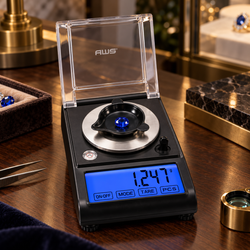
The best digital scale for fishing tackle should provide enough measurement detail for small terminal tackle while still offering enough capacity for heavier lures, sinkers, jig heads and batches of fishing components.
Fishing tackle covers an enormous weight range.
An angler, lure maker, tackle shop, fishing guide, collector or manufacturer might need to weigh:
-
Fishing hooks
-
Split shot
-
Sinkers
-
Jig heads
-
Swivels
-
Snaps
-
Beads
-
Weights
-
Lure bodies
-
Soft plastics
-
Spinnerbaits
-
Spoons
-
Crankbaits
-
Jigs
-
Terminal tackle
-
Tackle kits
-
Batches of components
That creates an important scale-selection question:
How much capacity do you need, and how fine should the scale's readability be?
For many general fishing-tackle applications:
100–500g capacity with 0.01g readability
provides a highly practical range.
For maximum versatility within that range:
500g × 0.01g
is especially useful.
For extremely lightweight individual components, finer measurement may sometimes be useful.
For heavy sinker batches or larger tackle collections:
500g may not be enough.
The correct scale depends on:
the lightest tackle component you actually need to distinguish and the heaviest complete load you need to weigh.
Quick Answer: What Is the Best Digital Scale for Fishing Tackle?
| Fishing Tackle | Capacity to Consider | Readability to Consider |
|---|---|---|
| Tiny hooks | 50–100g | 0.01g |
| Small split shot | 50–100g | 0.01g |
| Swivels | 50–200g | 0.01g |
| Snaps | 50–200g | 0.01g |
| Small jig heads | 100–500g | 0.01g |
| Sinkers | 100–500g | 0.01g |
| Fishing beads | 100–500g | 0.01g |
| Small lures | 100–500g | 0.01g |
| Crankbaits | 200–500g | 0.01g |
| Spinnerbaits | 200–500g | 0.01g |
| Larger lures | 500g+ | 0.01–0.1g |
| Tackle batches | 500g+ | 0.01–0.1g |
| Bulk sinkers | 1–5kg | 0.1–1g |
These are starting points rather than universal requirements.
Choose according to the actual tackle you weigh.
Why Weigh Fishing Tackle?
Weight can matter throughout fishing and tackle preparation.
A digital scale can help with:
-
Comparing lure weights
-
Sorting sinkers
-
Checking jig heads
-
Organizing hooks
-
Documenting custom lures
-
Comparing tackle configurations
-
Packaging fishing components
-
Managing tackle inventory
-
Checking batches
-
Recording handmade lure specifications
For lure makers in particular:
small weight differences can help document different:
-
Hook combinations
-
Jig heads
-
Hardware
-
Lure bodies
-
Added weights
Weight provides:
an objective measurement.
Best Scale for Fishing Hooks
Individual fishing hooks can be:
very lightweight.
For many hook-weighing applications:
0.01g readability
provides substantially more useful detail than a standard scale reading only:
whole grams.
Suppose:
Hook A = 0.42g
Hook B = 0.58g
Hook C = 0.76g
A:
0.01g scale
makes these differences easy to document.
When Finer Readability May Matter for Hooks
Extremely small hooks may weigh:
less than the useful working range of some 0.01g scales.
If your application genuinely requires measurement differences below:
0.01g,
a milligram scale may be considered.
However:
do not choose extra decimal places unless the actual measurement requires them.
Best Scale for Split Shot
Split shot can range from:
very small individual pieces
to:
substantial grouped quantities.
For individual or small quantities:
0.01g readability
can be useful.
For larger batches:
capacity becomes increasingly important.
Best Scale for Fishing Sinkers
Fishing sinkers vary dramatically.
Examples include:
-
Split shot
-
Egg sinkers
-
Bullet weights
-
Bank sinkers
-
Pyramid sinkers
-
Drop-shot weights
-
Casting sinkers
A small sinker may weigh:
only a few grams.
A large sinker can weigh:
well over 100g.
For a mixed sinker collection:
500g capacity
provides substantially more flexibility than:
a 50g pocket scale.
Best Scale for Jig Heads
Jig heads are excellent candidates for precision weighing.
An angler or lure maker may want to compare:
-
Bare jig head
-
Jig head + hook
-
Finished jig
-
Jig + soft plastic
A:
500g × 0.01g
scale can cover all of these without requiring a different scale for each stage.
Best Scale for Swivels
Swivels are:
small and lightweight.
For individual swivels:
0.01g readability can provide useful measurement detail.
For large inventory batches:
higher capacity becomes more important.
Best Scale for Snaps
Snaps can be weighed:
individually
or:
in batches.
For individual comparison:
0.01g is useful.
For counting or inventory:
batch capacity may matter more.
Best Scale for Fishing Beads
Fishing beads can be:
extremely light.
A precision scale can help compare:
-
Glass beads
-
Plastic beads
-
Metal beads
-
Tungsten beads
-
Brass beads
Different materials can produce:
very different weights at similar physical sizes.
Best Scale for Soft Plastic Lures
Soft plastics may vary according to:
-
Length
-
Body shape
-
Material
-
Salt content
-
Added scent
-
Embedded components
A:
0.01g precision scale
can help document lure weight consistently.
Best Scale for Crankbaits
Crankbaits can include:
-
Body
-
Bill
-
Hooks
-
Split rings
-
Internal weights
-
Paint and finish
For most crankbaits:
0.01g provides more than enough displayed detail for general comparison.
Best Scale for Spinnerbaits
Spinnerbaits combine:
-
Jig head
-
Hook
-
Wire frame
-
Blades
-
Swivels
-
Skirt
A 500g scale provides:
ample capacity for many individual spinnerbaits.
Best Scale for Spoons
Fishing spoons are generally heavier than:
tiny terminal tackle.
For most:
0.01g readability
with:
100–500g capacity
is highly practical.
Best Scale for Jigs
Finished jigs may combine:
-
Head
-
Hook
-
Skirt
-
Trailer
-
Additional hardware
A precision scale allows lure makers to compare:
finished configurations.
Best Scale for Custom Fishing Lures
Custom lure makers can use weight as:
a production specification.
For example:
Lure Body = 16.42g
Hooks = 3.75g
Split Rings = 0.86g
Hardware = 1.32g
Finished Lure = 22.35g
Recording these measurements can help with:
product consistency.
Best Scale for Terminal Tackle
Terminal tackle includes many small items such as:
-
Hooks
-
Swivels
-
Snaps
-
Sinkers
-
Beads
-
Stops
-
Split rings
For this mixed category:
500g × 0.01g
provides an excellent general-purpose range.
Why 500g × 0.01g Works Well for Fishing Tackle
AWS explains that:
500g × 0.01g
means:
500g maximum nominal capacity
with:
0.01g displayed increments.
For fishing tackle, this provides a useful balance between:
fine measurement and practical capacity.
Example:
Hook = 0.58g
Swivel = 1.24g
Jig Head = 7.35g
Sinker = 28.42g
Crankbait = 18.76g
Large Lure = 92.38g
Tackle Batch = 315.47g
All fit within:
500g capacity.
A Practical AWS Scale for Fishing Tackle
The AWS SC501g Precision Digital Pocket Scale provides:
500g × 0.01g
with a platform of approximately:
3.9 × 3.7 inches.
Its features include:
-
Stainless-steel weighing platform
-
Backlit LCD
-
Tare
-
Expansion trays
-
Multiple weighing units
-
Battery operation
This combination makes it particularly useful for:
-
Hooks
-
Sinkers
-
Jig heads
-
Swivels
-
Lures
-
Terminal tackle
-
Small tackle batches
Why the Platform Matters
Fishing tackle is not always:
flat.
Hooks can:
catch.
Sinkers can:
roll.
Lures can:
extend beyond a small weighing surface.
A larger platform or weighing tray can make the scale easier to use.
Use a Tray for Hooks
Hooks should be handled carefully.
A tray can keep them:
contained
and prevent them from:
sliding off the platform.
Procedure:
-
Place tray on scale.
-
Allow reading to stabilize.
-
Press tare.
-
Confirm zero.
-
Place hook or tackle inside.
-
Record weight.
Use a Tray for Sinkers
Round or egg-shaped sinkers can:
roll.
A shallow tray can help keep:
the weight centered.
Tare Does Not Increase Capacity
This is important.
Suppose:
scale capacity = 500g
tray = 75g.
Place tray on scale.
Press:
TARE.
Display:
0.00g.
The tray is still physically applying:
75g
to the weighing mechanism.
Approximate remaining physical capacity:
425g.
Tare changes the:
displayed reference.
It does not restore:
physical capacity.
Calculate Complete Tackle Load
Always calculate:
tackle + tray + container = total physical load.
Example:
Sinkers = 430g
Container = 90g
Total =
520g.
A 500g scale is:
too small.
Even if:
you tare the container.
Leave Capacity Headroom
Do not routinely operate:
at maximum capacity.
Suppose:
Tackle = 455g
Tray = 35g
Total =
490g.
A:
500g scale
provides only:
10g of nominal headroom.
A higher-capacity scale may be:
more practical.
When 100g Capacity Is Enough
Suppose you exclusively weigh:
-
Hooks
-
Swivels
-
Snaps
-
Small jig heads
-
Small sinkers
and your heaviest complete load is:
65g.
A:
100g × 0.01g
scale may be perfectly adequate.
More capacity is not automatically:
better.
When 500g Capacity Is Better
Choose 500g when your tackle includes:
-
Larger sinkers
-
Larger jigs
-
Multiple lures
-
Tackle batches
-
Containers
-
Larger custom lure components
The additional headroom provides:
more versatility.
When 500g Is Not Enough
A pocket precision scale becomes less suitable when weighing:
-
Large sinker batches
-
Bulk lead or tungsten weights
-
Large tackle boxes
-
Multiple heavy lures
-
Large fishing equipment
At that point:
choose a higher-capacity scale.
Higher-Capacity Fishing Tackle Scale
For larger tackle batches:
2–5kg capacity
may be more useful.
If your normal load is measured in:
kilograms,
0.001g or 0.01g readability is generally unnecessary.
A:
0.1g
or:
1g
higher-capacity scale may be more appropriate depending on the task.
One Scale vs. Two Scales for Fishing Tackle
For many anglers:
one scale is enough.
If your tackle ranges from:
0.5g hooks
to:
350g batches,
a:
500g × 0.01g
scale can cover:
the complete range.
When Two Scales Are Better
Suppose your tackle workflow includes:
Tiny hook = 0.08g
Swivel = 0.35g
Jig = 8.42g
Lure = 32.68g
Sinker batch = 850g
Bulk tackle = 2.4kg
One compact precision scale cannot optimally cover:
the entire range.
A stronger setup may be:
Precision Tackle Scale
500g × 0.01g
for:
-
Hooks
-
Swivels
-
Jigs
-
Individual sinkers
-
Lures
plus:
Higher-Capacity Scale
2–5kg × 0.1g
for:
-
Sinker batches
-
Bulk tackle
-
Larger inventory
Do You Need 0.001g for Fishing Tackle?
For most fishing tackle:
probably not.
A:
0.01g
scale already provides:
fine displayed increments.
Milligram readability may become useful when:
weighing extremely lightweight individual components.
Examples:
-
Tiny hooks
-
Very small fly-tying components
-
Lightweight hardware
But do not choose:
0.001g
simply because it displays:
another decimal place.
Readability Is Not Accuracy
Suppose a scale displays:
12.35g.
That means:
0.01g readability.
It does not automatically guarantee:
±0.01g accuracy.
Measurement performance can also depend on:
-
Accuracy specifications
-
Repeatability
-
Minimum usable load
-
Calibration
-
Environment
-
Load position
This distinction matters when comparing:
precision scales.
Minimum Usable Load Matters
A:
500g × 0.01g
scale displays:
hundredths of a gram.
That does not automatically mean:
0.01g
is an appropriate minimum working load.
For extremely lightweight tackle components:
review available manufacturer specifications for:
minimum load and measurement performance.
Repeatability Matters
Suppose the same jig head is weighed five times:
7.35g
7.35g
7.35g
7.35g
7.35g
That demonstrates:
consistent displayed readings under those conditions.
If the readings change significantly:
additional decimal places become less useful.
Test Repeatability
A simple test:
-
Place tackle on scale.
-
Allow reading to stabilize.
-
Record weight.
-
Remove tackle.
-
Allow scale to return to zero.
-
Replace tackle.
-
Record again.
-
Repeat several times.
Compare the results.
Calibration Matters
Precision scales should be calibrated according to:
the manufacturer's instructions.
Calibration requirements vary:
by model.
Do not assume:
every scale uses the same calibration mass.
SC501g Calibration
The AWS SC501g requires:
a specified calibration mass.
Follow the current model instructions for:
the correct procedure.
Do not substitute:
random fishing tackle.
Do Not Use Sinkers as Calibration Weights
A fishing sinker may be labeled:
1 oz
or:
1/2 oz.
That does not make it:
a calibration standard.
Manufacturing tolerances and actual mass can vary.
Do not use:
-
Sinkers
-
Lures
-
Coins
-
Hooks
-
Batteries
-
Household objects
as substitutes for:
appropriate calibration masses.
Calibration Is Not Tare
These are different functions.
Calibration
relates the scale's response to:
a known reference mass.
Tare
subtracts:
a tray or container
from the displayed result.
Grams vs. Ounces for Fishing Tackle
Fishing tackle is commonly described using:
both grams and ounces.
For example:
a lure may be sold as:
1/4 oz
3/8 oz
1/2 oz
1 oz.
A scale that supports:
grams and ounces
can therefore be convenient.
Gram-to-Ounce Reference
Approximate conversions:
| Ounces | Grams |
|---|---|
| 1/16 oz | 1.77g |
| 1/8 oz | 3.54g |
| 1/4 oz | 7.09g |
| 3/8 oz | 10.63g |
| 1/2 oz | 14.17g |
| 3/4 oz | 21.26g |
| 1 oz | 28.35g |
| 2 oz | 56.70g |
| 4 oz | 113.40g |
| 8 oz | 226.80g |
Actual tackle can differ from:
nominal marketed weight.
Why Actual Lure Weight May Differ From the Label
A lure sold as:
“1/2 oz”
may not necessarily weigh:
exactly 14.1748g
as a finished product.
Why?
Because product descriptions may refer to:
nominal design weight
and the finished lure may include:
-
Hooks
-
Split rings
-
Paint
-
Skirts
-
Hardware
-
Trailers
If exact finished weight matters:
measure the complete lure.
Bare Jig Head vs. Finished Jig
These are different measurements.
Example:
Bare Jig Head = 7.08g
Hook and Hardware = 1.25g
Skirt = 0.85g
Finished Jig = 9.18g
If you are documenting:
the fishing lure
Best Scale for Fishing Lures
Fishing lures vary enormously in weight.
A tackle box may contain:
-
Tiny jigs
-
Flies
-
Small spoons
-
Soft-plastic rigs
-
Crankbaits
-
Jerkbaits
-
Spinnerbaits
-
Topwater lures
-
Swimbaits
-
Large saltwater lures
Because of this range, there is no single ideal scale specification for every lure.
For many everyday fishing lures:
500g × 0.01g
provides a practical combination of capacity and fine readability.
For extremely lightweight lures, hooks, jig heads or individual lure components:
0.001g readability
may be useful when milligram-level measurement is genuinely required.
For very large offshore lures or heavy tackle:
higher capacity may matter more than extremely fine readability.
Why Lure Weight Matters
Anglers often pay attention to lure weight because it can affect:
-
Rod loading
-
Casting
-
Retrieval
-
Presentation
-
Tackle organization
-
Lure comparison
Rod manufacturers commonly specify recommended lure-weight ranges.
If a rod is rated for:
1/4–3/4 oz lures,
knowing the actual lure weight can help an angler compare a rig with that published range.
However:
always follow the rod manufacturer's specifications and recommendations.
A scale provides a measurement.
It does not determine whether a particular lure is appropriate or safe for a specific rod.
Weigh the Complete Fishing Lure
Do not automatically weigh only:
the lure body.
If you want to know the actual weight being cast, weigh the lure in the configuration in which it will be used.
Depending on the lure, that may include:
-
Hooks
-
Split rings
-
Jig head
-
Blade
-
Skirt
-
Trailer
-
Added weight
-
Other attached components
This distinction matters because:
advertised lure weight and complete rigged weight may not always represent exactly the same thing.
Example: Rigged Jig
Suppose:
Jig head = 7.00g
Hook = already part of jig head
Soft-plastic trailer = 3.25g
Complete rigged lure =
10.25g
If your goal is to document the weight of:
the complete rig you cast,
10.25g is the more relevant measurement.
Example: Hard Bait
Suppose a crankbait body and hardware together weigh:
14.82g.
That measurement includes:
the lure as actually placed on the scale.
If you remove:
hooks or split rings,
you are measuring a different configuration.
For meaningful comparisons:
weigh lures consistently.
Use the Same Configuration When Comparing Lures
Suppose you are comparing three crankbaits.
Do not weigh:
Lure A with hooks
Lure B without hooks
Lure C with replacement hooks.
That creates an inconsistent comparison.
Instead, define your method.
For example:
all lures weighed fully rigged as fished.
Or:
all lure bodies weighed without removable hooks.
Then use that same method consistently.
Best Scale for Tiny Fishing Lures
Very lightweight lures may benefit from:
finer readability.
Examples include:
-
Micro jigs
-
Small flies
-
Tiny jig heads
-
Ultralight spoons
-
Small lure components
When individual items weigh only a fraction of a gram:
0.001g readability
may provide useful displayed detail.
However:
do not assume 0.001g readability automatically means ±0.001g accuracy.
Readability and accuracy are separate specifications.
Best Scale for Ultralight Lures
For ultralight fishing:
a:
50–100g × 0.001g
scale may be useful when very fine lure-weight comparisons are important.
But if you primarily need to verify ordinary lure weights:
0.01g readability
may already provide more detail than necessary.
Best Scale for Jigs
Jigs can range from:
tiny micro-jigs
to:
heavy saltwater jigs.
For small jigs:
0.01g readability can provide detailed measurements.
For extremely lightweight jig heads:
0.001g may be useful.
For heavy offshore jigs:
capacity becomes more important.
Best Scale for Jig Heads
A digital scale can be useful for checking jig-head weights when:
-
Packaging is missing
-
Similar sizes are mixed together
-
You pour your own jig heads
-
You want to organize tackle by actual measured weight
For example:
Jig A = 3.48g
Jig B = 5.21g
Jig C = 7.06g
These measurements can help distinguish:
similar-looking tackle.
Best Scale for Crankbaits
Crankbaits typically do not require:
milligram readability.
A:
500g × 0.01g
scale provides more than enough capacity for most crankbaits while allowing detailed comparisons.
Make sure:
hooks and the lure body sit completely on the weighing platform or tray.
Best Scale for Jerkbaits
Jerkbaits can be relatively long.
Their weight may easily fall within:
a 500g scale's capacity,
but platform dimensions can become important.
If the lure extends beyond the platform:
that is acceptable only if it remains completely supported by the scale and does not touch the table or another surface.
Best Scale for Spinnerbaits
Spinnerbaits have irregular shapes.
They may contain:
-
Jig head
-
Hook
-
Wire frame
-
Blades
-
Skirt
-
Trailer
A weighing tray can make measurement easier.
Place the complete spinnerbait inside the tray, press:
tare
before adding the lure, and then record the displayed lure weight.
Best Scale for Spoons
Fishing spoons are relatively easy to weigh because they are compact.
For most spoons:
0.01g readability is more than sufficient for detailed weight comparison.
For tiny ultralight spoons:
0.001g may be useful if extremely fine differences matter.
Best Scale for Soft-Plastic Rigs
A soft-plastic bait alone may weigh:
significantly less
than the completed rig.
If you want to know the actual cast weight:
measure:
soft plastic + hook + jig head or sinker + other attached components.
Example
Soft plastic = 4.36g
Weighted hook = 5.18g
Complete rig =
9.54g
This gives you a more useful comparison with other:
fully rigged presentations.
Best Scale for Swimbaits
Large swimbaits can be substantially heavier than:
ordinary freshwater lures.
For most:
500g capacity provides considerable room.
However, very large specialty or offshore tackle may require:
higher capacity.
Always calculate:
the heaviest lure you actually use.
Best Scale for Topwater Lures
Topwater plugs, poppers and walking baits can usually be handled comfortably by:
a 500g × 0.01g precision scale.
For comparisons:
keep hook and hardware configurations consistent.
Best Scale for Saltwater Lures
Saltwater tackle can become much heavier.
Large:
-
Jigs
-
Plugs
-
Trolling lures
-
Offshore tackle
may require more capacity than:
small freshwater lures.
Do not sacrifice adequate capacity simply to obtain:
0.001g readability.
For a lure weighing:
250g,
hundredth-gram or even tenth-gram readability may provide more than enough useful detail.
Grams vs. Ounces for Fishing Lures
Fishing lure specifications are commonly expressed in:
-
Grams
-
Ounces
-
Fractions of an ounce
A scale supporting both:
grams and ounces
can simplify comparisons.
For precise measurement:
grams can be particularly convenient.
For example:
7.09g
is easier to record precisely than trying to express the same measurement immediately as:
a fractional ounce.
Common Lure Weight Conversions
Approximate conversions include:
| Ounces | Grams |
|---|---|
| 1/16 oz | 1.77g |
| 1/8 oz | 3.54g |
| 3/16 oz | 5.32g |
| 1/4 oz | 7.09g |
| 3/8 oz | 10.63g |
| 1/2 oz | 14.17g |
| 5/8 oz | 17.72g |
| 3/4 oz | 21.26g |
| 1 oz | 28.35g |
| 1.5 oz | 42.52g |
| 2 oz | 56.70g |
| 3 oz | 85.05g |
| 4 oz | 113.40g |
These are mathematical conversions.
Actual manufactured lure weights can differ from:
nominal labeled sizes.
Nominal Lure Weight vs. Measured Weight
A lure sold as:
1/2 oz
should not automatically be expected to measure:
exactly 14.1748g
in every finished configuration.
Possible differences can come from:
-
Hooks
-
Split rings
-
Paint
-
Skirts
-
Trailers
-
Manufacturing variation
-
Added hardware
-
How the manufacturer defines the stated weight
If exact finished weight matters to your workflow:
measure the actual lure.
Capacity for Fishing Lures
For most freshwater tackle:
500g capacity provides substantial room.
But capacity should include:
everything placed on the scale.
If you use a tray:
lure + tray = total physical load.
Tare Does Not Increase Capacity
Suppose:
Scale capacity = 500g
Tray = 75g
Press tare.
Display:
0.00g.
The tray still physically weighs:
75g.
Approximate remaining capacity is:
425g.
Tare removes the tray from:
the displayed measurement.
It does not remove it from:
the physical load.
Platform Size Matters for Fishing Lures
Some lures are:
longer than they are heavy.
Examples include:
-
Jerkbaits
-
Stickbaits
-
Spinnerbaits
-
Trolling lures
A lure may weigh only:
30g
while being too awkward for:
a tiny weighing platform.
A tray can provide a more practical weighing surface.
Use a Tray for Hooks and Irregular Lures
A tray is especially useful for:
-
Treble-hook lures
-
Spinnerbaits
-
Loose hooks
-
Split rings
-
Jig heads
-
Terminal tackle
It helps prevent tackle from:
rolling or sliding off the platform.
How to Weigh a Fishing Lure
For a consistent measurement:
-
Place the scale on a stable, level surface.
-
Turn it on and allow it to initialize.
-
Place an empty tray on the platform if needed.
-
Press tare.
-
Confirm the display returns to zero.
-
Place the complete lure in the tray.
-
Make sure nothing touches the table.
-
Allow the reading to stabilize.
-
Record the weight.
-
Repeat if you need to check consistency.
Repeatability Matters
Suppose the same lure produces:
14.28g
14.28g
14.28g
across repeated measurements.
That is a consistent set of displayed readings.
If the reading repeatedly changes:
check:
-
Surface stability
-
Lure movement
-
Airflow
-
Scale calibration
-
Platform contact
before relying on the measurement.
Calibration Matters for Lure Weight
If you want meaningful lure-weight comparisons:
follow the scale manufacturer's calibration procedure.
Use:
the specified calibration mass.
Do not use:
a lure, sinker, coin or random household object
as an improvised calibration standard.
Lure Weight Does Not Determine Lure Performance by Itself
Two lures with identical weights can behave very differently.
Performance can also depend on:
-
Shape
-
Buoyancy
-
Density
-
Weight distribution
-
Lip design
-
Hook configuration
-
Retrieval speed
-
Line
-
Current
-
Water conditions
A scale tells you:
mass.
It does not tell you:
how the lure will behave in the water.
Lure Weight Does Not Determine Casting Distance by Itself
A heavier lure does not automatically cast:
farther.
Casting performance can also depend on:
-
Aerodynamics
-
Rod
-
Reel
-
Line
-
Wind
-
Casting technique
-
Weight distribution
Use weight as:
one useful specification.
Lure Weight Does Not Determine Sink Rate by Itself
Two lures weighing:
20g
can have very different:
sink rates.
Factors include:
-
Volume
-
Shape
-
Buoyancy
-
Material
-
Water resistance
-
Weight distribution
Do not use mass alone to predict:
sink rate.
Lure Weight and Rod Ratings
Rod manufacturers may specify lure ranges such as:
1/8–1/2 oz
1/4–3/4 oz
or:
1–4 oz.
A digital scale can help you determine:
the actual weight of a rigged lure.
Then compare that measurement with:
the rod manufacturer's published specifications.
Do not treat a general online chart as a replacement for:
the specifications of your actual rod.
Why Weigh Custom Lures?
A scale can be particularly useful for:
custom lure builders.
It allows builders to document:
-
Prototype weight
-
Hardware changes
-
Hook changes
-
Added ballast
-
Paint and coating changes
-
Final assembled weight
Example Custom Lure Development
Prototype A:
18.45g
Prototype B:
19.72g
Difference:
1.27g
That objective measurement can be recorded alongside:
on-water testing.
Why Weigh Homemade Jigs?
If you cast your own jig heads:
a precision scale can help compare:
finished pieces.
For example:
Jig 1 = 7.08g
Jig 2 = 7.11g
Jig 3 = 7.06g
The scale provides:
objective weight data.
It does not independently determine:
whether the jig was manufactured correctly.
Best General-Purpose AWS Scale for Fishing Lures
For many fishing-tackle applications, the AWS SC501g's:
500g × 0.01g
configuration provides a useful balance.
Its capacity can accommodate:
most ordinary freshwater lures
and many heavier fishing-tackle items,
while its hundredth-gram readability provides:
fine measurement detail.
For tiny tackle requiring true milligram-level displayed increments:
an AWS 0.001g model may be more appropriate.
When to Choose a Milligram Scale for Fishing Lures
Consider:
0.001g
when your work centers on:
-
Tiny micro-jigs
-
Very lightweight flies
-
Individual hooks
-
Tiny split rings
-
Small lure-building components
and:
the weight differences you care about are smaller than:
0.01g.
For ordinary crankbaits, spinnerbaits and complete fishing lures:
milligram readability is usually unnecessary.
When to Choose Higher Capacity
Move beyond a 500g pocket scale when:
-
Large offshore tackle exceeds capacity
-
You weigh multiple lures together
-
Heavy containers are used
-
You weigh bulk tackle inventory
-
Your normal total load approaches 500g
Capacity should always be chosen according to:
the complete physical load.
Fishing Lure Scale Checklist
Before buying a scale for lure weighing, ask:
-
What types of lures will I weigh?
-
What is my lightest lure?
-
What is my heaviest lure?
-
Will I weigh micro-jigs?
-
Will I weigh crankbaits?
-
Will I weigh spinnerbaits?
-
Will I weigh swimbaits?
-
Will I weigh offshore tackle?
-
Will I weigh complete rigged lures?
-
Do I need 0.001g readability?
-
Would 0.01g be sufficient?
-
What maximum capacity do I need?
-
What does my tray weigh?
-
Is there enough capacity headroom?
-
Is the platform large enough?
-
Will long lures fit without touching the table?
-
Does the scale have tare?
-
Does it support grams?
-
Does it support ounces?
-
What calibration weight is required?
-
Is the calibration weight included?
-
Will I compare lure weights repeatedly?
-
Will I build custom lures?
-
Will I weigh individual hooks and hardware?
-
Do I need a second milligram scale for tiny components?
Frequently Asked Questions
What is the best digital scale for fishing lures?
For many general fishing-lure applications:
500g × 0.01g
is a strong starting specification.
It combines:
fine readability with enough capacity for most ordinary tackle.
Is 0.01g accurate enough for fishing lures?
For most complete fishing lures:
0.01g readability provides very fine measurement detail.
Whether a particular scale meets your accuracy requirements depends on its full specifications, calibration and operating conditions.
Do I need a 0.001g scale for fishing lures?
Usually not for ordinary complete lures.
0.001g is more useful for:
-
Micro-jigs
-
Tiny hooks
-
Small split rings
-
Lightweight lure components
What scale should I use for crankbaits?
A:
500g × 0.01g
scale provides ample capacity and fine readability for most crankbaits.
What scale should I use for jig heads?
For ordinary jig heads:
0.01g can provide detailed measurements.
For extremely lightweight micro-jigs:
0.001g may be useful.
What scale should I use for swimbaits?
For most swimbaits:
500g capacity provides substantial room.
Very large specialty tackle may require:
higher capacity.
Should I weigh a lure with hooks attached?
If your goal is to know:
the complete weight as fished,
weigh the lure with:
the hardware and components you actually use.
Should I include a soft-plastic trailer?
If you are measuring:
the complete rigged presentation,
yes.
Why is my measured lure weight different from the package?
Possible reasons include:
-
Added hooks
-
Replacement hardware
-
Split rings
-
Trailer
-
Paint or coatings
-
Manufacturing variation
-
Differences in how nominal weight is defined
Is 1/4 oz exactly 7g?
One-quarter ounce is approximately:
7.09g.
How many grams is 1/2 oz?
Approximately:
14.17g.
How many grams is 1 oz?
Approximately:
28.35g.
Does lure weight determine casting distance?
Not by itself.
Aerodynamics, rod, reel, line, wind and technique also matter.
Does lure weight determine sink rate?
No.
Shape, volume, buoyancy and hydrodynamics also matter.
Can a scale tell me which lure works best?
No.
A scale measures:
mass.
Fishing performance depends on many additional factors.