
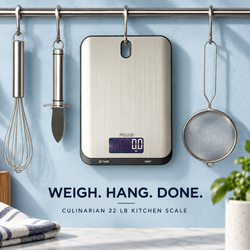
The best digital scale for meal prep should make it easy to portion ingredients, divide batch-cooked recipes, and record food weights without slowing down your kitchen routine. For most households, the ideal scale has a capacity of at least 5 kilograms or 11 pounds, 1-gram resolution, a responsive tare button, grams and ounces, and a platform large enough for plates and meal-prep containers.
People who regularly measure coffee, spices, yeast, salt, or small baking ingredients may prefer 0.1-gram resolution. Large-batch cooks should prioritize capacity, platform size, and display placement over unnecessary decimal places.
A digital scale provides weight measurements, not personalized nutrition advice. Individuals managing diabetes, kidney disease, food allergies, pregnancy, eating disorders, athletic performance, or another specialized concern should follow guidance from an appropriate healthcare professional.
Why Use a Digital Scale for Meal Prep?
Meal prep often involves dividing one recipe into several portions. Measuring cups and visual estimates can work, but they may produce inconsistent results when ingredients settle, compress, or vary in shape.
A digital scale can help you:
-
Divide a recipe into equal portions
-
Measure ingredients directly in a bowl
-
Track food using gram-based records
-
Follow recipes written by weight
-
Repeat successful recipes
-
Measure sauces and toppings
-
Portion snacks
-
Compare cooked serving sizes
-
Reduce the number of measuring cups used
-
Monitor ingredient quantities consistently
The USDA MyPlate website offers general resources for building meals with different food groups. A food scale can help measure quantities, but meal quality also depends on food variety, preparation, and individual needs.
What Makes a Digital Scale Good for Meal Prep?
A useful meal-prep scale should offer:
-
At least 5-kilogram or 11-pound capacity
-
1-gram resolution
-
A reliable tare function
-
Gram and ounce modes
-
A flat, stable platform
-
A display visible beneath containers
-
Easy-to-clean construction
-
Fast stabilization
-
Low-battery warning
-
Overload indication
-
Sensible automatic shutoff
-
Simple controls
The AWS kitchen scale collection includes digital models designed for cooking, portioning, baking, coffee preparation, and general food measurement.
Choose the Right Capacity
Capacity is the maximum physical load the scale can support. Meal preppers should include both the food and its container when calculating capacity.
5 Kilograms or 11 Pounds
A 5-kilogram scale provides enough range for most:
-
Individual plates
-
Storage containers
-
Mixing bowls
-
Batch-cooked grains
-
Chopped vegetables
-
Protein portions
-
Prepared meals
-
Baking recipes
The NEPTUNE-5KG digital kitchen scale offers an 11-pound capacity and a platform intended to accommodate a bowl or plate.
2 to 3 Kilograms
A lower-capacity scale may be appropriate for:
-
Individual portions
-
Coffee
-
Snacks
-
Small recipes
-
Lightweight containers
-
Sauces and dressings
A 3-kilogram capacity may be sufficient when you rarely weigh an entire batch at once.
More Than 5 Kilograms
Consider additional capacity when weighing:
-
Family-size recipes
-
Large mixing bowls
-
Heavy cookware
-
Bulk produce
-
Several portions at once
Confirm that the higher-capacity model still offers useful resolution.
Remember That Tare Does Not Increase Capacity
Tare subtracts the container’s weight from the displayed measurement, but the scale continues to carry the full physical load.
Suppose a scale has a capacity of 5 kilograms and the mixing bowl weighs 1 kilogram. After taring, only 4 kilograms of physical capacity remain.
Overloading can damage the weighing mechanism even when the displayed net food weight appears below the stated maximum.
What Resolution Do You Need?
Resolution is the smallest increment shown on the display.
1-Gram Resolution
One-gram resolution is appropriate for most meal-prep foods:
-
Meat and fish
-
Rice and grains
-
Pasta
-
Vegetables
-
Fruit
-
Cheese
-
Prepared meals
-
Snacks
-
Baking ingredients
It provides enough detail for everyday portioning without making the display overly sensitive to tiny changes.
0.1-Gram Resolution
A scale reading in 0.1-gram increments is useful for:
-
Coffee
-
Salt
-
Spices
-
Yeast
-
Small baking ingredients
-
Recipe testing
-
Sauces
-
Fine ingredient adjustments
The BARISTA-3KG coffee and kitchen scale combines a 3,000-gram capacity with 0.1-gram resolution and can support both meal preparation and coffee brewing.
Finer resolution is not necessary for ordinary portions of chicken, vegetables, rice, or other prepared foods.
Resolution, Accuracy, and Repeatability
Resolution is the smallest value displayed. Accuracy describes how closely the reading agrees with the actual mass within the scale’s stated tolerance. Repeatability describes whether the scale produces the same result when the same object is weighed repeatedly.
These terms should not be treated as interchangeable.
A scale displaying 0.1 gram may still vary because of:
-
An uneven counter
-
Weak batteries
-
Air movement
-
Food or crumbs under the platform
-
A container touching the counter
-
Temperature changes
-
Accidental overload
-
Scale damage
For meal prep, dependable repeatability is generally more valuable than additional unstable decimal places.
Why Tare Is the Most Important Digital Feature
Tare lets you subtract the weight of a bowl, plate, or container.
A typical meal-prep workflow is:
-
Place an empty container on the scale.
-
Press tare.
-
Add the first ingredient.
-
Record its weight.
-
Press tare again.
-
Add the next ingredient.
-
Repeat as needed.
This method makes it possible to assemble an entire meal in one container without manually subtracting the container or dirtying multiple measuring cups.
The tare button should remain accessible when a large plate or bowl is on the platform.
How to Divide a Batch Into Equal Portions
A digital scale can help divide a finished recipe by weight.
Suppose a prepared recipe weighs 1,800 grams and you want six portions:
1,800 ÷ 6 = 300 grams per portion
Use this process:
-
Place the empty batch container on the scale.
-
Press tare.
-
Add the complete recipe.
-
Record the total food weight.
-
Divide by the desired number of portions.
-
Place an empty meal-prep container on the scale.
-
Press tare.
-
Add one calculated portion.
-
Repeat with the remaining containers.
Mix combined dishes thoroughly when appropriate. If ingredients are not evenly distributed, equal-weight servings may not contain identical proportions of every ingredient.
Choose a Platform That Fits Your Containers
Platform size is one of the most overlooked features in a digital meal-prep scale.
The platform should support:
-
Plates
-
Reusable storage containers
-
Mixing bowls
-
Food-preparation trays
-
Small cutting boards
-
Portion containers
A container should not touch the counter because another surface could carry part of its weight. It should also avoid covering the display or pressing a button.
A scale with side-mounted controls or a display positioned toward the front may be easier to use with large bowls.
Display Features That Matter
Large Digits
The displayed weight should be easy to read without moving the container.
Backlighting
A backlit screen helps under cabinets and in kitchens with uneven lighting.
Unit Indicator
The screen should clearly show whether the scale is displaying grams, ounces, pounds, or milliliters.
Stable Reading
The scale should settle promptly and hold the result long enough to record it.
Low-Battery Warning
Weak batteries can interrupt meal prep and may contribute to inconsistent operation.
Overload Warning
An overload indicator alerts the user when the bowl and food exceed capacity.
Grams Versus Ounces
A versatile digital scale should display both grams and ounces.
Advantages of Grams
Grams work well for:
-
Precise portion division
-
Nutrition databases
-
International recipes
-
Baking
-
Ingredient scaling
-
Recipe calculations
Advantages of Ounces and Pounds
These units may be convenient for:
-
Meat portions
-
Packaged foods
-
Recipes using U.S. customary units
-
Familiar household measurements
Always confirm the active unit before recording a result. A unit-selection mistake can create a much larger error than the scale’s normal tolerance.
Digital Scale Features You May Not Need
Some features sound impressive but provide little practical value for everyday meal prep.
Excessive Measurement Units
Most users need grams, ounces, and possibly pounds. Specialized units add little value if they are never used.
Smartphone Connectivity
An app may help some users, but connectivity is not necessary for consistent portioning. Consider whether the software will remain supported and whether manual entry is actually slower.
Nutritional Calculations Built Into the Scale
Nutrition depends on the correct food entry, brand, recipe, and preparation method. A scale cannot identify every food automatically or guarantee that a database entry matches what is on the platform.
Extremely Fine Resolution
Hundredth-gram resolution is unnecessary for most foods and can make the scale more sensitive to air movement and vibration.
Weighing Food for Nutrition Tracking
Nutrition labels may provide serving information by grams, pieces, cups, tablespoons, or another household measure.
The FDA’s Nutrition Facts Label resources explain how serving sizes and nutrient information appear on packaged foods.
For more consistent records:
-
Match the food to the correct label or database entry
-
Confirm whether the entry refers to cooked or uncooked food
-
Record added oils, sauces, and toppings
-
Use the same unit consistently
-
Check whether the package has changed
-
Avoid assuming all brands have identical nutrition
The USDA’s FoodData Central provides food-composition data, but values can differ according to the product, source, and preparation method.
Raw Versus Cooked Weight
Cooking changes food weight.
-
Rice and pasta usually gain water.
-
Meat may lose moisture and fat.
-
Vegetables may gain or lose water depending on the method.
-
Sauces may become concentrated through evaporation.
A 100-gram cooked portion is therefore different from 100 grams of the same food before cooking.
Use a consistent method:
-
Weigh ingredients before cooking and calculate the whole recipe
-
Weigh the finished recipe and divide it into equal portions
-
Use nutrition information specifically for the cooked food
-
Follow the serving basis on the product label
Do not mix raw weights with cooked nutrition entries unless your calculation accounts for the change.
Weighing Liquids
Many digital kitchen scales include milliliter or fluid-ounce modes. These modes may assume a specific liquid density, often water or milk.
Not all liquids have the same density. Oil, syrup, cream, and sauces may produce different relationships between weight and volume.
For consistent recipe work, weighing liquids in grams can be simpler because the scale directly measures mass rather than estimating volume.
Automatic Shutoff
Automatic shutoff conserves battery power, but a short timeout can interrupt a recipe while you chop or prepare the next ingredient.
Look for:
-
A moderate shutoff interval
-
An adjustable setting
-
A warning before shutdown
-
Quick restart
-
Retention of preferred units
If the scale turns off with a bowl on the platform, remove the bowl before restarting unless the instructions say otherwise. Confirm zero and tare the container again.
Battery or Rechargeable Scale?
Replaceable Batteries
Advantages include:
-
Quick replacement
-
No charging delay
-
Easy long-term storage
-
Common battery availability
Rechargeable Power
Advantages include:
-
Less disposable-battery use
-
Convenient charging
-
No need to keep spare batteries
Consider whether the scale can be used while charging and whether the charging port is protected from food and liquid.
Flat Platform or Included Bowl?
Flat Platform Scale
A flat platform is usually the most versatile choice for meal prep because it accepts different containers.
It works well with:
-
Storage containers
-
Plates
-
Mixing bowls
-
Packaged ingredients
-
Meal-prep trays
Bowl Scale
A removable bowl can be helpful for:
-
Chopped produce
-
Loose grains
-
Baking ingredients
-
Foods that roll
-
Batch mixing
Confirm the bowl’s volume, material, cleaning requirements, and replacement availability.
Cleaning and Food Safety
Meal-prep scales can be exposed to crumbs, oils, raw-food packaging, spills, and condensation.
Clean the scale by:
-
Turning it off
-
Removing loose debris
-
Wiping the platform with a slightly damp cloth
-
Using only manufacturer-approved products
-
Preventing liquid from entering openings
-
Drying it before storage
Do not immerse a scale unless it is specifically rated and approved for immersion.
The USDA’s food-safety resources provide guidance on handling, preparation, cleaning, and preventing cross-contamination. Use a plate, bowl, or food-safe barrier when weighing raw meat or seafood.
Calibration and Consistency Checks
Some digital kitchen scales support user calibration with a specified weight.
Before calibrating:
-
Read the instructions
-
Use the specified calibration weight
-
Place the scale on a rigid, level surface
-
Clean the platform
-
Avoid vibration and airflow
-
Confirm the required unit
AWS offers calibration weights for compatible models.
Do not calibrate with a coin, food package, or household object. Its actual mass may differ from the labeled or assumed value.
You can also check repeatability by weighing the same appropriate reference several times. If the result changes considerably, inspect the batteries, surface, platform, and surrounding environment.
Storage and Maintenance
Store the scale:
-
Away from excessive heat and humidity
-
Without anything resting on the platform
-
With its cover installed when provided
-
Away from crowded drawers
-
In a location protected from impact
AWS provides scale maintenance guidance covering cleaning, temperature exposure, storage, and general care.
A scale should be checked after it is dropped, overloaded, transported, or stored for a long period.
Best Digital Meal-Prep Scale by Use Case
Best for Most People
Choose:
-
5-kilogram or 11-pound capacity
-
1-gram resolution
-
Flat platform
-
Grams and ounces
-
Tare
-
Backlit display
Best for Large Batches
Choose:
-
At least 5-kilogram capacity
-
Wide platform
-
Front-facing display
-
Durable controls
-
Overload warning
Best for Detailed Recipes
Choose:
-
2-to-5-kilogram capacity
-
0.1-gram resolution
-
Fast response
-
Stable readings
-
Easy tare
Best for Small Kitchens
Choose:
-
Slim profile
-
Flat platform
-
Protective storage
-
At least 3-kilogram capacity
-
1-gram resolution
Best for Coffee and Meal Prep
Choose:
-
3-kilogram capacity
-
0.1-gram resolution
-
Timer
-
Tare
-
Water-resistant or easy-clean surface
Meal-Prep Scale Comparison
| Feature | Recommended starting point |
|---|---|
| Capacity | 5 kg or 11 lb |
| Resolution | 1 g |
| Fine resolution | 0.1 g for small ingredients |
| Units | Grams and ounces |
| Tare | Essential |
| Platform | Flat and container-friendly |
| Display | Large, backlit, and visible |
| Shutoff | Moderate or adjustable |
| Cleaning | Smooth, wipeable surface |
| Warnings | Low battery and overload |
| Power | Replaceable or rechargeable battery |
| Storage | Slim profile with protected platform |
The complete range of American Weigh Scales products includes kitchen, precision, pocket, and other digital weighing formats.
Meal Prep and Balanced Eating
Weighing food can improve consistency, but nutrition is not determined by weight alone.
A meal plan should also consider:
-
Food variety
-
Fiber
-
Protein sources
-
Fruits and vegetables
-
Added sugars
-
Sodium
-
Dietary fats
-
Cultural preferences
-
Satisfaction and fullness
-
Individual health needs
The Dietary Guidelines for Americans provide evidence-based recommendations about overall eating patterns.
The CDC’s healthy-weight and growth resources also provide broader information about healthy behaviors. A digital scale is a practical kitchen tool, not a diagnosis or treatment device.
Common Digital Meal-Prep Scale Mistakes
Avoid these errors:
-
Forgetting to tare the container
-
Exceeding gross capacity
-
Assuming tare restores capacity
-
Letting a bowl touch the counter
-
Covering the display with a plate
-
Accidentally changing units
-
Recording cooked food as raw
-
Ignoring oils and sauces
-
Using the scale on a soft or uneven surface
-
Weighing under a fan
-
Cleaning with excessive liquid
-
Storing objects on the platform
-
Assuming more decimal places guarantee better accuracy
-
Treating a generic serving size as a personalized nutrition target
Digital Meal-Prep Scale Buying Checklist
Before ordering, confirm:
-
Capacity supports the largest batch and container
-
Resolution matches the foods you weigh
-
Tare is easy to access
-
Grams and ounces are available
-
The platform fits your containers
-
The display remains visible
-
Buttons remain accessible
-
Readings settle promptly
-
The surface is easy to clean
-
Automatic shutoff is suitable
-
Battery type is convenient
-
Low-battery warning is included
-
Overload indication is included
-
Calibration instructions are available
-
Storage dimensions fit your kitchen
Frequently Asked Questions
What is the best digital scale for meal prep?
For most households, it is a scale with a 5-kilogram or 11-pound capacity, 1-gram resolution, tare, grams and ounces, a large flat platform, and a visible backlit display.
Is 1-gram resolution accurate enough?
One-gram resolution is suitable for most portions of protein, grains, vegetables, fruit, snacks, and prepared meals. Smaller ingredients may benefit from 0.1-gram resolution.
Do I need a smart food scale?
No. A reliable digital scale with appropriate capacity, resolution, and tare is sufficient for most meal prep. Smart features are useful only if they improve your actual workflow.
Can I weigh a plate of food?
Yes, provided the plate and food remain within capacity, the plate sits entirely on the platform, and it does not cover the display or touch the counter.
Should meal-prep food be weighed before or after cooking?
Either method can work if you use matching nutrition data consistently. For batch recipes, weighing the finished recipe and dividing it into portions is often convenient.
How often should I calibrate a digital kitchen scale?
Follow the manufacturer’s instructions. Calibration or a consistency check may also be appropriate after transportation, impact, battery replacement, temperature changes, or unexpected readings.
Final Thoughts
The best digital scale for meal prep is the model that fits your everyday workflow. For most users, a 5-kilogram or 11-pound capacity, 1-gram resolution, reliable tare, grams and ounces, and a large flat platform provide the best combination of versatility and ease of use.
Choose 0.1-gram resolution when small ingredients, coffee, or detailed recipe development are regular parts of your routine. Prioritize a readable display, stable results, practical automatic shutoff, and easy cleaning over unnecessary smart features.
A dependable digital scale can simplify portioning, make recipes more repeatable, and reduce guesswork. Used as one part of a balanced meal-planning process, it can make weekly meal prep faster and more organized.