
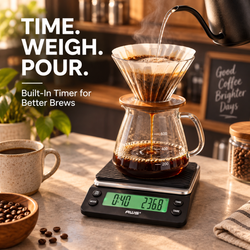
The best digital scale for roasting coffee should provide enough capacity for your green-bean batch and container, sufficient resolution to track meaningful weight changes, reliable repeatability, and a platform that fits your cooling tray or weighing vessel.
For most home coffee roasters, a digital scale with 2,000 to 5,000 grams of capacity and 0.1- or 1-gram resolution offers the most useful combination. Small sample roasters may prefer 0.1-gram resolution, while larger production batches may require substantially more capacity and can often use 1-gram resolution.
A coffee-roasting scale can help you measure:
-
Green coffee before roasting
-
Roasted coffee after cooling
-
Batch-to-batch consistency
-
Percentage weight loss
-
Coffee divided into storage bags
-
Sample-roast portions
-
Blending components
-
Packaging quantities
The right scale depends on your batch size, container weight, workflow, and the level of measurement detail you need. This guide explains how to compare capacity, resolution, accuracy, repeatability, calibration, platform size, and other features when selecting a digital scale for coffee roasting.
Why Weigh Coffee Before and After Roasting?
Green coffee beans lose mass during roasting as moisture and volatile compounds are released. Weighing a batch before and after roasting allows you to calculate its percentage weight loss.
The basic calculation is:
Roast weight loss percentage = (green weight − roasted weight) ÷ green weight × 100
For example:
-
Green coffee weight: 500 g
-
Roasted coffee weight: 425 g
-
Weight lost: 75 g
The calculation is:
75 ÷ 500 × 100 = 15%
That percentage becomes one data point in the roast record. It can be compared with:
-
Roast time
-
Bean temperature
-
Rate-of-rise data
-
Color
-
First-crack timing
-
Development time
-
Airflow
-
Energy input
-
Sensory results
Weight loss does not independently determine roast quality or degree. Two coffees can produce similar weight-loss percentages while tasting different because of green-coffee characteristics, roast profiles, equipment, cooling, and measurement conditions.
A scale simply gives the roaster another repeatable measurement.
The National Institute of Standards and Technology explains the relationship among kilograms, grams, and milligrams through its overview of SI units for mass. Using grams throughout a roast log makes calculations and comparisons easier.
Quick Recommendation: Which Coffee-Roasting Scale Should You Buy?
For Small Sample Roasting
Consider:
-
500–2,000 g capacity
-
0.1 g resolution
-
Reliable tare
-
A compact weighing container
-
Calibration capability
-
Good repeatability
For Home Coffee Roasting
Consider:
-
2,000–5,000 g capacity
-
0.1–1 g resolution
-
A large platform
-
A visible display
-
Fast stabilization
-
Easy cleaning
For Larger Hobby or Small Commercial Batches
Consider:
-
5,000–15,000 g capacity or more
-
1 g resolution or appropriate process resolution
-
A large, stable platform
-
Durable construction
-
AC or rechargeable power
-
A remote or elevated display when needed
For Commercial Production
Capacity and resolution must be selected around:
-
Maximum batch size
-
Container or tray weight
-
Production tolerances
-
Packaging requirements
-
Applicable legal-for-trade rules
-
Calibration and documentation procedures
The correct scale is not necessarily the one with the finest resolution. It is the one that measures the complete load while providing enough detail for the decisions you make from the result.
Understanding Scale Capacity
Capacity is the maximum physical load the scale is designed to support.
When weighing coffee, the physical load may include:
-
Green coffee beans
-
Roasted coffee beans
-
A cooling tray
-
A metal bowl
-
A plastic container
-
A sample cup
-
A storage bag
-
A scoop resting in the container
-
Any liner or protective mat placed on the platform
Use this formula:
Required capacity = container weight + largest coffee batch + reasonable margin
Example: Small Sample Roast
-
Empty container: 80 g
-
Green coffee: 200 g
-
Total load: 280 g
A 500-gram scale could accommodate the load, but a 1,000-gram model would provide more flexibility for different containers.
Example: Home Roast Batch
-
Empty bowl: 450 g
-
Green coffee: 1,000 g
-
Total load: 1,450 g
A 2,000-gram scale could work, but it would leave only 550 grams of margin. A 3,000- or 5,000-gram scale may be more practical.
Example: Larger Batch
-
Empty cooling tray: 1,800 g
-
Green coffee: 5,000 g
-
Total load: 6,800 g
A 5-kilogram scale would not be sufficient. A scale with at least 10 kilograms of capacity would be more appropriate.
Tare Does Not Increase Capacity
The tare function resets the displayed value to zero after a container is placed on the platform.
If a scale has a 5,000-gram capacity and the empty tray weighs 1,200 grams, approximately 3,800 grams of physical capacity remain after taring.
The display may show zero, but the load cell is still supporting the tray.
For example:
-
Scale capacity: 5,000 g
-
Empty tray: 1,200 g
-
Display after tare: 0 g
-
Remaining physical capacity: approximately 3,800 g
Adding 5,000 grams of coffee would place approximately 6,200 grams on the scale and exceed its rated capacity.
Always calculate the full physical load rather than relying on the displayed net value.
What Resolution Do You Need?
Resolution is the smallest weight increment displayed by the scale.
Common resolutions include:
-
1 g
-
0.1 g
-
0.01 g
-
0.001 g
The best resolution depends on the batch size and the smallest difference that matters to your process.
Is 1-Gram Resolution Enough for Coffee Roasting?
For many home and small commercial roasting batches, 1-gram resolution is sufficient.
Consider a 1,000-gram green-coffee batch. A difference of one gram represents 0.1% of the starting weight. That may provide enough detail for routine roast-loss calculations.
A 1-gram scale is practical for:
-
500 g to multi-kilogram batches
-
Routine home roasting
-
Larger production batches
-
Bulk green-coffee weighing
-
Roasted-coffee packaging
-
Inventory measurements
Its advantages may include:
-
Higher capacity
-
Larger platform
-
Less sensitivity to minor environmental movement
-
Faster everyday operation
A scale from the AWS kitchen scales collection may be suitable for home roasting when its capacity, platform dimensions, and resolution match the intended batch.
When Is 0.1-Gram Resolution Better?
A 0.1-gram scale displays weight in tenths of a gram:
-
199.8 g
-
199.9 g
-
200.0 g
This resolution is useful for:
-
Sample roasting
-
Batches below approximately 500 grams
-
Detailed roast comparisons
-
Green-coffee blending
-
Small packaging quantities
-
Coffee research and development
-
Tracking small retained samples
Suppose a sample roaster begins with 100 grams of green coffee and finishes with 84.6 grams. A 0.1-gram scale provides more useful detail than a whole-gram scale, which might display only 85 grams.
For a 100-gram batch, a 0.1-gram increment equals 0.1% of the starting quantity. This makes it easier to compare small differences among sample roasts.
Compact AWS pocket scales can be useful for green-coffee samples and small roasted-bean portions when the container and batch remain within capacity.
Do You Need 0.01-Gram Resolution?
A scale with 0.01-gram resolution can be useful for specialized work involving very small coffee samples or low-weight blending components.
Possible applications include:
-
Experimental sample roasting
-
Small green-coffee evaluations
-
Blend-development ingredients
-
Research
-
Measuring defect samples
-
Detailed laboratory-style records
For normal home roasting, 0.01 gram is often unnecessary. The lower capacity and smaller platform may create more limitations than the extra decimal place solves.
Is a Milligram Scale Useful for Roasting Coffee?
A 0.001-gram scale is rarely necessary for weighing coffee beans before or after roasting.
Milligram resolution may be relevant to specialized laboratory procedures, but it is generally excessive for:
-
Home-roasting batches
-
Sample-roaster batches
-
Finished-coffee packaging
-
Roast weight-loss calculations
The AWS milligram scales category is better suited to applications that genuinely require one-milligram readability.
For ordinary coffee roasting, focus on enough capacity, a stable platform, good repeatability, and an appropriate resolution rather than the greatest possible number of decimal places.
Capacity and Resolution Recommendations
| Roasting application | Suggested capacity | Suggested resolution |
|---|---|---|
| Small coffee samples | 500–1,000 g | 0.1 g |
| Sample roasting | 1,000–2,000 g | 0.1 g |
| Home roasting | 2,000–5,000 g | 0.1–1 g |
| Larger hobby batches | 5,000–10,000 g | 1 g |
| Small commercial batches | 10,000 g or more | 1 g or process-dependent |
| Laboratory work | Application-specific | 0.001–0.1 g |
These are general starting points rather than universal requirements. Container weight, batch size, platform dimensions, and required process tolerance determine the final choice.
Accuracy, Resolution and Repeatability
These terms should not be treated as interchangeable.
Resolution
The smallest displayed increment.
Accuracy
How closely the indicated result agrees with an accepted reference value.
Repeatability
How consistently the same load produces the same result under similar conditions.
Linearity
How consistently the scale performs across different parts of its weighing range.
A scale that displays 500.0 grams is not automatically accurate to exactly 0.1 gram. Review the model’s accuracy-related specifications, calibration requirements, and minimum-load information.
For controlled sample-roasting or product-development work, an AWS balance scale may offer an appropriate format when stable, repeatable measurement is more important than portability.
Why Repeatability Matters for Roast Comparisons
A roast log becomes more useful when measurements can be compared across batches.
If the same reference load produces substantially different readings each time, calculated roast loss may reflect scale variation rather than actual differences in the coffee.
A simple repeatability check can be performed by:
-
Placing the scale on a stable surface.
-
Turning it on and allowing it to stabilize.
-
Weighing an appropriate reference.
-
Recording the result.
-
Removing the reference.
-
Allowing the scale to return to zero.
-
Repeating the process several times.
-
Comparing the readings.
The results should be evaluated against the requirements of your process and the scale’s stated specifications.
How to Calculate Roast Weight Loss
Use:
Weight loss percentage = (green weight − roasted weight) ÷ green weight × 100
Example 1
-
Green weight: 250 g
-
Roasted weight: 215 g
-
Loss: 35 g
35 ÷ 250 × 100 = 14%
Example 2
-
Green weight: 1,000 g
-
Roasted weight: 840 g
-
Loss: 160 g
160 ÷ 1,000 × 100 = 16%
Example 3
-
Green weight: 5,000 g
-
Roasted weight: 4,300 g
-
Loss: 700 g
700 ÷ 5,000 × 100 = 14%
Use the same scale, container, weighing procedure, and post-roast timing when comparing batches. Consistent technique reduces unnecessary variation.
Weight-loss percentage should be interpreted alongside other roast and sensory data. It is not a standalone measurement of quality.
When Should Roasted Coffee Be Weighed?
Roasted coffee should be weighed consistently from batch to batch.
Potential sources of variation include:
-
How long the coffee cools
-
Whether chaff is included
-
Whether beans remain in the roaster or ducting
-
Whether samples were removed during roasting
-
Whether the cooling tray was completely emptied
-
Whether the same container was used
-
Whether the scale was tared correctly
Create a standard procedure, such as weighing the roasted coffee after the cooling cycle is complete and after the same amount of time has passed.
If samples are removed during roasting, record their weight or account for them consistently.
Platform Size and Container Fit
A scale can have enough capacity while still being too small for the cooling tray or bowl.
The container should:
-
Fit securely on the platform
-
Avoid touching the worktop
-
Leave the display visible
-
Avoid pressing control buttons
-
Remain stable while beans are added
-
Apply the load as centrally as practical
If the container touches another surface, the scale is no longer carrying the entire load, and the displayed result may be too low.
Measure the base of your normal tray or bowl before selecting a scale.
Display Visibility
Large containers can block the display.
Look for:
-
A display positioned forward of the platform
-
Large, high-contrast digits
-
Backlighting
-
A hold function when appropriate
-
A stable-weight indicator
-
An overload warning
-
A low-battery indicator
For larger roasting containers, a detached, elevated, or otherwise visible display may be easier to use than a screen placed directly beneath the platform’s edge.
Tare Function
Tare makes it possible to exclude the displayed weight of:
-
Cooling trays
-
Metal bowls
-
Green-coffee containers
-
Storage bags
-
Packaging
-
Sample cups
A reliable tare button should be easy to reach while the container is on the platform.
If you tare repeatedly, maintain awareness of the accumulated physical load. Multiple taring operations can make it easy to forget how much weight the scale is actually supporting.
Calibration Capability
A scale used for repeatable roast records should have a clear calibration or performance-check procedure.
Before buying, confirm:
-
Whether calibration is supported
-
Which reference weight is required
-
Whether the weight is included
-
Whether the calibration procedure is documented
-
Whether the scale retains calibration after power loss
-
How performance can be checked between calibrations
Compatible AWS calibration weights can be used with scales requiring those reference masses.
Do not calibrate with coffee bags, coins, scoops, or other objects of assumed weight. Use the reference specified for the instrument.
Calibration Versus Verification
Calibration, verification, and adjustment are related but different.
-
Calibration compares the scale’s reading with a known reference.
-
Verification checks whether performance is within an acceptable range.
-
Adjustment changes the scale’s response when the model permits it.
A scale can be verified without being adjusted. A successful calibration at one point also does not prove perfect accuracy throughout the entire weighing range.
When to Calibrate or Check a Coffee Scale
Consider calibration or verification:
-
When the scale is new
-
According to the manufacturer’s schedule
-
Before important sample-roasting sessions
-
After moving the scale
-
After changing batteries
-
After a substantial temperature change
-
After impact or overload
-
When readings appear unusual
-
When repeatability changes
-
According to a commercial quality procedure
Calibration cannot correct drafts, vibration, platform contact, overheating, or a damaged load cell.
Features That Matter in a Coffee-Roasting Scale
Fast Stabilization
A scale should settle quickly so batches can move efficiently through the roasting workflow.
Large Platform
The platform should support the cooling tray or container without unstable overhang.
Clear Display
The display should remain visible beneath large bowls and in the lighting conditions of the roasting area.
Appropriate Auto-Off
A short auto-off period may interrupt a roasting session. Choose a model with an adjustable timer or a suitable external power mode.
Durable Surface
Green and roasted coffee can produce dust, chaff, and small fragments. A smooth platform is easier to clean.
Overload Warning
An overload indicator helps protect the load cell when a heavy container is used.
Unit Selection
Grams and kilograms are convenient for roast records and percentage calculations. Using one unit consistently reduces transcription mistakes.
Battery and AC Options
Battery power allows portability. AC or USB power can be useful for a fixed roasting station or extended production sessions.
Protective Cover
A compact scale used for sample roasting benefits from a cover that protects its platform during storage.
Easy Controls
Buttons should remain accessible while a large container is on the platform.
Environmental Factors Affecting Coffee Scales
Vibration
Roasters, cooling fans, grinders, blowers, and nearby equipment can cause unstable readings.
Place the scale on a firm surface separated from operating machinery whenever possible.
Air Movement
Cooling fans and ventilation systems can influence fine-resolution scales and move chaff across the platform.
Temperature
Do not place hot beans or a hot cooling tray directly on a scale unless it is designed for the temperature involved.
Heat may:
-
Affect readings
-
Damage the platform
-
Distort the housing
-
Damage electronics
-
Shorten scale life
Allow the beans and container to reach an appropriate handling temperature before weighing.
Static Electricity
Coffee chaff and plastic containers can develop static, especially in dry environments. Static can cause particles to cling to containers and may affect fine readings.
Dust and Chaff
Coffee dust and chaff can collect around the platform and enter openings. Clean the scale according to the manufacturer’s instructions.
Uneven Surfaces
Use a rigid, level worktop. Avoid soft mats, warped trays, or flexible tables.
AWS provides additional guidance concerning digital scale maintenance and care.
Safety Around Coffee-Roasting Equipment
A scale should be positioned so that weighing does not introduce risks around hot equipment, rotating components, exhaust systems, or electrical connections.
Coffee-roasting operations can generate heat, smoke, dust, and chaff. OSHA provides information about combustible dust hazards, which may be relevant to facilities handling combustible particulate materials.
Practical precautions include:
-
Keeping the weighing area clean
-
Preventing chaff accumulation
-
Following roaster-manufacturer instructions
-
Keeping cords away from heat
-
Avoiding unstable containers
-
Allowing hot trays to cool appropriately
-
Maintaining ventilation systems
-
Following applicable workplace procedures
A scale measures mass; it does not monitor fire risk, exhaust performance, carbon monoxide, bean temperature, or equipment safety.
Coffee Standards and Consistent Measurement
The Specialty Coffee Association publishes information concerning coffee standards, including technical approaches used across the specialty-coffee industry.
A roaster’s internal procedure should clearly define:
-
How green coffee is weighed
-
Which container is used
-
Whether the container is tared
-
When roasted coffee is weighed
-
How chaff and samples are handled
-
How calculations are recorded
-
Which scale is used
-
How the scale is checked
Consistency in method makes the resulting data more comparable.
Using a Digital Scale for Coffee Roasting
Step 1: Prepare the Scale
Place the scale on a level, stable surface away from the operating roaster, cooling airflow, and vibration.
Step 2: Inspect the Platform
Remove coffee fragments, dust, and chaff. Confirm that nothing is lodged around the platform.
Step 3: Confirm the Unit
Select grams or kilograms according to your roast log.
Step 4: Check the Scale
Perform calibration or a reference check according to your procedure.
Step 5: Place the Empty Container
Center the bowl or tray and confirm that it does not touch surrounding objects.
Step 6: Press Tare
Wait for a stable zero.
Step 7: Weigh the Green Coffee
Add the batch and record the actual starting weight.
Step 8: Roast the Coffee
Follow the established roasting procedure and document relevant roast data.
Step 9: Cool the Beans
Use the same cooling endpoint for comparable batches.
Step 10: Weigh the Roasted Coffee
Use the same scale and container when practical. Record the final weight.
Step 11: Calculate Weight Loss
Apply the percentage formula and add the result to the roast log.
Step 12: Clean and Store the Scale
Remove chaff and dust according to the manufacturer’s instructions.
What to Record in a Roast Log
A useful roast record may include:
-
Green-coffee name
-
Origin
-
Process
-
Lot identification
-
Green batch weight
-
Roasted batch weight
-
Weight-loss percentage
-
Charge temperature
-
Total roast time
-
First-crack timing
-
Development time
-
Airflow adjustments
-
Energy adjustments
-
Final temperature
-
Color measurement, if available
-
Sensory observations
-
Scale used
-
Date and operator
The scale contributes only weight data, but that information becomes more valuable when combined with other controlled variables.
Using a Scale for Coffee Blends
Coffee can be blended before or after roasting.
When weighing blend components, calculate each component from the desired total.
For a 1,000-gram blend:
-
50% component = 500 g
-
30% component = 300 g
-
20% component = 200 g
For a 250-gram blend:
-
50% component = 125 g
-
30% component = 75 g
-
20% component = 50 g
Select resolution based on the smallest blend component and acceptable tolerance.
A 1-gram scale may be sufficient for a multi-kilogram blend, while a 0.1-gram scale may be preferable for small sample blends.
Using a Scale for Packaging Roasted Coffee
A scale can help portion roasted coffee into bags after the batch rests or according to the roaster’s packaging procedure.
A basic workflow is:
-
Place the empty bag or container on the platform.
-
Press tare.
-
Add coffee to the target weight.
-
Record or confirm the quantity.
-
Remove the package.
-
Confirm that the scale returns to zero.
-
Repeat.
Commercial packages sold by weight may be subject to equipment and labeling requirements. NIST provides resources concerning legal metrology and weights and measures. A home kitchen scale should not automatically be assumed suitable for legal-for-trade use.
Food Labeling and Handling
Businesses packaging roasted coffee must consider applicable requirements for net quantity, labeling, handling, and sanitation.
The FDA provides general information about food labeling and nutrition. Requirements can vary based on the product, package, claims, and sales channel.
The FDA also publishes the Food Code, a model used by many jurisdictions for retail and food-service safety practices.
Good weighing practices include:
-
Using clean containers
-
Keeping the platform free of residue
-
Avoiding cross-contamination
-
Protecting beans from moisture
-
Cleaning spills promptly
-
Following applicable facility procedures
Coffee Composition and Measurement Limits
The USDA’s FoodData Central provides available food-composition data for coffee and other foods.
A roasting scale does not directly measure:
-
Green-coffee moisture
-
Water activity
-
Roast color
-
Bean density
-
Caffeine
-
Chemical composition
-
Flavor
-
Roast uniformity
-
Contaminants
Separate instruments and analytical methods are required for those characteristics.
The scale measures mass. Roast weight loss is calculated from that mass, but its interpretation requires the broader roast context.
Common Mistakes When Buying a Coffee-Roasting Scale
Selecting Capacity Based Only on the Beans
The cooling tray or bowl also counts toward maximum capacity.
Assuming Tare Creates More Capacity
Tare resets the display but does not reduce the physical load.
Buying Too Little Capacity
A scale that barely supports the normal batch leaves little room for a heavier container or larger roast.
Buying Excessive Capacity
A very high-capacity scale may use increments too large for small sample roasts.
Choosing Based Only on Decimal Places
Resolution does not prove accuracy, repeatability, or stability.
Using a Platform That Is Too Small
A tray touching the table can produce an incorrect reading.
Weighing Hot Equipment
Heat can affect or damage a scale not designed for hot loads.
Placing the Scale Near the Roaster
Vibration, airflow, and heat may destabilize measurements.
Ignoring Auto-Off
A short auto-off period may interrupt the workflow and erase the tare state.
Calibrating With Coffee Bags or Coins
Use the calibration weight specified for the scale.
Comparing Inconsistent Procedures
Weight-loss data becomes less useful when beans are weighed at different cooling stages or when samples and chaff are handled inconsistently.
Coffee-Roasting Scale Buying Checklist
Capacity
-
What is the largest green batch?
-
What does the empty container weigh?
-
Will a cooling tray be used?
-
What is the total physical load?
-
Is there enough capacity margin?
Resolution
-
Is 1 gram sufficient?
-
Does sample roasting require 0.1 gram?
-
What is the smallest blend component?
-
Does the scale provide useful detail at the normal batch size?
Accuracy and Repeatability
-
Are tolerance specifications available?
-
Does the scale repeat the same reading?
-
Is a minimum load stated?
-
Does the display stabilize quickly?
-
Is calibration supported?
Physical Design
-
Does the container fit on the platform?
-
Will the display remain visible?
-
Are the buttons accessible?
-
Is the surface easy to clean?
-
Is the scale protected from heat and debris?
Workflow
-
Is tare easy to use?
-
Is the auto-off interval suitable?
-
Does the scale measure in grams and kilograms?
-
Is there an overload warning?
-
Are battery and external-power options appropriate?
Calibration
-
Which reference weight is required?
-
Is the procedure documented?
-
Can performance be checked across the working range?
-
Does the operation require calibration records?
Frequently Asked Questions
What is the best scale for roasting coffee?
For most home roasters, a scale with 2,000 to 5,000 grams of capacity, 0.1- or 1-gram resolution, reliable tare, a large platform, and calibration capability is a practical choice.
Is 1-gram resolution accurate enough for coffee roasting?
It is generally sufficient for medium and large batches. A 0.1-gram scale provides more detail for sample roasts and batches below approximately 500 grams.
Do I need a 0.01-gram scale for roasting coffee?
Usually not. It may be useful for specialized sample work or very small blend components, but 0.1 gram is sufficient for most small roasting batches.
What capacity should a home coffee-roasting scale have?
For many home roasters, 2,000 to 5,000 grams is appropriate. Add the container weight to the largest batch and include a margin.
How do I calculate roast weight loss?
Subtract the roasted weight from the green weight, divide the difference by the green weight, and multiply by 100.
Does tare remove the container from maximum capacity?
No. Tare resets the display, but the container’s physical weight still counts.
Can I weigh coffee while it is hot?
Avoid placing hot beans or trays on a scale unless the manufacturer states that the instrument can tolerate the temperature.
Why does my coffee scale fluctuate?
Common causes include roaster vibration, cooling airflow, static, heat, an uneven surface, low batteries, or a container touching another object.
How often should I calibrate a coffee-roasting scale?
Follow the manufacturer’s instructions and your quality procedure. A check may also be appropriate after moving, impact, overload, battery replacement, or significant temperature changes.
Can I use a kitchen scale for coffee roasting?
Yes, if its capacity, resolution, platform dimensions, and operating conditions match the roasting workflow.
Can a home scale be used for retail coffee packages?
Not automatically. Commercial sales may require approved equipment and compliance with applicable weights-and-measures regulations.
Final Thoughts
The best digital scale for roasting coffee should fit the entire roasting workflow—not merely the weight of the beans.
For most home roasting, 2,000 to 5,000 grams of capacity with 0.1- or 1-gram resolution provides a practical combination. Small sample roasters benefit from 0.1-gram resolution, while larger production batches usually require greater capacity and may not need measurements finer than one gram.
Before purchasing a scale:
-
Add the container weight to the largest batch.
-
Include a practical capacity margin.
-
Choose resolution based on the smallest meaningful change.
-
Measure the base of the cooling tray or bowl.
-
Confirm that the display remains visible.
-
Review accuracy and repeatability specifications.
-
Check calibration requirements.
-
Protect the scale from heat, airflow, vibration, dust, and chaff.
A suitable digital scale makes roast records more consistent and weight-loss calculations easier to compare. Combined with a standardized weighing procedure, it becomes a valuable tool for home roasting, sample evaluation, blend development, and production control.