
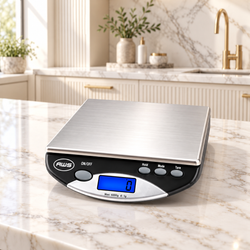
The best digital scale for tea leaves should make it easy to measure consistent portions without adding unnecessary complexity to your tea routine. For most home tea drinkers, a scale with 500 to 2,000 grams of capacity and 0.1-gram resolution provides a practical combination of sensitivity, platform space, and versatility. Tea enthusiasts preparing smaller or more precise portions may prefer 0.01-gram resolution.
A digital tea scale is useful because loose-leaf teas vary significantly in shape and density. A teaspoon of tightly rolled oolong can weigh considerably more than the same spoonful of a large, airy white tea. Measuring by weight creates a repeatable starting point regardless of leaf style.
When selecting a scale, focus on:
-
Resolution
-
Maximum capacity
-
Minimum useful weight
-
Tare function
-
Platform size
-
Display visibility
-
Calibration capability
-
Response speed
-
Water resistance and ease of cleaning
-
Battery life or power options
This guide explains which specifications matter, how much precision tea leaves require, and how to choose the best digital scale for your brewing method.
Why Weigh Tea Leaves?
Measuring tea by spoon can be convenient, but it is not especially consistent. Loose-leaf tea comes in many forms:
-
Fine broken leaves
-
Large whole leaves
-
Tightly rolled pellets
-
Twisted oolong leaves
-
Compressed tea fragments
-
Powdered tea
-
Herbal blends
-
Flowers and large botanicals
-
Dense fruit or spice pieces
A teaspoon measures volume rather than mass. Because different teas occupy space differently, two level teaspoons can contain very different amounts of tea.
A scale lets you establish a repeatable tea-to-water ratio. If a particular tea tastes best when brewed with 5.0 grams of leaves and 250 grams of water, you can begin with the same ratio the next time.
Weighing tea can help improve:
-
Consistency between brewing sessions
-
Control over flavor strength
-
Comparison of steeping variables
-
Brewing notes and tasting records
-
Portioning of expensive teas
-
Inventory management
-
Packaging of tea samples
-
Reproduction of successful recipes
-
Comparison between brewing vessels
The National Institute of Standards and Technology explains how grams relate to the internationally recognized system of SI units for mass. Using grams for both tea and water creates a straightforward way to document ratios without relying on spoon size or visual estimates.
Quick Recommendation: Which Tea Scale Should You Buy?
For most tea preparation, look for a digital scale with:
-
500–2,000 g capacity
-
0.1 g resolution
-
A responsive tare button
-
Gram measurement mode
-
A platform large enough for your tea vessel
-
A display that remains visible under the vessel
-
Automatic shutoff that does not interrupt brewing
-
A smooth, easy-to-clean surface
For enthusiasts who frequently measure portions below 2 grams or compare small recipe adjustments, consider:
-
200–500 g capacity
-
0.01 g resolution
-
Calibration capability
-
A stable weighing surface
-
A compact weighing tray or cup
-
Protection from drafts and vibration
For tea shops, blending rooms, or packaging operations, select capacity according to the complete physical load, including the empty container, finished quantity, and a reasonable margin.
The available AWS kitchen scales include useful options for everyday food preparation and larger tea vessels.
Is 0.1-Gram Resolution Enough for Tea?
For most cups and pots of tea, 0.1-gram resolution is sufficient.
A scale with 0.1-gram resolution displays readings such as:
-
3.0 g
-
3.1 g
-
3.2 g
-
3.3 g
This level of readability allows a user to distinguish between 3.0 and 3.5 grams of tea, which can create a noticeable difference in a small brewing vessel.
A 0.1-gram scale is typically suitable for:
-
Western-style tea brewing
-
Teapots serving several cups
-
Gongfu-style portions of several grams
-
Cold-brew tea preparation
-
Everyday loose-leaf tea
-
Herbal infusions
-
Tea sample preparation
-
General kitchen use
It also tends to offer more capacity than a milligram scale and may be less sensitive to minor environmental disturbances.
If your normal portion is between 3 and 10 grams, 0.1-gram resolution provides 30 to 100 displayed increments across that range. This gives the user considerably more control than a scale that reads only in whole grams.
When Is 0.01-Gram Resolution Better?
A scale with 0.01-gram resolution displays hundredths of a gram:
-
2.00 g
-
2.01 g
-
2.02 g
This finer resolution can be useful when:
-
Brewing very small servings
-
Measuring expensive tea samples
-
Comparing subtle ratio adjustments
-
Creating detailed tasting records
-
Portioning small sample bags
-
Measuring concentrated botanical additions
-
Developing tea blends
-
Working with low-weight powdered ingredients
For example, the difference between 1.50 and 1.75 grams cannot be displayed precisely on a scale that reads only in 0.1-gram increments. A 0.01-gram scale provides more detail.
The AWS pocket scales collection includes compact models that can be useful for small loose-leaf tea portions and portable tea kits.
However, more decimal places do not automatically create a better brewing experience. A 0.01-gram scale may have a smaller platform or lower maximum capacity. It may also react more noticeably to air currents, vibration, static electricity, and movement.
For most tea drinkers, 0.01 gram is a precision option rather than a necessity.
Do You Need 0.001-Gram Resolution for Tea Leaves?
A 0.001-gram scale displays weight in one-milligram increments. This level of resolution is usually unnecessary for preparing a normal cup or pot of loose-leaf tea.
Milligram resolution may have a role in specialized situations, such as:
-
Laboratory-style tea analysis
-
Research and product development
-
Measuring very small blending ingredients
-
Documenting minute powdered additives
-
Preparing highly controlled experimental samples
Users with a genuine need for this level of readability can compare AWS milligram scales.
For ordinary tea brewing, milligram resolution may create more complications than benefits. Fine-resolution instruments are sensitive to:
-
Drafts
-
Fans and air-conditioning vents
-
Table vibration
-
Static electricity
-
Temperature changes
-
Uneven surfaces
-
Movement near the scale
A 0.001-gram display should not be treated as proof that every reading is accurate to exactly one milligram. Resolution, accuracy, repeatability, and minimum load are different specifications.
What Capacity Does a Tea Scale Need?
Capacity is the maximum physical load the scale is designed to support. The required capacity depends on how the scale will be used.
Weighing Leaves in a Small Cup
If you place a lightweight tea cup on the scale and add 3 to 10 grams of leaves, a 200- or 500-gram scale may provide adequate capacity.
Weighing a Teapot
A ceramic or glass teapot may weigh several hundred grams before water or tea is added. A capacity of 1,000 to 2,000 grams may be more appropriate.
Weighing Brewing Water
If you intend to place the complete brewing vessel on the scale while pouring water, calculate:
-
Empty vessel weight
-
Tea-leaf weight
-
Water weight
-
Lid or filter weight
-
Capacity margin
For example:
-
Empty teapot: 450 g
-
Tea leaves: 8 g
-
Water: 500 g
-
Lid: 100 g
-
Total physical load: 1,058 g
A 1,000-gram scale would be insufficient. A 2,000-gram capacity would provide more practical room.
Portioning Bulk Tea
Tea sellers or enthusiasts dividing larger packages may need:
-
500 g capacity for small sample work
-
1,000 g capacity for general portioning
-
2,000 g or more for bulk quantities and heavier containers
Always Include the Container
Use this equation:
Required load = container weight + tea weight + water or additional contents
Then select a scale with enough extra capacity to avoid working constantly at the maximum limit.
Tare Does Not Increase Capacity
The tare function resets the displayed value to zero after a container is placed on the platform. It makes the tea easier to measure, but it does not remove the container’s physical weight.
For example:
-
Scale capacity: 500 g
-
Empty tea vessel: 320 g
-
Display after tare: 0.0 g
-
Remaining physical capacity: approximately 180 g
Even though the display says zero, the scale is already supporting 320 grams. Adding 500 grams of water would overload it.
This distinction is particularly important when weighing a teapot during water pouring. Select capacity based on the total physical load, not the weight shown after taring.
Understanding Resolution, Accuracy and Repeatability
These terms describe different aspects of scale performance.
Resolution
Resolution is the smallest increment displayed. A 0.1-gram scale changes in tenths of a gram.
Accuracy
Accuracy describes how closely a measurement agrees with an accepted reference value.
Repeatability
Repeatability describes whether the scale reports similar readings when the same load is measured repeatedly under the same conditions.
A scale may display 5.00 grams but still have a measurement tolerance larger than 0.01 gram. The number of decimal places alone does not guarantee accuracy.
When evaluating a tea scale, review the manufacturer’s specifications for:
-
Accuracy or tolerance
-
Repeatability
-
Minimum load
-
Maximum capacity
-
Calibration requirements
-
Operating temperature
-
Stabilization time
-
Recommended power source
For more controlled measurements or blending work, an AWS balance scale may provide a more appropriate format than a basic kitchen model.
Minimum Load: The Frequently Overlooked Specification
Tea portions are light, so the lower end of the weighing range matters.
A scale may display 0.1 gram but respond inconsistently when only 0.1 gram is added. The first increment can be affected by zero tracking, environmental movement, sensitivity, or the scale’s minimum-load behavior.
If your normal serving is 5 grams, a 0.1-gram scale provides many displayed increments and is generally more useful than it would be for a target of only 0.1 gram.
When comparing scales, consider the smallest complete portion you plan to weigh—not only the smallest number printed on the display.
A scale should provide adequate detail throughout your real working range.
Best Scale Specifications by Tea Use
| Tea application | Suggested capacity | Suggested resolution |
|---|---|---|
| Everyday cup or teapot | 500–2,000 g | 0.1 g |
| Gongfu-style brewing | 200–1,000 g | 0.01–0.1 g |
| Small tea samples | 100–500 g | 0.01 g |
| Tea blending | 500–2,000 g | 0.01–0.1 g |
| Bulk tea portioning | 1,000 g or more | 0.1–1 g |
| Research applications | Process-dependent | 0.001–0.01 g |
These are general starting points. The best scale depends on the vessel weight, desired portion size, platform dimensions, and acceptable measurement tolerance.
Digital Scale Features That Matter for Tea
Tare Function
Tare lets you place a cup, bowl, filter, or teapot on the platform and reset the displayed weight to zero.
This feature is essential when you want to measure only the tea leaves or brewing water.
Gram Mode
Grams provide an easy and widely used unit for tea ratios. Using the same unit for tea and water also simplifies brewing records.
Because one gram of water is approximately equivalent to one milliliter under ordinary brewing conditions, many tea drinkers use a scale to monitor water additions. For exact scientific or commercial work, temperature and density should be considered rather than treating grams and milliliters as universally identical.
Fast Response Time
A responsive scale makes it easier to stop pouring water at the desired amount. A slow display can continue rising after the user has stopped pouring, particularly when water is added quickly.
Response speed is less critical when measuring dry leaves in a separate cup, but it becomes important when the scale remains under the brewing vessel.
Stable Readings
The display should settle quickly and remain stable under proper conditions. Constant drifting makes it difficult to portion light tea leaves.
Platform Size
The platform should support the base of the tea vessel without allowing it to touch the surrounding table.
A container that extends beyond the platform can:
-
Cover the display
-
Press against buttons
-
Contact nearby surfaces
-
Create instability
-
Cause off-center loading
-
Increase spill risk
Check the platform dimensions before purchasing.
Readable Display
If a teapot blocks the display, the scale becomes difficult to use. A forward-facing or offset display is helpful for larger vessels.
A backlit screen can improve visibility in low light, but contrast and viewing angle are also important.
Timer
A built-in timer can be convenient because tea strength depends on both leaf quantity and steeping time. It allows the user to monitor two variables on one device.
A timer is useful but not essential. A separate phone or kitchen timer can perform the same function.
Auto-Off Control
Automatic shutoff saves battery power but can interrupt longer tea sessions. Gongfu-style brewing may include pauses between several short infusions.
Look for an adjustable timer, a longer auto-off period, or the ability to disable auto-off when appropriate.
Overload Indicator
An overload warning helps protect the scale when a heavy teapot or kettle is placed on the platform. Remove the load immediately if an overload indicator appears.
Protective Cover
A cover protects a pocket scale during storage or travel. Some covers can also be used as weighing trays when permitted by the manufacturer.
Power Options
Battery-powered scales are portable. USB or AC power can be convenient for a permanent tea station. If a cord is used, arrange it so that it does not pull on the scale or create an uneven setup.
Easy-to-Clean Surface
Tea dust, broken leaves, and water spills are common. A smooth platform is easier to wipe clean.
Do not assume that a scale is waterproof unless its specifications explicitly state an appropriate water-resistance rating. Avoid allowing water to enter buttons, seams, charging ports, or the space around the weighing platform.
Calibration: Keeping Your Tea Scale Reliable
Calibration compares the scale’s response with an appropriate reference weight and, when supported, adjusts the instrument accordingly.
A calibration routine can be useful when:
-
The scale is new
-
The scale has been moved
-
Batteries have been changed
-
The instrument has experienced a temperature change
-
The scale has been dropped or overloaded
-
Readings appear unusual
-
Repeatability has changed
-
Measurements are used for commercial portioning
Use the reference mass specified by the scale manufacturer. Suitable AWS calibration weights are available in different denominations for compatible instruments.
Do Not Calibrate With Household Objects
Coins, spoons, packaged foods, and other household items are not calibration standards. Their actual mass may vary because of manufacturing tolerance, wear, dirt, packaging differences, or damage.
Calibration Versus Verification
Calibration and verification are related but not identical:
-
Calibration compares or adjusts the scale using a reference.
-
Verification checks whether a reading falls within an acceptable range.
-
Adjustment changes the scale’s response when the instrument permits it.
Follow the manual for the exact model. Different scales require different weights and button sequences.
Environmental Factors That Affect Tea Measurements
Tea leaves are lightweight, and high-resolution scales respond to more than the product placed on them.
Air Movement
Fans, open windows, and air-conditioning vents can move lightweight leaves and influence fine readings.
Vibration
Coffee grinders, kettles, refrigerators, footsteps, or an unstable table can cause fluctuations.
Static Electricity
Dry tea, plastic trays, and low-humidity rooms can create static. Static forces can cause light leaves to cling to a container and may affect fine-scale readings.
Temperature Changes
A scale moved from a cold cabinet into a warm kitchen may need time to reach a stable temperature.
Do not place a hot kettle directly on a scale unless the manufacturer confirms that the scale and platform are designed for that use. Heat may damage the scale or affect its readings.
Uneven Surfaces
Use the scale on a firm, level surface. Soft mats, towels, warped trays, and flexible tables can produce unstable measurements.
Moisture
Steam and water can damage a scale that is not adequately protected. Keep the instrument away from direct kettle steam and wipe spills promptly according to its care instructions.
For additional care recommendations, consult the AWS guidance on scale maintenance.
How to Weigh Loose-Leaf Tea
A consistent routine helps produce repeatable results.
Step 1: Choose a Starting Ratio
Select a tea-to-water ratio based on the tea, brewing method, vessel, and your taste preferences.
Ratios are starting points—not universal rules. Tea origin, processing, leaf size, water chemistry, temperature, steep time, and personal preference all influence the cup.
Step 2: Place the Scale on a Stable Surface
Keep it away from open windows, fans, kettle steam, and vibrating appliances.
Step 3: Turn On the Scale
Allow the display to settle at zero. Confirm that gram mode is selected.
Step 4: Add a Weighing Container
Place a small cup, tea scoop, filter, or brewing vessel in the center of the platform.
Step 5: Press Tare
Wait until the reading is stable before resetting the display.
Step 6: Add Tea Leaves
Add the leaves gradually until the target weight is reached.
If the leaves are large or twisted, avoid pressing them down. The scale measures mass regardless of how much space the leaves occupy.
Step 7: Record the Weight
For tasting notes, record the actual amount rather than the intended amount.
Step 8: Weigh the Water If Desired
If the scale has enough capacity, tare the complete brewing vessel and monitor the water added. Confirm beforehand that the total load will remain below maximum capacity.
Step 9: Record the Other Variables
Useful brewing notes may include:
-
Tea weight
-
Water weight
-
Water temperature
-
Steep time
-
Number of infusions
-
Brewing vessel
-
Taste observations
Changing one variable at a time makes it easier to identify what improves the result.
Tea-to-Water Ratio Examples
There is no single correct tea ratio, but the following examples show how a scale supports repeatability.
| Tea weight | Water weight | Ratio |
|---|---|---|
| 2 g | 200 g | 1:100 |
| 3 g | 250 g | 1:83 |
| 5 g | 250 g | 1:50 |
| 5 g | 100 g | 1:20 |
| 8 g | 120 g | 1:15 |
A lower second number represents a higher concentration of tea relative to water. Brewing style, steep duration, leaf type, and the number of infusions all affect how a ratio tastes.
A scale helps reproduce the ratio, but it does not replace sensory evaluation. The best recipe is the one that produces the flavor you prefer.
Using a Tea Scale for Portioning and Packaging
A digital scale can also help divide bulk tea into smaller packages.
A typical workflow is:
-
Place an empty package or container on the scale.
-
Press tare.
-
Add tea until the target is reached.
-
Record or confirm the net amount.
-
Remove the package.
-
Confirm that the scale returns to zero.
-
Repeat the process.
For commercial packaging, additional requirements may apply. The FDA explains general principles concerning food labeling and nutrition, while the National Institute of Standards and Technology publishes information about legal metrology and weights and measures.
A household or pocket scale should not automatically be assumed suitable for legal-for-trade applications. Commercial sellers must confirm applicable federal, state, and local requirements, including equipment approval, labeling, net-quantity declarations, and inspection rules.
Tea Storage and Food-Safety Considerations
Accurate weighing does not protect tea from moisture, contamination, odors, or poor storage.
Store tea in a manner appropriate to the product, commonly considering:
-
Moisture
-
Heat
-
Light
-
Oxygen
-
Strong surrounding odors
-
Pests
-
Cross-contamination
-
Container cleanliness
The U.S. Food and Drug Administration publishes the Food Code as a model for safeguarding food in retail and food-service settings. Applicable rules depend on the nature of the business and its location.
The USDA’s FoodData Central can also be consulted for available food-composition data, although the information for a particular brewed tea can vary based on the product and preparation method.
A scale measures mass. It does not determine freshness, brewing safety, caffeine content, nutritional composition, or whether a tea is appropriate for an individual’s health needs.
Common Mistakes When Buying a Tea Scale
Buying a Whole-Gram Scale
A scale that displays only whole grams may be too coarse for 2-to-6-gram tea portions.
Choosing Resolution Without Considering Capacity
A 0.01-gram pocket scale may measure leaves precisely but lack enough capacity for a ceramic teapot and water.
Ignoring Platform Dimensions
The vessel may fit within the weight capacity while being physically too large for the platform.
Assuming Tare Restores Capacity
Tare changes the display, not the physical load.
Choosing Unnecessary Milligram Resolution
A 0.001-gram scale is generally more sensitive and may not improve normal tea brewing.
Forgetting About Auto-Off
A short auto-off timer can interrupt a multi-infusion tea session.
Placing a Hot Kettle on the Scale
Heat can damage an unsuitable platform or affect readings. Follow the manufacturer’s limits.
Letting the Vessel Touch the Counter
If any part of the vessel rests on another surface, the scale is not supporting the complete load.
Pouring Water Beyond Capacity
Calculate the weight of the vessel, leaves, lid, filter, and water before brewing on the scale.
Confusing Resolution With Accuracy
A display showing two decimal places does not guarantee that every reading is accurate to the nearest 0.01 gram.
How to Compare Digital Tea Scales
Use this checklist before purchasing.
Measurement Requirements
-
What is your normal tea portion?
-
What is the smallest amount you want to measure?
-
Will you weigh water as well as leaves?
-
What is the heaviest brewing vessel?
-
Do you need 0.1- or 0.01-gram resolution?
Physical Design
-
Does the vessel fit on the platform?
-
Will the display remain visible?
-
Is the scale low enough for comfortable pouring?
-
Is the platform easy to clean?
-
Is the scale protected from routine splashes?
Controls
-
Is the tare button easy to reach?
-
Does the scale support grams?
-
Is the response fast enough for water pouring?
-
Is there an overload warning?
-
Can auto-off be adjusted?
Reliability
-
Can the scale be calibrated?
-
Is the required calibration weight identified?
-
Are accuracy and minimum-load specifications available?
-
Does the scale produce repeatable readings?
-
Is technical support or a manual available?
Frequently Asked Questions
What is the best digital scale for tea leaves?
For most users, the best choice is a digital scale with 500 to 2,000 grams of capacity, 0.1-gram resolution, tare, gram mode, a readable display, and a platform suited to the brewing vessel.
Is 0.1 gram accurate enough for loose-leaf tea?
Yes, 0.1-gram resolution is sufficient for most tea portions. A 0.01-gram model may be preferable for very small samples or detailed recipe comparisons.
Do I need a 0.01-gram tea scale?
Not necessarily. Choose 0.01 gram if your portions are small, you want to compare fine adjustments, or you package small tea samples.
Can I use a kitchen scale for tea?
Yes, provided it has suitable resolution. A kitchen scale that reads only in whole grams may be too coarse, while one reading to 0.1 gram can work well.
Can I use a coffee scale for tea?
Many coffee scales also work for tea because they combine gram measurement, tare, a timer, and enough capacity for a brewing vessel. Confirm that the resolution and platform dimensions suit your tea setup.
How many grams of tea should I use per cup?
The appropriate amount depends on the tea, water quantity, brewing method, steep time, and taste preference. Product instructions can provide a starting point, which can then be adjusted and recorded.
Should I weigh tea before or after steeping?
Weigh dry tea before steeping. Water absorption changes the weight of used leaves.
Can a scale measure tea water?
Yes, if the scale has enough capacity for the vessel, tea, lid, and water combined. Keep steam and heat away from scales not designed for those conditions.
Does tare increase the scale’s capacity?
No. The tared container still counts toward the physical load.
How often should I calibrate a tea scale?
Follow the manufacturer’s instructions. A check may also be appropriate after moving, dropping, overloading, or exposing the scale to significant temperature changes.
Final Thoughts
The best digital scale for tea leaves should match your brewing method rather than simply offering the largest capacity or the greatest number of decimal places.
For most tea drinkers, a scale with 500 to 2,000 grams of capacity and 0.1-gram resolution is accurate enough for everyday loose-leaf tea while leaving room for a cup or teapot. A 0.01-gram pocket scale is useful for small samples, detailed tasting comparisons, and precise portioning.
Before purchasing, consider:
-
Your smallest tea portion
-
The weight of your brewing vessel
-
Whether you will weigh water
-
The total physical load
-
The size of the platform
-
The visibility of the display
-
The scale’s calibration procedure
-
The auto-off behavior
A well-matched digital scale creates a consistent starting point for every brew. By measuring the leaves, water, temperature, and steep time, you can reproduce your favorite cups and adjust one variable at a time until each tea tastes the way you want.