
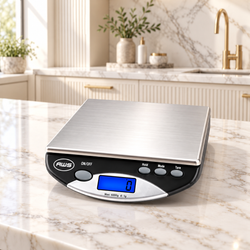
The best food scale for meal prep should make portioning ingredients faster, cleaner, and more consistent. For most home kitchens, that means choosing a digital scale with at least a 5-kilogram or 11-pound capacity, 1-gram resolution, an easy-to-use tare button, multiple weighing units, and a platform large enough for everyday bowls and meal-prep containers.
People preparing smaller quantities, spices, coffee, sauces, or baking ingredients may prefer 0.1-gram resolution. However, finer resolution is not necessary for every meal. The right scale should match the foods you weigh, the containers you use, and the level of precision your meal-prep routine actually requires.
A food scale can support consistent recipes and more accurate portion records, but it does not determine an individual’s nutritional needs. Use guidance from a qualified healthcare professional or registered dietitian when meal planning for a medical condition, athletic goal, pregnancy, or another specialized need.
Why Use a Food Scale for Meal Prep?
Measuring cups are convenient, but volume measurements can vary depending on how tightly an ingredient is packed, how it is cut, or how it settles in the container. A food scale measures mass directly.
A digital kitchen scale can help you:
-
Divide a prepared recipe into equal portions
-
Measure ingredients consistently
-
Track foods by weight
-
Reduce the number of measuring cups used
-
Repeat successful recipes
-
Portion proteins, grains, and vegetables
-
Divide snacks into containers
-
Measure ingredients directly into a mixing bowl
-
Follow recipes written in grams
-
Reduce accidental over- or under-portioning
The USDA MyPlate framework offers general food-group planning resources. A scale can help measure foods, but a balanced meal still depends on food selection, variety, and individual nutritional requirements.
Best Overall Scale Specifications for Meal Prep
For most households, a versatile meal-prep scale should offer:
-
Capacity of at least 5 kilograms or 11 pounds
-
Resolution of 1 gram or finer
-
Tare functionality
-
Grams and ounces
-
A flat, easy-to-clean platform
-
A readable display
-
Low-battery indication
-
Overload warning
-
Automatic shutoff
-
Controls that remain accessible under a bowl
-
Compact storage
The AWS kitchen scale collection includes models designed for cooking, baking, coffee preparation, portioning, and other household food-weighing tasks.
How Much Capacity Do You Need?
Capacity is the maximum weight the scale can support. When meal prepping, capacity must include both the food and its container.
5 Kilograms or 11 Pounds
A 5-kilogram or 11-pound scale is a practical choice for most households. It can generally accommodate:
-
Dinner plates
-
Meal-prep containers
-
Mixing bowls
-
Batch-cooked grains
-
Portions of meat or fish
-
Chopped vegetables
-
Baking ingredients
-
Several servings of prepared food
The NEPTUNE-5KG digital kitchen scale provides an 11-pound capacity and a full weighing platform designed to work with a bowl or plate.
2 to 3 Kilograms
A 2- or 3-kilogram scale can be sufficient for:
-
Individual meals
-
Snacks
-
Coffee
-
Small baking recipes
-
Sauces
-
Lightweight bowls
-
Ingredient preparation
Before choosing a lower-capacity model, weigh or estimate the heaviest container you expect to use.
More Than 5 Kilograms
Higher capacity may help if you routinely weigh:
-
Large batches
-
Heavy cookware
-
Family-size meal-prep containers
-
Bulk produce
-
Large mixing bowls
Make sure increased capacity does not come with resolution too coarse for individual portions.
Tare Does Not Increase Capacity
Tare resets the display to zero after a bowl or container is placed on the scale. It allows the display to show the food’s net weight.
However, taring does not remove the container’s physical weight from the scale.
If a scale has a 5-kilogram capacity and the bowl weighs 1 kilogram, only 4 kilograms of physical capacity remain after taring. Overloading can damage the weighing mechanism even when the displayed net weight appears to be below the stated limit.
What Resolution Is Best for Meal Prep?
Resolution is the smallest change shown on the display.
Common kitchen-scale resolutions include:
-
1 gram
-
0.1 gram
-
0.01 gram
-
0.1 ounce
1-Gram Resolution
A scale reading in 1-gram increments is appropriate for most meal-prep tasks, including:
-
Protein portions
-
Cooked grains
-
Vegetables
-
Fruit
-
Pasta
-
Cheese
-
Snacks
-
Prepared meals
-
Baking ingredients
For ordinary portioning, 1-gram resolution provides a useful balance between detail, capacity, and display stability.
0.1-Gram Resolution
A scale reading to 0.1 gram is useful for smaller amounts, such as:
-
Coffee
-
Spices
-
Salt
-
Yeast
-
Small baking ingredients
-
Sauces
-
Supplements when their labeling permits household weighing
The BARISTA-3KG coffee and kitchen scale combines a 3,000-gram capacity with 0.1-gram resolution, making it useful when meal prep overlaps with coffee or detailed recipe measurement.
A food scale should not be used to measure prescription medication or any substance requiring a pharmacist, laboratory balance, or professionally validated dosing method.
Resolution Is Not the Same as Accuracy
A scale displaying 0.1 gram is not automatically accurate to exactly 0.1 gram under every condition.
Resolution is the smallest displayed increment. Accuracy describes how closely the measurement agrees with the accepted value within the scale’s stated tolerance.
Repeatability is also important. If the same container produces noticeably different results each time it is placed on the platform, the scale may not be useful for consistent meal prep.
Measurement terminology and standards are discussed by the NIST Office of Weights and Measures. Home kitchen scales are different from regulated commercial weighing devices, but understanding the terminology makes product comparisons easier.
Why Tare Is Essential for Meal Prep
Tare is one of the most useful features on a meal-prep scale.
It allows you to:
-
Place an empty container on the scale.
-
Press tare to reset the display.
-
Add the first ingredient.
-
Record its weight.
-
Press tare again.
-
Add the next ingredient.
-
Continue until the meal is assembled.
This method can reduce cleanup because ingredients can be weighed directly into the meal-prep container.
Tare also makes it easier to divide a batch into equal portions without subtracting the container’s weight manually.
How to Divide a Recipe Into Equal Portions
Suppose you prepare one large batch and want five equal servings.
-
Place the empty storage container on the scale.
-
Record the container’s weight or press tare.
-
Add the entire prepared recipe.
-
Record the net food weight.
-
Divide the food weight by five.
-
Place an empty meal-prep container on the scale.
-
Press tare.
-
Add the calculated portion.
-
Repeat for the remaining containers.
For example, if the prepared food weighs 2,000 grams, five equal portions would weigh 400 grams each.
Equal weight does not necessarily mean that every serving has identical nutrition when ingredients are unevenly distributed. Mix combined recipes thoroughly when appropriate, and portion distinct ingredients separately when more consistency is needed.
Platform Size Matters
A scale can have the right capacity and resolution but still be inconvenient if its platform is too small.
A meal-prep scale should accommodate:
-
Dinner plates
-
Storage containers
-
Mixing bowls
-
Food-preparation trays
-
Reusable portion containers
The container should sit securely without touching the counter. Its base should not cover the display or press the scale’s controls.
Side-mounted or forward-facing buttons can remain accessible when a large plate is used.
Flat Platform or Bowl Scale?
Flat Platform
A flat scale is versatile because it can be used with different plates, bowls, and containers.
It is often better for:
-
Meal-prep containers
-
Individual plates
-
Large mixing bowls
-
Packaged foods
-
Cutting-board-compatible weighing
Scale With a Bowl
An included bowl is useful for:
-
Chopped vegetables
-
Loose grains
-
Fruit
-
Baking ingredients
-
Foods likely to roll
-
Ingredients added in stages
A removable bowl should be easy to clean and large enough for the intended batch. Confirm whether it is dishwasher-safe before placing it in a dishwasher.
Grams or Ounces?
The best meal-prep scales should include both grams and ounces.
Grams
Grams are convenient for:
-
Recipe calculations
-
Equal portioning
-
Nutrition databases
-
Baking
-
International recipes
-
Small ingredients
Ounces and Pounds
Ounces and pounds may be preferred for:
-
Meat portions
-
Packaged foods
-
Recipes written with U.S. customary units
-
Familiar household portion sizes
The scale should make unit changes obvious. Accidentally recording grams as ounces can create a major error.
How to Weigh Food for Nutrition Tracking
Food labels and nutrition databases may report values by weight, serving unit, cup, tablespoon, or piece.
The FDA’s information about serving sizes explains that a labeled serving size reflects the amount people customarily eat; it is not automatically a personalized recommendation.
For more consistent tracking:
-
Confirm whether the database entry refers to cooked or uncooked food
-
Use the same food description each time
-
Check whether edible and inedible portions are included
-
Record oils, sauces, and toppings when relevant
-
Match the weighing unit to the database entry
-
Avoid mixing data from different products without checking labels
The USDA’s FoodData Central provides food-composition information, but entries can differ by product, preparation method, and data source.
Weighing Cooked Versus Uncooked Food
Cooking changes weight through water gain or loss. Rice and pasta absorb water, while meat and vegetables may lose moisture.
A 100-gram cooked portion is not nutritionally identical to 100 grams of the same food before cooking.
Choose one consistent approach:
-
Weigh each ingredient before cooking and calculate the finished recipe
-
Weigh the complete finished recipe and divide it into portions
-
Use nutrition data specifically describing the cooked food
-
Follow the serving basis shown on the package
Consistency matters more than switching randomly between raw and cooked entries.
Useful Features for Meal Prep
Large Backlit Display
The display should be readable when a plate or bowl is on the platform.
Fast Response
The scale should react promptly as food is added and settle without excessive delay.
Stable Readings
A measurement should remain steady long enough to record it.
Overload Indicator
An overload warning helps protect the scale when a heavy bowl or batch exceeds capacity.
Low-Battery Indicator
Weak batteries can interrupt meal prep and may contribute to erratic behavior.
Automatic Shutoff
Automatic shutoff conserves batteries, but an interval that is too short can interrupt a recipe while ingredients are being prepared.
Protective or Removable Surface
A removable mat or tray can make cleanup easier, provided it is approved for use with the scale.
Portability and Storage
People who prepare meals at work, in a shared kitchen, or while traveling may prefer a compact scale.
Selected AWS pocket scales can be useful for smaller portions when their capacity, resolution, platform size, and food-contact procedures suit the intended task.
For everyday batch cooking, a full-size kitchen scale is usually more convenient because it supports larger containers and provides more capacity.
Store the scale:
-
Away from heat
-
Away from moisture
-
Without objects pressing on the platform
-
With its protective cover installed
-
Outside cluttered drawers where it may be damaged
AWS provides additional scale maintenance guidance, including recommendations related to temperature exposure and general care.
Cleaning a Meal-Prep Scale
Food scales may come into contact with crumbs, oil, liquids, raw-food packaging, and condensation.
Safe cleaning practices generally include:
-
Turning off the scale
-
Removing loose debris
-
Wiping with a slightly damp cloth
-
Using only approved cleaning products
-
Preventing liquid from entering buttons or platform gaps
-
Drying the surface before storage
Do not immerse a scale unless the manufacturer specifically identifies it as waterproof and provides immersion instructions.
Use separate containers and follow appropriate food-safety procedures when handling raw meat, seafood, or eggs.
Calibration and Routine Checks
A home kitchen scale may support user calibration with a specified reference weight.
Before calibrating:
-
Read the scale’s instructions
-
Use the specified calibration weight
-
Place the scale on a level surface
-
Keep the platform clean
-
Avoid fans and vibration
-
Confirm the correct unit
AWS offers calibration weights for compatible models. Do not substitute coins, food packages, or objects with an assumed weight.
You can also perform routine consistency checks by weighing the same appropriate reference several times. If the readings change noticeably, inspect the batteries, platform, surface, and environment before continuing.
Meal-Prep Scale Recommendations by User Type
Best for Most Home Meal Preppers
Choose:
-
5-kilogram or 11-pound capacity
-
1-gram resolution
-
Grams and ounces
-
Tare
-
Large flat platform
-
Easy-to-clean surface
Best for Detailed Recipes
Choose:
-
2-to-5-kilogram capacity
-
0.1-gram resolution
-
Multiple units
-
Fast response
-
Stable display
-
Tare
Best for Large Batch Cooking
Choose:
-
At least 5-kilogram capacity
-
Large platform
-
Display visible beneath large bowls
-
Durable controls
-
Overload warning
Best for Portable Meal Prep
Choose:
-
Compact size
-
Protective cover
-
Battery power
-
At least 500-gram capacity
-
0.1- or 1-gram resolution
-
Container that fits securely
Best for Coffee and Meal Prep
Choose:
-
2-to-3-kilogram capacity
-
0.1-gram resolution
-
Tare
-
Timer if desired
-
Splash-resistant or easily cleaned surface
Meal-Prep Scale Comparison Table
| Feature | Recommended starting point | Why it matters |
|---|---|---|
| Capacity | 5 kg/11 lb | Supports bowls, plates, and batches |
| Resolution | 1 g | Suitable for most food portions |
| Fine resolution | 0.1 g | Useful for spices and detailed recipes |
| Tare | Essential | Removes container weight |
| Units | Grams and ounces | Supports recipes and nutrition records |
| Platform | Large and flat | Accommodates meal-prep containers |
| Display | Backlit and visible | Easier to read beneath bowls |
| Cleaning | Wipeable surface | Supports kitchen hygiene |
| Shutoff | Moderate or adjustable | Prevents mid-recipe interruptions |
| Warning indicators | Battery and overload | Helps identify operating problems |
Using a Scale as Part of a Balanced Meal Plan
A food scale provides measurements, not dietary advice. Portion weight alone does not show:
-
Nutrient density
-
Vitamin and mineral content
-
Fiber
-
Food variety
-
Fullness
-
Individual energy needs
-
Medical suitability
The current Dietary Guidelines for Americans provide broader evidence-based guidance about healthy eating patterns. Meal plans should be adapted to the individual rather than copied solely from social media or generic portion charts.
The CDC’s healthy-weight resources also emphasize that health involves broader patterns and behaviors—not merely a single food measurement.
Common Meal-Prep Scale Mistakes
Avoid these frequent errors:
-
Forgetting to press tare
-
Ignoring the container’s physical weight
-
Exceeding capacity
-
Using a bowl that hides the display
-
Allowing the container to touch the counter
-
Switching units accidentally
-
Mixing cooked and uncooked database entries
-
Ignoring sauces, oils, and toppings
-
Weighing on an uneven surface
-
Using the scale under a fan
-
Storing heavy objects on the platform
-
Cleaning with excessive liquid
-
Assuming more decimal places always mean better performance
-
Treating a measured serving as a personalized nutritional recommendation
Food Scale Buying Checklist
Before purchasing a meal-prep scale, confirm:
-
Capacity supports your largest bowl and batch
-
Resolution suits the foods you measure
-
Tare is easy to use
-
Grams and ounces are included
-
The platform fits your containers
-
The display remains visible
-
Buttons remain accessible
-
Readings settle promptly
-
The surface is easy to clean
-
Automatic shutoff is not excessively short
-
Low-battery warning is provided
-
Overload indication is included
-
Batteries are easy to replace
-
Calibration instructions are available
-
Storage dimensions fit your kitchen
Frequently Asked Questions
What is the best food scale for meal prep?
For most people, the best choice has a 5-kilogram or 11-pound capacity, 1-gram resolution, tare, grams and ounces, a large flat platform, and an easy-to-read display.
Do I need 0.1-gram resolution for meal prep?
Not for most portions. One-gram resolution is sufficient for meats, grains, vegetables, fruit, and prepared meals. A 0.1-gram scale is useful for coffee, spices, yeast, salt, and detailed recipes.
Is a 5-kilogram scale large enough?
A 5-kilogram capacity is sufficient for most household meal prep. Remember to include the weight of the bowl or container when estimating the total load.
Should I weigh food cooked or uncooked?
Either method can work if you use the corresponding nutrition information consistently. Do not weigh a food cooked and log an uncooked database entry without performing the appropriate recipe calculation.
Can I place food directly on the scale?
Use a clean, food-safe container, plate, paper, or approved removable surface. Avoid placing wet, raw, oily, or contaminating foods directly on an unprotected scale.
How often should I calibrate a kitchen scale?
Follow the manufacturer’s instructions. Calibration or verification may also be appropriate after transportation, impact, battery replacement, temperature changes, or unexpectedly inconsistent results.
Final Thoughts
The best food scale for meal prep combines useful capacity, appropriate resolution, reliable tare, a practical platform, and simple cleaning.
For most households, a 5-kilogram or 11-pound scale with 1-gram resolution is the most versatile choice. It can handle individual portions, meal-prep containers, plates, mixing bowls, and batch recipes. People weighing spices, coffee, or small recipe ingredients may benefit from 0.1-gram resolution.
Choose a model that fits the containers you already use, displays both grams and ounces, and remains easy to operate while cooking. Used consistently, a good digital food scale can make meal preparation more repeatable, organized, and efficient without turning every meal into a complicated calculation.