
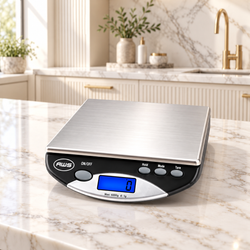
Following a ketogenic diet often involves more than removing bread, pasta, and sugar from your meals. To stay within a personal carbohydrate target while eating appropriate portions of protein, fat, vegetables, nuts, dairy, and other foods, you need dependable measurements.
That is where a digital kitchen scale becomes valuable.
The best kitchen scale for a keto diet makes it easier to weigh ingredients in grams, calculate net carbohydrates, track calories and macronutrients, divide recipes, and prepare consistent meals. It replaces visual guesses with repeatable measurements and can reveal significant differences between the portion you thought you served and the amount actually on your plate.
For most keto meal-preparation tasks, choose a digital food scale with at least a 5-kilogram capacity, readability of 1 gram or better, a tare function, multiple measurement units, a visible display, and a surface that is easy to clean.
American Weigh Scales offers a broad selection of digital kitchen scales for portioning ingredients, preparing recipes, and organizing meals.
This guide explains how to select and use a food scale for a ketogenic eating plan without making nutrition more complicated than it needs to be.
What Is the Best Kitchen Scale for Keto?
The best keto food scale should have the following features:
-
Readability of 1 gram or finer
-
A capacity of at least 5 kilograms
-
A dependable tare function
-
Gram and ounce measurement modes
-
A platform large enough for your usual plates and bowls
-
A display that remains visible during use
-
Simple controls
-
A smooth, easy-to-clean surface
-
Automatic shutoff that provides enough time to prepare a portion
-
A compact design that can remain accessible on the counter
A standard kitchen scale is usually enough for meat, cheese, vegetables, nuts, berries, avocado, sauces, and prepared meals. A model with 0.1-gram readability may be useful when measuring very lightweight ingredients, although most everyday keto portions do not require that degree of resolution.
The KF-5KG Digital Kitchen Scale combines a 5-kilogram capacity with 0.1-gram readability, making it a versatile option for both full portions and smaller ingredients within its stated range.
People preparing family-sized meals or weighing large containers may prefer a model with additional capacity, such as the PrepLite 10KG Kitchen Scale.
Why Use a Food Scale on a Keto Diet?
A kitchen scale is not required to eat nutritious food, but it can make a carbohydrate-conscious plan considerably easier to evaluate.
Carbohydrates Add Up Quickly
Foods such as leafy vegetables may contribute relatively few carbohydrates per serving, while nuts, berries, sauces, dairy products, and packaged “keto” foods can add more than expected.
The problem is not necessarily the food itself. It is the portion.
A small serving of nuts can become two or three servings when poured directly from a bag. A spoonful of sauce may be much larger than the serving listed on its label. Cheese, cream, dressings, and nut butter are easy to underestimate because a small volume can contain a meaningful number of calories.
A digital scale shows how much food is actually being used.
Visual Estimates Are Inconsistent
A “medium” avocado, “small” chicken breast, or “handful” of almonds is not a standardized measurement. Two pieces of the same food can differ greatly in weight.
When tracking food, vague descriptions introduce uncertainty. Weighing the edible portion provides a more consistent starting point for using nutrition labels or a food database.
Recipes Become Easier to Divide
A keto casserole may contain acceptable ingredients, but its nutrition per serving depends on how the completed recipe is divided.
If the finished dish weighs 1,800 grams and is intended to provide six servings, each serving should weigh approximately:
1,800 ÷ 6 = 300 grams
Without a scale, one portion may be much larger than another. That makes the nutritional estimate for each plate less reliable.
A Scale Creates Better Awareness
Short-term weighing can teach you what common portions look like. After weighing 30 grams of nuts, 100 grams of berries, or 150 grams of cooked protein several times, you may become better at estimating those portions when a scale is unavailable.
The goal does not have to be permanent, obsessive tracking. A scale can simply be a practical learning and meal-preparation tool.
Keto Nutrition Is About More Than Carbohydrates
Although keto is commonly associated with carbohydrate restriction, food quality and overall nutrition still matter.
The federal Dietary Guidelines for Americans emphasize nutrient-dense foods and dietary patterns that support health. People adapting those principles to a lower-carbohydrate approach can prioritize non-starchy vegetables, appropriate protein sources, unsaturated fats, and minimally processed foods.
A scale helps with portions, but it cannot determine whether an overall eating pattern is suitable for your health, medication, activity level, or nutritional needs.
Anyone considering a major dietary change—particularly someone who is pregnant, has diabetes, takes glucose-lowering medication, has kidney or liver disease, or has a history of disordered eating—should seek individualized guidance from a qualified healthcare professional.
Understanding Grams, Ounces, and Fluid Ounces
A good keto kitchen scale should display grams and ounces.
Grams
Grams are generally the easiest unit for nutrition tracking because most labels and food databases provide standardized information per 100 grams or per serving expressed in grams.
For example, if nutrition information lists 8 grams of carbohydrates per 100 grams of food and your portion weighs 75 grams:
75 ÷ 100 × 8 = 6 grams of carbohydrates
This calculation can be used for calories, protein, fat, fiber, or another listed nutrient.
Ounces
Some recipes and labels use ounces. A scale that switches between grams and ounces lets you follow either system without doing the conversion manually.
For consistent nutrition calculations, use the same unit shown in the data source whenever practical.
Fluid Ounces Are Not the Same as Weight Ounces
A fluid ounce measures volume. An ounce displayed by a kitchen scale measures mass or weight in everyday kitchen use.
The two cannot be treated as interchangeable for every ingredient. Oil, cream, water, and sauces have different densities.
If a recipe specifies fluid ounces, measure by volume unless it also provides a weight. If a product label supplies a gram weight for one serving, using that gram amount can make nutrition tracking more direct.
Understanding Net Carbs
Many people following a keto diet track “net carbs” rather than total carbohydrates. A commonly used calculation is:
Net carbohydrates = total carbohydrates − dietary fiber
Some people also subtract certain sugar alcohols, but sugar alcohols differ and may not all be handled identically. Product claims and tracking practices can therefore vary.
The food scale does not calculate net carbohydrates by itself unless it includes an accurate connected nutrition system. A conventional scale supplies the portion weight. You then use the nutrition label or a dependable database to calculate the nutrients in that weight.
The FDA’s guide to the Nutrition Facts label explains serving sizes, total carbohydrates, fiber, added sugars, and other information found on packaged foods.
Example Net-Carb Calculation
Imagine that a packaged product lists the following values per 40-gram serving:
-
Total carbohydrates: 12 grams
-
Dietary fiber: 7 grams
Using the basic calculation:
12 − 7 = 5 grams of net carbohydrates per 40 grams
If your portion weighs 60 grams, first calculate the portion multiplier:
60 ÷ 40 = 1.5
Then multiply:
-
Total carbohydrates: 12 × 1.5 = 18 grams
-
Fiber: 7 × 1.5 = 10.5 grams
-
Calculated net carbohydrates: 18 − 10.5 = 7.5 grams
This illustrates the calculation, but it does not establish an appropriate carbohydrate target for a particular person.
How to Use a Kitchen Scale for Keto Tracking
Using a digital scale requires only a few steps.
Step 1: Place the Scale on a Stable Surface
Set it on a hard, level counter. Avoid tablecloths, soft pads, uneven cutting boards, vibrating appliances, or surfaces that rock.
Step 2: Select the Correct Unit
Choose grams when working with nutritional data listed in grams. This reduces conversions and makes portion calculations easier.
Step 3: Add an Empty Container
Place your bowl, plate, or meal-prep container on the weighing platform.
Step 4: Press Tare
The display should return to zero. The scale will now show the weight of the food rather than the combined displayed weight of the food and container.
Remember that taring does not physically remove the container’s load. The total weight of the container and food must remain within the scale’s maximum capacity.
Step 5: Add the Food
Add the ingredient slowly and allow the reading to stabilize.
Step 6: Record the Weight
Enter the amount into your preferred nutrition tracker, spreadsheet, written journal, or recipe calculation.
Step 7: Tare Before the Next Ingredient
If building a meal in one bowl, press tare again before adding the next ingredient. Record each measurement before resetting the display.
How to Weigh a Complete Keto Meal
Consider a salad made with greens, chicken, avocado, cheese, seeds, and dressing.
Place the empty bowl on the scale and press tare. Add the ingredients one at a time:
-
Add greens and record their weight.
-
Press tare.
-
Add chicken and record its weight.
-
Press tare.
-
Add avocado and record its weight.
-
Press tare.
-
Add cheese and record its weight.
-
Press tare.
-
Add seeds and record their weight.
-
Press tare.
-
Add dressing and record its weight.
This method is efficient, but there is one disadvantage: if you add too much of an ingredient, removing it can be difficult once it has mixed with the other foods.
For calorie-dense ingredients such as dressing, nuts, seeds, cheese, and oil, weighing them separately before adding them may provide greater control.
Weighing Common Keto Foods
Different foods require slightly different weighing methods.
Meat, Poultry, and Fish
Determine whether your nutritional data refers to the food raw or cooked. Cooking changes water content, so 100 grams of raw chicken is not nutritionally identical to an assumed 100-gram portion of cooked chicken based on raw data.
Use raw weight with raw nutrition data or cooked weight with cooked nutrition data.
When meal prepping:
-
Weigh the total cooked protein.
-
Divide the weight by the number of intended servings.
-
Place the target amount into each container.
-
Record the cooking method and resulting yield.
For example, if cooked chicken weighs 1,050 grams and you need seven portions:
1,050 ÷ 7 = 150 grams per portion
Cheese
Cheese is easy to underestimate when sliced, shredded, or crumbled. Weigh it directly rather than relying on the apparent volume.
Place the plate or bowl on the scale, press tare, and add the cheese until you reach the intended portion.
Nuts and Seeds
A “handful” can vary dramatically. Nuts and seeds are nutrient-dense, but they are also energy-dense, making precise portions helpful for people monitoring calories.
For the clearest measurement, weigh them in a small dish before adding them to yogurt, salads, or snack containers.
Avocado
Nutrition entries may refer to the edible portion rather than the whole avocado with skin and pit.
To determine the edible amount:
-
Place the plate on the scale.
-
Press tare.
-
Add only the avocado flesh.
-
Record the displayed weight.
Alternatively, weigh the whole avocado and then weigh the discarded skin and pit. Subtract the waste weight from the starting weight.
Berries
Berries are often included in lower-carbohydrate plans in controlled portions. Because berry sizes vary, counting individual berries is less precise than weighing them.
Rinse and dry them before weighing. Water left on the fruit adds to the displayed weight.
Leafy and Non-Starchy Vegetables
A scale can help you document vegetables without compressing them into measuring cups. Weigh the edible portion and use an entry that matches the vegetable’s raw or cooked state.
FoodData Central, maintained by the USDA, provides searchable food composition data for many foods. Product labels remain the most direct source for a specific packaged item.
Oils and Dressings
Oil is often poured directly into a pan or onto a salad, making it easy to use more than expected.
One useful method is reverse weighing:
-
Place the oil bottle on the scale.
-
Press tare.
-
Pour the oil.
-
Return the bottle to the scale.
-
Read the negative number as the amount removed.
This method can be convenient when adding oil directly to cookware. Confirm that the bottle fits securely and does not exceed the scale’s capacity.
Sauces and Condiments
“Keto-friendly” does not mean unlimited. Sauces may contain carbohydrates, fat, calories, or sodium in quantities that become meaningful when several servings are used.
Weigh the sauce and compare the amount with the serving weight on its label.
Cream and Milk Alternatives
Liquids can be weighed if their label provides nutrition information in grams or a dependable weight conversion. Do not assume that every milliliter equals exactly one gram.
When the label lists only milliliters, using an appropriate volume measure may be the simpler choice.
Nut Butter
Nut butter sticks to spoons, making volume measurement messy. Reverse weighing works well:
-
Place the jar on the scale.
-
Press tare.
-
Remove the desired amount.
-
Return the jar to the scale.
-
Record the absolute value of the negative reading.
For example, a reading of −28 grams means approximately 28 grams were removed.
Choosing the Right Capacity
Scale capacity should reflect the combined weight of your food and container.
Five-Kilogram Capacity
A 5-kilogram scale is suitable for most individual meals, baking ingredients, vegetables, cuts of meat, and standard meal-prep containers.
The CAMEO-5K Digital Kitchen Scale features a tempered-glass platform and a capacity intended for general home-kitchen use.
Ten-Kilogram Capacity
A 10-kilogram scale may be preferable if you regularly weigh:
-
Large casserole dishes
-
Dutch ovens
-
Family-sized meat portions
-
Multiple meal-prep containers
-
Large mixing bowls
-
Bulk vegetables
-
Complete cooked recipes
Higher capacity can provide more flexibility, although a large-capacity scale may display larger increments than a smaller precision-oriented model.
Smaller Precision Scale
A compact scale can be useful for herbs, spices, supplements when the product directs measurement by weight, and other lightweight ingredients.
However, do not place a dinner plate or heavy bowl on a small pocket scale. Stay within its capacity and use a container that fits securely on the platform.
The AMW-2000 Digital Bench Scale offers 0.1-gram readability for portions and ingredients that remain within its 2,000-gram capacity.
Why the Tare Function Matters
Tare is arguably the most important feature for keto tracking because it lets you build a meal without calculating the container’s weight manually.
It also reduces dishes. You can measure several components in one bowl by recording each ingredient and pressing tare between additions.
For example:
| Ingredient | Recorded weight |
|---|---|
| Mixed greens | 85 g |
| Cooked chicken | 150 g |
| Avocado | 70 g |
| Cheese | 28 g |
| Seeds | 15 g |
| Dressing | 25 g |
The final number displayed after multiple tare operations is not necessarily the meal’s total weight. If you need the full finished weight, record the empty bowl weight and weigh the completed bowl without taring, then subtract the bowl.
Meal Prepping With a Kitchen Scale
A food scale makes batch preparation more consistent.
Dividing a Recipe Evenly
Suppose you prepare a crustless egg casserole. After cooking and cooling it appropriately, the food weighs 1,440 grams.
For eight servings:
1,440 ÷ 8 = 180 grams per serving
Place an empty meal-prep container on the scale, press tare, and add 180 grams. Repeat for each container.
Portioning Several Components
You can assign a target weight to each component:
-
Protein: 150 grams
-
Roasted vegetables: 180 grams
-
Sauce: 25 grams
-
Cheese: 20 grams
The appropriate quantities depend on the recipe and individual nutritional plan. The benefit of the scale is consistency, not the establishment of universal portion targets.
Accounting for the Serving Container
Meal-prep containers may appear identical but differ slightly in weight. Tare each empty container individually rather than assuming they all weigh exactly the same.
Labeling Prepared Meals
A practical label can include:
-
Recipe name
-
Preparation date
-
Portion weight
-
Estimated calories
-
Protein
-
Fat
-
Total carbohydrates
-
Fiber
-
Calculated net carbohydrates
Use safe refrigeration and storage practices appropriate to the ingredients.
Using a Food Scale for Keto Recipes
A scale is especially valuable in baking because low-carbohydrate flours and sweeteners can behave differently from conventional wheat flour and sugar.
Almond Flour
Almond flour can settle during storage. One cup may weigh differently depending on whether it is scooped, packed, or spooned into the cup.
Weighing the amount specified by a dependable recipe improves repeatability.
Coconut Flour
Coconut flour is highly absorbent, so even a relatively small measurement difference can influence texture. Add it by weight when the recipe supplies grams.
Sweeteners
Low-carbohydrate sweeteners differ in sweetness, density, and baking behavior. Do not substitute equal weights unless the recipe or manufacturer recommends it.
A kitchen scale measures quantity; it does not make unlike sweeteners function identically.
Psyllium Husk and Other Fibers
Fiber ingredients can affect structure and moisture absorption. Use the form specified in the recipe, since whole husks and powdered husks may perform differently.
Butter and Oil
Weight measurements are useful when scaling recipes and can reduce the need for multiple measuring cups.
The 2K-BOWL Digital Kitchen Scale includes a removable bowl that can be convenient for smaller baking mixtures and weighed ingredients within its capacity.
How to Calculate Nutrition for a Homemade Recipe
Calculating a homemade recipe requires the nutritional information for every ingredient.
Step 1: Weigh Every Ingredient
Record the edible amount of each ingredient before it enters the recipe.
Step 2: Find Nutrition Information
Use the product label for branded ingredients. Use a reputable food database for basic foods without labels.
Step 3: Calculate Each Ingredient’s Contribution
If 100 grams of an ingredient contains 6 grams of total carbohydrates and you use 250 grams:
250 ÷ 100 × 6 = 15 grams of total carbohydrates
Repeat for calories, fat, protein, fiber, and any other nutrients you track.
Step 4: Add the Recipe Totals
Add the nutritional contribution from every ingredient.
Step 5: Weigh the Finished Recipe
Once the dish is prepared and safely handled, weigh the total edible yield.
Assume the completed recipe weighs 1,600 grams.
Step 6: Calculate Nutrition per Gram
If the entire recipe contains 32 grams of calculated net carbohydrates:
32 ÷ 1,600 = 0.02 grams of net carbohydrates per gram
A 250-gram serving would contain:
250 × 0.02 = 5 grams of calculated net carbohydrates
This method accommodates uneven moisture loss more effectively than assuming the uncooked ingredient weight equals the cooked yield.
Does Weighing Food Help With Weight Loss?
A scale cannot cause weight loss by itself. It provides more accurate portion information, which may help someone follow a planned calorie intake or understand eating patterns.
The National Institute of Diabetes and Digestive and Kidney Diseases offers evidence-based information on choosing a safe and successful weight-loss program. Sustainable weight management generally involves more than tracking carbohydrates alone.
Large amounts of cheese, oils, cream, nuts, butter, and other calorie-dense foods can fit within a low-carbohydrate plan while still contributing substantial energy. Measuring them can help explain why progress has stalled despite maintaining a low estimated carbohydrate intake.
However, more tracking is not always better. Anyone who finds that weighing food produces anxiety, guilt, compulsive behavior, or excessive restriction should step back and seek guidance from a qualified professional.
Consider Fat Quality, Not Only Quantity
Ketogenic diets are often high in fat, but all dietary fats should not be treated as nutritionally identical.
The American Heart Association discusses the relationship between saturated fat and cardiovascular health. Depending on personal health needs and professional advice, someone may emphasize foods containing unsaturated fats, such as avocado, olives, olive oil, nuts, seeds, and certain fish.
A scale can measure the portion, but it cannot evaluate the entire diet’s nutritional quality.
Common Keto Food-Scale Mistakes
Weighing Cooked Food With Raw Nutrition Data
Cooking changes water content. Match raw weight with raw data and cooked weight with cooked data whenever possible.
Forgetting to Press Tare
If the container’s weight is included, the recorded food portion will be incorrect.
Confusing Grams of Food With Grams of Carbohydrates
If broccoli weighs 100 grams, that does not mean it contains 100 grams of carbohydrates. The food’s total weight includes water, fiber, protein, minerals, and other components.
Use nutrition data to determine the carbohydrate content of the weighed portion.
Trusting Generic Database Entries Over the Label
Two products that appear similar may use different ingredients. For a packaged food, use the current label on the actual product whenever possible.
Counting Pieces Instead of Weighing
Ten almonds, five strawberries, or one chicken breast can vary in size. Use weight when accuracy matters.
Weighing Inedible Parts
If the nutrition information refers to the edible portion, do not include pits, bones, peels, shells, or packaging.
Overloading the Scale
A tared container still counts toward the scale’s physical load. Never exceed the stated maximum capacity.
Using an Oversized Plate
A large plate may cover the display, touch the counter, or press against a control. Use a smaller container or choose a scale with an accessible display.
Entering the Wrong Unit
Confusing grams with ounces can create a major tracking error. Check the display before recording the number.
Assuming “Zero Carb” Always Means Literally Zero
Labeling rules and serving-size rounding can affect how small nutrient quantities appear. Multiple servings may contribute more than the rounded value suggests.
Measuring Everything Except Oils and Sauces
Oils, dressings, cream, cheese, and condiments are among the easiest ingredients to underestimate. Weigh the items that meaningfully affect your nutritional totals instead of focusing only on low-calorie vegetables.
Maintaining Accurate Measurements
To get consistent performance from a keto food scale:
-
Use a hard, level surface.
-
Keep the platform clean and dry.
-
Avoid direct airflow from fans or vents.
-
Keep it away from vibrating appliances.
-
Replace weak batteries.
-
Allow a reading to stabilize.
-
Center the load on the platform.
-
Do not leave heavy objects stored on the scale.
-
Follow the manufacturer’s calibration instructions.
-
Avoid rapid temperature changes.
-
Do not immerse the scale unless it is specifically designed for that treatment.
For a bowl-based setup, the Kitchen Pro 5KG provides another option for weighing ingredients and portions during everyday food preparation.
Frequently Asked Questions
Do I need a food scale to follow keto?
No. Some people follow a lower-carbohydrate diet without weighing food. A scale becomes useful when you want more accurate portion information, recipe calculations, or macro tracking.
Is a 1-gram scale accurate enough for keto?
A scale with 1-gram readability is sufficient for most meat, vegetables, cheese, nuts, berries, dressings, and meal-prep portions. A 0.1-gram model can be helpful for smaller ingredients but is not necessary for every meal.
Should I measure food in grams or ounces?
Grams are usually easier for nutrition calculations because labels and databases frequently provide gram-based serving weights. Ounces are still useful when following recipes written in U.S. customary units.
Should meat be weighed raw or cooked?
Either can work if you use matching nutrition information. Use raw nutritional data for raw weight and cooked data for cooked weight.
How do I weigh food already on a plate?
Place the empty plate on the scale, press tare, and then add the food. If the meal is already assembled, you can determine its net weight only if you know the plate’s empty weight.
Can I weigh liquids?
Yes, but weight and volume are not universally interchangeable. Use the gram serving information on the label or a dependable density conversion for that particular liquid.
What foods are most important to weigh on keto?
The most commonly underestimated foods include nuts, nut butter, cheese, oil, butter, cream, dressings, sauces, seeds, berries, and packaged snacks. Protein portions can also be weighed for consistent meal preparation.
Can a food scale calculate net carbs?
A standard food scale measures weight. You calculate net carbohydrates using label or database information. Some smart scales connect to nutrition databases, but their entries and portion matches should still be verified.
How large should the platform be?
The platform should securely support your normal plate or bowl without hiding the display or touching the counter. Large meal-prep containers may require a wider platform or a differently positioned display.
How often should I calibrate my kitchen scale?
Follow the manufacturer’s instructions. Check the scale if readings become inconsistent, it is moved frequently, it experiences an impact, or the batteries are replaced and performance appears different.
Final Verdict
The best kitchen scale for a keto diet is a straightforward digital model that helps you weigh real portions without making meal preparation difficult.
For most households, a 5-kilogram capacity, 1-gram or finer readability, gram and ounce modes, a dependable tare function, and an easy-to-clean platform provide the right combination of practicality and precision. A 10-kilogram model may be better for family-sized recipes, while a smaller 0.1-gram scale can complement the primary scale for lightweight ingredients.
Use your scale to measure the foods that are easiest to underestimate, calculate homemade recipes, divide meals evenly, and match portion weights with dependable nutritional information. Pay attention to whether foods are raw or cooked, weigh only the edible portion, and verify packaged foods against their current labels.
Most importantly, remember that the scale is a measurement tool—not a medical professional and not a judge of whether a food is “good” or “bad.” Used thoughtfully, it can remove uncertainty from keto meal preparation and help you build a more consistent, informed eating routine.