
Air fryers make it possible to prepare crisp vegetables, chicken, fish, potatoes, reheated foods, and complete meals with relatively little preparation. However, producing consistent results requires more than choosing a temperature and pressing the start button.
Ingredient weight affects cooking time, basket airflow, seasoning ratios, portion sizes, and nutritional calculations. A basket containing 300 grams of vegetables will cook differently from one containing 900 grams. Two chicken breasts that look similar can vary considerably in weight and thickness. A light spray of oil can also become several servings when it is poured without being measured.
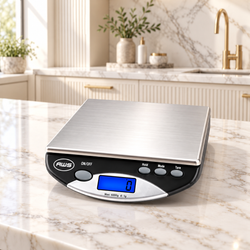
The best kitchen scale for air fryer recipes helps remove this uncertainty.
For most households, choose a digital scale with at least a 5-kilogram capacity, readability of 1 gram or better, a tare function, gram and ounce modes, and a platform large enough for everyday plates and bowls. The display should remain visible when a container is placed on the platform, and the surface should be easy to wipe clean.
American Weigh Scales offers a variety of digital kitchen scales that can be used for portioning ingredients, preparing air fryer recipes, and organizing weekly meals.
What Is the Best Kitchen Scale for Air Fryer Cooking?
The best air fryer food scale should provide a useful balance of capacity, readability, convenience, and durability.
Look for these features:
-
Capacity of at least 5 kilograms
-
Readability of 1 gram or finer
-
A dependable tare function
-
Measurements in grams and ounces
-
A stable platform
-
A clearly visible digital display
-
Simple buttons or touch controls
-
An easy-to-clean weighing surface
-
A compact design for countertop storage
-
Sufficient time before automatic shutoff
A 5-kilogram kitchen scale can handle most individual ingredients and family-sized portions. It is generally sufficient for bowls of vegetables, packages of meat, breading ingredients, potatoes, meal-prep containers, and finished air fryer recipes.
The KF-5KG Digital Kitchen Scale offers a 5-kilogram capacity and 0.1-gram readability, making it suitable for both substantial portions and lighter ingredients within its stated weighing range.
People who routinely prepare large batches may benefit from the additional capacity of the PrepLite 10KG Kitchen Scale.
Why Use a Kitchen Scale With an Air Fryer?
An air fryer cooks by circulating hot air around food. The amount of food placed in the basket and the way it is arranged can affect how evenly it cooks.
A kitchen scale helps you control that amount.
It Helps Prevent Basket Overcrowding
Air needs room to circulate around the food. When a basket is overloaded, ingredients may steam, cook unevenly, or take longer to become crisp.
Instead of guessing whether a basket is “too full,” record the weight that produces the best result for your particular appliance. The ideal amount will depend on the basket size, food shape, recipe, and air fryer design.
For example, you might discover that:
-
400 grams of vegetables cook evenly in one layer.
-
650 grams require shaking and additional time.
-
900 grams crowd the basket and cook inconsistently.
These figures are only examples. Your own results will depend on the appliance and food. Once you identify a successful batch weight, a scale lets you recreate it.
It Creates Consistent Portions
Air fryer foods are often prepared in several batches. Without weighing, one person may receive a much larger portion than another, or the first batch may contain more food than the final batch.
Weighing ingredients before cooking helps you divide them evenly. Weighing the final yield can also help portion completed meals.
It Improves Recipe Scaling
Many recipes are written for a fixed number of servings. If you want to prepare half the recipe or increase it by 50%, weight-based quantities are easier to scale than vague instructions such as “one large potato” or “two medium chicken breasts.”
If a recipe uses 600 grams of chicken and you want to prepare 900 grams, calculate the scaling factor:
900 ÷ 600 = 1.5
Multiply the other scalable ingredients by 1.5, while keeping the air fryer’s capacity and food-safety requirements in mind.
It Makes Nutrition Tracking More Accurate
A food scale supplies an actual portion weight that can be compared with a product label or nutrition database.
If a frozen product lists nutrition information for an 85-gram serving, weighing your portion will show whether you are preparing one serving, one and a half servings, or more.
The FDA’s guide to the Nutrition Facts label explains how serving sizes and nutrient amounts are presented on packaged foods.
Choosing the Right Scale Capacity
The capacity printed in a scale’s specifications represents the maximum physical load it can support. This includes both the food and its container.
Five-Kilogram Scales
A 5-kilogram scale is generally appropriate for:
-
Individual portions of meat or fish
-
Bowls of vegetables
-
Potatoes and sweet potatoes
-
Frozen air fryer foods
-
Breading ingredients
-
Prepared meal components
-
Standard meal-prep containers
-
Finished recipes in lightweight bowls
The CAMEO-5K Digital Kitchen Scale features a tempered-glass weighing platform and a slim design for home kitchen use.
Ten-Kilogram Scales
A 10-kilogram scale may be more appropriate for:
-
Large mixing bowls
-
Family-sized meal preparation
-
Bulk meat packages
-
Large casserole dishes
-
Several portions being divided at once
-
Heavy food-storage containers
-
Large batches of vegetables
Additional capacity can be useful, but consider readability as well. A high-capacity scale that reads in larger increments may not be the best choice for lightweight seasonings.
Smaller Precision Scales
A smaller precision scale may be useful for dry rub ingredients, salt, spices, and other lightweight additions. It should complement—not replace—a full-size food scale.
Do not place a large dinner plate or heavy bowl on a pocket scale. Use each scale only within its specified capacity and with a container that fits securely on the platform.
Readability: Do You Need 1 Gram or 0.1 Gram?
Readability is the smallest increment shown on the display.
One-Gram Readability
A scale reading in 1-gram increments is suitable for most air fryer tasks, including:
-
Chicken
-
Fish
-
Vegetables
-
Potatoes
-
Frozen foods
-
Cheese
-
Breading
-
Meal-prep portions
-
Finished dishes
For general cooking, 1 gram provides more precision than visual estimates or whole-ounce measurements.
One-Tenth-Gram Readability
A scale reading in 0.1-gram increments may be helpful for:
-
Small spice quantities
-
Salt
-
Lightweight dried herbs
-
Recipe testing
-
Small portions of powdered coatings
-
Carefully controlled ingredient ratios
Remember that display resolution does not guarantee perfect accuracy under all conditions. Air movement, vibration, an uneven counter, weak batteries, heat, and an unstable bowl can influence a reading.
The AMW-2000 Digital Bench Scale provides 0.1-gram readability for ingredients and portions within its 2,000-gram maximum capacity.
Why the Tare Function Is Essential
The tare function resets the display to zero after you place an empty container on the scale.
This allows you to measure only the food inside a bowl, plate, or meal-prep container.
How to Use Tare
-
Place the scale on a hard, level counter.
-
Turn it on and select the desired unit.
-
Place an empty bowl on the platform.
-
Press the tare or zero button.
-
Confirm that the display returns to zero.
-
Add the ingredient.
-
Wait for the number to stabilize.
-
Record the weight.
Taring does not remove the physical weight of the bowl. If a bowl weighs 1,000 grams and you add 4,500 grams of food, the total load is 5,500 grams—even if the display shows only the food’s weight.
Do not exceed the scale’s maximum capacity.
How to Weigh Food for an Air Fryer
The most practical method depends on whether you are measuring raw ingredients, cooking oil, coating, or a finished recipe.
Weighing Directly in a Bowl
Place a mixing bowl on the scale, press tare, and add the food. This method works well for vegetables, wings, potato wedges, shrimp, and other foods that will be seasoned before cooking.
Weighing on a Plate
A plate works well for individual chicken breasts, fish fillets, burger patties, or prepared portions. Make sure the plate does not cover the display or touch the countertop.
Reverse Weighing
Reverse weighing is useful for ingredients removed from a container, such as oil, mayonnaise, yogurt-based marinades, or sauces.
-
Place the ingredient container on the scale.
-
Press tare.
-
Remove the amount you plan to use.
-
Return the container to the scale.
-
Read the negative value.
If the display shows −20 grams, approximately 20 grams were removed.
Weighing Several Ingredients in One Bowl
You can add several ingredients to one bowl by pressing tare between additions.
For example:
-
Add 500 grams of vegetables.
-
Record the amount and press tare.
-
Add 12 grams of oil.
-
Record the amount and press tare.
-
Add 5 grams of seasoning.
-
Record the final amount.
Be cautious when adding ingredients directly over the bowl. If too much oil or seasoning is added, it may be difficult to remove after it touches the food.
Measuring Oil for Air Fryer Recipes
Air fryers can cook many foods with less oil than deep frying, but “less” does not mean “unlimited” or “unmeasured.”
A quick pour can contain more oil than expected. Weighing helps you reproduce the amount that delivers the texture you prefer.
Measuring Oil in a Small Dish
Place a small dish on the scale, press tare, and add the required oil. Transfer it to the food and toss thoroughly.
Measuring Oil by Reverse Weighing
Place the bottle on the scale, press tare, pour the oil, and return the bottle to the platform. The negative reading shows the amount removed.
Measuring Spray Oil
Aerosol and pump sprays can be difficult to measure by volume. Reverse weighing the can or bottle before and after spraying can provide an estimate if the scale has sufficient readability.
Always spray cooking oil away from the scale. Airborne droplets can coat the display and platform.
Weighing Chicken for the Air Fryer
Chicken pieces that appear similar can differ significantly in mass and thickness. This affects cooking time.
Chicken Breasts
Weigh each breast separately and note unusually thick sections. Two breasts with the same weight may still cook differently if one is thick and compact while the other is thin and wide.
For more even cooking, follow the recipe’s preparation method, which may involve flattening or dividing thick pieces.
Chicken Thighs
Bone-in and boneless thighs should be tracked separately. Nutrition information and edible yield differ because bone contributes to the scale weight but is not eaten.
Chicken Wings
For consistent batches:
-
Weigh the total wings.
-
Divide them into basket-sized batches.
-
Keep each batch close to the same weight.
-
Avoid packing pieces tightly together.
-
Use a food thermometer to confirm doneness.
The USDA provides a safe minimum internal temperature chart for poultry, meat, seafood, and leftovers.
A scale measures quantity. It cannot determine whether poultry is safely cooked.
Weighing Meat and Burgers
A scale can help create burger patties and meat portions with similar cooking characteristics.
Equal Burger Patties
If 680 grams of ground meat will be divided into four patties:
680 ÷ 4 = 170 grams per patty
Place a small sheet of parchment or a plate on the scale, press tare, and portion each patty to approximately 170 grams.
Uniform weight does not guarantee identical cooking if thickness varies. Shape each patty consistently and verify doneness with an appropriate food thermometer.
Steaks and Chops
Record the weight, but also consider thickness and whether the cut contains a bone. These factors can influence cooking time more than total weight alone.
Meatballs
Weighing each portion can produce meatballs that finish cooking at approximately the same time.
If the mixture weighs 900 grams and you want 30 meatballs:
900 ÷ 30 = 30 grams each
Weighing Fish and Seafood
Fish fillets, shrimp, and scallops can overcook quickly, so equal portions help improve consistency.
Fish Fillets
Weigh fillets individually and group pieces with similar thickness. Thin tail sections may cook faster than thick center cuts even when their total weights are similar.
Shrimp
If a package includes glaze or ice, use the drained edible weight when calculating portions. Pat shrimp appropriately dry before weighing if the recipe requires a dry surface for browning.
Scallops
Water on the exterior contributes to the scale reading and can interfere with browning. Prepare them according to the recipe and weigh the portion consistently.
Weighing Vegetables
Vegetables lose water during cooking, so their cooked weight is usually lower than their raw weight.
Use raw nutrition information with raw weights and cooked nutrition information with cooked weights whenever possible.
Broccoli and Cauliflower
Weigh the prepared florets after removing thick stems that will not be eaten. Keep the pieces reasonably similar in size for more even cooking.
Brussels Sprouts
Weigh after trimming and removing damaged outer leaves. Large sprouts may need to be halved according to the recipe.
Zucchini and Eggplant
These vegetables contain considerable moisture. Avoid crowding the basket, and record the batch weight that produces satisfactory browning in your appliance.
Frozen Vegetables
Use the weight of the frozen portion and the nutrition information supplied for the frozen product. Ice buildup can influence weight and texture, so follow the package directions when available.
The USDA’s FoodData Central can help you find nutrient information for basic foods when a package label is unavailable.
Weighing Potatoes and Homemade Fries
Potatoes vary greatly in size. “Two medium potatoes” can produce very different quantities from one cooking session to another.
For consistent homemade fries:
-
Wash and prepare the potatoes.
-
Remove any parts that will not be used.
-
Cut the potatoes uniformly.
-
Weigh the prepared pieces.
-
Divide them into suitable basket batches.
-
Record the oil and seasoning weights.
-
Note the cooking time and result.
Suppose your air fryer gives the best results with 450 grams of cut potatoes per batch. If you prepare 1,350 grams:
1,350 ÷ 450 = 3 batches
Cooking three controlled batches may produce better results than forcing the entire quantity into one basket.
Weighing Coatings and Breadcrumbs
A scale can show how much coating was actually used rather than merely how much was placed in the breading bowl.
Before-and-After Method
-
Weigh the bowl containing the coating.
-
Bread the food.
-
Weigh the remaining coating.
-
Subtract the remaining weight from the starting weight.
If you begin with 120 grams and have 55 grams left:
120 − 55 = 65 grams used
Discard coating that has contacted raw meat, poultry, seafood, or their juices. Do not return it to the original package.
Tracking Multi-Part Coatings
For flour, egg, and breadcrumb systems, record each component separately. This creates a more realistic estimate of the quantity used.
The amount placed in the bowl is not necessarily the amount consumed because some coating remains behind.
Measuring Seasonings and Dry Rubs
Seasoning by weight improves repeatability, especially when preparing multiple batches.
A dry rub can be recorded as a percentage of meat weight when a trusted recipe is designed that way.
If a recipe calls for seasoning equal to 1.5% of the meat’s weight and the meat weighs 800 grams:
800 × 0.015 = 12 grams of seasoning
This is an example of the calculation, not a universal seasoning or salt recommendation.
When salt is part of a seasoning blend, consider the total sodium contribution and follow the recipe. Different salts and seasoning blends have different densities, so equal spoonfuls do not necessarily contain equal weights.
Using a Scale for Frozen Air Fryer Foods
Frozen fries, nuggets, vegetables, appetizers, and similar foods usually display a serving size on the package.
To weigh a frozen portion:
-
Place a bowl on the scale.
-
Press tare.
-
Add the frozen food.
-
Record the weight.
-
Compare it with the label’s serving size.
-
Transfer it to the air fryer.
If the label lists one serving as 85 grams and your portion weighs 127.5 grams:
127.5 ÷ 85 = 1.5 servings
Multiply the listed nutrition values by 1.5 to estimate the amount in the weighed portion.
Do not place a hot air fryer basket directly on an ordinary kitchen scale. The heat can damage the scale or affect its reading.
Air Fryer Meal Prep With a Scale
A scale makes it easier to prepare several balanced, consistent containers.
Step 1: Weigh the Cooked Yield
After cooking, place an appropriate container on the scale and press tare. Add the finished food and record its total weight.
Step 2: Decide the Number of Portions
If the cooked chicken weighs 1,200 grams and you need eight meals:
1,200 ÷ 8 = 150 grams per meal
Step 3: Divide Each Component
Repeat the process for vegetables, potatoes, grains, or another side.
Step 4: Tare Every Container
Even matching containers can differ slightly in weight. Place each empty container on the scale and press tare before adding food.
Step 5: Label the Meals
Labels can include:
-
Recipe name
-
Preparation date
-
Portion weight
-
Reheating instructions
-
Estimated nutrition
-
Use-by or freezing information appropriate to the food
Follow safe cooling, refrigeration, freezing, and reheating practices.
The FDA explains basic household precautions through its safe food-handling guidance.
How to Calculate Nutrition for an Air Fryer Recipe
Air frying changes moisture and therefore changes the total weight of food, but it does not make the ingredients’ calories disappear.
To estimate nutrition for a homemade recipe:
Step 1: Record Every Ingredient
Weigh the edible amount of each ingredient, including oil, coating, sauce, and seasonings that contribute meaningful nutrients.
Step 2: Calculate the Nutritional Contribution
Use the product label or a reputable database.
If 100 grams of an ingredient contains 200 calories and you use 150 grams:
150 ÷ 100 × 200 = 300 calories
Step 3: Add the Entire Recipe
Add the calculated calories and nutrients from all ingredients.
Step 4: Weigh the Finished Edible Yield
Assume the cooked recipe weighs 900 grams and contains an estimated 1,800 calories.
Step 5: Calculate Nutrition per Gram
1,800 ÷ 900 = 2 calories per gram
A 250-gram portion would contain an estimated:
250 × 2 = 500 calories
Some oil, marinade, or coating may remain in a bowl or drip away during cooking, so homemade calculations are estimates. Consistent measuring still makes those estimates more useful.
Can You Weigh the Air Fryer Basket?
In most cases, it is better to weigh food in a separate bowl or container.
An air fryer basket may be:
-
Too hot
-
Too heavy
-
Too large for the platform
-
Unstable
-
Difficult to center
-
Likely to cover the display
-
Capable of exceeding the scale’s capacity
Never place a hot basket on a scale unless the scale’s manufacturer explicitly states that the surface can tolerate that temperature. Heat can damage electronic components and distort measurements.
Use a lightweight bowl for raw ingredients and an appropriate plate or container for cooked food.
A removable-bowl model such as the 2K-BOWL Digital Kitchen Scale can be useful for smaller recipes and ingredients that remain within its capacity.
Common Air Fryer Scale Mistakes
Forgetting the Container Weight
Always tare the bowl before adding food. Otherwise, the measurement includes both the bowl and the ingredient.
Overloading the Scale After Taring
Tare changes the displayed number, not the physical load. Include the bowl when determining whether the scale’s capacity has been exceeded.
Placing a Hot Basket on the Scale
Heat can damage a standard digital scale. Transfer food to a suitable container first.
Letting the Bowl Touch the Counter
If a bowl extends beyond the platform and rests on the counter, the displayed weight will be incorrect.
Hiding the Display With a Large Plate
Use a smaller plate, place a stable spacer on the platform if permitted, or choose a scale with a display that remains visible.
Mixing Raw and Cooked Nutrition Data
Match the state of the food with the data being used. Raw and cooked weights are not interchangeable because cooking changes moisture.
Measuring Only the Main Ingredient
Oil, sauce, cheese, coating, and condiments can meaningfully change a recipe’s nutritional total. Record the ingredients that matter to your goal.
Assuming Weight Determines Cooking Time by Itself
Thickness, shape, starting temperature, food arrangement, appliance design, and basket crowding also affect cooking. Use weight as one piece of information rather than the only factor.
Relying on Cooking Time Instead of Temperature
A food scale cannot confirm doneness. Use a suitable food thermometer and follow the recipe and current food-safety guidance.
Keeping Your Kitchen Scale Clean
Raw poultry, meat, fish, egg, and spilled marinades can contaminate kitchen surfaces.
To protect the scale:
-
Weigh raw food on a plate or in a bowl.
-
Do not place raw food directly on the platform.
-
Wash reusable containers after contact with raw ingredients.
-
Wipe spills promptly.
-
Follow the scale manufacturer’s cleaning instructions.
-
Do not immerse the scale unless it is specifically designed to be submerged.
-
Keep water away from the battery compartment and display.
-
Wash your hands before touching scale controls after handling raw food.
The CDC provides additional guidance on preventing food poisoning, including cleaning, separation, cooking, and chilling practices.
Improving Scale Accuracy
For dependable measurements:
-
Place the scale on a hard, level surface.
-
Confirm that all feet touch the counter.
-
Keep the scale away from fans and vents.
-
Avoid weighing beside a running blender or other vibrating appliance.
-
Center the load on the platform.
-
Wait for the reading to stabilize.
-
Replace weak batteries.
-
Do not store heavy objects on the scale.
-
Follow the manufacturer’s calibration instructions.
-
Use a suitable calibration weight when calibration is required.
NIST provides useful information about accurate kitchen weighing in its culinary measurement guidance.
The Kitchen Pro 5KG is another bowl-style option for measuring general cooking ingredients and meal components within its stated specifications.
Frequently Asked Questions
Do I need a food scale for air fryer cooking?
No, but a scale makes it easier to control basket loads, follow recipes, create equal portions, track nutrition, and reproduce successful batches.
What scale capacity is best?
A 5-kilogram scale is enough for most household air fryer recipes. Choose a 10-kilogram model if you regularly weigh heavy bowls or large family-sized batches.
Is 1-gram readability sufficient?
Yes. One-gram readability is suitable for most meat, vegetables, frozen foods, coatings, and meal-prep portions. Smaller seasoning quantities may benefit from 0.1-gram readability.
Should I weigh food before or after air frying?
It depends on your purpose. Weigh before cooking to follow a recipe and manage basket capacity. Weigh after cooking to divide the finished yield. For nutrition tracking, use data matching the food’s raw or cooked state.
Can I put the air fryer basket on the scale?
It is generally better not to. The basket may be hot, heavy, oversized, or unstable. Transfer food to an appropriate bowl or plate.
How do I divide an air fryer recipe evenly?
Weigh the total cooked food and divide that number by the desired servings. Place each empty container on the scale, press tare, and add the calculated portion.
Can a scale tell me how long to air fry food?
No. Weight can help you reproduce a batch size, but cooking time also depends on thickness, shape, appliance power, starting temperature, basket arrangement, and the type of food.
Does an air fryer food scale calculate calories?
A conventional scale measures weight. Use the weight with a nutrition label or reputable food database to calculate estimated calories and nutrients.
Can I weigh oil sprayed from a bottle?
You can estimate it by placing the bottle on a sufficiently readable scale, pressing tare, spraying the food away from the scale, and returning the bottle. The negative reading represents the approximate amount removed.
How do I weigh bone-in food?
The scale shows the total weight, including the bone. For nutrition tracking, use data specifically describing the bone-in product or subtract the weight of the uneaten bone afterward when an edible-weight estimate is needed.
Final Verdict
The best kitchen scale for air fryer recipes is a digital model that combines practical capacity with easy everyday operation.
For most users, a 5-kilogram capacity, 1-gram or finer readability, gram and ounce modes, a clearly visible display, and a reliable tare function provide everything needed for air fryer cooking. A 10-kilogram model can accommodate larger bowls and batch preparation, while a smaller precision scale can help with lightweight seasoning ingredients.
Use the scale to control basket loads, divide recipes, measure oil and coatings, create equal portions, and compare successful cooking batches. Record whether weights were taken before or after cooking, match those measurements with the correct nutritional information, and never use a scale as a substitute for a food thermometer.
With accurate measurements and consistent preparation, a kitchen scale can make air fryer meals easier to repeat, simpler to portion, and more dependable from one batch to the next.