
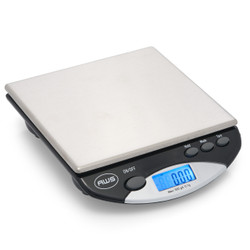
The best kitchen scale for cake baking and decorating should accurately measure large quantities of flour and sugar, small amounts of leavening, cake batter for individual pans, frosting, fondant, and finished portions.
For most home bakers, a digital scale with a capacity of at least 5,000 grams and readability of 1 gram or finer is the best all-purpose choice. A scale reading in 0.1-gram increments offers additional control for smaller ingredients, detailed recipe testing, food coloring, and decorations.
Cake recipes depend on carefully balanced ingredients. Small differences in flour, sugar, butter, eggs, and liquid can affect the height, texture, moisture, browning, and structure of the finished cake. Measuring with cups may introduce variation because ingredients can settle, compress, or be packed differently.
A scale replaces those inconsistent volume estimates with gram measurements. Once the batter is prepared, it can also be divided evenly among cake pans. Equal layers tend to bake at similar rates and create a more professional-looking stacked cake.
The same scale can help divide buttercream, portion fondant, calculate serving sizes, standardize cupcakes, and monitor ingredient costs for a baking business.
This guide explains how to select the best cake-baking scale, understand capacity and readability, weigh ingredients correctly, divide batter evenly, portion frosting, measure fondant, and troubleshoot common cake problems.
Why Every Cake Baker Needs a Digital Scale
Cakes rely on relationships among ingredients.
Flour provides structure. Sugar contributes sweetness, tenderness, moisture retention, and browning. Fat affects richness and texture. Eggs contribute structure, moisture, emulsification, flavor, and color. Leavening agents create gas that helps the batter rise.
When one ingredient is measured inconsistently, the balance changes.
Too much flour may produce a cake that is:
-
Dry
-
Dense
-
Tough
-
Crumbly
-
Less flavorful
-
Difficult to level cleanly
Too little flour may result in:
-
Weak structure
-
A sunken center
-
Excessive spreading
-
A gummy texture
-
Fragile layers
An excessive or insufficient quantity of sugar, fat, liquid, eggs, baking powder, or baking soda can cause additional problems.
A digital scale creates a repeatable starting point. If a cake succeeds, you know the ingredient masses used. If it does not, you can evaluate the formula without wondering whether the measuring cup contained more flour than expected.
Explore the full range of American Weigh Scales kitchen scales for options suitable for cake ingredients, mixing bowls, batter, frosting, and decorating materials.
Quick Answer: What Is the Best Scale for Baking Cakes?
The best kitchen scale for cakes should have:
-
Capacity of at least 5,000 grams
-
Readability of 1 gram or finer
-
Preferably 0.1-gram readability
-
Gram and ounce measurement modes
-
Reliable tare function
-
Platform large enough for a mixing bowl
-
Display visible beneath large containers
-
Stable feet
-
Fast stabilization
-
Easy-to-clean surface
-
Simple controls
-
Practical automatic shutoff timing
A 5,000-gram scale works for most home cake recipes. Bakers using heavy bowls or preparing large wedding-cake batches may benefit from a 10-kilogram model.
The KF-5KG digital kitchen scale combines a five-kilogram capacity with 0.1-gram readability, providing flexibility for flour, sugar, butter, cake batter, leavening agents, and small decorations.
Why Weight Is More Accurate Than Cups
Measuring cups determine volume, not mass. The mass inside a cup can vary according to the ingredient and the way it is handled.
A cup of flour can contain different quantities depending on whether the baker:
-
Scoops directly from the bag
-
Spoos flour into the cup
-
Sifts before measuring
-
Taps the cup on the counter
-
Shakes it
-
Compresses the flour
-
Levels it gently
-
Uses a different measuring-cup set
Brown sugar is often packed, but one baker’s firmly packed cup may contain more than another baker’s lightly packed cup. Cocoa powder can settle into dense clumps. Chopped nuts and chocolate pieces leave irregular gaps.
Mass avoids those differences.
If the recipe requires 250 grams of flour, the target remains 250 grams regardless of how the ingredient sits in the container.
The National Institute of Standards and Technology describes measuring cooking and baking ingredients by mass as a best practice for improving recipe accuracy. Its metric kitchen measurement guidance explains why scales can provide more consistent results than volume tools.
Understanding Scale Capacity
Capacity is the maximum total mass that a scale can safely support.
The total includes:
-
Empty mixing bowl
-
Flour
-
Sugar
-
Butter
-
Eggs
-
Milk or water
-
Chocolate
-
Fruit
-
Other ingredients
Pressing tare resets the displayed value but does not remove the container’s physical mass.
Suppose:
-
Scale capacity: 5,000 grams
-
Mixing bowl: 1,200 grams
-
Cake batter: 2,500 grams
The scale supports:
The total remains within capacity.
If the bowl weighs 1,500 grams and the batter weighs 3,800 grams, the combined load is 5,300 grams and exceeds a five-kilogram limit—even if the display shows only the batter mass after taring.
Is a Five-Kilogram Scale Enough for Cake Baking?
A five-kilogram capacity is appropriate for most household recipes. It can generally support a large bowl and enough batter for multiple layers.
The KITCHEN Pro-5KG digital bowl scale has a five-kilogram capacity, 0.1-gram readability, and an included bowl for weighing dry or wet ingredients.
When Is a 10-Kilogram Scale Better?
Consider a higher-capacity scale if you:
-
Make large celebration cakes
-
Prepare several batches at once
-
Use a heavy glass or ceramic bowl
-
Operate a home bakery
-
Produce wedding cakes
-
Weigh large quantities of buttercream
-
Work with substantial blocks of fondant
-
Need one scale for bulk kitchen preparation
The PrepLite-10KG kitchen scale supports up to 10 kilograms and reads in one-gram increments, making it suitable for heavier bowls and large recipes.
Understanding Readability
Readability is the smallest increment displayed by the scale.
A scale with 1-gram readability shows measurements such as:
-
248 grams
-
249 grams
-
250 grams
A scale with 0.1-gram readability can show:
-
249.8 grams
-
249.9 grams
-
250.0 grams
Whole-gram readability is sufficient for primary cake ingredients. A difference of less than one gram in several hundred grams of flour will rarely determine whether a cake succeeds.
Tenth-gram readability is helpful for:
-
Baking powder
-
Baking soda
-
Salt
-
Gelatin
-
Xanthan gum
-
Spices
-
Powdered food coloring
-
Small test cakes
-
Recipe development
-
Detailed decorating work
Does More Readability Always Mean a Better Scale?
Not necessarily. A scale must also have sufficient capacity and platform space.
A highly precise pocket scale may measure five grams of baking powder extremely well, but it may not be able to support a heavy mixing bowl or several kilograms of batter.
Many serious bakers use two scales:
-
A higher-capacity kitchen scale for primary ingredients
-
A smaller precision scale for leavening, salt, coloring, and other minor ingredients
For most households, a five-kilogram scale with 0.1-gram readability offers a useful compromise.
Accuracy, Readability, and Repeatability
These terms are related but describe different features.
Accuracy
Accuracy indicates how close a measurement is to the actual mass.
Readability
Readability is the smallest displayed increment.
Repeatability
Repeatability indicates whether the same item produces the same or nearly the same reading when weighed repeatedly under stable conditions.
A reliable cake scale should return to zero after taring, provide stable readings, and respond predictably as ingredients are added.
Additional decimal places do not guarantee perfect accuracy. Correct setup, calibration, maintenance, surface stability, and staying within capacity all matter.
Essential Features in a Cake-Baking Scale
Reliable Tare Function
Tare allows you to place a bowl on the platform and reset the display to zero.
You can then measure only the ingredient added to the bowl.
Tare also makes it possible to weigh several ingredients in one container, reducing dishes and preparation time.
Large, Stable Platform
The platform must support the mixing bowl without rocking. The bowl should not touch the counter, wall, mixer, or another object.
If part of the bowl rests outside the weighing platform, the displayed mass may be incorrect.
Visible Display
A wide bowl can cover the screen. Look for a display positioned far enough forward to remain readable.
An illuminated display is helpful in dim kitchens or beneath cabinets.
Responsive Readings
A responsive scale lets you stop pouring as the display approaches the target. A slow scale may continue increasing after you stop, causing you to overshoot flour, sugar, or liquid.
Easy-to-Clean Construction
Cake baking can expose the scale to:
-
Flour
-
Sugar
-
Cocoa
-
Butter
-
Oil
-
Milk
-
Egg
-
Batter
-
Frosting
-
Food coloring
Smooth surfaces are easier to wipe. Unless a model is specifically described as waterproof, do not rinse or submerge it.
Appropriate Auto-Off Time
Automatic shutoff conserves batteries, but a very short interval can be frustrating when preparing a complex recipe.
If the scale turns off while a bowl is loaded, you may lose the tare value and need to calculate the bowl’s mass again.
Best Scale for Weighing Cake Ingredients
A flat kitchen scale with at least five kilograms of capacity is a versatile choice for cake ingredients.
You can weigh:
-
Flour
-
Sugar
-
Butter
-
Oil
-
Eggs
-
Milk
-
Cream
-
Chocolate
-
Fruit
-
Nuts
-
Cocoa powder
-
Finished batter
A removable bowl scale can be especially convenient for containing flour and sugar.
The 2K-BOWL digital bowl scale offers a 2,000-gram capacity, 0.1-gram readability, and a removable bowl. It is suitable for smaller cake recipes, dry ingredients, toppings, and decorations when the total load stays within its capacity.
How to Weigh Cake Ingredients Properly
Step 1: Place the Scale on a Hard Surface
Use a level, rigid countertop. Avoid towels, soft mats, warped boards, or surfaces that vibrate.
Step 2: Turn On the Empty Scale
Wait until the display reads zero.
Step 3: Select Grams
Confirm that the correct unit is selected before adding ingredients.
Step 4: Add the Mixing Bowl
Center the bowl on the platform. Make sure it does not touch anything else.
Step 5: Press Tare
Wait for the display to return to zero.
Step 6: Add the Ingredient
Pour quickly at first, then slow down as you approach the target.
Step 7: Weigh Small Ingredients Separately
Baking soda, baking powder, and salt can ruin a recipe if accidentally overmeasured. Use a separate container before adding them to the main bowl.
Step 8: Record the Actual Amount
If the target was 250 grams and you accidentally added 254 grams, record the actual quantity.
Step 9: Remove the Bowl Before Mixing
Do not run a mixer, stir vigorously, or press ingredients while the bowl remains on the scale.
How to Use the Tare Function for Cake Baking
There are three common approaches.
Tare Between Every Ingredient
-
Add the empty bowl.
-
Press tare.
-
Add flour.
-
Press tare.
-
Add sugar.
-
Press tare.
-
Continue with the recipe.
This method reduces dishes but may make an overpoured ingredient difficult to remove.
Use Cumulative Targets
Suppose a dry mixture contains:
-
300 grams flour
-
250 grams sugar
-
25 grams cocoa
-
5 grams baking powder
Running totals would be:
-
Flour: 300 grams
-
Flour plus sugar: 550 grams
-
Add cocoa: 575 grams
-
Add baking powder: 580 grams
The display maintains the complete ingredient mass.
Weigh Everything Separately
This method uses more containers but gives you greater control.
It is particularly helpful for:
-
Leavening agents
-
Salt
-
Eggs
-
Extracts
-
Chocolate
-
Expensive ingredients
-
Allergy-sensitive recipes
Measuring Flour for Cakes
Flour measurement has a major influence on cake texture.
Too much flour can absorb excessive moisture and produce a dry or dense result. Too little may weaken the structure.
Weigh flour directly into a bowl, then add it to the recipe. Avoid adding unmeasured flour later unless you record the correction.
Different flour types are not automatically interchangeable by mass. Cake flour, all-purpose flour, whole-wheat flour, and gluten-free blends can behave differently even when measured accurately.
Use the flour specified by the recipe unless you understand the effect of the substitution.
King Arthur Baking provides gram conversions for many common ingredients in its ingredient weight chart, while also recommending that bakers follow the weight specified in the individual recipe whenever possible.
Measuring Sugar
Different sugars vary in density and moisture.
Examples include:
-
Granulated sugar
-
Brown sugar
-
Powdered sugar
-
Coconut sugar
-
Coarse sugar
-
Liquid sweeteners
A cup of packed brown sugar and a cup of loosely filled brown sugar can contain different masses. Weighing removes that uncertainty.
Do not assume that equal masses of different sweeteners will produce identical results. Sugar contributes more than sweetness, and substitutions can affect moisture, spreading, browning, and structure.
Measuring Butter and Oil
Butter can be weighed directly in the mixing bowl or in a separate container.
To weigh butter:
-
Place a container on the scale.
-
Press tare.
-
Add butter until the target is reached.
-
Transfer it to the mixing bowl.
Oil can also be measured by mass. Weighing oil avoids the need to pour it into a measuring cup and then scrape out the residue.
If you weigh oil directly into the main bowl, pour slowly near the target because removing excess oil is difficult.
Measuring Eggs
Eggs vary in mass. Counting eggs alone can introduce variation, especially when scaling a recipe.
For greater consistency:
-
Crack the eggs into a separate bowl.
-
Beat them until combined.
-
Place another container on the scale.
-
Press tare.
-
Add the required egg mass.
This method makes fractional batches easier. If a recipe requires 150 grams of egg and you want half a batch, use 75 grams rather than estimating one and a half eggs.
Do not include shells in the measurement.
Raw eggs should be handled carefully. The USDA’s shell egg safety guidance explains safe purchasing, refrigeration, preparation, and handling practices.
Measuring Baking Powder and Baking Soda
Leavening agents are used in small quantities, but they can have a substantial effect.
Too much may contribute to:
-
Excessive rising followed by collapse
-
Coarse texture
-
Unpleasant flavor
-
Uneven shape
-
Rapid browning
Too little may create:
-
Low volume
-
Dense texture
-
Poor aeration
-
Heavy layers
Use a scale capable of measuring the intended quantity or follow a tested spoon measurement when the amount is too small for your scale.
Do not measure a small amount directly into a large mixing bowl if an error would be impossible to remove.
Measuring Cake Batter for Equal Layers
One of the most valuable uses of a cake scale is dividing batter evenly among pans.
Method One: Weigh the Full Batter
-
Weigh the empty mixing bowl before starting.
-
Prepare the batter.
-
Weigh the bowl and finished batter.
-
Subtract the empty bowl mass.
-
Divide the batter mass by the number of pans.
Example:
-
Bowl and batter: 3,200 grams
-
Empty bowl: 1,100 grams
-
Batter: 2,100 grams
For three pans:
Each pan should receive 700 grams of batter.
Method Two: Tare Each Pan
-
Place the empty pan on the scale.
-
Press tare.
-
Add batter until the target appears.
-
Repeat with every pan.
Confirm that the scale has enough capacity for the pan and batter.
Method Three: Alternate Batter Among Pans
Place a portion into each pan, then weigh and adjust them. Alternating can help distribute heavier inclusions that settle toward the bottom of the bowl.
Why Equal Cake Layers Matter
Equal batter quantities help layers:
-
Bake at similar rates
-
Reach similar heights
-
Cool at similar speeds
-
Stack more evenly
-
Require less trimming
-
Look more professional
-
Produce consistent servings
Equal mass does not guarantee perfectly identical layers. Pan material, oven position, batter distribution, and oven hot spots also affect baking.
Spread the batter evenly and bake similar pans under similar conditions.
Weighing Batter for Cupcakes
A scale can standardize cupcakes as effectively as it standardizes cake layers.
Common cupcake batter portions may range from approximately 35 to 70 grams depending on the recipe and liner size.
To establish the correct portion:
-
Weigh an empty liner and pan position if needed.
-
Add a test amount of batter.
-
Bake several test cupcakes.
-
Evaluate the height and shape.
-
Record the successful batter mass.
-
Use that target for the full batch.
A scoop can speed production, while the scale verifies consistency.
If five test scoops weigh 48, 52, 50, 49, and 51 grams, their average is:
The scoop produces an average portion of 50 grams.
Weighing Buttercream
A scale helps determine how much frosting is used between layers and on the exterior.
Suppose you have 1,800 grams of buttercream for a three-layer cake.
You might plan:
-
300 grams between the first and second layer
-
300 grams between the second and third layer
-
900 grams for the sides and top
-
300 grams for piping and corrections
The exact allocation depends on cake size, decorating style, and desired coverage.
For colored designs, divide buttercream before tinting.
Example:
-
White exterior: 900 grams
-
Main piping color: 350 grams
-
Secondary color: 250 grams
-
Accent color: 100 grams
-
Reserve: 200 grams
Weighing prevents you from coloring more buttercream than necessary or running out of a critical shade.
Dividing Buttercream for Colors
When reproducing a custom design, record the mass of each color.
Suppose a palette uses:
-
60% pink
-
25% white
-
10% gold-toned buttercream
-
5% dark accent
For 1,000 grams:
-
Pink: 600 grams
-
White: 250 grams
-
Gold-toned: 100 grams
-
Accent: 50 grams
For 500 grams:
-
Pink: 300 grams
-
White: 125 grams
-
Gold-toned: 50 grams
-
Accent: 25 grams
Color concentration should be adjusted carefully. Different food-coloring products vary in strength.
Weighing Fondant
Fondant quantity depends on:
-
Cake diameter
-
Cake height
-
Number of tiers
-
Thickness
-
Decorative elements
-
Amount of waste during rolling
Weighing helps you:
-
Allocate fondant among tiers
-
Prepare equal decorative pieces
-
Divide colors
-
Estimate cost
-
Record actual usage
-
Reduce unnecessary leftovers
A larger platform is useful for weighing substantial blocks of fondant. The AMW-2000 compact digital bench scale provides a 2,000-gram capacity and 0.1-gram readability for smaller fondant portions, gum-paste decorations, and detailed decorating work.
Do not knead or roll fondant directly on the scale. Weigh it, remove it, and work on an appropriate surface.
Weighing Gum Paste and Decorations
A precision scale can help create matching pieces.
You can weigh:
-
Flower centers
-
Petals
-
Leaves
-
Figurine components
-
Decorative balls
-
Borders
-
Modeling chocolate
-
Isomalt pieces
-
Sprinkles
-
Dragees
Equal mass can help paired decorations look similar. Shape and thickness still require visual skill, but weighing provides a consistent starting point.
For tiny pieces, confirm that the scale’s readability is fine enough to detect them.
Weighing Chocolate Ganache
Ganache is commonly prepared using a relationship between chocolate and cream. The exact ratio depends on chocolate type and intended use.
A scale allows you to preserve the relationship when changing batch size.
Suppose a tested recipe uses:
-
600 grams chocolate
-
300 grams cream
If you want half:
-
300 grams chocolate
-
150 grams cream
If you want 1.5 batches:
-
900 grams chocolate
-
450 grams cream
Do not assume every chocolate behaves identically. Cocoa percentage, formulation, and type affect texture.
Using Baker’s Percentages for Cakes
Baker’s percentages express each ingredient relative to the flour mass, with flour set at 100%.
Suppose a cake formula contains:
-
Flour: 500 grams
-
Sugar: 600 grams
-
Butter: 400 grams
-
Eggs: 500 grams
-
Milk: 300 grams
Percentages are:
-
Flour: 100%
-
Sugar: 120%
-
Butter: 80%
-
Eggs: 100%
-
Milk: 60%
The percentage formula is:
This system makes it easier to analyze and scale formulas.
King Arthur Baking’s baker’s percentage reference explains how ingredient percentages can help bakers understand and resize formulas.
Scaling a Cake Recipe
Suppose a recipe makes two layers and uses:
-
400 grams flour
-
500 grams sugar
-
300 grams butter
-
400 grams egg
-
240 grams milk
-
8 grams baking powder
-
5 grams salt
To make three layers:
Multiply every ingredient by 1.5:
-
Flour: 600 grams
-
Sugar: 750 grams
-
Butter: 450 grams
-
Egg: 600 grams
-
Milk: 360 grams
-
Baking powder: 12 grams
-
Salt: 7.5 grams
To make one layer, multiply the original quantities by 0.5.
Weighing makes scaling easier because you do not need to calculate awkward fractions of cups or eggs.
Scaling a Cake for Different Pan Sizes
Changing pan size is not always as simple as doubling the recipe. The pan’s surface area and depth affect the amount of batter and baking time.
For a round pan:
An eight-inch round pan has a radius of four inches:
A ten-inch round pan has a radius of five inches:
The ten-inch pan has approximately:
times the surface area of the eight-inch pan.
A similar-depth ten-inch layer may therefore require approximately 1.56 times as much batter, although recipe and pan-depth adjustments still matter.
A scale lets you calculate and distribute the required mass.
Weighing Ingredients for Gluten-Free Cakes
Gluten-free cake recipes may include multiple flours, starches, gums, or other binders.
Possible ingredients include:
-
Rice flour
-
Almond flour
-
Oat flour
-
Tapioca starch
-
Potato starch
-
Cornstarch
-
Xanthan gum
-
Psyllium husk
Small changes in concentrated binders can affect texture. A scale with 0.1-gram readability can be helpful.
For medically necessary gluten avoidance, measurement alone is not enough. Ingredient selection and cross-contact prevention also matter.
The FDA’s gluten-free food-labeling guidance explains the federal definition and labeling requirements for foods marketed as gluten-free.
Weighing Cakes for a Home Bakery
A scale supports consistency and cost control in a baking business.
It can help you:
-
Standardize layers
-
Calculate recipe yield
-
Control buttercream use
-
Portion fillings
-
Measure fondant
-
Track ingredient costs
-
Standardize cupcakes
-
Monitor waste
-
Fill packages consistently
-
Create production records
Suppose a batch produces 4,000 grams of batter and should fill eight pans:
Each pan should receive 500 grams.
If employees add 550 grams to the first six pans, there will not be enough batter for the last two. Standardized measurements prevent this type of variation.
Businesses that sell packaged cakes or baking products should follow applicable labeling, net-content, allergen, and commercial-weighing requirements.
The FDA identifies nine major food allergens and provides guidance through its food-allergen information resources, which are important for bakers handling ingredients such as milk, eggs, wheat, peanuts, tree nuts, soy, and sesame.
Calculating Cake Cost With a Scale
Suppose a cake uses:
-
$6.00 of flour, sugar, and basic ingredients
-
$8.00 of butter and eggs
-
$10.00 of filling and buttercream
-
$6.00 of fondant and decorations
Ingredient cost:
If the cake serves 20 people:
The ingredient cost is $1.50 per serving before labor, utilities, packaging, equipment, delivery, marketing, payment fees, taxes, and overhead.
Weighing actual ingredient use makes the cost calculation more accurate. If the decorator uses 1,500 grams of buttercream rather than the estimated 1,000 grams, the true cost is higher.
Common Scale Mistakes in Cake Baking
Exceeding the Capacity
Include the bowl, pan, plate, and ingredients when calculating the physical load.
Letting the Bowl Touch the Counter
An overhanging bowl can produce an incorrect reading if it touches another surface.
Measuring on a Soft Surface
Place the scale on a rigid, level countertop.
Mixing While the Bowl Is on the Scale
Vigorous stirring or operating a mixer adds force. Remove the bowl first.
Using the Wrong Unit
Confirm that the scale is set to grams before starting.
Adding Leavening Directly to the Main Bowl
Measure small, powerful ingredients separately so mistakes can be corrected.
Ignoring Actual Measurements
Record the quantity you truly added, not only the recipe target.
Assuming Tare Increases Capacity
Tare changes the displayed number but does not reduce the physical load.
Allowing Flour Under the Platform
Clean flour and sugar from platform edges after use.
Troubleshooting Cake Problems With Measurements
Cake Is Dry
Possible causes include:
-
Too much flour
-
Too little liquid
-
Too little fat
-
Overbaking
-
Excessive oven temperature
-
Incorrect pan size
A scale can confirm ingredient quantities, but baking time and temperature must also be evaluated.
Cake Sinks in the Center
Possible causes include:
-
Too much leavening
-
Underbaking
-
Opening the oven too early
-
Excessive liquid
-
Weak structure
-
Incorrect pan size
Cake Is Dense
Possible causes include:
-
Too much flour
-
Insufficient leavening
-
Improper mixing
-
Cold ingredients
-
Overmixed or undermixed batter
-
Inactive leavening
Layers Have Different Heights
Check:
-
Batter mass per pan
-
Pan dimensions
-
Batter distribution
-
Oven rack position
-
Pan material
-
Oven hot spots
Weighing the batter removes unequal fill quantities as a major variable.
Raw Batter and Food Safety
Do not taste raw cake batter unless it was specifically formulated for safe consumption.
Raw flour and raw eggs may contain harmful microorganisms. Children should not be allowed to play with or eat ordinary raw batter.
The CDC’s raw dough and batter safety guidance advises against eating uncooked flour mixtures and explains precautions for handling raw ingredients.
Use good kitchen hygiene:
-
Wash hands before and after preparation.
-
Clean utensils and counters.
-
Prevent cross-contamination.
-
Keep eggs refrigerated.
-
Bake the cake according to tested directions.
-
Refrigerate perishable fillings and frostings.
-
Store finished cakes appropriately.
Cleaning and Maintaining a Cake Scale
After baking:
-
Brush away dry flour and sugar.
-
Wipe the platform with a lightly damp cloth.
-
Dry it immediately.
-
Remove sticky batter promptly.
-
Keep liquid away from the display and buttons.
-
Do not submerge the scale.
-
Avoid abrasive cleaners.
-
Clean around platform edges carefully.
-
Wash removable bowls according to their instructions.
-
Store the scale without objects on it.
-
Replace weak batteries.
-
Follow the calibration directions in the manual.
Food coloring should be cleaned quickly because concentrated dyes may stain some surfaces.
Calibration and Accuracy Checks
If readings become inconsistent:
-
Move the scale to a hard, level surface.
-
Remove everything from the platform.
-
Clean away flour and debris.
-
Replace weak batteries.
-
Allow the scale to reach room temperature.
-
Test it using an appropriate reference weight.
-
Calibrate according to the manufacturer’s instructions.
Do not use a bag of flour, stick of butter, or random household object as a calibration standard. Package labels represent nominal contents and do not necessarily provide an exact reference mass.
Keeping a Cake-Baking Journal
Record:
-
Recipe name
-
Flour type and mass
-
Sugar type and mass
-
Fat type and mass
-
Egg mass
-
Liquid mass
-
Leavening
-
Salt
-
Flavorings
-
Total batter mass
-
Batter mass per pan
-
Pan dimensions
-
Oven temperature
-
Baking time
-
Cooling time
-
Filling mass
-
Buttercream mass
-
Fondant mass
-
Finished cake mass
-
Texture and flavor
-
Planned adjustment
These records help transform a successful cake into a reliable formula.
Frequently Asked Questions
What is the best kitchen scale for cake baking?
Choose a digital scale with at least 5,000 grams of capacity, 1-gram or finer readability, a dependable tare function, and a platform large enough for your mixing bowl.
Is a five-kilogram scale enough for cakes?
Yes, for most home cake recipes. A 10-kilogram scale may be better for large batches, wedding cakes, or heavy bowls.
Is 1-gram readability accurate enough?
Yes. One-gram readability is sufficient for primary cake ingredients and dividing batter. A 0.1-gram model offers greater control for leavening and small ingredients.
Can I weigh cake batter directly in the pan?
Yes. Place the empty pan on the scale, press tare, and add the target mass of batter.
How do I divide cake batter evenly?
Determine the total batter mass and divide it by the number of pans. If you have 2,100 grams of batter for three pans, add 700 grams to each.
Can I put a hot cake pan on a kitchen scale?
Avoid placing extremely hot cookware directly on a scale unless the manufacturer states that it is suitable. Heat may affect the platform, electronics, or reading.
Does tare increase scale capacity?
No. Tare resets the display, but the bowl or pan still counts toward the maximum load.
Should I weigh eggs with the shells?
No. Weigh the egg contents after cracking them.
Can I use the same scale for buttercream and fondant?
Yes, provided the capacity and platform size are suitable. Use a clean container and protect the scale from sticky ingredients.
Is a pocket scale useful for cake decorating?
Yes. A compact precision scale is useful for food coloring, gum paste, decorative pieces, salt, and leavening. It may not have enough capacity for a mixing bowl.
Why does my scale reading change?
Possible causes include vibration, air movement, an uneven surface, weak batteries, a bowl touching the counter, temperature changes, excessive load, or debris around the platform.
Why do equal cake layers still bake differently?
Oven hot spots, pan color, pan material, rack position, and uneven batter distribution can produce different results even when the batter mass is equal.
Should I weigh the finished cake?
You can. Finished mass may help with production records, serving estimates, packaging, and delivery planning. Remember that moisture loss during baking changes the mass from the raw batter.
Final Verdict
The best kitchen scale for cake baking and decorating combines adequate capacity, useful readability, reliable tare, and a stable platform that fits your bowls and cake pans.
For most bakers, the ideal specifications are:
-
At least 5,000 grams of capacity
-
Readability of 1 gram or finer
-
Preferably 0.1-gram readability
-
Gram measurement mode
-
Dependable tare
-
Large, stable platform
-
Visible display
-
Fast response
-
Easy cleaning
-
Practical auto-off timing
A 10-kilogram model may be preferable for large celebration cakes and commercial batches. A separate precision scale can be useful for leavening, coloring, and small decorations.
Weighing improves nearly every stage of cake preparation. It helps balance the recipe, divide batter evenly, standardize cupcakes, allocate buttercream, portion fondant, control ingredient costs, and document successful results.
Once your cake recipes and decorating materials are measured in grams, it becomes much easier to reproduce the same height, texture, flavor, and presentation from one project to the next.