
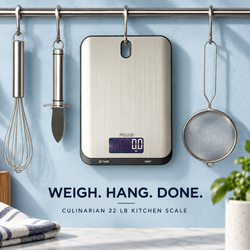
Homemade granola can be customized with your preferred oats, nuts, seeds, dried fruit, spices, sweeteners, and oils. Homemade snack mixes offer similar flexibility, allowing you to combine savory, sweet, crunchy, or high-protein ingredients in almost any proportion.
The challenge is keeping those proportions consistent.
A cup of chopped nuts does not necessarily weigh the same every time. Large pieces leave more empty space in a measuring cup, while finely chopped ingredients pack together more closely. Sticky ingredients such as honey can coat the measuring cup, and a casual pour of oil can add more than expected.
The best kitchen scale for homemade granola solves these problems by allowing every ingredient to be measured directly in grams. It also helps you scale recipes, calculate finished yield, divide the batch into equal servings, estimate nutrition, control ingredient costs, and package snack portions consistently.
For most granola and snack-mix recipes, choose a digital food scale with at least a 5-kilogram capacity, readability of 1 gram or finer, a tare function, multiple measurement units, and an easy-to-clean surface. A removable bowl can be helpful for loose ingredients, while a larger-capacity model may be more practical for bulk batches.
American Weigh Scales offers a variety of digital kitchen scales for baking, recipe development, snack preparation, and portioning.
What Is the Best Scale for Homemade Granola?
The best granola scale should include:
-
Capacity of at least 5 kilograms
-
Readability of 1 gram or better
-
A reliable tare function
-
Gram and ounce modes
-
A stable weighing platform
-
A display that remains visible beneath a mixing bowl
-
Simple controls
-
An easy-to-clean surface
-
A compact design for convenient storage
-
Enough operating time before automatic shutoff
A 5-kilogram scale can accommodate most household recipes. It is generally sufficient for oats, nuts, seeds, dried fruit, sweeteners, oils, flavorings, and finished portions.
The KF-5KG Digital Kitchen Scale offers a 5-kilogram capacity with 0.1-gram readability, making it suitable for substantial recipe components and smaller ingredients within its stated range.
For heavy mixing bowls and large batches, the PrepLite 10KG Kitchen Scale provides additional capacity.
Why Use a Kitchen Scale for Granola?
A scale improves granola preparation in several ways.
Weight Is More Consistent Than Cups
Measuring cups work by volume. The weight contained in that volume changes according to the ingredient’s size, density, shape, and how tightly it is packed.
One cup of whole almonds does not weigh the same as one cup of sliced almonds. A cup of large oat clusters contains more open space than a cup of fine crumbs.
Weight avoids this variability.
The National Institute of Standards and Technology provides additional information about using mass measurements in its culinary measurement guidance.
Ratios Are Easier to Control
Granola depends on the balance among dry ingredients, coating ingredients, and flavorings.
Too much liquid can make a batch heavy, greasy, overly sweet, or slow to crisp. Too little may leave the mixture dry or prevent clusters from forming.
Recording every ingredient by weight makes it easier to adjust the formula intentionally.
Batch Scaling Becomes Simple
Suppose a recipe produces 1,000 grams of granola mixture, but you want to prepare 1,500 grams.
The scaling factor is:
1,500 ÷ 1,000 = 1.5
Multiply every scalable ingredient by 1.5.
If the original formula uses 400 grams of oats:
400 × 1.5 = 600 grams of oats
If it uses 100 grams of nuts:
100 × 1.5 = 150 grams of nuts
Portions Become More Predictable
A bowl filled by eye can contain substantially more granola than another bowl. Weighing the finished product makes snack preparation and nutrition tracking more consistent.
Choosing the Right Capacity
The maximum capacity must support both the ingredient and the container.
Five-Kilogram Capacity
A 5-kilogram scale is suitable for:
-
Standard household granola recipes
-
Individual ingredient bowls
-
Moderate snack-mix batches
-
Meal-prep containers
-
Finished portions
-
Recipe testing
-
Baking ingredients
The CAMEO-5K Digital Kitchen Scale features a slim tempered-glass platform for general kitchen use.
Ten-Kilogram Capacity
A 10-kilogram scale may be more appropriate for:
-
Bulk snack preparation
-
Large mixing bowls
-
Heavy glass containers
-
Family-sized recipes
-
Event portions
-
Small-batch food production
-
Several packages weighed together
Container Weight Still Counts After Taring
Suppose a bowl weighs 1,400 grams and the granola ingredients weigh 4,000 grams.
The scale’s physical load is:
1,400 + 4,000 = 5,400 grams
This exceeds the capacity of a 5-kilogram scale even if the display shows only 4,000 grams after taring.
What Scale Readability Do You Need?
One-Gram Readability
A scale displaying whole grams is suitable for:
-
Oats
-
Nuts
-
Seeds
-
Dried fruit
-
Oil
-
Honey
-
Maple syrup
-
Chocolate
-
Finished portions
One-Tenth-Gram Readability
A 0.1-gram scale can be helpful for:
-
Salt
-
Lightweight spices
-
Small test batches
-
Recipe development
-
Extracts when specified by weight
-
Powdered flavorings
The AMW-2000 Digital Bench Scale provides 0.1-gram readability for smaller recipes and ingredients within its 2,000-gram capacity.
More decimal places are not always necessary. The best readability depends on the ingredient amount and purpose of the measurement.
Why the Tare Function Matters
The tare function resets the display to zero after a container is placed on the scale.
Basic Tare Method
-
Place the scale on a hard, level counter.
-
Turn it on.
-
Select grams.
-
Place the empty mixing bowl on the platform.
-
Press tare.
-
Confirm that the display reads zero.
-
Add the first ingredient.
-
Record its weight.
-
Press tare again before adding the next ingredient.
Why You Should Record Before Taring Again
Once you press tare, the previous ingredient’s displayed weight is no longer visible. Record each amount before moving to the next ingredient.
If you accidentally add too much, removing the excess may be difficult after ingredients have mixed. Consider weighing expensive nuts, lightweight seasonings, and liquid ingredients separately before adding them to the main bowl.
Weighing Oats for Granola
Oats commonly form the base of homemade granola.
Weigh Oats Directly in the Mixing Bowl
Place the bowl on the scale, press tare, and add oats until the target weight is reached.
This avoids filling and leveling multiple measuring cups.
Record the Type of Oats
Different oat products may vary in thickness, texture, and cooking behavior. Record whether you used:
-
Old-fashioned rolled oats
-
Thick-cut rolled oats
-
Quick oats
-
Certified gluten-free oats
-
Another specific oat product
Do not assume that all oat types will produce identical granola when used at the same weight.
Keep the Recipe Consistent
If one batch uses 500 grams of a particular oat product, use the same weight and product when comparing changes to oil, sweetener, temperature, or baking time.
Weighing Nuts
Nuts can be among the most expensive and calorie-dense ingredients in a granola recipe, making accurate measurement especially useful.
Whole vs. Chopped Nuts
Weigh nuts after preparing them to the state required by the recipe. If the recipe calls for chopped almonds, weigh the chopped almonds rather than including pieces or waste you will not use.
Combine Nuts by Weight
A mixed-nut formula might include:
-
100 grams almonds
-
75 grams walnuts
-
50 grams pecans
-
25 grams cashews
The total nut weight is:
100 + 75 + 50 + 25 = 250 grams
Recording each amount lets you recreate the flavor and cost of the blend.
Watch for Allergens
Tree nuts and peanuts are major food allergens. The FDA provides information about food allergies and major allergens.
If granola will be shared, gifted, packaged, or sold, clearly communicate allergen ingredients and avoid claims that cannot be supported by your production environment.
Weighing Seeds
Seeds can add texture, flavor, fat, protein, and other nutrients.
Common choices include:
-
Pumpkin seeds
-
Sunflower seeds
-
Sesame seeds
-
Chia seeds
-
Flaxseed
-
Hemp seeds
Weigh each seed separately if you want to record the recipe accurately. Small seeds can spill easily, so use a bowl with a stable base and adequate sides.
When flaxseed, chia, or another seed is ground, its behavior may change. Record whether it was whole or ground.
Weighing Dried Fruit
Dried fruit can vary in size, moisture, added sugar, and texture.
Weigh the Prepared Ingredient
If large fruit pieces are chopped before use, weigh the amount that actually enters the recipe.
Add at the Correct Stage
Many granola recipes add dried fruit after baking to prevent burning or excessive drying. Follow your chosen recipe.
Use the Product Label
Sweetened cranberries, unsweetened raisins, dried dates, banana chips, and other products can have significantly different nutrition information.
Use the label from the specific package when calculating the batch.
Weighing Oil
Oil can be measured directly or by reverse weighing.
Direct Method
-
Place a small bowl on the scale.
-
Press tare.
-
Add oil slowly.
-
Stop at the recipe’s target.
-
Transfer it to the mixture.
Reverse-Weighing Method
-
Place the oil container on the scale.
-
Press tare.
-
Pour the oil into the recipe.
-
Return the container to the scale.
-
Read the negative number.
A reading of −40 grams indicates that approximately 40 grams were removed.
Do Not Confuse Weight With Volume
Grams and milliliters are not universally interchangeable. Use the unit specified by the recipe unless a dependable conversion is provided.
Weighing Honey and Syrups
Sticky sweeteners can be messy in measuring cups because some ingredient remains behind.
A kitchen scale allows you to add the sweetener directly to the bowl.
Direct-to-Bowl Method
-
Place the mixing bowl containing the dry ingredients on the scale.
-
Press tare.
-
Pour in the sweetener.
-
Stop at the target weight.
If you add too much, removing it may be difficult. Pour slowly as you approach the required amount.
Reverse-Weighing Method
Place the sweetener container on the scale, press tare, remove the desired amount, and return the container. The negative reading shows the approximate quantity removed.
Weighing Sugar and Dry Sweeteners
Granulated sugar, brown sugar, coconut sugar, and powdered sweeteners have different densities.
Weight-based recipes avoid differences caused by packing.
Do not substitute one sweetener for another solely because they weigh the same. Sweetness, moisture, flavor, browning, and baking behavior may differ.
Follow a recipe designed for the sweetener being used or make controlled test batches.
Weighing Salt and Spices
Salt and spices can transform the flavor of granola, but they are required in relatively small quantities.
A scale with finer readability may be useful for:
-
Salt
-
Cinnamon
-
Ginger
-
Nutmeg
-
Cardamom
-
Cocoa powder
-
Vanilla powder
-
Chili powder
-
Savory seasoning blends
Measure Separately
Place a small dish on the scale, press tare, and add the ingredient gradually.
If you pour salt directly into the oat mixture and exceed the target, removing it evenly may be impossible.
Scale Seasonings Carefully
If a recipe uses 4 grams of cinnamon for 1,000 grams of mixture, a 500-gram batch would use:
4 × 0.5 = 2 grams
Not every ingredient needs to scale perfectly in recipe testing, but weight gives you a reliable starting point.
Measuring Chocolate and Other Add-Ins
Chocolate chips, cacao nibs, coconut, cereal pieces, pretzels, and candies may be added after the baked ingredients cool.
Weigh each add-in so it is distributed in the intended proportion.
For example:
-
Baked granola base: 1,000 grams
-
Chocolate: 100 grams
-
Dried fruit: 150 grams
-
Coconut: 50 grams
Final combined weight = 1,300 grams
If you want 13 equal bags:
1,300 ÷ 13 = 100 grams per bag
Making Homemade Trail Mix
Trail mix usually does not require baking, making weight-based preparation especially simple.
Select a Total Batch Weight
Suppose you want a 2,000-gram batch.
Assign Ingredient Percentages
An example formula might use:
-
Nuts: 40%
-
Dried fruit: 30%
-
Seeds: 15%
-
Cereal or crackers: 10%
-
Chocolate: 5%
Calculate each component:
-
Nuts: 2,000 × 0.40 = 800 grams
-
Dried fruit: 2,000 × 0.30 = 600 grams
-
Seeds: 2,000 × 0.15 = 300 grams
-
Cereal: 2,000 × 0.10 = 200 grams
-
Chocolate: 2,000 × 0.05 = 100 grams
These percentages are an example of the calculation method, not a nutritional recommendation.
Mix Thoroughly
Ingredients of different sizes can separate, with smaller items settling at the bottom. Stir the mixture again before portioning each package.
How to Scale a Granola Recipe
Suppose an original recipe produces approximately 1,200 grams, but you need 3,000 grams.
Calculate the scaling factor:
3,000 ÷ 1,200 = 2.5
Multiply each ingredient by 2.5.
| Original ingredient | Original weight | New weight |
|---|---|---|
| Oats | 600 g | 1,500 g |
| Nuts | 180 g | 450 g |
| Seeds | 100 g | 250 g |
| Oil | 80 g | 200 g |
| Sweetener | 180 g | 450 g |
| Other ingredients | 60 g | 150 g |
A larger recipe may need to be baked in several batches. Increasing every ingredient does not mean the entire quantity should be crowded onto one pan.
Follow the recipe’s guidance for pan size, depth, temperature, stirring, and baking time.
Calculating Finished Yield
Granola typically loses moisture during baking, so the finished weight may be lower than the raw mixture weight.
Record the Starting Weight
Add the weights of every ingredient in the unbaked mixture.
Weigh the Finished Granola
Allow the granola to cool according to the recipe before weighing. A hot baking sheet should not be placed on an ordinary digital scale.
Transfer the cooled granola to a tared container.
Calculate Yield Percentage
If the raw mixture weighs 1,500 grams and the cooled granola weighs 1,350 grams:
1,350 ÷ 1,500 × 100 = 90% yield
The missing mass may largely represent moisture lost during baking, along with any mixture remaining on utensils or the pan.
Yield data can help you predict packaging quantities for future batches.
Dividing Granola Into Equal Portions
Determine the Total Finished Weight
Suppose the cooled granola weighs 1,440 grams.
Choose the Number of Portions
For 16 equal portions:
1,440 ÷ 16 = 90 grams per portion
Tare Each Container
Place the empty bag, jar, or bowl on the scale and press tare.
Add the Granola
Add granola until the display reaches approximately 90 grams.
Remix Before Every Few Portions
Nuts, seeds, and small pieces can settle. Stir the batch during packaging so the final portions have a similar ingredient distribution.
The 2K-BOWL Digital Kitchen Scale combines a removable bowl with 0.1-gram readability for smaller batches and ingredients within its capacity.
Calculating Nutrition for Homemade Granola
Granola nutrition depends on every ingredient and the final batch weight.
Step 1: Record Every Ingredient
Weigh all oats, nuts, seeds, oils, sweeteners, fruit, chocolate, coconut, and other additions.
Step 2: Find Nutrition Information
Use package labels for branded products. Use an appropriate food database for basic ingredients without labels.
The FDA explains serving sizes and nutrient information in its guide to understanding the Nutrition Facts label.
Step 3: Calculate Every Ingredient
If an ingredient provides 500 calories per 100 grams and the recipe contains 60 grams:
60 ÷ 100 × 500 = 300 calories
Repeat the process for the nutrients you want to estimate.
Step 4: Add the Batch Totals
Add the estimated nutrition from every ingredient.
Step 5: Weigh the Finished Batch
Assume the finished granola weighs 1,500 grams and the complete batch contains an estimated 6,000 calories.
Step 6: Calculate per Gram
6,000 ÷ 1,500 = 4 calories per gram
A 50-gram portion would contain an estimated:
50 × 4 = 200 calories
Homemade calculations remain estimates, but weighing makes them more consistent.
Using a Scale for Calorie-Dense Ingredients
Nuts, seeds, oils, chocolate, coconut, and dried fruit can contribute substantial nutrition in relatively small portions.
That does not make these foods inherently inappropriate. It simply means a casual handful or pour may be larger than expected.
Short-term weighing can help you learn what a listed serving looks like.
The Dietary Guidelines for Americans offer broader guidance about nutrient-dense eating patterns and individual food choices.
Making Granola for Gifts
Homemade granola can be packaged in jars, bags, or boxes.
Standardize the Net Weight
Choose a target such as 250, 500, or 750 grams depending on the container and purpose.
Tare Every Container
Glass jars can differ in weight even when they appear identical. Tare each empty jar individually.
Label the Product Clearly
Include:
-
Product name
-
Preparation date
-
Net weight
-
Ingredient list
-
Allergen information
-
Storage guidance
-
Best-quality guidance based on the recipe
If the granola is being sold, comply with the food-business, labeling, allergen, licensing, and inspection requirements applicable to your location.
Calculating Ingredient Cost
A scale helps determine how much each ingredient contributes to the cost of a batch.
Suppose a 1,000-gram bag of almonds costs $14.
$14 ÷ 1,000 = $0.014 per gram
If the recipe uses 200 grams:
200 × $0.014 = $2.80
Repeat this calculation for each ingredient.
Cost per Batch
Add the cost of:
-
Oats
-
Nuts
-
Seeds
-
Oil
-
Sweetener
-
Dried fruit
-
Chocolate
-
Flavorings
-
Packaging
Cost per Package
If the total ingredient and packaging cost is $24 and the batch produces 12 equal bags:
$24 ÷ 12 = $2 per bag
For commercial pricing, also consider labor, utilities, equipment, waste, payment fees, insurance, licensing, marketing, taxes, and profit.
Preventing Allergen Cross-Contact
Granola and snack mixes commonly contain or come into contact with:
-
Peanuts
-
Tree nuts
-
Milk
-
Wheat
-
Soy
-
Sesame
Use clean tools and containers, keep ingredients organized, and avoid making unsupported “allergen-free” claims.
If preparing a batch for someone with a food allergy, ask about their requirements and take the risk of cross-contact seriously. Home kitchens may not be suitable for producing food for people with severe allergies.
Food Safety and Storage
Low-moisture foods still require clean handling and proper storage.
Keep Tools and Containers Clean
Use clean, dry bowls, utensils, baking sheets, jars, and bags.
Cool Granola Completely
Packaging warm granola may trap moisture, which can reduce crispness and potentially affect storage quality.
Use Dry Storage Containers
Moisture can make granola stale or soft. Select containers appropriate to the recipe and intended storage time.
Inspect Ingredients
Do not use nuts, seeds, dried fruit, or grains that smell rancid, show signs of pests, contain visible mold, or otherwise appear spoiled.
The USDA explains foundational household practices through its four steps to food safety.
Cleaning a Kitchen Scale After Granola Preparation
Granola ingredients can leave behind oil, syrup, crumbs, and fine powders.
Use a Bowl or Parchment
Loose seeds and sticky ingredients are easier to contain when they are weighed in a bowl.
Wipe Spills Promptly
Clean syrup and oil before they enter seams or dry on the platform.
Do Not Immerse the Scale
Unless the model is specifically designed for immersion, use the manufacturer’s recommended wiping method.
Avoid Abrasive Tools
Abrasive pads can scratch glass, plastic, and metal surfaces.
Store the Scale Dry
Allow the platform to dry fully before placing the scale in a cabinet.
For bowl-based ingredient preparation, the Kitchen Pro 5KG provides another option for weighing loose ingredients within its specifications.
Common Granola Scale Mistakes
Forgetting to Tare the Bowl
If the bowl is not tared, its weight becomes part of the ingredient measurement.
Taring Without Recording
Write down each ingredient before resetting the display for the next addition.
Pouring Liquid Too Quickly
As the target approaches, pour oil, honey, or syrup slowly. Removing excess after it mixes with dry ingredients is difficult.
Overloading the Scale
The bowl’s physical weight still counts after tare.
Letting the Bowl Touch the Counter
An oversized bowl may extend beyond the platform and rest on another surface, producing an inaccurate reading.
Using the Wrong Unit
Check whether the recipe requires grams or ounces before adding ingredients.
Placing a Hot Pan on the Scale
Heat can damage an ordinary digital scale and affect its reading. Transfer cooled food to an appropriate container.
Assuming Every Sweetener Is Interchangeable
Equal weights do not guarantee equal sweetness, moisture, or baking behavior.
Forgetting Post-Bake Ingredients
If dried fruit or chocolate is added after baking, include it in the final recipe and nutrition calculations.
Packaging Without Remixing
Small ingredients settle at the bottom. Remix periodically to distribute the ingredients more evenly.
Improving Scale Accuracy
-
Place the scale on a hard, level surface.
-
Keep it away from fans and vents.
-
Avoid vibration from running appliances.
-
Center the bowl on the platform.
-
Make sure the bowl does not touch another surface.
-
Select the correct unit.
-
Press tare before adding ingredients.
-
Add lightweight ingredients gradually.
-
Wait for the reading to stabilize.
-
Replace weak batteries.
-
Keep the platform clean.
-
Follow the manufacturer’s calibration instructions.
Do not store heavy jars or bowls on the scale. Long-term loading can affect the weighing mechanism.
Frequently Asked Questions
What capacity scale is best for homemade granola?
A 5-kilogram scale is sufficient for most household recipes. Choose a 10-kilogram model for heavy bowls or bulk snack production.
Is one-gram readability accurate enough?
Yes. One-gram readability works for oats, nuts, seeds, oil, sweeteners, dried fruit, and finished portions. A 0.1-gram model can help with lightweight seasonings.
Should I weigh granola before or after baking?
Weigh ingredients before baking to follow the recipe. Weigh the cooled finished granola to calculate yield, nutrition per gram, and package portions.
Can I add ingredients directly to the mixing bowl?
Yes. Place the bowl on the scale, press tare, add the ingredient, record its weight, and tare again. Consider weighing expensive or easy-to-overpour ingredients separately.
How do I portion granola evenly?
Weigh the complete finished batch, divide by the number of portions, and weigh that amount into each tared container.
Why does granola weigh less after baking?
Moisture evaporates during baking. Some mixture may also remain on the bowl, spoon, or baking sheet.
Can I weigh honey directly in the bowl?
Yes. Tare the bowl first and pour slowly as you approach the target weight.
Can a kitchen scale calculate calories?
A conventional scale measures weight. Use ingredient labels or a reliable nutrition database to calculate estimated calories and nutrients.
How do I calculate cost per package?
Calculate the total batch cost and divide it by the number of equal packages. Include ingredients and packaging at a minimum.
Is a bowl scale useful for trail mix?
Yes. A removable bowl can help contain loose nuts, seeds, cereal pieces, chocolate, and dried fruit.
Final Verdict
The best kitchen scale for homemade granola and snack mixes should make ingredient measurement and portioning simple.
For most kitchens, a digital scale with at least a 5-kilogram capacity, 1-gram or finer readability, a dependable tare function, gram and ounce modes, and an easy-to-clean surface provides the right balance of capacity and precision.
Choose a 10-kilogram model for bulk recipes and heavy containers. Consider a smaller 0.1-gram scale for salt, spices, and test-batch ingredients.
Use the scale to weigh oats, nuts, seeds, oil, sweeteners, fruit, chocolate, and other additions. Record the finished yield, calculate equal portions, and tare every package before filling it.
With accurate measurements and a repeatable formula, homemade granola becomes easier to scale, package, price, and recreate—whether you are preparing one breakfast jar or an entire week of snacks.