
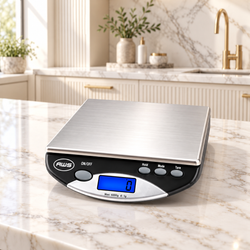
Making sausage at home gives you control over the meat, fat, seasoning, texture, casing, and final portion size. You can prepare fresh breakfast links, Italian-style sausage, patties, bulk ground sausage, poultry sausage, or custom blends built around your preferred flavors.
That control depends on accurate measurements.
A handful of seasoning may work once and taste completely different the next time. A recipe written for one kilogram of meat cannot be applied unchanged to a larger batch. Meat-to-fat ratios, salt quantities, spice blends, liquid additions, and finished link sizes all depend on knowing the actual weight of the ingredients.
The best kitchen scale for homemade sausage makes those calculations faster and more repeatable. It helps you weigh trimmed meat, fat, salt, spices, liquids, casings, individual links, patties, and complete batches.
For most home sausage makers, the best setup includes a primary digital kitchen scale with a capacity of at least 5 kilograms and a smaller precision scale for lightweight seasonings. The primary scale should read in 1-gram increments or finer, while the secondary scale may offer 0.1-gram or finer readability for appropriately sized ingredients.
American Weigh Scales offers a selection of digital kitchen scales for ingredient preparation, portioning, and home food processing.
What Is the Best Scale for Making Sausage?
The best primary sausage-making scale should offer:
-
Capacity of at least 5 kilograms
-
Readability of 1 gram or finer
-
A dependable tare function
-
Gram, kilogram, ounce, and pound modes
-
A platform large enough for mixing bowls
-
A display that remains visible beneath the container
-
Simple controls
-
An easy-to-clean weighing surface
-
A stable base
-
Enough operating time before automatic shutoff
The KF-5KG Digital Kitchen Scale combines a 5-kilogram capacity with 0.1-gram readability, making it useful for moderate batches and ingredients that fall within its stated range.
Larger batches may require additional capacity. The PrepLite 10KG Kitchen Scale can accommodate heavier containers and bulk ingredients while displaying in 1-gram increments.
The most appropriate choice depends on the size of your batches. Someone making 500 grams of breakfast sausage has different capacity requirements from someone processing several kilograms of meat at once.
Why Weight Is Important in Sausage Making
Sausage recipes depend on ratios. Those ratios affect flavor, texture, moisture, and consistency.
Meat Pieces Are Not Standard Sizes
One pork shoulder may weigh twice as much as another. The amount remaining after bones, skin, connective tissue, or unwanted fat are removed may also differ substantially from the package weight.
Seasoning should usually be calculated from the amount of prepared meat and fat that will actually enter the sausage mixture—not simply from the weight printed on the original package.
Volume Measurements Vary
A tablespoon of fine salt can weigh more than a tablespoon of coarse salt. Ground spices settle, powders compact, and measuring spoons can be filled differently.
Weight provides a more repeatable measurement.
The National Institute of Standards and Technology offers additional information about mass and volume measurements in its culinary measurement guidance.
Recipes Are Easier to Scale
Suppose a sausage recipe is designed for 1,000 grams of meat, but your trimmed meat and fat weigh 1,650 grams.
Calculate the scaling factor:
1,650 ÷ 1,000 = 1.65
An ingredient originally listed as 8 grams would become:
8 × 1.65 = 13.2 grams
This proportional approach works well for many ordinary herbs, spices, and recipe ingredients. Specialized curing ingredients require additional caution and should never be adjusted casually.
Portions Become More Consistent
Equal-weight patties and links are more likely to cook at similar rates. A scale also makes packaging, freezing, nutrition calculations, and recipe costing easier.
Do You Need One Scale or Two?
Many sausage makers benefit from a two-scale setup.
Primary Kitchen Scale
Use the full-size kitchen scale for:
-
Trimmed meat
-
Fat
-
Ice or water
-
Large seasoning quantities
-
The complete sausage mixture
-
Stuffed links
-
Patties
-
Bulk packages
-
Finished batch yield
A capacity of 5 to 10 kilograms works for many home applications.
Precision Scale
Use a smaller precision scale for:
-
Salt
-
Individual spices
-
Dried herbs
-
Sugar
-
Lightweight powdered ingredients
-
Small test-batch seasonings
The AMW-2000 Digital Bench Scale provides 0.1-gram readability for smaller portions and ingredients within its 2,000-gram capacity.
Do not use a pocket or precision scale for a bowl that exceeds its capacity. Likewise, do not assume a high-capacity kitchen scale will measure an extremely small quantity reliably.
Choosing the Right Scale Capacity
Scale capacity is the maximum physical load the scale can support. This includes the food and its container.
Five-Kilogram Capacity
A 5-kilogram scale is suitable for:
-
Small and moderate batches
-
Individual cuts of meat
-
Trimmed fat
-
Bowls of ground sausage
-
Sausage patties
-
Individual links
-
Seasoning mixtures
-
Packaging portions
Ten-Kilogram Capacity
A 10-kilogram model is useful for:
-
Larger batches
-
Heavy stainless-steel bowls
-
Bulk meat packages
-
Multiple packages being portioned
-
Large containers of finished sausage
-
Family or hunting-season processing
Remember the Bowl Weight
Pressing tare does not remove the physical load from the scale.
If a bowl weighs 1,200 grams and contains 4,300 grams of sausage mixture, the total physical load is:
1,200 + 4,300 = 5,500 grams
That would exceed the capacity of a 5-kilogram scale even though the display shows only 4,300 grams after taring.
Understanding Scale Readability
Readability is the smallest increment displayed by the scale.
One-Gram Readability
A scale displaying whole grams is suitable for:
-
Meat
-
Fat
-
Water
-
Ice
-
Large seasoning mixtures
-
Individual patties
-
Links
-
Packaging portions
-
Finished yield
One-Tenth-Gram Readability
A scale displaying 0.1 gram is more useful for:
-
Small spice quantities
-
Salt for test batches
-
Lightweight seasonings
-
Recipe development
-
Smaller ingredient additions
Display readability does not guarantee that every quantity can be measured accurately. If an ingredient amount is extremely small, confirm that it falls within the scale’s usable weighing range.
Specialized Curing Ingredients
When a recipe involves curing salts or other safety-critical ingredients, use a validated recipe from a trusted authority and follow it exactly. Confirm that the scale is appropriate for the specified quantity.
Do not estimate curing ingredients, substitute one curing product for another, or create your own curing ratio. Products vary in composition, and errors can create serious food-safety risks.
The National Center for Home Food Preservation provides guidance on smoking and curing foods, including important safety considerations.
Why the Tare Function Matters
The tare function resets the displayed weight to zero after an empty container is placed on the scale.
Basic Tare Method
-
Place the scale on a hard, level surface.
-
Turn it on.
-
Select grams.
-
Place the empty bowl on the platform.
-
Press tare.
-
Confirm that the display reads zero.
-
Add the ingredient.
-
Wait for the reading to stabilize.
-
Record the weight.
Weighing Multiple Ingredients in One Bowl
You can weigh meat and fat in one bowl by recording each amount and pressing tare between additions.
For seasonings, separate dishes may be safer. If too much spice or salt is poured directly into the meat, removing the excess can be difficult or impossible.
How to Weigh Meat for Sausage
The most useful weight is usually the prepared meat that will enter the grinder.
Start With the Package Weight
The package weight provides a rough planning number, but it may include:
-
Bone
-
Skin
-
Packaging liquid
-
Thick connective tissue
-
Fat you intend to remove
-
Parts not used in the recipe
Weigh After Trimming
After trimming the meat according to the recipe:
-
Place a clean bowl on the scale.
-
Press tare.
-
Add the prepared meat.
-
Record the weight.
-
Keep the meat properly chilled.
This trimmed weight becomes the basis for many recipe calculations.
Work in Manageable Batches
If the entire batch exceeds the scale’s capacity, divide it into smaller portions and add the recorded weights.
For example:
-
First container: 2,250 grams
-
Second container: 2,180 grams
-
Third container: 1,970 grams
Total prepared meat = 6,400 grams
Never attempt to balance an oversized bowl on a small platform.
How to Weigh Fat for Sausage
Fat contributes to flavor, texture, moisture, and mouthfeel. The appropriate percentage depends on the sausage style and validated recipe.
To calculate the proportion of fat in a meat-and-fat mixture:
Fat percentage = fat weight ÷ total meat-and-fat weight × 100
If a mixture contains 800 grams of fat and 3,200 grams of lean meat:
Total mixture = 800 + 3,200 = 4,000 grams
Fat percentage = 800 ÷ 4,000 × 100 = 20%
This demonstrates the calculation only. It is not a universal fat recommendation.
Calculate the Required Fat From a Target Total
Suppose a tested recipe calls for a particular meat-to-fat ratio. Follow the recipe’s formula carefully, since the percentage may be described in different ways.
A percentage of the final mixture is not always the same as a percentage added relative to the lean meat. Read the recipe closely and avoid assuming the calculation method.
How to Calculate Salt by Weight
Salt is one of the ingredients most likely to be measured inaccurately by volume because crystal sizes vary.
If a trusted recipe states salt as a percentage of the meat mixture:
Salt weight = meat mixture weight × salt percentage
For a mathematical example, if a recipe calls for 1.5% ordinary salt and the mixture weighs 2,000 grams:
2,000 × 0.015 = 30 grams
This is only an example of percentage calculation. The appropriate amount depends on the recipe, sausage style, other salty ingredients, and dietary considerations.
Do Not Confuse Ordinary Salt With Curing Salt
Table salt, kosher salt, sea salt, and curing salts are not automatically interchangeable. Curing products may contain nitrite or nitrate in specific concentrations and require validated formulas.
Never substitute ordinary salt for curing salt when a tested cured-sausage recipe requires the latter. Never use curing salt as though it were ordinary seasoning salt.
Weighing Herbs and Spices
A spice blend can be calculated relative to the weight of the meat mixture.
Suppose a recipe written for 1,000 grams of meat uses:
-
5 grams black pepper
-
4 grams paprika
-
3 grams garlic powder
-
2 grams fennel
-
1 gram dried herb
If your batch weighs 2,500 grams, the scaling factor is:
2,500 ÷ 1,000 = 2.5
Multiply each ingredient by 2.5:
-
Black pepper: 12.5 grams
-
Paprika: 10 grams
-
Garlic powder: 7.5 grams
-
Fennel: 5 grams
-
Dried herb: 2.5 grams
Use separate dishes and label them when preparing several seasonings. This reduces the risk of forgetting an ingredient or adding one twice.
Weighing Liquids and Ice
Some sausage recipes include water, ice, wine, vinegar, milk, or another liquid.
Liquids may be weighed if the recipe provides gram measurements. Do not assume every milliliter of every liquid weighs exactly one gram because density varies.
Adding Liquid Directly
Place the mixing bowl on the scale, press tare, and add the liquid gradually.
Measuring Separately
For greater control, weigh the liquid in a separate container before adding it to the meat mixture.
Keep meat and equipment at the temperatures specified by the recipe. A scale measures the ingredient amount but does not manage temperature.
Making a Small Test Batch
A test batch helps evaluate seasoning before stuffing an entire quantity of sausage.
Divide the Mixture Before Seasoning
If you want to compare two seasoning blends, divide the ground meat by weight.
For example, a 1,000-gram batch could become:
-
Test batch A: 500 grams
-
Test batch B: 500 grams
Apply the corresponding seasoning amounts to each portion.
Cook a Test Patty Safely
Cook a small portion according to safe food-handling and temperature guidance. Taste only after it has reached an appropriate safe internal temperature.
A test patty can help assess ordinary seasoning, but it cannot validate the safety of a curing, fermentation, drying, or preservation method.
Using a Scale for Sausage Patties
Equal-weight patties are easier to package and tend to cook more evenly when shaped to similar dimensions.
Calculate the Target Weight
If the finished mixture weighs 1,600 grams and you want 16 patties:
1,600 ÷ 16 = 100 grams per patty
Portion Each Patty
-
Place parchment, a dish, or a plate on the scale.
-
Press tare.
-
Add sausage mixture.
-
Adjust until the target is reached.
-
Shape the patty consistently.
-
Repeat.
The CAMEO-5K Digital Kitchen Scale offers a flat tempered-glass platform that can be used for general food preparation and portioning.
Using a Scale for Sausage Links
Links can be portioned during or after stuffing.
Weighing Individual Links
Place a plate or tray on the scale, press tare, and add one link. Adjust the link length during stuffing until you develop a reliable visual reference.
Weighing Link Sections
If several links remain connected, weigh the complete chain and divide by the number of links for an average.
If eight links weigh 960 grams:
960 ÷ 8 = 120 grams per link on average
The individual links may still vary, but the calculation provides a useful quality-control number.
Portioning Before Stuffing
Another method is to divide the sausage mixture into equal bowls before loading the stuffer. This is useful when preparing different casing sizes, flavors, or package quantities.
Weighing Sausage Casings
Casing weight is usually less important than meat and seasoning weight, but recording it can be useful for production planning.
Natural casings are typically selected by diameter and length rather than food-scale weight. Follow the casing supplier’s preparation and storage directions.
Do not use an estimated casing weight to decide how much filling a casing can safely hold. Avoid overstuffing, which can cause tearing or uneven links.
Fresh Sausage vs. Cured or Fermented Sausage
The role of the scale changes depending on the type of sausage.
Fresh Sausage
Fresh sausage is generally prepared for refrigeration, freezing, or prompt cooking. A scale helps measure:
-
Meat
-
Fat
-
Ordinary salt
-
Herbs
-
Spices
-
Liquids
-
Patties
-
Links
-
Packages
Fresh sausage still requires careful sanitation, cold holding, and thorough cooking.
Cured, Smoked, Dried, or Fermented Sausage
These processes introduce additional safety variables, potentially including:
-
Curing agents
-
Controlled temperature
-
Controlled humidity
-
Fermentation cultures
-
Acidity
-
Smoke application
-
Moisture loss
-
Defined processing times
Do not improvise these methods based on a general kitchen article. Use a scientifically validated recipe and appropriate equipment.
A precise scale is necessary for certain ingredients, but precision alone does not make an unvalidated process safe.
Tracking Weight Loss During Drying
Some validated dry-sausage methods use weight loss as one part of the process documentation.
The calculation is:
Weight loss percentage = ((starting weight − current weight) ÷ starting weight) × 100
If a sausage begins at 500 grams and later weighs 350 grams:
((500 − 350) ÷ 500) × 100 = 30%
Weight loss by itself does not prove that a fermented or dried sausage is safe. Safety may also depend on acidity, curing formulation, ingredient quality, process temperature, humidity, culture activity, sanitation, and other controlled factors.
Do not use a target copied from an unrelated recipe.
Calculating Finished Yield
Finished yield helps you evaluate water loss, cooking loss, trimming, and packaging quantities.
Raw Mixture Yield
Add the weights of all ingredients entering the mixture.
Cooked Yield
After cooking a batch safely, weigh the finished edible product.
Yield Percentage
Yield percentage = finished weight ÷ starting mixture weight × 100
If a batch begins at 2,000 grams and produces 1,600 grams of cooked sausage:
1,600 ÷ 2,000 × 100 = 80% yield
A different sausage style or cooking method may have a different yield. Compare similar recipes prepared under similar conditions.
Packaging Homemade Sausage
A scale can help you create standardized freezer or refrigerator packages.
Choose a Package Weight
Common household portions might be selected according to the number of people and intended recipes.
For example, you might package bulk sausage in:
-
250-gram portions
-
500-gram portions
-
1,000-gram portions
These are packaging examples, not serving recommendations.
Tare the Packaging
Place the empty bag or container on the scale and press tare before adding sausage.
Label Every Package
Useful information includes:
-
Type of sausage
-
Net weight
-
Preparation date
-
Raw or cooked status
-
Seasoning variation
-
Storage instructions
-
Allergen information
-
Batch number, if used
A bowl-based scale such as the 2K-BOWL Digital Kitchen Scale may be convenient for smaller batches and loose sausage mixture within its capacity.
Calculating Sausage Cost per Pound or Portion
A scale can help determine the true ingredient cost of a batch.
Suppose you use:
-
Meat: $20
-
Fat: $4
-
Seasonings: $2
-
Casings: $3
-
Other ingredients: $1
Total ingredient cost = $30
If the finished batch weighs 4,000 grams:
$30 ÷ 4,000 = $0.0075 per gram
A 500-gram package has an estimated ingredient cost of:
500 × $0.0075 = $3.75
This does not include equipment, electricity, refrigeration, labor, packaging, waste, licensing, insurance, or overhead.
Anyone selling sausage must comply with all applicable federal, state, and local food-processing requirements.
Sausage-Making Food Safety
Raw meat can contain harmful microorganisms, and grinding increases the amount of surface area exposed to handling and equipment.
Keep Meat Cold
Follow the temperature instructions in your tested recipe. Work in manageable batches and return ingredients to refrigeration when necessary.
A scale should be positioned in a clean preparation area away from heat and splashing water.
Prevent Cross-Contamination
Use bowls or trays instead of placing raw meat directly on the scale.
The CDC’s guidance for preventing food poisoning emphasizes cleaning, separating foods, cooking appropriately, and chilling promptly.
Wash hands and clean food-contact equipment according to current food-safety recommendations.
Cook to a Safe Internal Temperature
Link size, weight, color, and cooking time cannot prove that sausage is safely cooked.
Use an appropriate food thermometer. The USDA’s safe minimum internal temperature chart includes guidance for ground meat, ground poultry, and other foods.
The USDA also provides consumer information specifically addressing sausages and food safety.
Refrigerate Promptly
Follow appropriate cooling and storage practices. The FDA’s food-safety guidance for the home offers general information about safe handling, storage, and preparation.
Cleaning a Scale After Handling Meat
Raw meat juices should not come into direct contact with the scale.
Use a Container
Always place meat in a clean bowl, tray, or plate before weighing.
Protect the Controls
Avoid touching buttons with hands that have just handled raw meat. Press tare before handling the ingredient or wash your hands before touching the scale again.
Wipe Spills Promptly
Follow the manufacturer’s cleaning instructions. Do not immerse a standard electronic scale or allow liquid to enter the display, buttons, seams, or battery compartment.
Sanitize Appropriately
Use a cleaning and sanitizing method suitable for the scale’s surface and consistent with its care instructions. Avoid chemicals that can damage the platform or display.
For routine ingredient weighing, the Kitchen Pro 5KG offers another bowl-style option within its stated capacity.
Common Sausage-Making Scale Mistakes
Weighing Meat Before Trimming
If bones, skin, or unwanted tissue are removed afterward, the seasoning calculations may be based on the wrong meat weight.
Using Tablespoons for Every Ingredient
Volume measurements can vary with particle size and packing. Use weight when the recipe provides grams.
Adding Seasoning Before Recording It
Measure ordinary seasonings in separate dishes so you can confirm the amount before adding them to the meat.
Overloading the Scale
Remember that the container’s weight counts toward total capacity even after pressing tare.
Using a High-Capacity Scale for Tiny Quantities
Large scales may not register very small additions reliably. Use a suitable precision scale when appropriate.
Treating Curing Salt Like Ordinary Salt
Curing products require exact, validated instructions. Never improvise, substitute, or estimate.
Letting the Bowl Touch the Counter
The scale must support the entire container. Outside contact can produce an inaccurate reading.
Ignoring Raw vs. Cooked Weight
Cooking changes moisture and weight. Record whether each measurement represents raw mixture or finished sausage.
Using Weight to Judge Doneness
A link’s weight cannot confirm that its center reached a safe temperature.
Failing to Label Packages
Unlabeled packages can make it difficult to identify the recipe, preparation date, raw or cooked status, and storage history.
How to Get Consistent Scale Readings
-
Place the scale on a hard, level counter.
-
Keep all feet in contact with the surface.
-
Avoid fans, vents, and vibration.
-
Center the bowl on the platform.
-
Confirm that the bowl touches nothing else.
-
Select the correct unit.
-
Press tare before adding ingredients.
-
Add lightweight ingredients slowly.
-
Wait for the display to stabilize.
-
Record the number immediately.
-
Replace weak batteries.
-
Follow the manufacturer’s calibration instructions.
Do not store heavy bowls or equipment on the platform. Long-term loading can affect the weighing mechanism.
Frequently Asked Questions
What scale capacity is best for sausage making?
A 5-kilogram scale works for small and moderate home batches. A 10-kilogram scale is better for large batches, heavy bowls, and bulk meat preparation.
Do I need a precision scale?
A precision scale is helpful for small quantities of salt and spices. It becomes especially important when a validated recipe specifies a lightweight ingredient that must be measured accurately.
Can I use the same scale for meat and spices?
Yes, if both quantities fall within the scale’s useful range. Many sausage makers prefer a larger scale for meat and a smaller precision model for seasonings.
Should I weigh meat before or after grinding?
Weighing after trimming but before grinding gives you a useful base for recipe calculations. You can also weigh the complete mixture afterward to calculate portions and finished yield.
Should sausage seasoning be calculated from meat weight?
Follow the recipe. Many formulas use the combined weight of meat and fat, while others may define the base differently. Read the instructions carefully.
Can I measure curing salt with a kitchen scale?
Only use a scale with suitable capacity and readability, and only follow a validated recipe from a trusted source. Never estimate curing ingredients or invent your own ratio.
How do I make equal sausage patties?
Weigh the complete mixture, divide it by the desired number of patties, and portion each patty to the calculated target.
How do I weigh sausage links?
Tare a plate or tray and weigh each link individually. You can also weigh a connected group and divide by the number of links to find the average.
Can a scale tell me when dried sausage is safe?
No. Weight loss may be one measurement in a validated process, but it does not independently prove safety.
Can I place raw meat directly on the scale?
It is better to use a clean bowl, plate, or food-safe barrier. This helps prevent contamination and protects the scale.
Final Verdict
The best kitchen scale for homemade sausage is one that matches both the size of your meat batches and the quantities of your seasonings.
For most home sausage makers, a 5- to 10-kilogram digital kitchen scale with 1-gram or finer readability, a reliable tare function, multiple measurement units, and a platform large enough for mixing bowls provides an effective primary tool.
A smaller precision scale can complement it for salt, spices, and other lightweight ingredients that fall within its usable range.
Use the primary scale to weigh trimmed meat, fat, liquids, completed mixtures, patties, links, and packages. Use the precision scale for properly sized seasoning quantities. Record every ingredient, note whether weights are raw or cooked, and keep the scale protected from raw meat juices.
Most importantly, use validated recipes for curing, smoking, fermentation, and drying. Accurate weight is essential, but it is only one part of a safe sausage-making process.
With a dependable scale and careful documentation, homemade sausage becomes easier to repeat, adjust, portion, package, and evaluate from one batch to the next.