
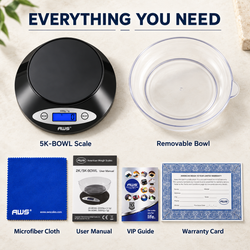
The best kitchen scale for portioning cookie dough should be accurate, responsive, easy to clean, and large enough to support a mixing bowl or plate. For most home bakers, a digital scale with 1-gram readability and a capacity of at least 5,000 grams is an excellent choice. A model with 0.1-gram readability provides even greater control for small cookies, salt, leavening agents, and recipe development.
Weighing cookie dough helps every cookie bake at approximately the same rate. When some portions are much larger than others, the small cookies may become dry or overbaked while the larger ones remain soft or underbaked in the center.
A scale also allows you to measure flour, sugar, butter, chocolate, and other ingredients more consistently than relying exclusively on cups. Once the dough is mixed, you can calculate its total mass and divide it into the exact number of cookies you want.
This process is useful whether you are making six oversized bakery-style cookies, four dozen holiday cookies, uniform sandwich cookies, or hundreds of portions for a home baking business.
In this guide, you will learn how to choose a cookie dough scale, determine the best portion weight, use the tare function, calculate recipe yield, divide dough evenly, troubleshoot spreading problems, and maintain consistent results from batch to batch.
Why Weigh Cookie Dough?
Cookie scoops are convenient, but they do not always produce identical portions.
Dough can stick inside the scoop, form a rounded top, contain large chocolate pieces, or become compressed differently with each use. A scoop may produce reasonably consistent results, but a scale confirms the actual mass of every portion.
For example, cookies intended to weigh 40 grams might vary as follows when measured only with a scoop:
-
34 grams
-
37 grams
-
41 grams
-
45 grams
-
48 grams
That difference can affect:
-
Baking time
-
Diameter
-
Thickness
-
Center texture
-
Edge crispness
-
Browning
-
Appearance
-
Package weight
-
Cost per cookie
-
Number of cookies produced
When every dough portion weighs approximately 40 grams, the cookies are more likely to bake and look alike.
A scale is equally important before portioning begins. Measuring ingredients by mass reduces variation in the dough itself.
Explore digital kitchen scales from American Weigh Scales to compare capacities, platform styles, removable bowls, and readability options for baking.
Quick Answer: What Is the Best Scale for Cookie Dough?
For most cookie recipes, choose a scale with:
-
At least 5,000 grams of capacity
-
Readability of 1 gram or finer
-
Gram measurement mode
-
A reliable tare function
-
A large, stable platform
-
A display that remains visible beneath a bowl
-
Simple controls
-
An easy-to-clean surface
-
Fast stabilization
-
A practical automatic shutoff time
A five-kilogram capacity is helpful because the scale may need to support the combined mass of a mixing bowl and a full batch of dough.
If you only plan to portion individual cookies, a smaller 2,000-gram scale can be sufficient. However, a five-kilogram model offers more flexibility for weighing flour, sugar, butter, and the complete batch.
The KF-5KG digital kitchen scale provides a 5,000-gram capacity with 0.1-gram readability. This combination is suitable for large ingredient quantities as well as precise cookie portions.
Why Weight Is More Reliable Than Cups
A cup measures volume. A scale measures mass.
Flour can settle or become compressed, causing the quantity inside a measuring cup to vary. The result depends on whether the baker:
-
Scoops flour directly from the bag
-
Uses a spoon to fill the cup
-
Sifts the flour
-
Shakes the cup
-
Packs the ingredient
-
Levels it firmly
-
Uses a different cup
-
Measures from a newly opened or settled package
Sugar, cocoa powder, oats, nut butter, and chopped ingredients can also be measured differently by volume.
Measuring by mass creates a consistent starting point. Two hundred grams of flour remains 200 grams whether it appears fluffy or compacted.
The National Institute of Standards and Technology recommends measuring ingredients by mass with an appropriate kitchen scale as a best practice for improving recipe accuracy. Its metric kitchen measurement guidance explains why volume measurements can be less consistent and how a digital scale can improve recipe repeatability.
Understanding Scale Capacity
Capacity is the maximum total mass a scale is designed to support.
The total physical load includes:
-
Mixing bowl
-
Flour
-
Sugar
-
Butter
-
Eggs
-
Chocolate
-
Nuts
-
Oats
-
Finished dough
Pressing tare resets the displayed value, but it does not physically remove the bowl’s mass.
Suppose:
-
Scale capacity: 5,000 grams
-
Empty mixing bowl: 1,100 grams
-
Finished dough: 2,600 grams
The physical load is:
The scale remains within capacity.
If the empty bowl weighs 1,500 grams and the dough weighs 3,700 grams, the combined load is 5,200 grams and exceeds a five-kilogram limit—even if the display shows only the dough mass after taring.
Is a Five-Kilogram Scale Enough?
A five-kilogram scale is sufficient for most home cookie recipes. It can generally accommodate a large bowl and enough dough for several dozen cookies.
The KITCHEN Pro-5KG digital bowl scale offers a five-kilogram capacity, 0.1-gram readability, and an included bowl that can help contain flour, sugar, chocolate chips, and other ingredients.
When Would You Need More Capacity?
A higher-capacity scale may be useful if you:
-
Make commercial-size batches
-
Use a heavy ceramic bowl
-
Prepare several recipes together
-
Portion bulk cookie dough
-
Weigh shipping or storage containers
-
Make cookies for events
-
Operate a bakery or catering business
For larger jobs, the PrepLite-10KG kitchen scale provides a capacity of up to 10 kilograms with 1-gram readability.
Understanding Readability and Precision
Readability is the smallest increment shown by the scale.
A model with 1-gram readability displays:
-
38 grams
-
39 grams
-
40 grams
A model with 0.1-gram readability can display:
-
39.8 grams
-
39.9 grams
-
40.0 grams
Whole-gram readability is sufficient for most cookie portions. A difference of less than one gram will rarely affect the way a 40- or 100-gram cookie bakes.
Tenth-gram readability is useful for:
-
Small cookies
-
Salt
-
Baking soda
-
Baking powder
-
Spices
-
Recipe testing
-
Gluten-free binders
-
Expensive inclusions
-
Mini sandwich cookies
-
Precise commercial portioning
Do You Need 0.1-Gram Readability?
It is helpful but not essential for ordinary cookie portions.
If your target is 50 grams, portions weighing 49, 50, and 51 grams should bake similarly. Chasing a perfect 50.0-gram reading may add time without noticeably improving the result.
However, a 0.1-gram scale gives you greater flexibility for measuring the smaller ingredients used to make the dough.
Accuracy, Readability, and Repeatability
These terms describe different characteristics.
Accuracy
Accuracy refers to how close the displayed measurement is to the actual mass.
Readability
Readability is the smallest displayed increment.
Repeatability
Repeatability describes whether the scale produces the same or nearly the same reading when the same item is weighed several times under stable conditions.
A good cookie dough scale should provide consistent readings and return to zero correctly after taring.
A display with multiple decimal places does not guarantee perfect accuracy. The scale must also be used within its capacity, placed on a stable surface, and kept clean.
Best Cookie Dough Portion Sizes
The best cookie size depends on the recipe, desired texture, and presentation.
Common starting portions include:
| Cookie style | Example dough weight |
|---|---|
| Mini cookies | 8–15 g |
| Small cookies | 15–25 g |
| Standard cookies | 25–40 g |
| Large cookies | 40–70 g |
| Bakery-style cookies | 70–120 g |
| Extra-large stuffed cookies | 120–180+ g |
These ranges are only starting points. A thin sugar cookie and a thick chocolate-chip cookie may use different portion weights even if their final diameters are similar.
The recipe’s ingredient ratios also affect spreading. Cookies containing more butter or sugar may spread differently from doughs containing more flour, oats, or nut butter.
How Portion Weight Affects Baking
Larger dough portions generally require more time to bake than smaller ones.
A large cookie may develop:
-
A deeply browned edge
-
A soft center
-
More contrast between the edge and middle
-
Greater thickness
-
A more substantial bakery-style appearance
A small cookie may:
-
Bake more quickly
-
Become crisp throughout
-
Brown sooner
-
Lose moisture faster
-
Require closer monitoring
If a tray contains multiple sizes, using one baking time for every cookie becomes difficult.
Uniform mass does not guarantee perfectly identical cookies because shape and ingredient distribution also matter. However, it removes one major source of variation.
How to Calculate Cookie Yield
If you know the total dough mass and target portion size, divide the total by the portion size.
Suppose the finished dough weighs 1,200 grams.
At 30 grams per cookie:
The recipe should produce approximately 40 cookies.
At 40 grams per cookie:
At 60 grams per cookie:
At 100 grams per cookie:
The exact yield may differ slightly if some dough remains on the bowl, spoon, mixer attachment, or scoop.
Weighing the dough before portioning helps you choose the cookie size and verify whether the recipe’s stated yield is realistic.
How to Determine Portion Size From Desired Yield
You can reverse the calculation when you know how many cookies you want.
Use:
If the dough weighs 1,350 grams and you need 30 cookies:
Each dough portion should weigh 45 grams.
If you need 24 cookies:
You could make each portion approximately 56 grams and use the remaining dough to adjust the final cookies.
Best Scale for Standard Home Baking
A general-purpose five-kilogram scale is the most versatile option for home bakers. It can measure the ingredients, complete dough batch, and individual portions.
Look for a platform that supports your usual bowls without obstructing the display.
The controls should remain accessible when the bowl is in place. If a wide bowl covers the buttons, you may have difficulty using tare.
A flat platform offers flexibility, while an included bowl can help control flour and loose ingredients.
Best Scale for Small Cookie Batches
A compact 2,000-gram model may be sufficient for a small batch or individual portions.
For example, a half-batch might weigh only 500 to 800 grams. A smaller scale can easily handle the dough if you use a lightweight container.
The AMW-2000 compact digital bench scale provides a 2,000-gram capacity and 0.1-gram readability, making it suitable for small dough batches and individual cookie portions.
Always include the plate or bowl when checking the total load.
Best Bowl Scale for Cookie Dough
A removable bowl can make ingredient measurement easier because it contains flour, sugar, nuts, and chocolate pieces.
Advantages include:
-
Less mess around the platform
-
Easier transfer of ingredients
-
Convenient weighing of chocolate chips
-
Better control of chopped nuts
-
Simple weighing of sticky dough portions
-
Reduced risk of ingredients touching the buttons
The 5KBOWL digital bowl scale has a 5,000-gram capacity, 1-gram readability, and a removable bowl suitable for general kitchen measurements.
Remove the bowl from the scale before mixing or pressing dough. Vigorous movement can apply force beyond the ingredients’ static mass and may overload the sensors.
How to Weigh Cookie Ingredients
Step 1: Place the Scale on a Hard Surface
Use a rigid, level countertop. Do not weigh on a towel, flexible mat, or unstable cutting board.
Step 2: Turn On the Empty Scale
Wait for the display to show zero before adding the bowl.
Step 3: Select Grams
Grams make recipe scaling and portion calculations straightforward.
Step 4: Add the Mixing Bowl
Center the bowl and check that it does not touch the wall, countertop, mixer, or another object.
Step 5: Press Tare
Wait for a stable zero reading.
Step 6: Add the First Ingredient
Pour quickly at first and slow down as the display approaches the target.
Step 7: Tare Again or Use Running Totals
You can reset between ingredients or calculate cumulative targets.
Step 8: Weigh Small Ingredients Separately
Salt and leavening agents are easier to control in a small container. This also prevents a major mistake from contaminating the main bowl.
Step 9: Remove the Bowl Before Mixing
Do not operate a hand mixer, stand mixer, or heavy spoon while the bowl is on the scale.
How to Use the Tare Function
Tare subtracts the displayed mass of a container or previous ingredients.
Taring Between Ingredients
-
Place the empty bowl on the scale.
-
Press tare.
-
Add flour.
-
Press tare.
-
Add sugar.
-
Press tare.
-
Add another ingredient.
This method is fast and reduces the number of dishes.
The disadvantage is that an ingredient may be difficult to remove if you add too much.
Using Cumulative Totals
Suppose the recipe begins with:
-
300 grams flour
-
5 grams salt
-
4 grams baking soda
Your targets would be:
-
Flour: 300 grams
-
Flour plus salt: 305 grams
-
Flour, salt, and baking soda: 309 grams
Running totals create an additional record of what entered the bowl.
Measuring Separately
For ingredients such as baking soda, salt, extracts, or expensive chocolate, use a separate container.
This creates more cleanup but gives you a chance to correct an error before combining ingredients.
How to Portion Cookie Dough With a Scale
Method One: Weigh Every Portion
-
Place a plate or parchment square on the scale.
-
Press tare.
-
Scoop a piece of dough.
-
Place it on the scale.
-
Add or remove dough until it reaches the target.
-
Transfer it to the baking sheet.
-
Repeat.
This produces the greatest consistency.
Method Two: Use a Scoop and Check Periodically
-
Determine the target mass.
-
Scoop and weigh the first several portions.
-
Learn what the correct scoop looks and feels like.
-
Continue portioning.
-
Check every fifth or tenth cookie.
-
Correct the technique if portions begin drifting.
This is faster for large batches.
Method Three: Divide by Total Mass
For slice-and-bake dough or shortbread:
-
Weigh the complete dough.
-
Divide by the desired cookie count.
-
Form the dough into an even log.
-
Mark equal sections.
-
Cut and check individual pieces.
This method combines visual division with measured confirmation.
Using a Cookie Scoop and Scale Together
A scoop and scale work well as a pair.
The scoop provides speed and shape. The scale verifies consistency.
Choose a scoop that produces a portion close to your target. If you want 40-gram cookies but the scoop consistently produces 70 grams, you will spend unnecessary time removing dough.
Before portioning the full batch:
-
Fill the scoop normally.
-
Weigh the dough.
-
Repeat five times.
-
Calculate the average.
-
Decide whether the scoop suits the recipe.
For example, five portions weigh:
-
38 grams
-
41 grams
-
39 grams
-
42 grams
-
40 grams
Total:
Average:
The scoop produces an average 40-gram portion.
Portioning Chocolate-Chip Cookies
Chocolate chips create additional variation because each scoop may contain a different number of chips.
A 40-gram dough portion with many chips contains less base dough than a 40-gram portion with relatively few chips. The cookies may still differ slightly in shape or spreading.
To improve consistency:
-
Mix inclusions evenly.
-
Scrape the bowl thoroughly.
-
Avoid allowing chips to settle at the bottom.
-
Use the same portion mass.
-
Shape the portions similarly.
-
Distribute visible chips as evenly as practical.
King Arthur Baking recommends using ingredient weights for repeatable baking and provides conversions for flour, sugars, chocolate, and other ingredients in its ingredient weight chart.
Portioning Sugar Cookies
Sugar-cookie dough may be rolled and cut rather than scooped. A scale is still useful for dividing the dough into equal sections.
If a dough batch weighs 1,000 grams, divide it into four 250-gram sections. Working with equal pieces can help maintain:
-
Similar rolling thickness
-
Similar chilling time
-
Consistent flouring
-
Easier handling
-
Predictable yield
For cutout cookies, thickness is as important as mass. Two cookies cut with the same cutter may bake differently if one was rolled much thinner.
Use rolling guides or another thickness-control method alongside the scale.
Portioning Sandwich Cookies
Sandwich cookies require paired pieces. Uneven cookies can make the finished product look unbalanced.
To improve consistency:
-
Weigh each dough portion.
-
Shape every portion similarly.
-
Space cookies evenly.
-
Bake similar sizes on the same tray.
-
Weigh or measure filling portions.
-
Match baked cookies with similar diameters.
Suppose each cookie shell weighs 15 grams before baking and each sandwich receives 12 grams of filling. The finished sandwich contains approximately:
Moisture loss during baking means the final product will weigh less than the raw ingredients.
Portioning Stuffed Cookies
Stuffed cookies have two or more measured components:
-
Outer dough
-
Filling
-
Optional topping
Suppose the target is a 120-gram raw cookie:
-
Outer dough: 95 grams
-
Filling: 20 grams
-
Topping: 5 grams
Weighing each component improves consistency and reduces the risk of filling leaking from an overly thin section.
For a centered filling:
-
Weigh the filling.
-
Weigh the outer dough.
-
Flatten the dough evenly.
-
Place the filling in the center.
-
Seal completely.
-
Confirm the total mass if necessary.
-
Shape each cookie similarly.
Weighing Gluten-Free Cookie Ingredients
Gluten-free cookies may contain multiple flours, starches, and binders.
Ingredients can include:
-
Rice flour
-
Almond flour
-
Oat flour
-
Tapioca starch
-
Cornstarch
-
Potato starch
-
Xanthan gum
-
Psyllium
-
Nut butter
Precise measurement becomes valuable when small changes affect structure or spread.
A scale with 0.1-gram readability is useful for binders and leavening agents. Use a higher-capacity scale for the primary flour mixture and complete dough.
For people avoiding gluten because of celiac disease or another medical requirement, ingredient selection and cross-contact controls matter in addition to measurement. The FDA’s gluten-free labeling guidance explains the federal definition used for foods labeled gluten-free in the United States.
Weighing Cookie Dough for a Baking Business
Consistent portions are particularly important when cookies are sold.
A scale can support:
-
Standardized product size
-
Predictable yield
-
Ingredient-cost calculations
-
Consistent packaging
-
Inventory planning
-
Nutrition calculations
-
Production records
-
Quality control
-
Reduced overportioning
Suppose a batch should produce 50 cookies at 60 grams each:
If employees routinely portion 65 grams instead, the same 3,000-gram batch produces only:
The business loses approximately four cookies per batch.
If the cookies average 58 grams, the business may produce more pieces, but customers may receive less product than expected.
Businesses selling packaged food should follow applicable net-content, labeling, and local commercial-weighing requirements. NIST’s Handbook 133 provides official procedures for checking the net contents of packaged goods.
A general kitchen scale should not automatically be assumed legal for trade. Businesses should verify local requirements before using any device to determine a selling price by weight.
How to Calculate Ingredient Cost per Cookie
A scale can help connect the recipe to its cost.
Suppose a batch costs $18 in ingredients and produces 30 cookies:
The ingredient cost is $0.60 per cookie.
If the batch costs $18 and produces only 25 oversized cookies:
The ingredient cost becomes $0.72 per cookie.
This calculation does not include:
-
Labor
-
Packaging
-
Utilities
-
Delivery
-
Payment fees
-
Marketing
-
Equipment
-
Rent
-
Waste
-
Taxes
Consistent portion weight makes yield and cost estimates more dependable.
Using a Scale for Mix-Ins
Chocolate, nuts, dried fruit, candy, and other inclusions should also be measured.
A formula can express inclusions as a percentage of flour mass.
Suppose a recipe contains:
-
500 grams flour
-
350 grams chocolate chips
The chocolate equals:
If you increase the recipe to 750 grams of flour while preserving the same ratio:
Use 525 grams of chocolate.
This approach keeps the character of the cookie consistent when the batch size changes.
Scaling a Cookie Recipe
To double a recipe, multiply every ingredient by two. To prepare one and a half batches, multiply each ingredient by 1.5.
Suppose the original recipe contains:
-
300 grams flour
-
200 grams butter
-
180 grams sugar
-
100 grams egg
-
5 grams salt
-
4 grams baking soda
-
250 grams chocolate
For 1.5 batches:
-
Flour: 450 grams
-
Butter: 300 grams
-
Sugar: 270 grams
-
Egg: 150 grams
-
Salt: 7.5 grams
-
Baking soda: 6 grams
-
Chocolate: 375 grams
Weighing beaten egg makes fractional batches easier. Instead of guessing half an egg, beat it, weigh it, and use the required mass.
Troubleshooting Cookies With Measured Ingredients
Cookies Spread Too Much
Possible causes include:
-
Too little flour
-
Too much sugar
-
Too much butter
-
Warm dough
-
Warm baking sheets
-
Incorrect leavening
-
Insufficient chilling
-
Ingredient substitutions
-
Oven-temperature issues
A scale helps confirm whether the formula was followed, but temperature and technique still matter.
Cookies Do Not Spread Enough
Possible causes include:
-
Too much flour
-
Cold dough
-
Insufficient sugar or fat
-
Different flour characteristics
-
Too much leavening
-
Incorrect shaping
If flour was measured with cups, excess flour is a common possibility. Weighing removes that uncertainty.
Cookies Bake Unevenly
Check:
-
Portion mass
-
Dough shape
-
Tray placement
-
Oven hot spots
-
Baking-sheet color and material
-
Spacing
-
Oven temperature
-
Whether multiple sizes share one tray
Yield Is Lower Than Expected
Weigh the complete dough and individual portions.
If the recipe contains 1,200 grams of dough and should make 40 cookies, the intended portion is:
If your portions average 36 grams, the batch will produce only about 33 cookies.
Common Cookie-Weighing Mistakes
Exceeding Scale Capacity
Remember to include the mixing bowl’s mass.
Pressing on the Platform
Do not shape, cut, or press dough directly on the scale.
Letting the Bowl Touch Another Surface
A large bowl that touches the countertop can produce an incorrect reading.
Using the Wrong Unit
Confirm that the scale is set to grams before beginning.
Measuring on a Soft Surface
Use a rigid, level counter rather than a towel or silicone mat.
Adding Minor Ingredients Directly to the Main Bowl
An accidental overdose of baking soda or salt can ruin the batch. Weigh small ingredients separately.
Chasing Unnecessary Decimal Places
For a 50-gram cookie, 49.8 and 50.2 grams are functionally similar in most home recipes.
Failing to Record Actual Amounts
If you accidentally add 205 grams instead of 200, record 205. Accurate notes help explain the final result.
Mixing on the Scale
Remove the bowl before using a mixer or applying force.
Raw Cookie Dough Safety
Do not eat raw cookie dough unless it was specifically produced to be eaten without baking and its ingredients were treated appropriately.
Raw flour may contain harmful microorganisms, and raw eggs may also present a food-safety risk. Freezing ordinary cookie dough does not make raw flour or eggs safe to eat.
The CDC advises consumers not to taste or eat raw flour, batter, or dough and provides additional precautions in its raw dough food-safety guidance.
Practice safe handling:
-
Wash hands before and after handling dough.
-
Keep raw dough away from ready-to-eat food.
-
Clean utensils and countertops.
-
Follow recipe baking instructions.
-
Keep perishable ingredients refrigerated.
-
Avoid allowing children to play with raw flour dough.
-
Store finished cookies appropriately.
Storing Portioned Cookie Dough
Portioning before refrigeration or freezing makes future baking easier.
To prepare dough for storage:
-
Weigh each portion.
-
Place portions on a lined tray.
-
Chill or freeze as directed by the recipe.
-
Transfer firm portions to a suitable container.
-
Label with cookie type, portion weight, and date.
-
Record baking directions.
-
Follow appropriate storage practices.
Portion mass may change slightly during extended storage if dough loses moisture or develops freezer damage. Use packaging that limits unnecessary exposure to air.
For general guidance on cooling and storing prepared food, consult the USDA’s leftovers and food-safety recommendations.
Cleaning and Maintaining a Cookie Dough Scale
Cookie preparation can expose the scale to flour, sugar, butter, chocolate, and sticky dough.
After use:
-
Brush away dry flour and crumbs.
-
Wipe the platform with a lightly damp cloth.
-
Dry it immediately.
-
Keep liquid away from the display.
-
Do not submerge the scale.
-
Do not use abrasive cleaners.
-
Remove sticky residue promptly.
-
Clean around platform edges carefully.
-
Wash removable bowls according to their instructions.
-
Store the scale without objects on top.
-
Replace weak batteries.
-
Follow the manufacturer’s calibration procedure.
Do not pour flour directly over the scale if the bowl is too small to contain it. Fine particles can enter gaps around the platform or controls.
Calibration and Accuracy Checks
If readings appear inconsistent:
-
Move the scale to a hard, level surface.
-
Remove everything from the platform.
-
Clean away debris.
-
Replace weak batteries.
-
Allow the scale to reach room temperature.
-
Test it with an appropriate reference weight.
-
Calibrate it according to the instruction manual.
Do not use a bag of sugar, butter package, or random household item as a calibration standard. Product labels identify nominal quantities and do not necessarily provide a calibration-quality reference.
Keeping a Cookie Recipe Journal
Record the following:
-
Recipe name
-
Flour type and mass
-
Sugar type and mass
-
Butter mass and temperature
-
Egg mass
-
Salt
-
Leavening
-
Mix-ins
-
Total dough mass
-
Portion mass
-
Number of cookies
-
Chilling time
-
Dough temperature
-
Oven temperature
-
Baking time
-
Baking-sheet type
-
Finished diameter
-
Texture
-
Browning
-
Planned adjustment
These notes make it easier to distinguish recipe problems from portioning or baking problems.
Frequently Asked Questions
What is the best kitchen scale for cookie dough?
For most bakers, choose a digital scale with at least 5,000 grams of capacity, readability of 1 gram or finer, a tare function, and a platform large enough for a mixing bowl.
Is 1-gram readability enough for cookies?
Yes. Whole-gram readability is sufficient for most cookie portions and primary ingredients. A 0.1-gram scale is helpful for salt, baking soda, spices, and small batches.
How many grams should a cookie dough ball weigh?
Standard cookies often use 25 to 40 grams of dough, while large bakery-style cookies may use 70 to 120 grams or more. The best mass depends on the recipe and desired result.
How do I make every cookie the same size?
Use a scoop to form each portion and a scale to verify its mass. Shape every piece similarly and bake cookies of equal size on the same tray.
Can I put cookie dough directly on the scale?
A clean platform may allow direct contact, but parchment, a plate, or a removable tray is usually easier to clean. Press tare after adding the container.
Does tare increase the scale’s capacity?
No. Tare resets the displayed value, but the bowl and ingredients still count toward maximum capacity.
Should I weigh cookie dough before or after chilling?
Follow the recipe. Soft dough may be easier to portion before chilling, while some recipes require chilling the full batch first. Use the same method each time for consistency.
Why do cookies of the same weight still look different?
They may have different shapes, thicknesses, ingredient distribution, or spacing. Oven hot spots can also cause variation.
Can I use a small pocket scale for cookie dough?
A pocket scale can measure individual portions and minor ingredients, but its platform and capacity may be too small for a full mixing bowl.
How do I calculate the number of cookies in a batch?
Divide the total dough mass by the target portion mass. A 1,200-gram batch divided into 40-gram portions yields approximately 30 cookies.
Can a scale help reduce baking costs?
Yes. Consistent portions improve yield calculations and reduce accidental overportioning, especially in a baking business.
Should I weigh cookies after baking?
You can, but moisture loss means baked cookies weigh less than raw dough. Use raw portion mass to standardize production and finished mass for packaging or quality-control checks.
Why does my scale reading fluctuate?
Possible causes include:
-
Uneven surfaces
-
Air movement
-
Vibration
-
Weak batteries
-
Temperature changes
-
A container touching the counter
-
Debris around the platform
-
Excessive load
Final Verdict
The best kitchen scale for portioning cookie dough combines sufficient capacity, practical readability, dependable tare, and an easy-to-clean platform.
For most home bakers, the ideal specifications are:
-
Capacity of at least 5,000 grams
-
Readability of 1 gram or finer
-
Preferably 0.1-gram readability
-
Gram measurement mode
-
Reliable tare function
-
Stable weighing platform
-
Visible display
-
Simple controls
-
Easy cleaning
-
Enough room for a mixing bowl
A higher-capacity model is useful for commercial-size recipes, while a compact precision scale may be helpful for salt, leavening, and other small ingredients.
Weighing helps at every stage of cookie production. It improves ingredient consistency, confirms total dough mass, establishes predictable yield, creates even portions, controls costs, and makes baking times more reliable.
Once you know exactly how much dough goes into each cookie, you can reproduce the same size, texture, and presentation much more consistently—from the first tray to the last.