
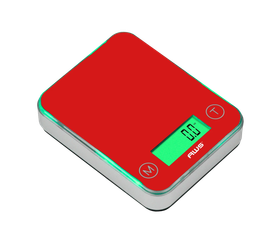
The best precision scale for epoxy pigments is not necessarily the scale with the most decimal places.
For pigment work, the features that matter most are the ones that help you measure small quantities consistently and reproduce successful color formulas.
That means looking beyond the number on the display.
A good precision scale for epoxy pigments should offer an appropriate combination of:
-
Fine readability
-
Appropriate capacity
-
Stable and repeatable measurements
-
Tare
-
Suitable minimum usable load
-
Clear calibration procedures
-
A practical weighing platform
-
Easy-to-read display
-
Protection from drafts and vibration
-
A design that is easy to keep clean
For many resin pigment applications, a practical starting specification is:
100–500g capacity × 0.01g readability
That range can be useful for weighing:
-
Mica powder
-
Concentrated colorants
-
Glitter
-
Lightweight additives
-
Small resin samples
-
Jewelry color formulas
-
Experimental batches
American Weigh Scales currently offers several 500g × 0.01g precision scales that fit this general use case, including the SC501g, SC501A and SM-501-BLK.
But capacity and readability are only the beginning.
Here are the features that actually matter when choosing a precision scale for epoxy pigments.
Quick Answer: What Features Matter Most?
If you are buying a digital precision scale primarily for epoxy pigments, prioritize these features:
| Feature | Why It Matters |
|---|---|
| 0.01g readability | Useful for many sub-gram pigment measurements |
| 100–500g capacity | Supports small containers, trays and resin samples |
| Tare | Lets you zero containers before adding pigment |
| Repeatability | Helps reproduce successful color formulas |
| Appropriate minimum load | Important for very small pigment quantities |
| Calibration capability | Helps check and maintain scale performance |
| Stable platform | Helps containers sit securely |
| Backlit display | Makes small decimal readings easier to see |
| Draft/vibration resistance through proper setup | Important with fine-resolution measurements |
| Protective tray or cover | Useful around loose powders |
| Gram mode | Simplifies formulation records |
| Suitable power source | Important for portable or permanent workstations |
For many hobbyists and small workshops, 0.01g readability provides a strong balance between fine measurement and usable capacity.
1. Readability: Probably the Most Important Starting Feature
Readability is the smallest increment displayed by the scale.
A scale with:
0.1g readability
displays:
0.1g
0.2g
0.3g
0.4g
A scale with:
0.01g readability
can display:
0.21g
0.22g
0.23g
0.24g
A scale with:
0.001g readability
can display:
0.211g
0.212g
0.213g
0.214g
For epoxy pigment work, the goal is not simply to choose the greatest number of decimal places.
You need enough readability for the smallest meaningful amount you actually measure.
2. Why 0.01g Is Often the Sweet Spot for Epoxy Pigments
For many pigment applications, 0.01g readability is a practical choice.
It can be useful for:
-
Mica powder
-
Concentrated pigments
-
Colorants
-
Small additive trials
-
Jewelry resin
-
Small formula tests
-
Multi-color blends
-
Repeatable pigment formulas
Suppose your color formula contains:
Resin sample: 50.00g
Blue mica: 0.65g
Pearl pigment: 0.22g
Metallic powder: 0.15g
A 0.01g scale provides useful displayed detail for recording these quantities.
A 0.1g scale would show those changes in larger increments.
For makers developing repeatable resin colors, that difference can matter.
For more information about fine scale resolution, read 0.001g vs. 0.01g Scales: Which Precision Do You Need? on American Weigh Scales.
3. Do You Need 0.001g for Epoxy Pigments?
Usually not for ordinary epoxy pigment work.
A 0.001g scale displays changes of one milligram.
That additional decimal place can be useful when your actual materials need milligram-level measurement.
But there are tradeoffs.
Milligram scales are typically more sensitive to:
-
Drafts
-
Vibration
-
Static
-
Temperature changes
-
Surface movement
-
Sample placement
That can make them less convenient in a normal resin workshop.
If you normally measure:
0.50g
1.25g
2.75g
of pigment, 0.001g readability is probably unnecessary.
If your formulation genuinely requires quantities such as:
0.015g
or:
0.027g
then you may need to investigate a dedicated milligram scale.
The correct principle is:
Choose 0.001g because your application requires milligram measurement—not simply because three decimal places look more precise.
4. Readability Is Not the Same as Accuracy
This distinction is extremely important when shopping for a precision scale.
A scale displaying:
5.27g
has 0.01g readability.
That does not automatically mean every measurement is guaranteed accurate to exactly ±0.01g.
Readability describes the smallest displayed increment.
Accuracy concerns how closely the measurement agrees with the appropriate reference under specified conditions.
Repeatability describes how consistently the same stable load produces the same result under similar conditions.
When comparing pigment scales, consider:
-
Readability
-
Accuracy specification
-
Repeatability
-
Tolerance
-
Minimum usable load
-
Calibration
-
Capacity
-
Linearity where specified
-
Operating environment
Do not choose a precision scale based solely on how many digits appear after the decimal point.
For a more detailed explanation, see What Does 500g × 0.01g Mean on a Digital Scale? from American Weigh Scales.
5. Minimum Usable Load Matters for Tiny Pigment Quantities
This feature is easy to overlook.
Suppose you purchase a scale labeled:
500g × 0.01g
The 0.01g specification tells you the displayed increment.
It does not automatically mean that a 0.01g sample is an ideal or dependable working load.
Very small quantities can approach the lower practical measurement range of a scale.
If you regularly weigh tiny quantities of highly concentrated pigment, check the manufacturer's available specifications for:
-
Minimum load
-
Accuracy
-
Repeatability
-
Tolerance
If the quantities you need to measure fall below the appropriate usable range of a 0.01g scale, a milligram scale may be more suitable.
6. Capacity Still Matters
Pigment quantities may be tiny, but that does not mean you should automatically buy the lowest-capacity scale.
Remember that everything sitting on the weighing platform contributes to the physical load.
That can include:
Container + resin sample + pigment + additives
For example:
Pigment cup: 35g
Resin sample: 100g
Pigments: 2g
Total physical load:
137g
A 100g scale would not have enough capacity.
A 500g scale provides significantly more room.
That is why:
500g × 0.01g
is such a versatile specification for many resin pigment applications.
7. Why 500g × 0.01g Is a Strong Combination
A 500g × 0.01g scale gives you:
500g maximum capacity
combined with:
0.01g displayed readability
This can cover a wide range of pigment-related tasks without requiring an extremely low-capacity scale.
It can accommodate:
-
Small pigment cups
-
Weighing trays
-
Mica powder
-
Colorants
-
Small resin samples
-
Jewelry batches
-
Multiple pigments
-
Formula-development work
If your resin work involves both pigments and small finished batches, the additional capacity can be particularly useful.
8. Tare Is Essential
Tare is one of the most important practical features for epoxy pigment work.
Place your empty container on the scale.
Suppose it reads:
32.47g
Press tare.
The display returns to:
0.00g
You can now add pigment and read the pigment quantity directly without manually subtracting the container.
A typical workflow might be:
-
Place the empty pigment cup on the scale.
-
Allow the reading to stabilize.
-
Press tare.
-
Confirm 0.00g.
-
Add Pigment A.
-
Record its mass.
-
Tare again if appropriate for your formulation method.
-
Add Pigment B.
-
Record the amount.
-
Continue with additional components.
This makes multi-pigment formulations much easier to document.
9. Tare Does Not Increase Capacity
Tare changes what the display shows.
It does not physically remove the container from the load cell.
Suppose you have:
500g maximum capacity
and place a:
75g container
on the platform.
After pressing tare, the display reads:
0.00g
But the scale is still physically supporting 75g.
Approximately:
425g
of nominal capacity remains.
Keep this in mind when choosing a scale for pigment cups and resin samples.
10. Repeatability Is Critical for Color Matching
For epoxy pigment work, repeatability may matter as much as fine readability.
Imagine creating a color you want to reproduce for a customer.
Your formula says:
Mixed resin: 75.00g
Black pigment: 0.45g
Blue mica: 0.72g
Silver pigment: 0.18g
If the scale provides stable and repeatable measurements, you have a much better foundation for recreating those quantities later.
Repeatability is particularly valuable for:
-
Product batches
-
Jewelry sets
-
Customer color matching
-
Resin art collections
-
Prototype development
-
Production formulas
-
Multi-pigment blends
The purpose of a precision pigment scale is not merely to produce more digits.
It is to help make your formulation measurable and reproducible.
11. Stable Zero Is an Important Feature
Before adding pigment, the scale should return reliably to zero.
If the display constantly drifts between:
0.00g
0.02g
-0.01g
0.03g
before anything has been added, measuring a 0.25g pigment quantity becomes difficult.
Zero stability can be affected by:
-
Air movement
-
Vibration
-
Weak batteries
-
Temperature
-
Static
-
Unstable work surfaces
-
Calibration
-
Physical condition of the scale
AWS explains these causes in Why Does My Digital Scale Give Different Readings?
A fluctuating display does not automatically mean the scale is defective.
The environment matters more as readability becomes finer.
12. Platform Size Matters More Than You Might Expect
A precision scale can have excellent readability and still be inconvenient if the platform is too small.
Your weighing container should:
-
Sit securely
-
Remain centered
-
Be fully supported
-
Avoid touching the surrounding counter
-
Avoid touching the scale housing
-
Leave the display visible
A container touching another surface may prevent the scale from supporting the entire load correctly.
For resin makers using pigment cups or small resin containers, a relatively generous precision-scale platform can be a major practical advantage.
13. A Stainless-Steel Weighing Surface Is Useful
Pigment work can get messy.
Mica powder can spread.
Liquid colorants can drip.
Uncured resin can accidentally reach the weighing surface.
A stainless-steel platform can make routine surface cleaning easier than some more porous or difficult-to-maintain materials.
However, you should still prevent resin from entering:
-
Button gaps
-
Display seams
-
Electronics
-
Battery compartments
-
Charging ports
-
Platform openings
Follow the scale manufacturer's cleaning instructions.
14. Expansion Trays Can Be Valuable
A removable tray or protective cover that doubles as a weighing tray can be particularly useful for pigments.
A tray can help contain:
-
Loose mica
-
Glitter
-
Metallic powder
-
Small craft materials
It can also provide a convenient surface for lightweight pigment cups.
Remember that any tray placed on the scale counts toward the total physical capacity, even after taring.
15. Backlit Displays Make Fine Measurements Easier
A 0.01g measurement contains two decimal places.
You want to be able to distinguish:
1.25g
from:
1.35g
quickly and confidently.
Look for:
-
Clear digits
-
Strong decimal-point visibility
-
Backlighting
-
Appropriate viewing angle
-
Display placement that remains visible behind the weighing container
A precision scale is much less convenient if your pigment cup blocks the display.
16. Gram Mode Is the Most Practical for Formulation
Many precision scales support multiple units, including:
-
g
-
oz
-
ct
-
gn
-
dwt
-
ozt
For resin pigment formulas, grams are usually the most straightforward unit for documenting small ingredient quantities.
Using one consistent unit also reduces unnecessary conversion.
For example:
Resin: 100.00g
Mica A: 0.75g
Mica B: 0.30g
Glitter: 0.50g
is easier to reproduce than a formula that mixes grams, ounces and informal scoops.
17. Calibration Capability Matters
Precision measurement is more useful when the scale provides a defined calibration procedure.
Calibration requirements differ between models.
Before buying, check:
-
Can the scale be calibrated by the user?
-
What calibration weight is required?
-
Is that weight included?
-
What procedure does the manufacturer specify?
-
Does the manual explain the calibration sequence?
Do not assume every 500g scale uses the same calibration procedure.
For general guidance, see How to Calibrate a Digital Scale for Accurate Results from American Weigh Scales.
18. Use the Correct Calibration Weight
Do not use random household objects as substitutes for the scale's specified calibration reference.
Avoid calibrating with:
-
Coins
-
Resin bottles
-
Pigment jars
-
Jewelry
-
Tools
-
Cured resin pieces
-
Kitchen objects
Use the calibration reference specified for your exact model.
This is especially important for a precision scale used to create repeatable pigment formulations.
19. Draft Sensitivity Matters
Mica powder is extremely lightweight.
A precision scale is also sensitive enough to detect small forces.
That combination means airflow matters.
Avoid weighing immediately beside:
-
Fans
-
Open windows
-
HVAC vents
-
Strong air-conditioning airflow
-
Air purifiers blowing across the workbench
If the display fluctuates, airflow should be one of the first things you check.
20. Vibration Matters
Workshop vibration can come from:
-
Sanders
-
Drills
-
Rotary tools
-
Compressors
-
Speakers
-
Nearby machinery
-
Foot traffic
-
Flexible tables
When weighing small pigment quantities, turn off nearby vibrating equipment when practical.
Place the scale on a rigid work surface.
The finer the readability, the more important the environment becomes.
21. Static Can Matter With Lightweight Powders
Very lightweight powders can be affected by static.
Static can also complicate the handling and transfer of fine pigment particles.
If you work with extremely small quantities, keep the weighing environment controlled and follow the pigment manufacturer's handling recommendations.
This is another reason that chasing unnecessarily fine readability can make normal workshop weighing more complicated.
22. Temperature Stability Matters
Precision scales are designed to operate within specified environmental conditions.
Avoid moving a scale directly from:
-
A hot garage
-
A cold vehicle
-
An outdoor workspace
and immediately expecting optimal fine-resolution performance.
Allow the instrument to acclimate to its working environment when necessary.
Also check the operating-temperature specifications for the scale you are considering.
23. Battery vs. AC Power
Both can work well.
The better option depends on how you use the scale.
Battery Power
Useful when you want:
-
Portability
-
Flexible placement
-
No power cable
-
Easy storage
AC Power
Useful when you have:
-
A permanent pigment workstation
-
Frequent weighing sessions
-
A dedicated workbench
-
Convenient access to an outlet
For occasional hobby use, battery operation may be more convenient.
For a fixed formulation station, AC power can be attractive.
24. Protective Covers Matter in a Resin Workshop
A precision scale may spend most of its life near:
-
Mica powder
-
Resin
-
Hardener
-
Glitter
-
Pigment
-
Dust
-
Craft materials
A protective cover can help protect the weighing platform during storage.
Some compact scales use the cover as an expansion tray as well.
This gives the cover two useful functions:
Protection during storage + weighing surface during use
25. Compact Size Is Useful—but Don't Go Too Small
Pocket scales are attractive because they are:
-
Easy to store
-
Portable
-
Lightweight
-
Suitable for small workspaces
But an extremely small platform can become inconvenient if your pigment containers are wide.
Choose compactness only after considering the containers you actually use.
26. Best AWS Precision Scale Features for Epoxy Pigments
One strong AWS option for this application is the SC501g Precision Digital Pocket Scale.
It provides:
500g capacity × 0.01g readability
along with:
-
3.9 × 3.7-inch platform
-
Stainless-steel weighing surface
-
Backlit LCD
-
Tare
-
Two expansion trays
-
Anti-slip padding
-
Multiple weighing units
-
Battery operation
-
10-year manufacturer's warranty
AWS currently specifies a 500g calibration weight, which is not included.
For epoxy pigment work, the combination of 0.01g readability, 500g capacity, a relatively generous platform and expansion trays makes this an especially practical configuration.
Internal product link: SC501g Precision Digital Pocket Scale
27. SC501A for a Permanent Pigment Workstation
The SC501A Precision Digital Pocket Scale provides the same:
500g × 0.01g
measurement specification.
It also offers:
-
3.9 × 3.7-inch platform
-
Stainless-steel weighing surface
-
Backlit LCD
-
Tare
-
Expansion trays
-
Anti-slip padding
The key difference is power.
The SC501A uses an included AC adapter.
That can make it attractive for someone building a permanent resin pigment or formulation station.
AWS currently specifies calibration using a 200g or 500g weight, not included.
Internal product link: SC501A Precision Digital Pocket Scale with AC Adapter
28. SM-501-BLK for Maximum Portability
The SM-501-BLK is another AWS model with:
500g capacity × 0.01g readability
Its platform is smaller at approximately:
2.86 × 2.6 inches
but the overall scale is very compact.
Features include:
-
Stainless-steel weighing surface
-
Backlit display
-
Magnetic protective cover
-
Cover that doubles as an expansion tray
-
Vinyl protective pouch
-
Battery operation
-
10-year manufacturer's warranty
This makes the SM-501-BLK particularly attractive when compact storage and portability matter more than platform size.
Internal product link: SM-501-BLK 500g × 0.01g Digital Pocket Scale
29. Which AWS Scale Is Best for Epoxy Pigments?
For many resin pigment users:
Best All-Around: SC501g
Choose it when you want:
-
500g capacity
-
0.01g readability
-
Larger platform
-
Battery operation
-
Expansion trays
Best for a Fixed Workstation: SC501A
Choose it when you want:
-
500g capacity
-
0.01g readability
-
Larger platform
-
AC power
-
Expansion trays
Best Compact Option: SM-501-BLK
Choose it when you want:
-
500g capacity
-
0.01g readability
-
Compact dimensions
-
Protective magnetic cover
-
Portable storage
All three share the same basic 500g × 0.01g measurement range.
The best choice comes down primarily to platform size, power source and portability.
30. Should Your Pigment Scale Also Weigh Resin?
It can.
For very small resin samples or jewelry batches, a 500g precision scale may have enough capacity for both the resin and pigment.
But it should not be expected to replace a larger resin scale for every project.
For example, a 500g × 0.01g scale cannot support a 1.5kg mixing batch.
If you work with medium or large resin quantities, consider two scales.
31. The Two-Scale Setup
A highly practical resin workstation can use:
Main Resin Scale
2–5kg × 0.1g
Use for:
-
Resin
-
Hardener
-
Mixing cups
-
Molds
-
General batches
Precision Pigment Scale
100–500g × 0.01g
Use for:
-
Mica
-
Pigments
-
Colorants
-
Small additives
-
Formula development
This gives you capacity where you need capacity and finer readability where you need finer readability.
Trying to make one scale handle both multi-kilogram batches and tiny pigment quantities usually involves compromises.
32. Create Repeatable Pigment Formulas
One of the biggest benefits of a precision scale is moving away from vague measurements.
Instead of writing:
“one scoop blue mica”
record:
Blue mica: 0.75g
Instead of:
“a little white pigment”
record:
White pigment: 0.22g
A formula might look like:
| Component | Recorded Mass |
|---|---|
| Mixed resin | 100.00g |
| Blue mica | 0.75g |
| Pearl pigment | 0.30g |
| Metallic pigment | 0.20g |
| Glitter | 0.40g |
Now you have a numerical record that is much easier to reproduce.
Always follow the pigment and resin manufacturers' recommended loading limits and instructions.
33. Do Not Confuse Pigment Precision With Epoxy Mixing Ratio
A precision scale can help measure pigment.
It does not tell you the correct resin-to-hardener ratio.
When measuring resin and hardener by weight, use the exact weight ratio supplied or approved by the manufacturer of that epoxy system.
Do not assume that:
2:1 by volume
automatically means:
2:1 by weight
Resin and hardener can have different densities.
Therefore, the numerical weight ratio may differ from the numerical volume ratio.
Always follow the instructions for the exact epoxy product you are using.
34. Common Precision Pigment Scale Buying Mistakes
Buying 0.001g Because It Looks More Precise
Choose readability based on your actual measurement requirements.
Confusing Readability With Accuracy
A 0.01g display does not automatically establish ±0.01g accuracy.
Ignoring Minimum Load
The smallest displayed increment is not necessarily the smallest ideal working quantity.
Buying Too Little Capacity
Your weighing container also counts.
Forgetting That Tare Does Not Restore Capacity
The container remains physically on the scale.
Choosing a Tiny Platform
Make sure your real pigment cups fit.
Ignoring Calibration
Know which reference weight and procedure your scale requires.
Using Coins to Calibrate
Use the specified calibration reference.
Weighing Beside a Fan
Airflow matters more with precision scales.
Weighing on a Flexible Surface
Use a rigid, level work surface.
Ignoring Vibration
Turn off nearby equipment when performing fine measurements.
Letting Pigment Enter the Scale
Protect buttons, gaps and electronics.
Failing to Record Measurements
Precision is far more useful when the resulting formula is documented.
35. Precision Scale for Epoxy Pigments Buying Checklist
Before buying, ask:
-
What is the smallest pigment quantity I actually use?
-
Is 0.1g enough?
-
Would 0.01g be more appropriate?
-
Do I genuinely require 0.001g?
-
What is the scale's maximum capacity?
-
How much do my pigment containers weigh?
-
What is the maximum complete load?
-
What minimum load does the manufacturer specify?
-
What accuracy or tolerance information is available?
-
Is repeatability suitable for my work?
-
Does the scale have tare?
-
Does it measure grams?
-
Is the platform large enough?
-
Will my container remain centered?
-
Will the display remain visible?
-
Is the display backlit?
-
Does the scale include a tray?
-
Does it include a protective cover?
-
Is the weighing surface easy to maintain?
-
Can the scale be calibrated?
-
Which calibration weight is required?
-
Is the calibration weight included?
-
Is battery power preferable?
-
Would AC power be more convenient?
-
Can I use the scale away from drafts?
-
Is my workbench stable?
-
Can I protect the scale from resin?
-
Can I protect it from pigment dust?
-
Do I need a separate high-capacity resin scale?
-
Does the scale fit my actual formulation workflow?
Frequently Asked Questions
What is the best precision scale for epoxy pigments?
For many pigment applications, a scale around 100–500g × 0.01g provides a useful balance between capacity and fine readability.
Is 0.01g precise enough for mica powder?
For many resin makers, yes.
0.01g provides hundredth-of-a-gram displayed increments and can be useful when mica quantities fall below one gram.
Do I need 0.001g for mica?
Usually not for ordinary resin crafting.
A 0.001g scale becomes appropriate when your actual measurement quantities require milligram-level readability.
Is 500g × 0.01g good for epoxy pigments?
It can be an excellent general specification because it combines relatively generous capacity with hundredth-of-a-gram readability.
What features should a resin pigment scale have?
Prioritize:
-
Appropriate readability
-
Adequate capacity
-
Tare
-
Repeatability
-
Appropriate minimum load
-
Calibration
-
Stable platform
-
Clear display
-
Suitable platform size
Is readability the same as accuracy?
No.
Readability is the smallest increment displayed.
Accuracy describes measurement agreement with an appropriate reference within the scale's specified performance.
Why does minimum load matter?
A scale's smallest display increment is not necessarily its smallest reliable working quantity.
If you need extremely small pigment measurements, review the model's available minimum-load and accuracy specifications.
Does tare increase capacity?
No.
Tare resets the display but does not physically remove the container from the scale.
Should a pigment scale have a tray?
A tray can be very useful for loose mica, pigment and other lightweight materials.
Is stainless steel good for a pigment scale?
A stainless-steel weighing surface can make routine cleaning and maintenance easier.
Always prevent resin and pigment from entering electronics and platform gaps.
Why does my 0.01g scale fluctuate?
Possible causes include:
-
Drafts
-
Vibration
-
Static
-
Weak batteries
-
Temperature changes
-
Unstable surfaces
-
Off-center loads
-
Calibration issues
Should I use one scale for resin and pigments?
You can if all your measurements fall within the same useful range.
For makers handling both larger resin batches and sub-gram pigments, two scales can be more practical.
What two scales should I use?
A useful setup is approximately:
2–5kg × 0.1g for resin and hardener
plus:
100–500g × 0.01g for pigments and additives
Which AWS precision scale is best for pigments?
The SC501g is a strong general choice because it combines 500g capacity, 0.01g readability, a relatively large stainless-steel platform, tare, expansion trays and battery operation.
The SC501A offers a similar configuration with AC power.
The SM-501-BLK offers the same 500g × 0.01g measurement range in a smaller portable design.
Final Verdict: Which Precision Scale Features Matter Most?
For epoxy pigments, do not buy a scale simply because it has the most decimal places.
Start by determining the smallest quantity you actually need to measure.
For many resin pigment applications:
0.01g readability
provides useful measurement detail for:
-
Mica
-
Pigments
-
Concentrated colorants
-
Small additives
-
Color formulation
-
Resin jewelry
-
Experimental batches
Then choose enough capacity for:
Container + resin sample + pigment + additives
For many makers:
100–500g
is a useful precision-scale capacity range.
A:
500g × 0.01g
scale can provide an especially practical balance between fine readability and useful capacity.
But the features that matter extend beyond those two numbers.
Look for:
Tare. Repeatability. Appropriate minimum load. Calibration capability. Stable zero. Adequate platform size. Clear display. Practical power. Easy maintenance.
And remember that your weighing environment matters.
Use a precision scale on a:
hard, rigid and stable surface
away from:
drafts, vibration and unnecessary temperature changes.
For many resin makers, the best setup is ultimately two scales:
2–5kg × 0.1g main resin scale
plus:
100–500g × 0.01g precision pigment scale
That combination gives you higher capacity for resin and hardener while preserving finer measurement capability for the pigments that define the final color.
When choosing the best precision scale for epoxy pigments, those practical features matter far more than simply buying the scale with the longest string of decimal places.