
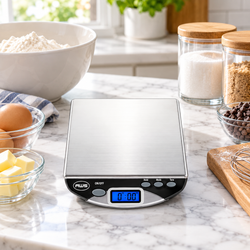
The best precision scale for farmers market products should deliver consistent measurements while remaining practical enough for food preparation, packaging, transportation and outdoor market use. It needs the right capacity for the heaviest container, fine enough resolution for the lightest product, fast stabilization and a platform that is easy to keep clean.
For most farmers market preparation tasks, the essential features include:
-
Appropriate capacity
-
Useful resolution
-
Strong repeatability
-
Reliable tare
-
Fast stabilization
-
Food-friendly platform
-
Battery power
-
Clear display
-
Calibration capability
-
Protection during transport
If the scale determines the price charged to a customer, legal-for-trade requirements may also apply. A general kitchen or precision scale can be excellent for recipes, packaging and inventory without necessarily being approved for customer-facing sales by weight.
The ideal configuration depends on whether you sell produce, herbs, baked goods, coffee, honey, soap, candles or crafts. A vendor with varied products may need two or more scales rather than one device attempting to cover every possible load.
What Makes a Farmers Market Scale Precise?
Precision is more than the number of decimal places on the display.
A useful precision scale combines:
| Feature | What It Means | Why It Matters |
|---|---|---|
| Capacity | Maximum supported load | Must cover the product and container |
| Resolution | Smallest displayed increment | Determines how small a change is visible |
| Accuracy | Closeness to an accepted value | Supports dependable portioning and package checks |
| Repeatability | Consistency across repeated measurements | Helps produce uniform products |
| Linearity | Performance across the weighing range | Matters when weighing both small and large loads |
| Minimum load | Smallest practical measurable quantity | Important for herbs, spices and samples |
| Stabilization time | Time needed for the reading to settle | Affects production and checkout speed |
| Calibration | Establishing or adjusting scale response | Supports ongoing measurement confidence |
A scale showing 0.01 gram is not automatically more useful than a one-gram scale. The finer model may be ideal for spices but unsuitable for large produce baskets.
Precision Requirements by Product
| Product | Suggested Capacity | Useful Resolution |
|---|---|---|
| Spices and concentrated ingredients | 100–500 g | 0.01 g |
| Tea and dried herbs | 500–2,000 g | 0.01–0.1 g |
| Coffee and small packaged foods | 1–5 kg | 0.1–1 g |
| Baked goods and recipe batches | 5–15 kg | 1 g |
| Honey, jam and filled jars | 5–15 kg | 1 g |
| Soap and candles | 5–15 kg | 0.1–1 g |
| Berries and small produce | 5–15 kg | 1–5 g |
| Melons, squash and bulk produce | 15–30 kg or more | 5–10 g |
These figures are general recommendations. The correct choice depends on the actual container, product variation and intended use.
Capacity: Start With the Heaviest Complete Load
Capacity is the maximum load the scale is designed to support.
Include the weight of:
-
Product
-
Bowl
-
Produce basket
-
Food-safe container
-
Packaging
-
Tray
-
Platform liner
For example, if a stainless-steel bowl weighs two kilograms and may hold eight kilograms of dough, the scale must support at least ten kilograms. A 15-kilogram model would provide a more practical margin.
American Weigh Scales offers digital kitchen scales for food preparation, portioning and general weighing tasks.
Leave Capacity Above Normal Loads
Additional capacity allows for:
-
Larger batches
-
Heavier containers
-
Seasonal products
-
Product expansion
-
Multi-item orders
-
Packaging changes
Avoid operating continuously near the maximum.
Excess Capacity Can Reduce Useful Precision
A high-capacity platform scale may display weight in larger increments than a compact precision balance. This can make it unsuitable for lightweight herbs or samples.
Select enough capacity for the task, but do not buy unnecessary range at the expense of resolution.
Tare Does Not Increase Capacity
Tare subtracts a bowl or basket from the displayed result. It does not remove that object’s physical weight.
If a three-kilogram crate is placed on a 15-kilogram scale and tared, approximately 12 kilograms of capacity remain.
This limitation is especially important with:
-
Heavy produce baskets
-
Glass jars
-
Stainless-steel bowls
-
Wooden display containers
-
Large food-safe tubs
Resolution: Match It to the Product
Resolution is the smallest increment the scale displays.
0.01 Gram
Best suited to:
-
Concentrated flavorings
-
Fine spices
-
Small dried-herb quantities
-
Samples
-
Detailed formulations
This sensitivity is rarely necessary for whole produce.
0.1 Gram
Useful for:
-
Tea
-
Herbs
-
Coffee
-
Small confections
-
Soap additives
-
Craft materials
AWS pocket scales provide compact options for vendors who need fine resolution and portability.
1 Gram
A strong general-purpose choice for:
-
Bread
-
Pastries
-
Packaged foods
-
Filled jars
-
Soap bars
-
Candles
-
Recipe batches
5 to 10 Grams
Often suitable for:
-
Watermelons
-
Pumpkins
-
Squash
-
Bulk vegetables
-
Produce crates
The increment should be small enough for the decisions being made but not finer than the workflow can meaningfully support.
Resolution Is Not Accuracy
Resolution indicates the displayed increment. Accuracy describes closeness to an accepted reference value.
A scale may display:
250.01 g
That does not prove the product truly weighs exactly 250.01 grams.
Measurement quality can also be affected by:
-
Calibration
-
Repeatability
-
Minimum load
-
Temperature
-
Vibration
-
Air movement
-
Surface stability
-
Load placement
-
Battery condition
More decimal places can create an appearance of precision without improving the underlying measurement.
Repeatability Is a Critical Feature
Repeatability indicates whether the same item produces a similar reading when weighed repeatedly under the same conditions.
To test it:
-
Place the scale on a stable, level surface.
-
Turn it on with the platform empty.
-
Confirm zero.
-
Center a representative product or reference weight.
-
Wait for the reading to stabilize.
-
Record the result.
-
Remove the load.
-
Allow the display to return to zero.
-
Repeat five to ten times.
-
Compare the readings.
A scale with good repeatability supports consistent portions and packages.
Unstable readings may result from:
-
Wind
-
A flexible table
-
Low batteries
-
Temperature changes
-
Platform debris
-
Off-center loading
-
Nearby movement
-
Improper calibration
-
Previous overload
Minimum Load Matters for Small Products
Maximum capacity receives most of the attention, but minimum practical load matters for lightweight products.
A scale designed to hold 30 kilograms may not reliably detect:
-
One gram of herbs
-
A small tea sample
-
A lightweight soap additive
-
A few coffee beans
-
A minor package adjustment
Ask whether the scale can consistently measure the smallest quantity used in production.
If not, add a separate compact precision scale.
Linearity Across the Working Range
A scale should perform acceptably at different points across the range you use.
For example, a 15-kilogram scale used for:
-
500-gram packages
-
Five-kilogram recipe batches
-
Twelve-kilogram produce baskets
should be checked at more than one weight.
Testing only with one small reference does not reveal how the scale performs near the middle or upper portion of its range.
Fast Stabilization
A precision scale should reach a stable reading quickly.
This matters during:
-
Busy customer periods
-
Repetitive packaging
-
Batch preparation
-
Product sorting
-
Inventory checks
Look for:
-
Fast response
-
Clear stable-weight indication
-
Consistent return to zero
-
Minimal unnecessary fluctuation
A very sensitive scale may take longer to settle because it responds to wind, vibration and operator movement.
Platform Size and Shape
A good platform should support the product or container without allowing it to:
-
Tip
-
Rock
-
Slide
-
Touch the table
-
Press against the display
-
Cover the controls
-
Rest against a wall
Any outside contact can transfer part of the load away from the scale.
Large Produce Baskets
Choose a broad platform or elevated design that keeps the basket clear of the controls and display.
Mixing Bowls
A raised platform can help a bowl sit securely while leaving the screen visible.
Small Herbs and Spices
Use a shallow tray or draft-protected platform that contains lightweight materials.
Food-Friendly Materials
A stainless-steel platform is useful because it is durable and relatively easy to clean.
Other desirable design features include:
-
Smooth surfaces
-
Sealed buttons
-
Removable trays
-
Minimal seams
-
Splash resistance
-
Non-slip feet
Follow the manufacturer’s cleaning instructions. Do not immerse the scale unless it is specifically rated for immersion.
Federal food-safety guidance emphasizes cleaning and preventing contamination as part of the four steps to food safety.
Tare Function
Tare allows the vendor to subtract a bowl, basket, jar or tray.
Typical process:
-
Place the empty container on the platform.
-
Wait for a stable reading.
-
Press tare.
-
Confirm zero.
-
Add the product.
-
Read the net weight.
A responsive tare button is especially valuable when containers change repeatedly during production or sales.
Multiple Tare and Ingredient Addition
During recipe preparation, tare can be used between ingredients:
-
Place the bowl on the scale.
-
Press tare.
-
Add the first ingredient.
-
Record the quantity.
-
Press tare again.
-
Add the next ingredient.
This reduces extra dishes but requires careful recordkeeping. If an ingredient is added beyond the target, the display cannot identify how much of the mixture should be removed without also removing other ingredients.
Counting Function
A counting function can estimate the number of uniform items from their average piece weight.
Potential applications include:
-
Soap samples
-
Wrapped candies
-
Tea bags
-
Small craft items
-
Promotional pieces
-
Packaged accessories
AWS counting scales can be useful for market preparation and inventory.
Counting by weight is less dependable when individual products vary substantially in size, moisture or packaging.
Display Quality
A farmers market display should remain readable in changing lighting.
Important features include:
-
Large digits
-
High contrast
-
Backlighting
-
Clear unit symbols
-
Stable-weight indicator
-
Low-battery warning
-
Customer-facing visibility when required
Test the display in direct sun and under a canopy. A screen that looks bright indoors may be difficult to read outdoors.
Battery Life and Power Options
Portable market scales should provide reliable battery operation.
Useful features include:
-
Long battery life
-
Common battery type
-
Rechargeable capability
-
Battery-level indicator
-
External power input
-
Adjustable auto-off
Carry spare batteries and check them before leaving for the market.
Auto-Off
Auto-off conserves power but can interrupt customer transactions.
A practical scale allows the setting to be:
-
Adjusted
-
Extended
-
Disabled
-
Bypassed when externally powered
Outdoor Stability
A scale that performs well in a kitchen may behave differently outdoors.
Wind
Wind can affect lightweight products and sensitive scales. Use a windbreak for herbs, tea and small samples.
Uneven Ground
Although the scale rests on a table, uneven ground can cause the table to tilt or wobble. Level the workstation before opening.
Heat and Sun
Direct sunlight can heat the scale and reduce display visibility. Position it under the canopy.
Cold
Allow a cold scale to reach the working temperature before important measurements.
Vibration
Customer traffic, coolers and shared tables can create movement. Use a dedicated weighing station.
Moisture
Protect the scale from rain, condensation and produce water unless it is rated for wet environments.
Portability and Transport Protection
A farmers market scale must survive frequent movement.
Look for:
-
Compact construction
-
Protective case
-
Removable tray
-
Secure battery compartment
-
Durable display cable
-
Transport lock when applicable
-
Low weight
During transport:
-
Do not stack heavy objects on the platform.
-
Remove loose trays.
-
Protect the display.
-
Disconnect cables.
-
Keep calibration weights in a separate case.
-
Avoid extreme vehicle temperatures.
-
Never carry the scale by its platform.
Calibration Capability
Calibration establishes or adjusts the relationship between the applied load and displayed result.
Before selecting a scale, determine:
-
Whether calibration is user-accessible
-
Which reference mass is required
-
Whether the weight is included
-
Whether compatible weights are available
-
Whether instructions are provided
-
Whether official service is required
AWS offers purpose-made calibration weights for compatible scale models.
Calibration Versus Verification
Calibration adjusts or establishes the scale response.
Verification checks the scale with a known reference to determine whether it performs within the required tolerance.
Do not recalibrate automatically whenever a reading looks unusual. First inspect:
-
Surface stability
-
Battery condition
-
Zero setting
-
Unit selection
-
Platform cleanliness
-
Temperature
-
Wind
-
Container contact
For routine verification, a vendor might record:
-
Date
-
Scale identification
-
Test weight
-
Expected result
-
Observed result
-
Operator
-
Corrective action
Legal-for-Trade Requirements
If scale weight determines the price paid by the customer, the device may be subject to commercial weighing regulations.
NIST explains commercial-use considerations in its weighing and scales FAQs.
The National Type Evaluation Program evaluates commercial weighing devices for conformance with applicable requirements.
A commercial farmers market scale may need:
-
NTEP certification
-
State or local approval
-
Inspection
-
Registration
-
Security sealing
-
Customer-visible readings
-
Approved units
-
Price-computing functionality
Requirements vary, so consult the applicable weights-and-measures authority before conducting sales by weight.
NIST publishes model specifications and requirements in its current Handbook 44 resources.
Internal Preparation Versus Customer Sales
A precision scale used for recipes or package checks is not necessarily required to be legal for trade.
Internal uses include:
-
Ingredient measurement
-
Package consistency
-
Inventory
-
Harvest tracking
-
Quality control
-
Recipe development
Commercial uses may include:
-
Calculating a produce price per pound
-
Determining a tea price per ounce
-
Charging for bulk products based on displayed weight
Confirm the classification with local authorities rather than assuming that an internal-use scale can be moved to the sales counter.
Packaged Food Labeling
For packaged products, vendors should distinguish:
-
Gross weight: Product plus packaging
-
Tare weight: Packaging
-
Net weight: Product only
The basic calculation is:
Net weight = Gross weight − Tare weight
Packaging components can include:
-
Jar
-
Lid
-
Bag
-
Label
-
Wrapper
-
Tie
-
Protective insert
FDA provides resources on food labeling and nutrition. State cottage-food and farmers market requirements may add additional obligations.
Cross-Contact and Sanitation
A scale platform can transfer residue between products.
Consider separate trays or cleaning procedures for products containing:
-
Peanuts
-
Tree nuts
-
Wheat
-
Milk
-
Eggs
-
Soy
-
Sesame
-
Fish
-
Shellfish
Do not place unpackaged food directly on a dirty platform. Use food-safe containers and clean the workstation according to applicable procedures.
Recommended Scale Setups
Herb, Tea and Spice Vendor
-
Capacity: 500–2,000 g
-
Resolution: 0.01–0.1 g
-
Features: Draft protection, tare and calibration
-
Environment: Sheltered from wind
Baker
-
Capacity: 5–15 kg
-
Resolution: 1 g
-
Features: Large platform, tare and washable surface
-
Environment: Kitchen preparation area
Produce Vendor
-
Capacity: 15–30 kg or more
-
Resolution: 5–10 g or as required
-
Features: Large platform, battery power and visible display
-
Requirement: Confirm legal-for-trade rules
Honey and Jam Vendor
-
Capacity: 5–15 kg
-
Resolution: 1 g
-
Features: Stainless platform, tare and spill-resistant controls
-
Environment: Clean packaging area
Soap and Candle Vendor
-
Capacity: 5–15 kg
-
Resolution: 0.1–1 g
-
Features: Tare, stable platform and calibration capability
-
Environment: Separate from food production
Multi-Product Vendor
-
Fine-resolution compact scale
-
Higher-capacity produce or bench scale
-
Appropriate commercial scale when required
-
Separate food-safe trays
-
Verification log
For applications requiring greater sensitivity under controlled conditions, compare AWS balance scales.
Common Buying Mistakes
Assuming Every Accurate Scale Is Legal for Trade
Commercial approval is separate from general measurement performance.
Buying Too Much Capacity
Unnecessary capacity may reduce useful resolution.
Buying Too Little Capacity
The container and product must both fit within the scale’s limit.
Confusing Resolution With Accuracy
More digits do not guarantee better measurements.
Ignoring Minimum Load
A produce scale may not detect lightweight herbs reliably.
Selecting an Undersized Platform
A basket touching the table can produce an incorrect result.
Ignoring Outdoor Conditions
Wind, heat and unstable tables can affect readings.
Forgetting Transport Protection
Repeated impacts can damage a precision scale.
Using Improvised Calibration Objects
Coins and packaged goods are not dependable calibration standards.
Overlooking Cleaning
Residue can affect sanitation and platform movement.
Precision Farmers Market Scale Checklist
Before purchasing, confirm:
-
Products being weighed
-
Internal or commercial use
-
Local legal requirements
-
Lightest measurement
-
Heaviest combined load
-
Required capacity
-
Required resolution
-
Minimum practical load
-
Repeatability
-
Stabilization speed
-
Platform dimensions
-
Container compatibility
-
Tare function
-
Display readability
-
Customer display requirements
-
Battery life
-
External power
-
Auto-off control
-
Cleaning method
-
Moisture protection
-
Calibration capability
-
Test-weight availability
-
Transport protection
Frequently Asked Questions
What is the best precision scale for farmers market products?
The best model matches the lightest product, heaviest container and intended use. It should offer suitable resolution, good repeatability, tare, fast stabilization and portable power.
What capacity does a market vendor need?
Herb and tea vendors may need only 500 to 2,000 grams. Bakers and packaged-food sellers often benefit from 5 to 15 kilograms, while produce vendors may require 15 to 30 kilograms or more.
What resolution is best?
Use 0.01 to 0.1 gram for spices and herbs, one gram for baked goods and packaged food, and larger increments for heavy produce.
Does finer resolution mean better accuracy?
No. Resolution is the smallest displayed increment. Accuracy and repeatability are separate performance characteristics.
Can I use a kitchen scale to sell produce?
A kitchen scale may be useful for internal preparation, but it may not be approved for calculating a customer’s price. Confirm local legal-for-trade requirements.
Is NTEP certification always required?
Requirements vary by jurisdiction and use. Contact the appropriate state or local weights-and-measures authority.
Why is tare important?
Tare removes the container from the displayed result so the vendor can measure net product weight.
Does tare increase capacity?
No. The container continues to apply a physical load to the scale.
How often should a market scale be checked?
Verify it before the market season and after transport, impact, overload, major temperature change or unusual readings.
Can coins be used for calibration?
Purpose-made calibration weights are preferable because coins vary with wear, contamination and manufacturing differences.
Final Thoughts
The best precision scale for farmers market products is not necessarily the scale with the most decimal places. It is the scale that produces stable, repeatable results for the products and containers you actually use.
Fine herbs, spices and tea may require 0.01- or 0.1-gram resolution. Baked goods and packaged foods often need one-gram readability. Heavy produce requires more capacity and can usually use larger increments.
Beyond the basic specifications, prioritize tare, fast stabilization, platform size, food-friendly construction, battery life and display visibility. Account for wind, uneven surfaces, temperature and frequent transportation.
Most importantly, distinguish internal preparation from customer-facing sales by weight. A precision kitchen scale may be excellent for formulation and packaging without being approved for commercial price determination. Confirm applicable requirements before placing any scale at the sales counter.
With the right combination of capacity, resolution, repeatability and portability, a precision scale can support consistent products, better inventory control and a smoother market-day workflow.