
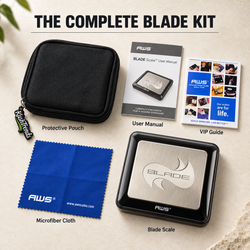
The best precision scale for fishing tackle should provide enough measurement detail for small hooks and terminal tackle while maintaining enough capacity for sinkers, jig heads, lures and tackle batches.
Fishing tackle spans a surprisingly wide weight range. An angler or lure maker may need to weigh everything from a tiny hook to a heavy swimbait or several hundred grams of sinkers.
That means the scale with the most decimal places is not automatically the best option.
For many general fishing-tackle applications, 500g × 0.01g provides an excellent balance of capacity and fine readability. Extremely lightweight tackle components may benefit from 0.001g readability, while large batches may require more than 500g of capacity.
The features that matter most are:
-
Readability
-
Capacity
-
Repeatability
-
Calibration
-
Tare
-
Platform size
-
Minimum usable load
-
Weighing units
-
Trays
-
Stable operation
The right scale ultimately depends on the lightest component you need to measure and the heaviest complete load you need to support.
Quick Guide to Fishing Tackle Scale Specifications
| Tackle Type | Capacity to Consider | Readability to Consider |
|---|---|---|
| Tiny hooks | 20–100g | 0.001–0.01g |
| Swivels and snaps | 50–200g | 0.01g |
| Split shot | 50–200g | 0.01g |
| Jig heads | 100–500g | 0.01g |
| Sinkers | 100–500g | 0.01g |
| Crankbaits | 100–500g | 0.01g |
| Spinnerbaits | 100–500g | 0.01g |
| Swimbaits | 200–500g+ | 0.01g |
| Tackle batches | 500g+ | 0.01–0.1g |
| Bulk sinkers | 1–5kg | 0.1–1g |
These are starting points rather than universal requirements.
Readability: How Much Precision Do You Actually Need?
Readability describes the smallest increment displayed by a scale.
A scale with 0.01g readability displays hundredths of a gram:
7.34g
14.28g
28.47g
A scale with 0.001g readability displays thousandths of a gram:
0.125g
0.126g
0.127g
Because 0.001g equals one milligram, these are commonly called milligram scales.
For most fishing tackle, 0.01g is already extremely detailed.
A jig head weighing 7.36g or a lure weighing 18.42g can be documented very precisely without needing another decimal place.
When 0.001g Makes Sense
Milligram readability may be useful for extremely lightweight:
-
Hooks
-
Split rings
-
Tiny beads
-
Fly-tying components
-
Micro-jig components
-
Small lure-building hardware
If a component weighs only 0.05g, a difference of 0.01g represents a substantial percentage of its total mass.
For complete crankbaits, spinnerbaits, sinkers and larger lures, however, 0.001g is generally unnecessary.
Readability Is Not the Same as Accuracy
A scale displaying 0.001g does not automatically guarantee accuracy to ±0.001g.
Readability only describes the smallest displayed increment.
Overall measurement performance can also depend on:
-
Accuracy specifications
-
Repeatability
-
Calibration
-
Minimum usable load
-
Linearity
-
Surface stability
-
Temperature
-
Airflow
-
Vibration
This is why buying a scale simply because it shows more decimal places can be misleading.
Capacity: How Much Weight Should Your Scale Handle?
Capacity is the maximum physical load the scale is designed to support.
For fishing tackle, common useful capacities include:
-
50g
-
100g
-
200g
-
500g
-
1kg
-
2kg
-
5kg
For broad tackle use, 500g provides excellent versatility.
It can accommodate many hooks, sinkers, jig heads, crankbaits, spinnerbaits, spoons, swimbaits and tackle batches without moving into a large bench-scale format.
Why 500g × 0.01g Is a Strong Combination
Consider this tackle collection:
Hook = 0.58g
Swivel = 1.24g
Jig head = 7.35g
Crankbait = 18.76g
Sinker = 56.70g
Swimbait = 112.45g
Tackle batch = 325.80g
Every item fits within a 500g capacity while 0.01g readability provides detailed measurements.
This makes 500g × 0.01g one of the most useful general-purpose configurations for fishing tackle.
Capacity Includes Your Weighing Tray
Everything physically supported by the scale counts toward capacity.
Suppose:
Sinkers = 420g
Tray = 65g
Total physical load:
485g
That load fits within a 500g scale, but only barely.
Tare Does Not Restore Capacity
If your tray weighs 65g and you press tare, the display returns to zero.
The tray is still physically applying 65g to the weighing mechanism.
On a 500g scale, approximately 435g of nominal physical capacity remains.
Tare changes the displayed reference; it does not increase the scale's maximum load.
Leave Capacity Headroom
Avoid selecting a scale that routinely operates right at its maximum.
If your normal complete load is 480–495g, a 500g scale provides very little headroom.
Moving to a higher-capacity model may be more practical.
Likewise, if your tackle batches regularly exceed 500g, choose a scale designed for kilogram-level loads rather than repeatedly splitting batches.
Platform Size Matters for Fishing Tackle
Fishing tackle presents a challenge that small jewelry components often do not:
length and irregular shape.
A jerkbait may weigh only 25g but extend several inches.
Spinnerbaits contain wire frames.
Hooks can catch on objects.
Round sinkers can roll.
Platform size and weighing trays therefore matter.
The entire lure should be supported by the scale or its tray. If part of a long lure rests on the surrounding table, the scale is not receiving the complete load.
Tare and Expansion Trays Are Important Features
A tray makes weighing awkward tackle much easier.
It can contain:
-
Hooks
-
Swivels
-
Split rings
-
Sinkers
-
Jig heads
-
Beads
-
Spinnerbaits
Place the empty tray on the platform, press tare, confirm zero and then add the tackle.
This eliminates the need to manually subtract the tray's displayed weight.
Repeatability Matters More Than Extra Digits
A precision scale should produce consistent results under similar conditions.
Suppose the same jig head is measured repeatedly:
7.35g
7.35g
7.35g
7.35g
Those are consistent displayed measurements.
If it produces:
7.28g
7.41g
7.32g
7.39g
the additional decimal places are much less useful.
A simple repeatability check is to weigh an item, remove it, allow the scale to return to zero and weigh it again several times.
Calibration Matters
Precision weighing depends on proper calibration.
Follow the procedure specified for the exact scale model and use the required calibration mass.
Do not use fishing tackle as an improvised calibration reference.
A sinker marked 1 oz is not a calibration weight. Its actual mass may differ from the nominal product designation.
Likewise, do not substitute:
-
Coins
-
Hooks
-
Jig heads
-
Lures
-
Batteries
-
Household objects
for an appropriate calibration mass.
Calibration and tare are also different functions. Calibration relates the scale's response to a known reference mass; tare subtracts a container from the displayed result.
Grams and Ounces Are Both Useful
Fishing tackle is frequently specified in ounces, particularly in the United States.
Common approximate conversions include:
| Ounces | Grams |
|---|---|
| 1/16 oz | 1.77g |
| 1/8 oz | 3.54g |
| 1/4 oz | 7.09g |
| 3/8 oz | 10.63g |
| 1/2 oz | 14.17g |
| 3/4 oz | 21.26g |
| 1 oz | 28.35g |
| 2 oz | 56.70g |
| 4 oz | 113.40g |
A scale supporting both grams and ounces makes it easier to compare measured weights with tackle specifications.
Best Precision Scale for Hooks
Hooks are among the lightest tackle components.
For most ordinary hooks, 0.01g readability provides useful detail.
For extremely small hooks or specialized lure-building work, 0.001g may be useful.
A tray is recommended because hooks can slide, roll or catch around the platform.
Best Precision Scale for Sinkers
Sinkers range from tiny split shot to heavy saltwater weights.
For individual sinkers, 500g × 0.01g provides a versatile range.
For bulk sinker inventory, capacity becomes more important than extreme readability.
If you routinely weigh several kilograms of sinkers, a higher-capacity scale with 0.1g or 1g readability may be more appropriate.
Best Precision Scale for Jig Heads
Jig heads are excellent candidates for 0.01g weighing.
Lure makers can compare:
-
Bare jig head
-
Hook and head
-
Skirted jig
-
Jig with trailer
-
Finished presentation
For example:
Bare jig = 7.08g
Skirt = 0.86g
Trailer = 3.42g
Complete lure = 11.36g
This creates a useful production or tackle-organization record.
Best Precision Scale for Crankbaits
Crankbaits generally do not require milligram readability.
A 500g × 0.01g scale offers ample capacity for most crankbaits and enough detail to compare finished lure weights.
For consistent comparisons, weigh every crankbait in the same configuration—such as fully rigged with hooks and split rings.
Best Precision Scale for Spinnerbaits
Spinnerbaits have irregular geometry.
They may include:
-
Jig head
-
Hook
-
Wire
-
Blades
-
Swivels
-
Skirt
-
Trailer
For these lures, a useful tray and tare function may matter more than an additional decimal place.
Best Precision Scale for Swimbaits
Large swimbaits can be significantly heavier than ordinary freshwater tackle.
For many, 500g capacity is sufficient.
Very large specialty or saltwater lures may require higher capacity.
Choose based on the heaviest lure you actually use rather than assuming every lure fits comfortably on a pocket scale.
Best Precision Scale for Custom Lure Making
Custom lure builders can use a precision scale to document prototypes and finished designs.
For example:
Lure body = 16.42g
Hooks = 3.75g
Split rings = 0.84g
Additional hardware = 1.31g
Finished lure = 22.32g
If a second prototype weighs 24.10g, the builder now has an objective measurement to compare alongside on-water performance.
Weight does not determine how a lure will perform, but it provides a repeatable design specification.
Nominal Lure Weight vs. Actual Weight
A lure marketed as 1/2 oz may not necessarily measure exactly 14.17g in its finished or rigged configuration.
Actual weight can be affected by:
-
Hooks
-
Split rings
-
Paint
-
Skirts
-
Trailers
-
Added hardware
-
Manufacturing variation
If actual cast weight matters, weigh the lure in the configuration in which it will be used.
A Strong AWS Option for General Fishing Tackle
For broad tackle weighing, the AWS SC501g Precision Digital Pocket Scale is a strong general-purpose option.
Its 500g × 0.01g configuration provides enough capacity for many ordinary tackle items while maintaining fine hundredth-of-a-gram readability.
Its useful features include:
-
500g capacity
-
0.01g readability
-
Approximately 3.9 × 3.7-inch platform
-
Stainless-steel weighing surface
-
Tare
-
Expansion trays
-
Backlit display
-
Multiple weighing units
-
Battery operation
This combination works particularly well for anglers and lure makers who want one compact scale for many different tackle categories.
When a Milligram Scale Is Better
A 0.001g scale becomes more relevant when your work centers on:
extremely lightweight individual components.
Examples include tiny hooks, fly-tying hardware, micro-jig parts and small split rings.
The tradeoff is usually lower capacity and greater sensitivity to environmental conditions.
Do not buy a milligram scale for ordinary lures simply because it has another decimal place.
When a Higher-Capacity Scale Is Better
Move beyond 500g when weighing:
-
Bulk sinkers
-
Large tackle batches
-
Multiple heavy lures
-
Large offshore tackle
-
Heavy containers
A 2–5kg scale may be much more practical for these applications.
At kilogram-level weights, 0.1g readability may provide a better balance than 0.001g.
Environmental Stability Matters
Precision scales work best on a:
firm, level and stable surface.
Avoid weighing on:
-
Moving boats
-
Flexible tackle boxes
-
Unstable tables
-
Uneven ground
Vibration and movement can affect readings.
For 0.001g measurements, direct airflow from fans or HVAC vents can also become relevant.
A portable scale can certainly travel on a fishing trip, but meaningful precision measurements are best made when the scale itself is stable.
Minimum Usable Load Matters
Do not assume a scale with 0.01g readability can meaningfully weigh every object beginning at exactly 0.01g.
Readability and minimum usable load are separate considerations.
For extremely lightweight tackle components, review the manufacturer's specifications and determine whether a milligram scale is more appropriate.
Fishing Tackle Scale Buying Checklist
Before choosing a precision scale, ask:
-
What tackle will I weigh?
-
What is my lightest component?
-
What is my heaviest lure?
-
Will I weigh tackle batches?
-
Do I need 0.01g readability?
-
Do I genuinely need 0.001g?
-
Is 500g enough capacity?
-
What does my weighing tray weigh?
-
Have I left capacity headroom?
-
Is the platform large enough for my lures?
-
Does the scale have tare?
-
Are expansion trays included?
-
Does it support grams and ounces?
-
What calibration mass is required?
-
Is calibration straightforward?
-
What repeatability can I expect?
-
Is there a specified minimum usable load?
-
Will I weigh long or irregular lures?
-
Will I build custom lures?
-
Do I need battery operation?
-
Will the scale be used on a stable surface?
-
Do I need more than 500g capacity?
Frequently Asked Questions
What is the best precision scale for fishing tackle?
For many general tackle applications, 500g × 0.01g provides an excellent balance of capacity and fine readability.
Is 0.01g good for fishing tackle?
Yes. It provides detailed measurements for hooks, jig heads, sinkers, swivels and most complete fishing lures.
Do I need a 0.001g fishing scale?
Usually not for ordinary complete tackle. Milligram readability is more useful for extremely lightweight individual components.
Is 500g enough capacity?
For most individual freshwater lures and terminal tackle, 500g provides substantial capacity. Bulk sinkers and heavy tackle batches may require more.
What scale should I use for fishing lures?
A 500g × 0.01g scale is a strong general-purpose option for most fishing lures.
What scale should I use for jig heads?
For most jig heads, 0.01g readability provides excellent detail.
What scale should I use for sinkers?
For individual sinkers, 500g × 0.01g is highly versatile. Bulk sinker batches may require kilogram-level capacity.
Does tare increase capacity?
No. Tare changes the displayed zero but does not change maximum physical capacity.
Does the tray count toward capacity?
Yes. Everything physically supported by the scale contributes to the load.
Can I calibrate a scale with a sinker?
A sinker should not be treated as a calibration standard. Use the appropriate calibration mass specified for the scale.
Should I weigh a lure with hooks attached?
If you want to measure the complete lure as actually fished, weigh it with the hardware and components you use.
Why is my lure heavier than its advertised weight?
Hooks, split rings, paint, skirts, trailers, hardware and manufacturing differences can affect the finished measurement.
Does lure weight determine casting distance?
No. Casting distance also depends on aerodynamics, rod, reel, line, wind and technique.
Does lure weight determine sink rate?
No. Sink rate also depends on volume, buoyancy, shape, material and hydrodynamics.
Is readability the same as accuracy?
No. Readability describes the smallest displayed increment. Accuracy is a separate performance characteristic.