
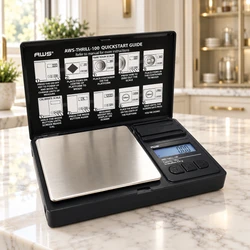
The best precision scale for soap fragrance oils combines fine readability with enough capacity for your containers, fast stabilization, dependable tare operation, a practical platform, and a calibration process appropriate for the scale.
For most soap makers, 0.1-gram readability is suitable for everyday fragrance measurement. A scale with 0.01-gram readability becomes more valuable for test batches, fragrance blending, sample bars, and formulas that use very small additive quantities. Large batches may require a separate high-capacity scale for base oils and soap batter.
A precision scale does more than display extra decimal places. It should produce stable, repeatable readings in the environment where you actually work. It must also be easy to clean, resistant to accidental overloading, compatible with your weighing containers, and simple enough to operate without disrupting the soap-making process.
This guide examines the precision-scale features that matter most when measuring soap fragrance oils.
Quick Answer: Which Features Matter Most?
When comparing precision scales for fragrance oils, prioritize these features:
-
Appropriate capacity for the container and fragrance
-
Readability of 0.1 or 0.01 gram
-
Reliable tare function
-
Stable and repeatable measurements
-
Gram measurement mode
-
Fast stabilization
-
An appropriately sized platform
-
A display that remains visible under the container
-
Calibration support
-
Overload and low-battery indicators
-
Easy-to-clean surfaces
-
Practical automatic-shutoff settings
For routine home soap making, a 1,000- to 3,000-gram scale with 0.1-gram readability is a versatile option. For tiny test batches or fragrance blending, consider a 500- to 1,000-gram scale with 0.01-gram readability.
Soap makers handling large mixing vessels may get better results from a two-scale setup: one of the larger digital kitchen scales for bulk ingredients and a smaller precision scale for fragrances and low-weight additives.
Why Precision Matters When Measuring Fragrance Oil
A small difference in fragrance weight can have a greater effect in a small test batch than in a large production batch. Measuring too little can change the intended scent profile. Measuring too much can alter the formula and may exceed a supplier’s recommended or applicable usage level.
Precision also matters when developing fragrance blends. If a blend contains several oils, a small uncontrolled variation in one component can change the final aroma.
A suitable scale supports:
-
Consistent fragrance loading
-
Repeatable test batches
-
Accurate formula scaling
-
Controlled scent comparisons
-
More useful production records
-
Reduced ingredient waste
-
Easier troubleshooting
-
More consistent finished products
The scale does not decide how much fragrance is appropriate. It only measures the amount specified by the formula. Soap makers must determine permitted or recommended usage through current supplier documentation, applicable safety standards, and the requirements relevant to the finished product.
The International Fragrance Association explains how its IFRA Standards establish fragrance-use restrictions and specifications. Always check the documentation for the exact fragrance and intended product category rather than applying a limit from another material or application.
Feature 1: The Right Readability
Readability—also called resolution or graduation—is the smallest weight increment the scale displays.
A scale with 1-gram readability displays whole grams. A 0.1-gram model displays tenths of a gram, while a 0.01-gram scale displays hundredths.
Is 1-Gram Readability Enough?
A 1-gram scale may work for large soap batches in which fragrance is measured in substantial quantities. It is also useful for:
-
Base oils
-
Water
-
Large additive quantities
-
Finished soap batter
-
Heavy containers
However, it may be too coarse for test batches or small fragrance blends.
If the target is 8.5 grams, a whole-gram scale cannot show the difference between 8.4 and 8.6 grams. That limitation can be meaningful in a small formula.
When 0.1-Gram Readability Works Best
A 0.1-gram scale is the practical choice for many soap-making environments. It gives makers enough detail for routine fragrance measurements without the increased environmental sensitivity often associated with higher-resolution scales.
It is commonly suitable for:
-
Regular home batches
-
Small commercial batches
-
Moderate fragrance quantities
-
Essential-oil blends
-
Colorants and additives
-
Recipe testing
-
Formula adjustments
For example, it can display a change from 24.7 to 24.8 grams as fragrance is added.
When You Need 0.01-Gram Readability
Choose 0.01-gram readability when your work involves:
-
Tiny test batches
-
Sample-sized soap formulas
-
Multi-component fragrance blends
-
Concentrated additives
-
Formula research
-
Detailed scent comparisons
-
Quantities below several grams
A scale displaying hundredths of a gram gives you greater control over small additions, but it also requires a more stable workspace.
You can compare compact options in the AWS collection of precision pocket scales.
Is 0.001-Gram Readability Better?
Not automatically. A 0.001-gram scale is generally more sensitive to drafts, vibration, static, temperature fluctuations, and surface movement. It may also have a lower maximum capacity and a smaller platform.
For ordinary fragrance-oil measurement, thousandths of a gram usually provide more resolution than the process requires. Specialized research and extremely small formulations may justify that level, but most soap makers will find 0.01 or 0.1 gram more practical.
AWS milligram scales are worth considering when the formula truly requires milligram-level measurements and the working environment can support them.
Feature 2: Sufficient Capacity
Capacity is the maximum total load the scale is designed to support. That total includes:
-
The weighing container
-
The fragrance oil
-
Any weighing tray or permitted accessory
-
Additional ingredients placed on the platform
A common mistake is to consider only the fragrance weight.
If a scale has a capacity of 500 grams and the empty container weighs 180 grams, approximately 320 grams of capacity remain. Pressing tare changes the displayed number, but it does not remove the container’s physical load from the scale.
How to Calculate Required Capacity
Use this formula:
Required capacity = heaviest container + maximum ingredient amount + safety margin
For example:
-
Empty glass beaker: 175 g
-
Maximum fragrance amount: 100 g
-
Combined load: 275 g
A 300-gram scale would leave very little margin. A 500-gram model would be more practical.
For a larger container:
-
Empty stainless steel pitcher: 650 g
-
Maximum fragrance amount: 400 g
-
Combined load: 1,050 g
A scale with only 1,000 grams of capacity would be insufficient, even after taring.
Avoid Choosing Excess Capacity Without a Reason
Higher capacity may come with coarser readability. A shipping scale capable of weighing heavy boxes may not show the small changes required for fragrance formulation.
Choose enough capacity for the intended vessel and ingredients, but prioritize a scale designed for precision work.
Feature 3: Reliable Tare Function
Tare is essential for fragrance-oil measurement because it subtracts the displayed weight of the empty container.
The basic process is straightforward:
-
Place the empty container on the scale.
-
Wait for a stable reading.
-
Press tare.
-
Confirm that the display returns to zero.
-
Add the fragrance oil gradually.
A responsive tare button should reset the display quickly and consistently.
Why Tare Reliability Matters
An inconsistent tare function can lead to:
-
Incorrect ingredient weights
-
Repeated restarting
-
Formula errors
-
Wasted fragrance
-
Difficulty documenting the actual addition
Test the tare function before beginning a production batch. The scale should return to zero without drifting substantially.
Tare Does Not Increase Maximum Capacity
Even when the display shows zero, the sensor remains loaded by the container. Never continue adding ingredients when the physical combined load may exceed the scale’s rating.
Feature 4: Fast Stabilization
Stabilization time is the period required for the scale to settle on a final reading after weight is added.
A fast, stable scale makes it easier to approach a target without waiting after every drop or pour. However, an instant-looking result is not useful if it fluctuates or locks onto an incorrect value.
The best precision scale balances responsiveness with stability.
Why Stabilization Matters for Fragrance Oils
Fragrance oil can continue flowing from a dropper, pipette, or pouring spout after you begin watching the display. A slow response may cause you to add more than intended before the scale registers the full change.
As you approach the target:
-
Reduce the pouring speed.
-
Use a pipette or controlled transfer tool.
-
Pause between additions.
-
Wait for the stable reading.
-
Record the final actual weight.
Avoid using an oversized dropper that releases more fragrance per drop than your scale’s resolution can meaningfully control.
Feature 5: Repeatability
Repeatability is the ability to produce similar readings when the same item is weighed repeatedly under the same conditions.
A scale that reads 20.01, 20.02, and 20.01 grams during repeated measurements is more useful than one that reads 19.72, 20.48, and 19.91 grams, assuming the weighing method and environment remain consistent.
Repeatability matters because soap making depends on reproducing formulas over time.
How to Test Repeatability
-
Place the scale on a stable, level surface.
-
Turn it on and allow it to initialize.
-
Weigh a stable test object.
-
Record the result.
-
Remove the object completely.
-
Wait for the scale to return to zero.
-
Repeat the process several times.
The readings should remain reasonably close within the model’s expected performance.
This is not formal calibration, but it can reveal problems with setup, batteries, handling, or the scale itself.
Feature 6: Appropriate Accuracy
Accuracy describes how closely a measurement agrees with a trusted reference. It is not identical to readability.
A scale may display 10.00 grams but still be offset from the reference value. Additional decimal places do not prove greater accuracy.
When reviewing product specifications, distinguish among:
-
Capacity
-
Readability
-
Accuracy
-
Repeatability
-
Linearity
-
Calibration method
Not every consumer scale lists each characteristic separately. Choose a scale from a manufacturer that provides clear capacity, readability, operating, and calibration information.
The National Institute of Standards and Technology’s Office of Weights and Measures provides broader information about accurate measurements and weighing practices.
Feature 7: Gram Measurement Mode
A precision fragrance scale should display grams. Grams are practical for soap formulation because they work well for both small and large quantities.
Examples include:
-
0.75 g
-
8.4 g
-
42.6 g
-
1,250 g
Using grams simplifies percentage calculations and minimizes the need for complex decimal-ounce conversions.
Some scales offer multiple units, such as:
-
Grams
-
Ounces
-
Troy ounces
-
Pennyweight
-
Carats
-
Grains
Additional units may be useful for other applications, but soap makers should verify the selected mode before every measurement. Accidentally weighing in ounces when the formula requires grams can create a major formulation error.
Feature 8: A Suitable Weighing Platform
The platform must comfortably support your chosen container without instability or interference.
Platform Size
A very small platform may work for a fragrance cup but not for a large beaker or pitcher. If the container hangs far beyond the edges, it may become unstable or block the display.
Platform Material
Smooth stainless steel or another nonporous surface can be easier to wipe than a heavily textured surface. However, a metal platform does not necessarily make the entire scale resistant to liquids.
Buttons, seams, displays, battery compartments, and internal electronics may remain vulnerable.
Platform Placement
The container should sit centrally without touching:
-
The countertop
-
A nearby wall
-
The display housing
-
Another container
-
The scale cover
-
Your hand
Any external contact can support part of the load and produce an inaccurate result.
Feature 9: A Visible Display
A wide fragrance container can block a display located too close to the platform. This forces the user to lean, lift the container, or reposition it while weighing.
Look for:
-
Large digits
-
Strong contrast
-
Backlighting
-
A display positioned away from the platform
-
A viewing angle appropriate for countertop use
-
A stable-weight indicator when available
The screen should remain readable throughout the addition process.
If the display becomes hidden, measure fragrance in a smaller container and transfer it to the production vessel rather than using an unstable workaround.
Feature 10: Calibration Support
Calibration checks whether a scale’s indication corresponds appropriately to a known reference. Some models also allow user adjustment through a defined calibration procedure.
Look for a scale that provides:
-
Clear calibration instructions
-
The required calibration mass
-
Accessible calibration mode
-
Confirmation when calibration is complete
-
Error messages when the procedure fails
Never assume that every scale uses the same weight or calibration sequence. Follow the instructions for the exact model.
AWS offers individual and packaged calibration weights for digital scales that can be matched to compatible models and procedures.
When to Check Calibration
Check the scale:
-
When it is new
-
Before critical formulation work
-
After relocation
-
After an impact or drop
-
After an accidental overload
-
After replacing batteries
-
When repeatability changes
-
At intervals required by your quality process
Calibration cannot repair mechanical damage, contamination, or an overloaded sensor. Contact the manufacturer if the scale continues to behave abnormally after following approved instructions.
Feature 11: Draft Protection
Air movement can affect high-resolution measurements. This is especially relevant to 0.01- and 0.001-gram scales.
Potential sources include:
-
Air-conditioning vents
-
Fans
-
Open windows
-
Rapid hand movement
-
People walking past the scale
-
Heating systems
Some precision scales include a draft shield or protective cover. This can help isolate small loads from air movement.
A draft shield is less important for a 0.1-gram scale weighing a substantial fragrance quantity, but it becomes more valuable as the required resolution increases.
Feature 12: Stable Feet and Level Placement
Precision scales work best on a hard, level, stable surface.
Avoid placing the scale on:
-
Flexible folding tables
-
Cushioned mats
-
Uneven tile
-
Moving carts
-
Appliances
-
Surfaces shared with operating mixers
-
Counters that shake when touched
Nonslip feet can help keep the scale in position, but they cannot correct an unsuitable work surface.
Some higher-end balances include adjustable feet and a level indicator. These features are valuable when the formulation requires controlled precision.
Feature 13: Protection From Overloads
An overload indicator warns that the applied load exceeds the scale’s intended capacity. If the warning appears, remove the load immediately.
Repeated overloads can:
-
Damage the sensor
-
Reduce accuracy
-
Create unstable readings
-
Affect calibration
-
Cause permanent failure
Do not test the scale’s limit by pressing on the platform. Do not store heavy objects on it, either.
A protective cover can help prevent accidental pressure during storage. If the cover doubles as a weighing tray, tare it before use and include its physical weight when calculating capacity.
Feature 14: Low-Battery Indicator
Weak batteries can cause:
-
Dim displays
-
Inconsistent readings
-
Slow response
-
Unexpected shutdowns
-
Failure to complete calibration
A low-battery indicator gives you time to replace the power source before beginning a batch.
Keep appropriate replacement batteries available, particularly when the scale is used for production. After replacement, allow the scale to initialize and perform any checks recommended by the manufacturer.
Feature 15: Practical Automatic Shutoff
Automatic shutoff saves battery life, but an overly short timer can interrupt a slow fragrance measurement.
Consider how you work. If you pause to review calculations, prepare a pipette, or record a previous ingredient, the scale should not turn off and erase the tare setting before you resume.
Useful options include:
-
A reasonably long shutoff delay
-
Adjustable auto-off timing
-
The ability to disable auto-off when appropriate
-
An AC adapter for compatible bench models
Review the manual before buying. Product listings do not always explain how the power-saving function behaves during an active measurement.
Feature 16: Easy Cleaning
Fragrance oils can leave persistent residues and strong aromas. A scale used around them should be easy to clean without allowing liquid into the electronics.
Helpful design elements include:
-
Smooth platform
-
Removable tray
-
Minimal seams around the weighing area
-
Protective platform cover
-
Buttons positioned away from likely spills
-
A surface compatible with the manufacturer’s approved cleaning method
Never submerge the scale or spray cleaning liquid directly onto it unless the manufacturer specifically permits that procedure.
Apply the approved cleaner to a cloth, wipe carefully, and prevent liquid from entering the housing. Review the AWS recommendations for digital scale maintenance alongside the instructions for your model.
Feature 17: A Protective Cover or Weighing Tray
Many precision scales include a cover that protects the platform and load cell during storage. Some covers can also serve as weighing trays.
This feature is useful for soap makers because it can:
-
Protect the platform from dust
-
Reduce accidental pressure during storage
-
Contain minor drips
-
Hold small fragrance containers
-
Make the scale easier to transport
If the cover is used as a tray, make sure it is stable, does not touch the countertop, and is tared before ingredients are added.
Feature 18: Spill-Conscious Construction
Very few compact precision scales are completely waterproof. Descriptions such as “stainless steel platform” or “easy to clean” do not necessarily mean liquid can safely enter the buttons, display, seams, or battery compartment.
To reduce spill risk:
-
Use a vessel with adequate headspace.
-
Place the scale away from the main mixing area.
-
Transfer fragrance slowly.
-
Use a pipette near the target.
-
Keep absorbent materials available.
-
Clean drips promptly.
-
Close fragrance bottles immediately.
-
Never pour directly over exposed buttons.
If fragrance enters the housing, discontinue use and follow the manufacturer’s instructions.
Feature 19: Sensible Unit Conversion
A multi-unit scale can be useful, but accidental unit changes are a common source of errors.
Before every measurement:
-
Look at the unit symbol.
-
Compare it with the written formula.
-
Confirm that the displayed decimal places make sense.
-
Record the unit next to the number.
Do not rely on memory or assume the scale powers on in the same unit every time.
For consistent batch records, choose one primary unit—usually grams—and convert the entire formula before production rather than converting individual ingredients during the batch.
Feature 20: Manufacturer Instructions and Support
A precision scale is more useful when the manufacturer provides:
-
Complete specifications
-
Operating instructions
-
Calibration directions
-
Battery information
-
Error-code explanations
-
Cleaning recommendations
-
Warranty information
-
Customer support
Clear documentation reduces guesswork and helps protect the instrument from misuse.
If you have questions about an AWS model, compatibility, capacity, or calibration procedure, consult AWS customer support before using the scale for critical formulation work.
Best Scale Setup for Different Soap Makers
Beginner Soap Maker
Start with:
-
Capacity of 2,000–5,000 g
-
Readability of 0.1–1 g
-
Gram mode
-
Tare
-
A clear display
-
A stable platform
Add a 0.01-gram precision scale if your test batches require measurements below the useful range of the first scale.
Fragrance-Blend Developer
Choose:
-
Capacity of 500–1,000 g
-
Readability of 0.01 g
-
Fast stabilization
-
Draft protection
-
Calibration support
-
A small, easy-to-clean tray
-
Strong repeatability
Home-Based Soap Business
Use two scales:
-
A higher-capacity scale for bulk oils, water, and batter
-
A 0.01- or 0.1-gram precision scale for fragrance oils and additives
Document routine performance checks and protect both scales from spills.
Growing Artisan Producer
Choose a higher-capacity bench scale for production vessels and a separate precision instrument for formula development. Consider whether the working environment needs:
-
AC power
-
Adjustable auto-off
-
A larger platform
-
More formal calibration checks
-
Written maintenance records
-
Dedicated fragrance-measurement stations
Sample-Batch Maker
Prioritize 0.01-gram readability, quick stabilization, draft protection, and a low minimum working range. A large-capacity scale is less important unless the test container is unusually heavy.
Using a Precision Scale Correctly
Even a feature-rich scale can produce poor measurements if used incorrectly.
Prepare the Scale
Place it on a hard, level surface away from mixers, vents, fans, and foot traffic.
Allow It to Stabilize
If the scale or fragrance was stored in a different temperature, allow time for it to reach room conditions.
Confirm the Unit
Verify grams before placing the container on the platform.
Tare the Container
Place the container centrally, wait for stability, and press tare.
Add Fragrance Gradually
Pour slowly. As you approach the target, switch to a pipette or smaller transfer tool.
Wait for a Stable Reading
Do not record a rapidly changing number.
Record the Actual Weight
If the target is 12.50 grams and the actual addition is 12.53 grams, document the actual value. Whether that deviation is acceptable depends on the formula and quality criteria.
Remove the Container Carefully
Avoid pushing, twisting, or dragging it across the platform.
Clean Promptly
Close fragrance bottles and remove residue using the approved cleaning procedure.
Fragrance Safety and Documentation
Precision measurement supports responsible formulation but does not replace product-safety information.
Before using a fragrance oil:
-
Verify its identity.
-
Review the current supplier documentation.
-
Confirm the appropriate product category.
-
Check the applicable maximum or recommended use level.
-
Review the Safety Data Sheet.
-
Wear appropriate protective equipment.
-
Maintain ventilation.
-
Label temporary containers.
-
Record supplier and lot information when applicable.
-
Prevent access by children and pets.
The Occupational Safety and Health Administration explains the standardized information found in Safety Data Sheets, including handling, storage, exposure controls, first aid, and accidental-release information.
Do not calculate a fragrance percentage from the final bar weight unless that is the basis specified by the formula and applicable guidance. Different suppliers or standards may express usage relative to different components or finished-product categories.
Regulatory Context for Soap Makers
The regulatory treatment of a product can depend on its composition, intended use, presentation, and claims. A product sold solely as soap for cleansing may be treated differently from one marketed with cosmetic or therapeutic benefits.
The U.S. Food and Drug Administration addresses these distinctions in its frequently asked questions about soap.
Fragrance labeling is another consideration. The FDA’s overview of fragrances in cosmetics provides useful background for businesses selling scented personal-care products in the United States.
A precision scale can strengthen formulation control and recordkeeping, but it cannot determine whether a formula, label, claim, or fragrance level complies with applicable requirements.
Common Buying Mistakes
Choosing Resolution Without Checking Capacity
A 0.01-gram scale is unusable if the container exceeds its capacity.
Assuming More Decimal Places Mean More Accuracy
Resolution is only one performance characteristic. Repeatability, calibration, environment, and build quality also matter.
Ignoring the Container
The container may use a significant percentage of the scale’s capacity.
Buying a Platform That Is Too Small
Oversized containers can block the display, create instability, or touch surrounding surfaces.
Selecting a Very Short Auto-Off Timer
The scale may turn off while you review the formula or prepare the next addition.
Treating Stainless Steel as Waterproof
A metal platform does not protect every seam and electronic component from fragrance spills.
Forgetting Calibration Requirements
Some scales require a specific calibration weight that may be sold separately.
Using a Shipping Scale for Tiny Additions
High capacity does not guarantee the fine readability needed for small fragrance quantities.
Using a Milligram Scale for a Large Soap Pot
Fine-resolution scales typically have limited capacity and small platforms.
Ignoring Environmental Sensitivity
A high-resolution model may perform poorly near a fan, mixer, flexible table, or vibrating appliance.
Precision Scale Buying Checklist
Before purchasing, confirm the following:
| Question | Why It Matters |
|---|---|
| What is the smallest amount I measure? | Determines required readability |
| What is my heaviest container? | Affects required capacity |
| What is the maximum combined load? | Prevents overload |
| Does the scale measure in grams? | Supports consistent formulas |
| Is tare included? | Removes container weight from the displayed result |
| Is the platform large enough? | Improves stability and visibility |
| Does the display remain visible? | Helps prevent overshooting |
| How quickly does it stabilize? | Affects pouring control |
| Is calibration supported? | Helps verify performance |
| What calibration weight is required? | Determines accessory needs |
| Is auto-off adjustable? | Prevents interruption |
| Is the surface easy to clean? | Reduces residue and cross-contamination |
| Does it have overload protection? | Helps protect the sensor |
| Is there a low-battery indicator? | Reduces unexpected power issues |
| Is support available? | Helps with troubleshooting and maintenance |
Frequently Asked Questions
What is the best precision scale for soap fragrance oils?
For most makers, a digital scale with 0.1-gram readability, sufficient capacity, gram mode, tare, and calibration support is the most versatile choice. Use 0.01-gram readability for very small batches and fragrance blending.
Is 0.01 gram better than 0.1 gram for fragrance oil?
It is better when the smallest quantity requires hundredth-gram control. For ordinary soap batches, 0.1 gram may be more stable, affordable, and practical.
How much scale capacity do I need?
Add the weight of your heaviest container to the maximum fragrance quantity, then choose a scale with additional capacity for a reasonable margin.
Does pressing tare remove the container from capacity?
No. It removes the container from the displayed value, but the sensor still supports its physical weight.
Can I use a kitchen scale for fragrance oil?
Yes, if it has suitable readability and capacity. A kitchen scale may be ideal for larger fragrance quantities, while a pocket precision scale is better for smaller additions.
Do I need a separate scale for fragrance oils?
A dedicated precision scale is useful when your primary soap scale does not have enough resolution. It may also help reduce residue and cross-contamination.
How can I prevent overshooting the target weight?
Pour slowly and switch to a pipette or controlled dropper near the target. Pause between additions and wait for the reading to stabilize.
Why does a 0.01-gram scale fluctuate?
Drafts, vibration, static, temperature changes, surface instability, weak batteries, or movement near the platform can affect the measurement.
How often should I calibrate the scale?
Follow the model’s instructions and your quality procedures. Check it after relocation, impact, overload, battery replacement, or unexplained changes in performance.
Can I clean fragrance oil from a digital scale?
Follow the manufacturer’s cleaning instructions. Do not submerge the scale or apply liquid directly to openings unless the model is specifically designed for it.
Is a removable tray useful?
Yes. It can contain small drips and protect the platform, provided it is stable, properly tared, and does not contact surrounding surfaces.
Does an accurate scale determine a safe fragrance amount?
No. Determine the permitted or recommended usage through current supplier documentation, applicable standards, and relevant product requirements.
Final Thoughts
The best precision scale for soap fragrance oils is not simply the model with the most decimal places. It is the scale whose capacity, readability, platform, stabilization time, tare function, and calibration process fit your actual formulation workflow.
For most soap makers, 0.1-gram readability is the practical standard for routine fragrance measurement. Choose 0.01 gram when creating small samples, testing blends, or weighing ingredients used in very small amounts. Use a separate higher-capacity scale when measuring heavy vessels, base oils, water, or complete soap batches.
The most important features are:
-
Appropriate capacity
-
Useful readability
-
Stable, repeatable measurements
-
Fast stabilization
-
Reliable tare
-
Gram mode
-
Proper platform size
-
Visible display
-
Calibration support
-
Overload and low-battery warnings
-
Practical auto-off behavior
-
Easy cleaning and spill-conscious construction
A well-chosen precision scale improves repeatability, documentation, and control. Combined with current supplier guidance, proper safety practices, and disciplined batch records, it becomes one of the most valuable tools in a soap maker’s formulation process.