
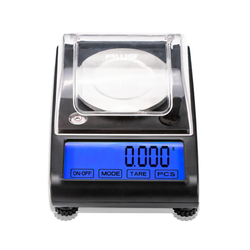
Buying a scale for collectibles is not simply a matter of finding the model with the most decimal places.
The right scale must balance three core specifications:
accuracy, capacity and calibration.
A coin collector comparing individual pieces may benefit from:
0.01g readability
while someone documenting:
-
Figurines
-
Die-cast models
-
Boxed collectibles
-
Heavy memorabilia
may gain far more from:
2–5kg capacity with 0.1g readability.
For many mixed collections of smaller objects, one of the most practical configurations is:
500g × 0.01g.
It combines useful hundredth-of-a-gram readability with enough capacity for many:
-
Coins
-
Tokens
-
Watches
-
Medals
-
Pins
-
Badges
-
Jewelry pieces
-
Card slabs
-
Miniatures
But the scale specification printed on the box is only the beginning.
A good buying decision should also consider:
-
Repeatability
-
Minimum usable load
-
Tare
-
Platform size
-
Stable zero
-
Calibration procedure
-
Calibration reference
-
Weighing units
-
Environmental sensitivity
-
Portability
-
Power source
This guide explains how to compare those features without paying for precision or capacity that your collection does not need.
Quick Answer: What Scale Should Collectors Buy?
| Collectible Type | Practical Capacity | Useful Readability |
|---|---|---|
| Individual coins | 100–250g | 0.01g |
| Coin capsules | 100–250g | 0.01g |
| Coin groups | 250–500g+ | 0.01g |
| Tokens | 100–500g | 0.01g |
| Pins and badges | 100–250g | 0.01g |
| Small medals | 250–500g | 0.01g |
| Watches | 250–500g+ | 0.01g–0.1g |
| Trading cards | 100–250g | 0.01g–0.1g |
| Graded card slabs | 250–500g | 0.01g–0.1g |
| Collectible jewelry | 100–500g | 0.01g |
| Miniatures | 100–500g | 0.01g |
| Very tiny collectible parts | 20–100g | 0.001g when genuinely required |
| Figurines | 1–2kg+ | 0.1g |
| Die-cast models | 1–5kg+ | 0.1g |
| Memorabilia | 1–5kg+ | 0.1g |
| Boxed collectibles | 2–5kg+ | 0.1g–1g |
For general small collectible weighing:
250–500g × 0.01g
is an excellent range.
For maximum flexibility within that category:
500g × 0.01g
is especially versatile.
The Three Specifications That Matter Most
When comparing collectible scales, start with:
1. Capacity
How much total physical load can the scale support?
2. Readability and measurement performance
How finely does the display change, and how consistently does the scale perform?
3. Calibration
Can the scale be checked and calibrated using an appropriate reference mass?
These three specifications are interconnected.
Buying excessive resolution while ignoring capacity can leave you with a scale that cannot weigh your collection.
Buying excessive capacity while ignoring readability can make small-object comparisons unnecessarily coarse.
What Does 500g × 0.01g Mean?
This common precision-scale specification describes two different characteristics.
500g
is the nominal maximum capacity.
0.01g
is the readability, or smallest displayed increment.
AWS explains this notation in greater detail in What Does 500g × 0.01g Mean on a Digital Scale?.
A display might therefore show:
84.31g
84.32g
84.33g
But this does not automatically mean every measurement is guaranteed to be accurate within exactly ±0.01g.
That distinction is fundamental when comparing precision scales.
Readability Is Not the Same as Accuracy
One of the biggest scale-buying mistakes is assuming:
more decimals = greater accuracy.
Not necessarily.
Readability describes:
the smallest increment shown by the display.
Accuracy concerns how close the measurement is to the relevant true or reference value within the scale's stated performance.
Repeatability describes:
how consistently the same object produces similar readings.
A scale could display:
26.731g
but that additional third decimal does not automatically make it a better collectible scale than a stable 0.01g model.
For technical background on mass measurement and traceability, NIST maintains its Calibration of Mass Standards program.
Why Repeatability Matters
Imagine weighing the same collectible coin three times.
Scale A
26.72g
26.72g
26.73g
Scale B
26.721g
26.894g
26.612g
Scale B displays more decimal places.
Scale A produces more consistent measurements in this example.
For collectors comparing:
-
Coins
-
Tokens
-
Watches
-
Medals
-
Components
consistent repeated measurements can be more useful than another displayed digit.
What Causes Poor Repeatability?
Unstable readings can result from:
-
Airflow
-
Vibration
-
Static
-
Uneven surfaces
-
Improper load placement
-
Weak batteries
-
Temperature changes
-
Calibration problems
-
Objects touching another surface
-
Overloading
Before assuming a scale is inaccurate, examine how it is being used.
Choosing Capacity: Start With Your Heaviest Complete Load
Capacity should be based on:
the entire physical load placed on the platform.
Not simply the collectible.
Consider:
Collectible = 385g
Protective tray = 72g
Total load:
457g
A 500g scale has sufficient nominal capacity.
Now consider:
Collectible = 465g
Tray = 72g
Total:
537g
A 500g scale cannot support the combination within its nominal capacity.
Tare Does Not Increase Maximum Capacity
Suppose:
Scale capacity = 500g
Tray = 80g
You press tare.
Display:
0.00g
The scale is still physically supporting:
80g.
You have not magically created another 500g of load capacity.
Approximately:
420g
of nominal capacity remains before the original 500g physical limit is reached.
This matters considerably when weighing:
-
Coin lots
-
Large medals
-
Watches
-
Collections inside containers
How Much Capacity Headroom Should You Buy?
Avoid selecting a scale that your normal objects routinely push close to maximum capacity.
Suppose:
Heaviest collectible = 470g
Planned scale = 500g
That leaves just:
30g
for holders or trays.
A higher-capacity model may provide better flexibility.
A practical buying approach is to determine:
your heaviest realistic total physical load
and select enough capacity to handle it comfortably.
100g Capacity: Who Is It For?
A 100g precision scale can work well for:
-
Individual coins
-
Small tokens
-
Rings
-
Pins
-
Tiny jewelry pieces
-
Lightweight components
Advantages include:
-
Very compact format
-
Easy portability
-
Potential availability with fine readability
Its primary limitation is obvious:
100g does not provide much headroom.
Many watches and medals can exceed it.
200g Capacity: A Better Small-Object Range
A 200g scale can handle many:
-
Coins
-
Capsules
-
Tokens
-
Pins
-
Trading cards
-
Small jewelry pieces
-
Lightweight watches
For collectors who rarely handle objects above approximately 150g:
200g × 0.01g
can be perfectly adequate.
But adding:
-
Tray
-
Holder
-
Heavy watch
-
Medal
can push the total above capacity quickly.
500g Capacity: The Collectible Sweet Spot
For mixed small collectibles:
500g
offers significantly greater flexibility.
It can cover many:
-
Coins
-
Coin groups
-
Watches
-
Medals
-
Tokens
-
Jewelry pieces
-
Card slabs
-
Pins
-
Miniatures
without giving up the 0.01g readability available on many precision pocket scales.
For collectors deciding between lower-capacity options, AWS also discusses the practical tradeoff in its 200g vs. 500g Pocket Scale guide.
When 500g Is Not Enough
A pocket-style precision scale stops being practical once your collection includes objects such as:
-
Heavy figurines
-
Large die-cast models
-
Statues
-
Large memorabilia
-
Boxed collectibles
Example:
Figurine = 760g
Base = 280g
Total:
1,040g
A 500g scale cannot weigh the finished piece.
A:
2kg or higher-capacity scale
is required.
Is 0.1g Accurate Enough for Collectibles?
For many larger collectibles:
yes.
A 0.1g scale displays:
845.1g
845.2g
845.3g
This can be more than sufficient for:
-
Figurines
-
Large medals
-
Die-cast models
-
Heavy memorabilia
-
Boxed objects
If your collectible weighs:
1,625g
knowing the difference between:
1,625.01g
and:
1,625.02g
usually provides little practical value.
Higher capacity is likely more important.
Why 0.01g Is Useful for Collectors
A 0.01g scale displays:
31.10g
31.11g
31.12g
This makes it well suited to many:
-
Coins
-
Tokens
-
Watches
-
Jewelry pieces
-
Medals
-
Small components
-
Miniatures
For individual coin applications, AWS's Best Digital Scale for Coins guide explains why hundredth-of-a-gram readability provides a practical balance for many collectors.
For a general mixed collection:
0.01g is usually the best place to start.
When Should You Consider 0.001g?
A 0.001g scale displays:
2.351g
2.352g
2.353g
That is:
milligram-level readability.
It can be appropriate for:
-
Tiny gemstones
-
Small precious-metal fragments
-
Very lightweight collectible components
-
Specialized research
But milligram readability introduces greater sensitivity to the weighing environment.
It may also come with:
-
Lower capacity
-
Smaller platform
-
Higher cost
-
Greater environmental sensitivity
AWS compares these tradeoffs in 0.001g vs. 0.01g Scales: Which Precision Do You Need?.
Do Not Buy 0.001g Just Because It Looks Better
Compare:
Scale A
500g × 0.01g
Scale B
50g × 0.001g
Suppose your medal weighs:
175g.
Scale B cannot weigh it.
The extra decimal place is useless.
This is why the buying sequence should be:
capacity first → useful readability second → overall performance third.
Minimum Usable Load Matters
A precision scale's maximum capacity is not the only relevant limit.
Extremely light objects can also require attention to the lower end of the scale's practical performance.
Do not assume:
0.001g readability means every 0.001g object can necessarily be measured meaningfully.
For very small collectibles, review:
-
Minimum-load specifications
-
Accuracy information
-
Repeatability
-
Manufacturer guidance
Why Calibration Matters for Collectible Scales
Calibration helps establish or adjust the relationship between:
the scale reading
and:
a known reference mass.
For regular precision measurement, a clear calibration process is valuable.
Before buying, ask:
-
Can the scale be calibrated?
-
What reference mass is required?
-
Is the calibration weight included?
-
Are instructions available?
-
Is calibration straightforward?
Calibration Is Model-Specific
Do not assume a scale's calibration mass simply from capacity.
A:
500g scale
does not universally require a 500g calibration weight.
A:
200g scale
does not universally require a 200g calibration weight.
The correct process depends on the model.
AWS explains the general workflow in How to Calibrate a Digital Scale for Accurate Results.
Always follow the instructions for the exact scale you own.
What Should You Use for Calibration?
Use the appropriate specified calibration reference.
Do not substitute:
-
Coin
-
Medal
-
Watch
-
Jewelry
-
Household object
-
Packaged product
simply because you think you know its weight.
NIST also maintains technical calibration procedures for weights and measures laboratories, illustrating why controlled reference standards and documented procedures matter in precision mass measurement.
Why a Coin Is Not an Ideal Calibration Weight
Collectors sometimes assume a coin can function as an exact reference because its nominal specifications are published.
But an individual circulated coin can be affected by:
-
Wear
-
Corrosion
-
Dirt
-
Damage
-
Residue
-
Material loss
That makes it a poor substitute for an appropriate calibration reference.
Use coins as:
objects being measured
rather than default calibration standards.
Calibration vs. Verification
These concepts are related but different.
Calibration
Establishes or adjusts the scale's relationship to a known reference according to the instrument's procedure.
Verification
Checks whether the scale produces an acceptable reading when an appropriate known mass is placed on it.
A collector may verify scale behavior periodically without necessarily performing a full recalibration every time.
Stable Zero Matters
Before weighing a collectible, the unloaded scale should settle appropriately.
If an empty scale repeatedly moves among values such as:
0.00g
0.06g
-0.03g
0.11g
investigate before trusting hundredth- or thousandth-of-a-gram comparisons.
Potential causes include:
-
Drafts
-
Vibration
-
Static
-
Weak batteries
-
Uneven placement
-
Calibration issues
Platform Size Is a Buying Specification Too
Many scale comparisons focus entirely on:
-
Capacity
-
Readability
but ignore:
platform dimensions.
A collectible can weigh less than capacity and still be unsuitable for the scale.
Example:
Object = 380g
Scale capacity = 500g
But the collectible is physically large enough to:
-
Touch the desk
-
Lean against a wall
-
Receive support from another object
That can interfere with the measurement.
Can a Collectible Hang Over the Platform?
Some overhang may be workable if:
-
The object remains stable.
-
Its entire load is transferred to the scale.
-
Nothing touches another surface.
The issue is not simply visual overhang.
The issue is:
external support.
If part of the collectible rests on the surrounding table, the scale is no longer receiving the full load.
Why Tare Is Worth Having
Tare is one of the most useful scale features for collectors.
It lets you use a:
-
Tray
-
Container
-
Dish
-
Protective holder
and reset the display to zero before adding the collectible.
Example:
Tray = 52.34g
Press tare.
Display:
0.00g
Add medal.
Display:
184.27g
The scale now shows the medal's net displayed weight.
Platform Material and Delicate Collectibles
Many pocket precision scales use stainless-steel platforms.
This can be convenient because stainless steel is:
-
Durable
-
Easy to clean
-
Suitable for general weighing
However, some collectibles may scratch easily.
For delicate:
-
Watches
-
Coins
-
Jewelry
-
Polished objects
consider an appropriate:
-
Tray
-
Protective surface
-
Weighing container
instead of placing the collectible directly on the platform.
Best Scale for Collectible Coins
Coins are among the most common reasons collectors buy precision scales.
For individual coins:
100–250g × 0.01g
is often sufficient.
For:
-
Coin groups
-
Capsules
-
Larger tokens
-
Medals
500g × 0.01g
provides more versatility.
AWS's dedicated Coin Scale Buying Guide goes deeper into numismatic scale selection.
Can Weight Authenticate a Coin?
No.
Weight is one useful physical characteristic.
It can be compared with:
-
Published specifications
-
Known references
-
Diameter
-
Thickness
-
Other physical characteristics
But professional coin grading and authentication involve much more than mass.
PCGS describes professional coin grading in terms of evaluating a coin's condition under recognized grading standards. See PCGS's explanation of coin grading.
Why Correct Weight Does Not Prove a Coin Is Genuine
A counterfeit could potentially be manufactured close to the expected mass.
Likewise, an authentic circulated coin could differ somewhat from nominal weight because of:
-
Wear
-
Corrosion
-
Damage
-
Residue
-
Contamination
Weight should therefore be treated as:
supporting evidence rather than a final verdict.
Weight Is Not Coin Grade
Coin grade describes condition.
It does not simply describe how much a coin weighs.
NGC uses an established numerical grading system for problem-free coins and assesses condition as part of professional grading. See the NGC Coin Grading Scale.
A scale cannot tell you whether a coin is:
-
AU
-
MS60
-
MS65
-
MS70
or another grade.
Best Scale for Trading Cards
Trading cards weigh very little.
A scale may be useful for:
-
Documentation
-
Comparing cards
-
Comparing sleeves
-
Comparing top loaders
-
Recording slab weight
For ordinary collecting:
0.01g or 0.1g
is usually sufficient.
There is little reason to sacrifice practical capacity solely to obtain 0.001g readability.
Can Weight Authenticate or Grade a Trading Card?
No.
A digital scale cannot determine:
-
Authenticity
-
Centering
-
Corners
-
Edges
-
Surface condition
-
Alterations
-
Overall grade
Professional card grading uses specialized inspection and authentication procedures. PSA explains its authentication and grading process through its card authentication and grading services.
Weight can support:
documentation or comparison.
It cannot replace professional grading.
Best Scale for Watches
For many collectible watches:
250–500g capacity
provides useful headroom.
A:
500g × 0.01g
scale can be particularly useful because it accommodates many watches plus an appropriate lightweight tray.
Example:
Watch = 174.52g
Tray = 56.30g
Physical load:
230.82g
A 500g scale handles this comfortably.
Weight Cannot Authenticate a Watch
Watch authentication can involve:
-
Movement
-
Case
-
Dial
-
Serial numbers
-
Materials
-
Construction
-
Finishing
-
Provenance
-
Documentation
Two watches could have similar total mass and still differ substantially in authenticity or construction.
Treat weight as one documented physical property.
Best Scale for Medals
Medals vary widely in size and material.
For smaller medals:
250–500g × 0.01g
works well.
For larger pieces:
1kg+ × 0.1g
may be more appropriate.
A collector handling both coins and medals may find:
500g capacity
much more convenient than a 100g scale.
Best Scale for Tokens, Pins and Badges
These generally fit comfortably within pocket-scale ranges.
Typical recommendation:
100–500g × 0.01g.
A 500g model provides additional flexibility for:
-
Groups
-
Heavy badges
-
Display holders
-
Trays
Best Scale for Collectible Jewelry
Vintage jewelry can include:
-
Rings
-
Bracelets
-
Chains
-
Brooches
-
Pendants
-
Precious-metal pieces
For many applications:
0.01g readability
is highly practical.
Tiny gemstones may require a different lower-capacity scale with finer readability.
Choose based on whether you primarily weigh:
complete jewelry pieces
or:
very small gemstones and components.
Best Scale for Miniatures
Miniatures can range from:
a few grams
to several hundred grams.
For many:
500g × 0.01g
provides an excellent balance.
It can cover:
-
Metal miniatures
-
Resin miniatures
-
Bases
-
Components
-
Small assemblies
without requiring a larger bench scale.
Best Scale for Figurines
Figurines frequently fall outside pocket-scale capacity.
Example:
Figure = 920g
Base = 280g
Total:
1,200g
A 500g scale is not appropriate.
Choose:
2kg or greater capacity.
For substantially larger statues:
5kg+
may be required.
In this category:
0.1g readability is often more useful than 0.01g with inadequate capacity.
Best Scale for Die-Cast Models
Die-cast objects can be compact but surprisingly heavy.
Small models may fit on:
500g–1kg scales.
Larger:
-
Cars
-
Trains
-
Aircraft
-
Machinery models
may require:
2–5kg capacity.
Again, capacity should reflect the real object rather than the category name.
Best Scale for Memorabilia
Memorabilia may range from a:
5g pin
to:
multi-kilogram equipment.
There is no universal memorabilia scale specification.
Determine:
-
Smallest meaningful object
-
Heaviest object
-
Whether the item requires a tray
-
Whether portability matters
Then choose accordingly.
Best Scale for Boxed Collectibles
If you want to document the entire boxed item, include:
-
Collectible
-
Retail packaging
-
Inserts
-
Accessories
Example:
Collectible = 1.5kg
Box = 0.4kg
Accessories = 0.3kg
Total:
2.2kg
A:
5kg × 0.1g
scale may be considerably more practical than a pocket scale.
Weight Is Not Material Identification
A scale tells you:
mass.
It does not directly tell you:
-
Gold purity
-
Silver purity
-
Alloy composition
-
Plastic type
-
Resin formulation
Two differently composed objects can have similar mass.
Material identification may require additional methods and professional examination.
Weight Is Not Value
A collectible's market value can depend on:
-
Rarity
-
Authenticity
-
Condition
-
Grade
-
Provenance
-
Edition
-
Historical significance
-
Demand
-
Manufacturer
-
Artist
A:
4g coin
can easily be worth more than a:
4kg statue.
Do not treat weight as a valuation method.
Should Collectors Buy One Scale or Two?
If your collection falls within a narrow weight range:
one scale may be enough.
Example:
Lightest object = 5g
Heaviest object = 310g
A:
500g × 0.01g
scale can cover the collection effectively.
When Two Scales Are Better
Suppose your collection includes:
Coin = 8g
Watch = 170g
Medal = 340g
Statue = 3.1kg
Trying to use one scale for everything creates compromise.
A better setup is:
Precision Scale
500g × 0.01g
for small objects
plus:
Higher-Capacity Scale
5kg × 0.1g
for larger collectibles.
This gives you:
precision where precision matters + capacity where capacity matters.
A Practical AWS Option for Small Collectibles
For small collectible applications, the AWS SC501g Precision Digital Pocket Scale provides:
500g × 0.01g
along with features such as:
-
Stainless-steel platform
-
Backlit LCD
-
Tare
-
Multiple weighing units
-
Expansion trays
-
Battery operation
That combination can be useful for many:
-
Coins
-
Tokens
-
Watches
-
Medals
-
Jewelry pieces
-
Card slabs
-
Miniatures
provided the complete load remains within capacity.
Weighing Environment Matters More as Resolution Gets Finer
A coarse shipping scale may tolerate a relatively ordinary environment.
A precision collectible scale is more sensitive.
Pay attention to:
-
Surface stability
-
Drafts
-
Vibration
-
Static
-
Temperature
-
Load placement
The finer your readability:
the more important these factors become.
Use a Hard, Stable Surface
Place the scale on a:
-
Rigid desk
-
Solid table
-
Countertop
-
Workbench
Avoid:
-
Mattress
-
Couch
-
Carpet
-
Foam
-
Flexible shelf
A stable surface supports more consistent measurements.
Avoid Strong Airflow
Do not perform fine weighing directly below:
-
Air-conditioning vents
-
Fans
-
Open windows
At:
0.01g
and especially:
0.001g
air movement can contribute to unstable readings.
Control Vibration
Nearby equipment can transfer vibration through the surface.
Avoid sharing the weighing table with:
-
Printer
-
Speaker
-
Fan
-
Machinery
when taking fine measurements.
Watch for Static
Plastic:
-
Capsules
-
Card sleeves
-
Holders
-
Trays
can create static-related measurement challenges.
Static is not the cause of every fluctuating reading, but it is one factor to consider at fine resolution.
Batteries and Power
For collectors who travel, battery operation is useful.
This can matter at:
-
Coin shows
-
Antique markets
-
Collector conventions
-
Dealer meetings
-
Estate sales
For stationary inventory work, longer power availability may matter more.
Compare:
-
Battery type
-
Auto-off
-
Replacement convenience
-
Optional AC power if available
Useful Weighing Units
Collectors may encounter:
-
g — grams
-
oz — ounces
-
ozt — troy ounces
-
dwt — pennyweight
-
ct — carats
-
gn — grains
For mixed collectibles:
grams are usually the most useful universal choice.
Troy Ounces for Precious Metals
Gold and silver collectors may benefit from troy-ounce mode.
Remember:
troy ounces and ordinary ounces are different units.
Always confirm the scale mode before comparing measurements with reference specifications.
Carats for Gemstones
Gemstone collectors may value carat mode.
However, carats are generally unnecessary for:
-
Coins
-
Watches
-
Cards
-
Figurines
Choose scale features that correspond to your actual collection.
Example 1: Coin Collection
Heaviest individual coin = 34g
Capsule = 8g
Largest small group = 180g
Recommended range:
250–500g × 0.01g.
Example 2: Watch Collection
Watch = 195g
Tray = 65g
Total:
260g
A:
500g × 0.01g
scale provides comfortable headroom.
Example 3: Medal
Medal = 355g
Tray = 80g
Total:
435g
A 500g scale works.
A 400g model would not.
This demonstrates why the tray must be included in capacity planning.
Example 4: Trading Card Slab
Card + slab:
48.2g
A:
100g scale
can handle the object.
But if you collect other categories too, 500g gives far more flexibility.
Example 5: Miniature
Miniature = 96.37g
Base = 31.42g
Complete piece:
127.79g
A:
200g or 500g × 0.01g
scale can handle it.
Example 6: Figurine
Figure = 1.3kg
Base = 0.4kg
Total:
1.7kg
A 500g precision scale is unsuitable.
Choose:
2kg or higher capacity.
Example 7: Mixed Collection
Collection contains:
Coin = 12g
Watch = 170g
Medal = 430g
Figurine = 2.6kg
Best solution:
500g × 0.01g precision scale
plus:
5kg × 0.1g higher-capacity scale.
Common Collectible Scale Buying Mistakes
Buying Based Only on Decimal Places
More digits do not guarantee better overall measurement.
Confusing Readability With Accuracy
0.01g describes display increments.
Ignoring Repeatability
Stable measurements matter.
Ignoring Minimum Load
Fine resolution does not automatically define minimum useful weight.
Buying Too Little Capacity
Include holders and trays.
Operating Near Maximum Capacity
Leave practical headroom.
Assuming Tare Increases Capacity
It does not.
Ignoring Platform Size
A large object may not be supported properly.
Calibrating With a Random Coin
Use the correct reference mass.
Assuming Every Scale Uses the Same Calibration Weight
Calibration is model-specific.
Ignoring Drafts
Fine measurements are more sensitive to airflow.
Ignoring Vibration
Use a stable surface.
Ignoring Static
Plastic holders can contribute to unstable measurements.
Assuming Weight Proves Authenticity
It does not.
Using Weight to Determine Grade
Professional grading involves condition and category-specific standards.
Using Weight to Determine Metal Purity
A scale measures mass, not chemical composition.
Using Weight to Determine Value
Value depends on many characteristics beyond mass.
Trying to Use One Scale for Every Collectible
Two scales may provide a much better solution.
Collectibles Scale Buying Checklist
Before buying, ask:
-
What collectibles will I weigh?
-
Why am I weighing them?
-
What is my lightest object?
-
What is my heaviest object?
-
What is my heaviest complete load with tray or holder?
-
Do I need 100g capacity?
-
Is 200g sufficient?
-
Would 500g be more versatile?
-
Do I need 1kg?
-
Do I need 2kg?
-
Do I need 5kg or more?
-
How much capacity headroom do I have?
-
Is 0.1g readability enough?
-
Do I need 0.01g?
-
Do I genuinely need 0.001g?
-
What accuracy specification is provided?
-
What repeatability can I expect?
-
What is the minimum usable load?
-
Does the unloaded scale maintain a stable zero?
-
Can it be calibrated?
-
What calibration mass does it require?
-
Is the calibration reference included?
-
Does it have tare?
-
Does the tray count toward capacity?
-
Is the platform large enough?
-
Can my collectible avoid touching another surface?
-
Does it support grams?
-
Do I need troy ounces?
-
Do I need carats?
-
Do I need pennyweight?
-
Do I need portability?
-
Is there a protective cover?
-
Is the display easy to read?
-
What batteries does it use?
-
Can I create a stable weighing environment?
-
Can I avoid strong airflow?
-
Can I minimize vibration?
-
Could static affect very light objects?
-
Would one scale cover my entire collection?
-
Would a two-scale setup be better?
-
Am I using weight as measurement data rather than proof of authenticity, grade or value?
Frequently Asked Questions
What is the best scale for collectibles?
For many small collectibles:
500g × 0.01g
is one of the most versatile configurations.
For large figurines and memorabilia:
2–5kg × 0.1g
may be more practical.
What accuracy do I need for collectibles?
The useful requirement depends on what you are weighing.
For many:
-
Coins
-
Watches
-
Tokens
-
Medals
-
Jewelry
0.01g readability provides useful measurement detail.
Do not confuse readability with guaranteed accuracy.
Is 0.01g accurate enough for coins?
For many general collectible coin applications:
0.01g readability
is highly practical.
Authentication still requires more than weight alone.
Do collectors need 0.001g?
Most do not.
0.001g is most appropriate when you genuinely need milligram-level measurement of very small objects.
Is a 500g scale good for collectibles?
Yes, especially for mixed collections of small items.
It can handle many:
-
Coins
-
Watches
-
Medals
-
Card slabs
-
Jewelry pieces
-
Miniatures
while preserving fine 0.01g readability on appropriate models.
Is 200g enough?
It may be sufficient if you primarily collect:
-
Coins
-
Tokens
-
Cards
-
Small pins
Watches and medals can exceed it.
How much capacity headroom should I have?
Choose enough capacity that your typical heaviest object plus tray or holder does not routinely approach the maximum limit.
Does tare increase capacity?
No.
The tared object still contributes to physical load.
Is calibration important for collectible scales?
Yes, particularly for regular precision measurements.
Follow the documented calibration procedure for the specific model.
What weight should I use to calibrate my scale?
Use the reference mass specified for your model.
Do not guess based solely on scale capacity.
Can I calibrate using a coin?
Do not treat a collectible coin as an automatic calibration standard.
Use an appropriate known reference specified for the scale.
How often should I calibrate my collectible scale?
There is no universal interval appropriate for every scale and application.
Follow:
-
Manufacturer guidance
-
Your measurement requirements
-
Verification results
If verification suggests the scale is outside its expected performance, calibration may be appropriate according to the model instructions.
Why does my scale show different weights?
Possible causes include:
-
Drafts
-
Vibration
-
Static
-
Uneven surface
-
Weak battery
-
Temperature changes
-
Improper placement
-
Calibration issues
-
External contact
Does platform size matter?
Yes.
The collectible must be supported properly without transferring part of its load to another surface.
What scale should I use for coins?
For many individual coins:
100–250g × 0.01g.
For groups, medals and broader collecting:
500g × 0.01g
provides more flexibility.
What scale should I use for watches?
For many watches:
250–500g capacity
with:
0.01g or 0.1g readability
is practical.
What scale should I use for trading cards?
For ordinary documentation:
0.01g or 0.1g
is generally sufficient.
Weight cannot determine authentication or grade.
What scale should I use for medals?
Small and medium medals often work well with:
500g × 0.01g.
Heavier medals may require 1kg+ capacity.
What scale should I use for figurines?
For many figurines:
1–5kg capacity with approximately 0.1g readability
is more useful than a pocket precision scale.
Can weight tell me whether a collectible is genuine?
No.
Weight is one physical characteristic.
Authentication can require:
-
Materials
-
Dimensions
-
Construction
-
Markings
-
Condition
-
Provenance
-
Professional inspection
Can weight determine coin grade?
No.
Coin grading evaluates condition according to established grading standards.
Can weight determine a trading-card grade?
No.
Card grading involves authentication and evaluation of condition.
Can a scale determine whether something is gold or silver?
No.
The scale measures mass, not chemical composition or purity.
Can weight determine collectible value?
No.
Collectible value can depend on:
-
Authenticity
-
Rarity
-
Grade
-
Condition
-
Provenance
-
Demand
-
Edition
-
Historical significance
Should I buy one collectible scale or two?
If your collection ranges from tiny coins to multi-kilogram figurines, two scales can be more practical.
A useful setup is:
500g × 0.01g
for small precision objects
plus:
2–5kg × 0.1g
for heavier collectibles.
Final Verdict: Buying the Right Scale for Collectibles
A good collectibles scale buying guide ultimately comes down to matching the instrument to the collection.
Do not begin by asking:
Which scale has the most decimal places?
Instead ask:
What is the lightest meaningful difference I need to measure?
and:
What is the heaviest complete load I will place on the scale?
For many collectors handling:
-
Coins
-
Tokens
-
Watches
-
Medals
-
Jewelry
-
Card slabs
-
Pins
-
Miniatures
500g × 0.01g
provides one of the best general-purpose combinations of capacity and readability.
For larger:
-
Figurines
-
Die-cast models
-
Memorabilia
-
Boxed collectibles
move toward:
2–5kg+ capacity with approximately 0.1g readability.
Choose:
0.001g
only when genuine milligram-level measurement is necessary.
Then evaluate the remaining features:
accuracy specifications + repeatability + minimum load + stable zero + tare + calibration + platform size + environmental stability.
Remember that calibration procedures and reference masses are model-specific.
Remember that tare does not increase physical capacity.
And remember that additional decimal places do not automatically mean a more accurate scale.
Most importantly, understand the role of weighing in collecting.
A precision scale can provide:
repeatable, objective mass data.
It cannot independently determine:
authenticity, grade, material purity, rarity or market value.
For many serious mixed collections, the strongest overall setup is therefore:
500g × 0.01g precision scale for smaller objects
paired with:
2–5kg × 0.1g higher-capacity scale for larger collectibles.
That combination gives you fine measurement when fine measurement matters—and practical capacity when it does not.