
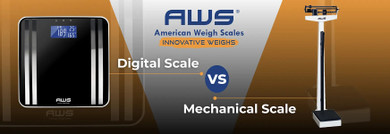
The selection of the appropriate weighing scale is significant whether you operate a retail or warehouse, laboratory or shipping centre or industrial facility. There have been two very prevalent choices: digital scales and mechanical scales.
Both are used similarly to measure the weight, but they differ greatly in the accuracy, functionality, maintenance and long-term value. This comprehension of these differences can assist any business and individuals to invest in the appropriate weighing solution.
We will compare digital scales and mechanical scales in this guide, discuss their benefits and drawbacks, and assist you in choosing the one which fits best to your needs.
| Feature | Digital Scale | Mechanical Scale |
| Accuracy | Highly accurate | Moderate accuracy |
| Weight Display | Digital screen | Analog dial or pointer |
| Ease of Reading | Very easy | Can be difficult from certain angles |
| Power Source | Battery or electricity | No power required |
| Maintenance | Low | Regular calibration may be needed |
| Advanced Features | Multiple functions available | Limited functionality |
| Speed | Instant readings | Slightly slower |
| Cost | Higher initial investment | Lower upfront cost |
| Industrial Applications | Widely used | Limited applications |
| Data Storage | Available in many models | Not available |
What Is a Digital Scale?
Digital scale involves the use of electronic sensors (load cells) to record weight. These are sensors that transform the applied force on an object to electrical signals that are then shown on a digital display.
Digital weighing scales are commonly found in:
- Retail stores
- Warehouses
- Logistics centres
- Manufacturing plants
- Laboratories
- Healthcare facilities
- Food processing industries
More recent types of digital scales may feature more advanced features like data recording capabilities, connection features, counting features, unit conversions, and tare functions.
Example
A warehouse that produces daily shipments of products that need to be precise in terms of weight. The scale can be instantly shown digitally, connected with inventory management systems, and enhance operational efficiency.
What Is a Mechanical Scale?
A mechanical scale quantifies weight through springs, lever and mechanical parts within. In this case, a needle or a dial moves to state a measurement when weight is applied.
Mechanical scales are widely used in:
- Homes
- Small shops
- Agricultural settings
- Temporary weighing locations
- Areas without reliable electricity
Since they do not need any batteries or electrical power, they are still a viable solution to simple weighing purposes.
Example
A farmer who weighs produce in an isolated place might choose a mechanical scale due to its use even without electricity and its ability to withstand weather.
Digital Scale vs Mechanical Scale: Key Differences
1. Accuracy and Precision
One of the largest considerations when purchasing a weighing scale is accuracy.
Digital scales are installed to provide very accurate scales and can even achieve a reading of grams or fractions of grams. This allows them to be used in sectors where precision is of direct consequence in the operations and adherence.
Mechanical scales are not as accurate as they require the spring tension and mechanical parts which can deteriorate or wear.
Winner: Digital Scale
2. Ease of Reading
Digital scales show weight on a digital screen and guessing is done away with.
Mechanical scales are dependent on a needle which points to a dial which has numbers on it. The reading mistakes may be in case of viewing angle, light condition, or dials.
In settings that demand rapid readings on a daily basis, digital readings are more effective.
Winner: Digital Scale
3. Maintenance Requirements
Mechanical scales have moving components that may become worn out. Measurement accuracy may be lost due to loss of tension in the springs.
With digital scales, mechanical wear is minimized since there are fewer moving parts. Nevertheless, batteries and electronic systems are to be periodically checked.
Both of the types of scales should be calibrated regularly.
Winner: Digital Scale
4. Power Dependency
The benefits of mechanical scales are that they do not need batteries or electricity.
The digital scales rely on power supply, but most of the modern products have long-duration batteries and designs that consume limited energy.
For remote environments with limited access to power, mechanical scales may be more practical.
Winner: Mechanical Scale
5. Features and Functionality
Digital scales have a number of high-quality features not available in mechanical scales.
Typical scale properties of digital scales involve:
- Tare function
- Piece counting
- Multiple weighing units
- Data storage
- Wireless connectivity
- Barcode integration
- Inventory tracking support
- Printing capabilities
Mechanical scales are limited to basic weight measurement.
Winner: Digital Scale
6. Durability
The two types of scales are both durable when put in the proper use.
Mechanical scales are usually appreciated due to being rugged and capable of operating under rough conditions.
Digital scales are as well very robust and those used in warehouses, manufacturing industries and other heavy industries are heavy-duty scales made to be durable.
The real life is determined by the quality of the build, its maintenance and operating conditions.
Winner: Tie
7. Cost Considerations
The initial cost of mechanical scales is cheaper. Digital scales can be more expensive when considering a short-term perspective but can be more effective in the long-term due to advanced accuracy, productivity and operational efficiency.
Businesses which are dependent on accurate measurements tend to recoup the investment in form of less errors and better work processes.
Winner: Depends on Usage
Advantages of Digital Scales
High Accuracy
Digital scales offer an accurate measurement that helps in quality control and compliance with regulations.
Faster Operations
Real-time readings are useful in enhancing productivity in workplaces.
Advanced Features
Digital scales, such as data tracking to connectivity, have the ability to add value through functionality across business functions.
Better User Experience
Clear digital displays reduce reading errors and improve efficiency.
Scalability
Smaller inventory, logistics and production management systems have the ability to imbibe the use of digital weighing systems.
Advantages of Mechanical Scales
No Electricity Required
Mechanical scales can operate anywhere without batteries or power outlets.
Lower Initial Cost
They are generally more affordable for basic weighing applications.
Simple Operation
The users are in a position to weigh objects without learning software or online environment.
Reliable in Remote Locations
Even in a region with poor infrastructure, mechanical scales can still be used.
Frequently Asked Questions
Are digital scales more accurate than mechanical scales?
Yes. Digital scales are generally considered to be more reliable and accurate measurement scales since they are done using electronic load cell technology as compared to mechanical springs.
Do mechanical scales need calibration?
Yes. Mechanical scales must be periodically calibrated to ensure accuracy, particularly when used over an extended period of time.
Which scale lasts longer?
They both have a number of years to live in case they are taken care of. The life expectancy is determined by the conditions of use, quality of construction and maintenance.
Can digital scales work without electricity?
Numerous digital scales use batteries to work, which means that they do not require a power source to be connected. But they need a source of power, as well.
Are digital scales worth the higher cost?
In business and other professional settings, the enhanced accuracy, efficiency, and advanced features are usually worth the investment.
Final Verdict: Digital Scale vs Mechanical Scale
Digital model is evidently better in accuracy, speed, readability and functionality when compared to mechanical scale. They suit best the business and industries whereby measurements are required.
Mechanical scales are still useful in low end applications, especially where electricity is nonexistent or ease of use is desired.
To the majority of contemporary business practices, the use of a high-quality digital weighing solution will be more efficient and reliable, as well as valuable in the long run.
In need of reliable weighing solutions to your business? Discover high-quality digital scales that can give the most correct output, enhance efficiency, and work in a long term.