
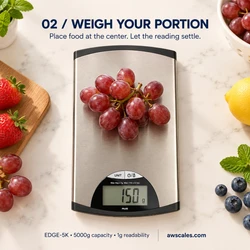
Choose the EDGE-5K for heavier ingredients, larger containers and everyday kitchen weighing. Choose the Blade 1kg for portable weighing and tasks that need smaller display increments.
The key tradeoff is capacity versus readability: the EDGE accommodates larger loads, while the Blade displays finer increments within a smaller range.
This comparison covers the BLADE-1KG-BLACK, rather than every model sold under the Blade name. It uses published manufacturer information, without independent hands-on testing.
EDGE-5K vs Blade Scale: Specifications Compared
The EDGE-5K digital kitchen scale suits larger weighing jobs. The Blade 1kg digital pocket scale combines a portable format with a retractable display.
| Feature | EDGE-5K | Blade 1kg |
|---|---|---|
| Model identifier | EDGE-5K | BLADE-1KG-BLACK |
| Maximum capacity | 5000g | 1000g |
| Gram readability | 1g | 0.1g |
| Listed units | lb, fl, g, ml | g, oz, ozt, dwt |
| Display design | LCD | Backlit, swing-out LCD |
| Construction features | Stainless steel and black plastic | Stainless steel weighing surface |
| Tray accessories | Not established by reviewed listing | Two clear covers double as trays |
| Calibration mass | 5kg, not included | 500g, not included |
| Battery information | Confirm with AWS | Two AAA batteries included |
The table follows the Blade’s specification fields. Its descriptive copy lists different unit options, so confirm the exact version if a particular mode is essential. The EDGE listing also contains inconsistent power and dimension fields; those details need confirmation.
Capacity: Start With Your Heaviest Complete Load
Include the container when calculating how much capacity you need.
A bowl, tray or dish continues to load the weighing mechanism even after you subtract its indicated weight with tare.
Consider these hypothetical setups:
| Container weight | Contents | Combined load | Capacity fit |
|---|---|---|---|
| 30g | 200g | 230g | Within both limits |
| 150g | 650g | 800g | Within both limits |
| 400g | 800g | 1200g | EDGE-5K only |
| 1000g | 2500g | 3500g | EDGE-5K only |
| 1500g | 4000g | 5500g | Exceeds both limits |
These examples illustrate load compatibility rather than measured accuracy.
For a recipe mixed directly in a substantial bowl, the container can consume a meaningful part of the available capacity. Weigh the empty bowl first if you are unsure.
Leave headroom for additions instead of planning around the absolute maximum.
Does Tare Increase the Weighing Limit?
No. Tare changes the display’s reference point.
For example, a 300g container on a scale with a 1000g limit leaves a theoretical 700g for contents. The container’s physical load remains after the screen returns to zero.
The same rule applies to accessory trays. A larger tray can help contain objects, but it does not increase the scale’s load rating.
Readability: When Does the Smaller Increment Help?
Readability describes the smallest displayed increment.
A tenth of a gram equals 100mg. A whole gram equals 1000mg. NIST’s guide to mass units provides background on these metric relationships.
Suppose your task requires a target of 12.5g. A display that advances in whole grams cannot directly show that value. A tenth-gram display can represent it, although its measurement performance must still meet your tolerance.
That makes finer readability useful when tracking modest differences between light objects or adding small quantities gradually.
Readability Is Different From Accuracy
More decimal places do not establish a matching accuracy guarantee.
| Term | What it tells you |
|---|---|
| Readability | Smallest increment shown on the display |
| Repeatability | How closely repeated measurements agree |
| Accuracy | How closely a result agrees with an appropriate reference |
A scale may repeat the same result while remaining offset from a reference value. Another may show variation between trials.
Neither specification establishes the smallest reliable quantity you can weigh. For demanding work, check performance near the intended load and compare the observed variation and error with your tolerance.
Which Scale Is Better for Cooking and Baking?
For heavier batches and substantial bowls, capacity is often the deciding factor.
Bulk ingredients can quickly fill the range of a compact instrument, especially when the mixing container is already heavy. A kitchen scale with sufficient capacity lets you keep more ingredients in one vessel.
Smaller recipe additions introduce a different requirement. If the recipe needs fractional-gram control, a whole-gram display may be too coarse.
A practical approach is to weigh bulk ingredients in the main bowl and measure smaller additions separately with suitable equipment.
Explore the AWS kitchen scale collection if you need a different balance of capacity, readability and container fit.
Can One Scale Handle Every Ingredient?
Sometimes, but evaluate both ends of the recipe.
Your largest complete load determines the required capacity. Your smallest addition and allowed error help determine the necessary measurement performance.
A single scale may meet both requirements. If it does not, two instruments can serve complementary purposes.
Which Scale Is Better for Coffee?
Separate weighing dry coffee from weighing an entire brewing setup.
A small dish of beans creates a different load from a server, brewer and accumulating beverage. Calculate the maximum combined load before choosing equipment.
Also consider the adjustment size you want to make. A recipe that changes in fractions of a gram benefits from a finer display increment than one recorded only in whole grams.
Neither product should be assumed to include a brewing timer, water resistance or other coffee-specific functions unless the exact model’s documentation confirms them.
For brewing, keep spills away from the instrument and use a container that remains stable throughout the process.
Which Scale Is Better for Jewelry and Collectibles?
Smaller display increments are generally more useful when comparing light objects, provided the scale’s verified performance supports the comparison.
For jewelry and collectible records, also consider unit selection and the expected differences between items.
A change smaller than the instrument’s measurement variation may not support a reliable conclusion. Repeating a measurement helps reveal inconsistency, but repeated agreement alone does not prove accuracy.
Mass also cannot establish gemstone quality, precious-metal purity or coin authenticity.
The AWS pocket scale collection offers other combinations of readability and capacity when your objects require finer measurement or a different working range.
Portable Design and Display Access
A portable scale is useful when you need to move between work areas or store equipment in a small space.
For any compact design, think about how the container will sit relative to the screen and controls. A dish that blocks the display can make repeated additions inconvenient.
Keep moving display components clear of loose material, and follow the instructions when opening or storing them. During transport, protect the weighing platform from pressure.
How to Use a Tray Correctly
Place the tray securely and make sure it touches no other support.
A tray resting partly on the table or housing can divert some of the load away from the weighing mechanism. The resulting reading may look stable while failing to represent the full contents.
Always:
-
Include tray mass when calculating capacity.
-
Center the load.
-
Keep material clear of buttons and openings.
-
Remove residue between samples.
-
Avoid pressing down on the platform while handling the tray.
Units: Choose the Right Mode Before Weighing
Record the unit alongside every measurement.
Ordinary ounces and troy ounces differ. Grams and grains differ as well. Switching modes without checking the symbol can create recording errors.
NIST’s SI units reference explains standardized measurement units and notation.
What About Milliliters and Fluid Ounces?
A scale measures mass. A volume mode estimates volume using an assumed density.
That assumption matters because equal masses of different liquids can occupy different volumes. Follow the manufacturer’s instructions for the liquid mode instead of treating it as a universal conversion.
When a recipe specifies grams, weigh in grams directly.
Calibration: Follow the Exact Model’s Instructions
Use the AWS scale manuals to find the appropriate procedure.
Do not select a calibration mass simply because it matches the instrument’s maximum capacity. Different models may require different reference loads or sequences.
NIST’s calibration overview explains the relationship between instrument indications and reference values. Consumer calibration routines may also adjust the instrument’s response.
Check Results Near Your Typical Load
After following the instructions, verify performance using suitable reference masses.
Repeat the check several times, removing the load between trials. Observe whether the display returns to zero and whether results remain within your required tolerance.
Keep records if you need to monitor changes over time. NIST’s guidance on check standards describes using reference checks to monitor measurement performance.
An AWS calibration weight kit may provide useful masses, but confirm that its contents and specifications suit the procedure.
A printed nominal value does not establish certified traceability. NIST’s metrological traceability guidance explains the documented chain connecting measurement results to a reference.
How to Get More Consistent Readings
Use a firm, level surface away from drafts and vibration.
Keep the platform clean, center the load and wait for the indication to settle. Check that the container touches no surrounding object.
If readings fluctuate, inspect the setup and power condition before attempting calibration. Calibration cannot correct an overloaded platform or a container partly supported by the countertop.
Clean according to the manufacturer’s instructions. A stainless steel surface does not establish that the complete instrument is waterproof or dishwasher safe.
Can Either Scale Be Used for Commercial Sales?
Check applicable requirements before using weighing results to determine a selling price.
Readability and user calibration do not establish legal-for-trade approval. NIST’s weighing and scales FAQs provide background on commercial weighing requirements.
EDGE-5K vs Blade Scale: Buying Recommendations
| Your priority | Model to consider |
|---|---|
| Heavier bowls and larger ingredient batches | EDGE-5K |
| Everyday kitchen weighing with whole-gram targets | EDGE-5K |
| Smaller display increments for light loads | Blade 1kg |
| Portable weighing and compact storage | Blade 1kg |
| Both large batches and small additions | Evaluate using separate scales |
| Performance within a strict measurement tolerance | Verify suitable equipment before buying |
Frequently Asked Questions
Is the Blade more accurate than the EDGE-5K?
It has finer gram readability. Comparative accuracy requires testing against suitable reference masses at relevant loads.
Which scale can handle a heavier bowl?
The EDGE-5K provides more capacity. Include the bowl and all ingredients in the combined load.
Does a tray increase the Blade’s capacity?
No. The tray contributes to the physical load along with its contents.
Are all Blade scales the same?
No. This article compares the 1kg version identified as BLADE-1KG-BLACK. Check the exact model before applying these specifications.
Which scale is better for small recipe adjustments?
The finer-reading model is the stronger candidate when fractional-gram increments matter, subject to verified performance. Some tasks may require finer equipment than either option.
Which AWS Scale Should You Choose?
Choose the EDGE-5K for heavier containers and larger kitchen batches.
Choose the Blade 1kg for portable weighing and smaller display increments.
Base the purchase on your complete load, smallest required adjustment and measurement tolerance, then verify performance at the weights you use.