
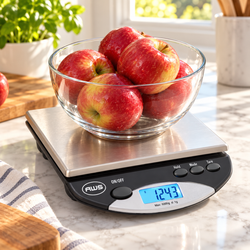
A dependable digital scale can help farmers market vendors portion ingredients, prepare consistent packages, check net weight, manage inventory and weigh products during eligible commercial transactions. Selecting the right scale, however, requires more than comparing maximum capacities.
The scale must provide an appropriate combination of:
-
Capacity
-
Resolution
-
Accuracy
-
Repeatability
-
Minimum load
-
Platform size
-
Tare range
-
Calibration capability
-
Portable power
-
Environmental stability
-
Sanitary design
The intended use is equally important. A kitchen scale used to measure ingredients or check packages may not meet the regulatory requirements for a scale that determines the price paid by a customer.
This farmers market products scale buying guide explains the technical and practical factors that matter when weighing produce, baked goods, herbs, tea, coffee, honey, preserves, soaps, candles and small crafts.
Why Farmers Market Vendors Need the Right Scale
Farmers market vendors may use scales for:
-
Portioning baked goods
-
Measuring recipe ingredients
-
Filling tea and spice packages
-
Checking net contents
-
Weighing produce
-
Preparing product bundles
-
Counting uniform pieces
-
Monitoring inventory
-
Recording harvest quantities
-
Calculating prices when permitted
An unsuitable scale can create several problems:
-
Inconsistent package weights
-
Wasted product
-
Recipe variation
-
Unstable measurements
-
Customer disputes
-
Regulatory concerns
-
Overloaded equipment
-
Slow checkout
-
Difficult cleaning
American Weigh Scales offers digital kitchen scales for food preparation, portioning and general weighing applications.
Begin With the Intended Use
Before selecting capacity or resolution, determine how the measurement will be used.
Internal Preparation
Internal applications include:
-
Recipe formulation
-
Portion control
-
Package checks
-
Inventory management
-
Harvest records
-
Batch preparation
-
Product development
A general kitchen, pocket, counting or precision scale may be suitable when it provides the necessary measurement performance.
Customer-Facing Sales by Weight
When the scale’s result determines the amount a customer pays, it may be considered a commercial weighing device.
NIST explains commercial scale applications in its weighing and scales FAQs.
Depending on the jurisdiction, a commercial farmers market scale may require:
-
NTEP certification
-
Registration
-
Inspection
-
Security sealing
-
Approved measurement units
-
Customer-facing display
-
Price-computing functionality
-
Periodic testing
A scale can be accurate without being approved for regulated commercial transactions.
Legal-for-Trade Considerations
The NIST National Type Evaluation Program evaluates commercial weighing devices against applicable requirements.
NIST also provides model requirements and test procedures through its current Handbook 44 resources.
Enforcement generally occurs at the state or local level. Before using a scale to establish a customer’s charge:
-
Contact the appropriate weights-and-measures authority.
-
Explain the product and sales method.
-
Confirm whether NTEP certification is required.
-
Ask about registration and inspection.
-
Confirm customer-display requirements.
-
Check the farmers market’s vendor rules.
-
Do not begin weight-based pricing until the equipment is approved where required.
Capacity Recommendations by Product
Capacity is the maximum load the scale can safely support.
| Product or Application | Suggested Capacity | Useful Resolution |
|---|---|---|
| Fine spices and concentrated ingredients | 100–500 g | 0.01 g |
| Tea and dried herbs | 500–2,000 g | 0.01–0.1 g |
| Coffee and small packaged foods | 1–5 kg | 0.1–1 g |
| Baked goods and recipe batches | 5–15 kg | 1 g |
| Honey, jam and filled jars | 5–15 kg | 1 g |
| Soap and candles | 5–15 kg | 0.1–1 g |
| Berries and small produce | 5–15 kg | 1–5 g |
| Melons, squash and bulk produce | 15–30 kg or more | 5–10 g |
| Commercial sales by weight | Application-specific | Application-specific |
These recommendations are starting points. The final scale must fit the actual product, container and operating environment.
How to Calculate the Capacity You Need
Capacity must include every object supported by the platform:
-
Product
-
Bowl
-
Basket
-
Jar
-
Bag
-
Tray
-
Packaging
-
Platform liner
Suppose a produce basket weighs two kilograms and may hold ten kilograms of vegetables. The maximum combined load is 12 kilograms.
A 12-kilogram scale would leave no practical margin. A 15-kilogram model would be more suitable.
Leave Capacity Above the Expected Maximum
Additional capacity accommodates:
-
Larger batches
-
Heavier containers
-
Seasonal products
-
Product expansion
-
Multi-item purchases
-
Packaging changes
Repeatedly operating at the scale’s maximum can increase the risk of overload.
Avoid Excessive Capacity
A very high-capacity scale may display larger increments than necessary. It may perform well for pumpkins but poorly for herbs or spices.
Choose enough capacity for the task without sacrificing useful resolution.
Tare Does Not Increase Physical Capacity
Tare subtracts a container from the displayed result, but the scale still supports its physical weight.
If a three-kilogram bowl is placed on a 15-kilogram scale and tared, approximately 12 kilograms of physical capacity remain.
This is particularly important with:
-
Produce crates
-
Heavy glass jars
-
Stainless-steel bowls
-
Wooden display baskets
-
Food-safe tubs
Choosing the Right Resolution
Resolution is the smallest weight increment shown by the scale.
0.01-Gram Resolution
Appropriate for:
-
Fine spices
-
Concentrated flavorings
-
Small herbal quantities
-
Soap additives
-
Detailed formulations
This sensitivity usually requires an indoor, controlled environment.
0.1-Gram Resolution
Useful for:
-
Tea
-
Dried herbs
-
Coffee
-
Small confections
-
Samples
-
Craft materials
AWS pocket scales provide portable options for lightweight products requiring fine resolution.
1-Gram Resolution
A practical choice for:
-
Baked goods
-
Packaged food
-
Filled jars
-
Soap bars
-
Candles
-
Recipe batches
5- to 10-Gram Resolution
Often suitable for:
-
Melons
-
Pumpkins
-
Squash
-
Large vegetable orders
-
Bulk produce containers
The correct resolution is the smallest increment needed to make the intended decision reliably.
Resolution, Accuracy and Repeatability Are Different
Resolution
The smallest increment displayed.
Accuracy
How closely the displayed result agrees with an accepted reference value.
Repeatability
How consistently the scale reports the same result for an unchanged load.
Linearity
How consistently the scale performs across different parts of its weighing range.
A scale displaying 0.01 gram is not necessarily accurate to exactly ±0.01 gram. The final digits may also fluctuate when the scale is exposed to wind, vibration or an unstable surface.
Test Repeatability
Use a representative product or suitable reference weight:
-
Place the scale on a firm, level surface.
-
Confirm that the platform is clean and empty.
-
Turn the scale on.
-
Confirm zero.
-
Center the load.
-
Wait for the reading to stabilize.
-
Record the result.
-
Remove the load.
-
Wait for the display to return to zero.
-
Repeat five to ten times.
Possible causes of inconsistent readings include:
-
Wind
-
Vibration
-
Low batteries
-
Temperature changes
-
Uneven surfaces
-
Platform debris
-
Off-center loading
-
Improper calibration
-
Previous overloads
Minimum Load Matters
Maximum capacity does not describe the entire useful weighing range.
A scale designed to hold 30 kilograms may not measure a one-gram quantity of herbs dependably. The display might remain at zero, round too coarsely or fluctuate.
Consider the lightest:
-
Ingredient
-
Product portion
-
Finished package
-
Sample
-
Piece being counted
A multi-product vendor may need separate precision and high-capacity scales.
Platform Size and Container Support
A scale can have enough capacity but an unsuitable platform.
The container should not:
-
Touch the table
-
Lean against another object
-
Press against the display
-
Rest on a cable
-
Cover essential controls
-
Tip or rock
-
Shift during weighing
Any outside contact can transfer part of the load away from the platform and create an incorrect result.
Platform Features to Compare
-
Width and depth
-
Raised design
-
Stainless-steel surface
-
Removable tray
-
Non-slip feet
-
Washable construction
-
Separate display
-
Sealed controls
A large produce basket may require a platform scale, while herbs and spices may need a small enclosed tray.
Tare Function
Tare allows the vendor to subtract the container and view net product weight.
The process is:
-
Place the empty container on the scale.
-
Wait for a stable reading.
-
Press tare.
-
Confirm zero.
-
Add the product.
-
Record the net weight.
Tare is useful for:
-
Produce baskets
-
Mixing bowls
-
Ingredient containers
-
Packaging trays
-
Jars and bags
For regulated commercial sales, follow applicable rules governing tare use.
Counting Uniform Products
A counting scale estimates quantity by dividing net weight by average piece weight.
Potential farmers market applications include:
-
Wrapped candies
-
Tea bags
-
Soap samples
-
Small craft products
-
Promotional items
-
Packaged accessories
AWS counting scales can support repetitive packaging and inventory.
Counting by weight is most effective when individual pieces are uniform. Handmade products and moisture-sensitive foods may vary too much for dependable estimates.
Display Features
A market scale should be easy to read under changing lighting.
Look for:
-
Large digits
-
High contrast
-
Backlighting
-
Clear unit symbols
-
Stable-weight indicator
-
Low-battery warning
-
Customer-facing visibility where required
Test the display:
-
Indoors
-
Under a canopy
-
In shade
-
In direct sunlight
-
From the customer’s position
Stabilization Time
Fast stabilization improves both preparation and checkout.
A good scale should:
-
Settle quickly
-
Return to zero consistently
-
Avoid unnecessary fluctuation
-
Indicate when the reading is stable
Fine-resolution scales may require more time to stabilize because they respond to smaller environmental changes.
Battery Life and External Power
Farmers markets may not provide electrical service.
Useful features include:
-
Long battery life
-
Common battery type
-
Rechargeable battery
-
Low-battery indicator
-
AC or USB power option
-
Adjustable auto-off
Carry spare batteries and test the scale before each market.
Auto-Off
Auto-off conserves battery power, but a short timeout can interrupt a transaction.
Look for a model that allows auto-off to be:
-
Adjusted
-
Extended
-
Disabled
-
Bypassed while using external power
Outdoor Conditions Affect Accuracy
Wind
Wind can disturb herbs, tea, bags and sensitive readings. Use a windbreak or complete precision measurements indoors.
Uneven Ground
A folding table can tilt or wobble on rough pavement or grass. Level and stabilize the workstation.
Temperature
Allow a scale stored in a hot or cold vehicle to acclimate before use.
Direct Sunlight
Sun can heat the scale and reduce display visibility.
Vibration
Foot traffic, coolers and shared tables can cause unstable readings.
Moisture
Protect the scale from rain, condensation and produce water unless it is designed for wet environments.
Food-Safe Design and Cleaning
A scale used around food should have:
-
Smooth surfaces
-
Removable trays
-
Sealed buttons
-
Minimal seams
-
Splash resistance
-
Corrosion-resistant materials
Do not immerse a scale unless the manufacturer specifically permits it.
Federal guidance explains basic sanitation principles in the four steps to food safety.
Use separate food-safe trays or cleaning procedures when switching between products.
Allergen Cross-Contact
Residue on a platform or tray may transfer between products containing:
-
Peanuts
-
Tree nuts
-
Wheat
-
Milk
-
Eggs
-
Soy
-
Sesame
-
Fish
-
Shellfish
Possible safeguards include:
-
Dedicated trays
-
Covered containers
-
Separate utensils
-
Cleaning between products
-
Documented procedures
-
Avoiding direct food contact with the platform
Weighing Packaged Products
For packaged goods:
Net weight = Gross weight − Tare weight
Packaging may include:
-
Jar
-
Lid
-
Bag
-
Wrapper
-
Label
-
Tie
-
Protective insert
FDA provides information related to food labeling and nutrition.
Vendors should also check state, local, cottage-food and market-specific labeling requirements.
Calibration and Verification
Calibration establishes or adjusts the scale’s response using a known reference mass.
Verification checks whether the scale performs within the tolerance required for the application.
Before choosing a scale, determine:
-
Whether it supports calibration
-
Which calibration mass is required
-
Whether the weight is included
-
Whether compatible weights are available
-
Whether instructions are accessible
-
Whether official service is required
AWS supplies calibration weights for compatible models.
How to Verify a Farmers Market Scale
A basic internal verification may include:
-
Positioning the scale on a level surface
-
Allowing it to reach the operating temperature
-
Confirming zero
-
Applying a suitable known weight
-
Comparing the displayed and expected values
-
Repeating the test
-
Documenting the result
Internal verification does not replace an official commercial inspection.
When Should the Scale Be Checked?
Verify the scale:
-
When first received
-
Before the market season
-
After transportation
-
After an overload
-
After a drop or impact
-
When results seem inconsistent
-
After battery replacement
-
After major temperature changes
-
At scheduled intervals
Transportation deserves particular attention because market scales are frequently packed and moved.
Calibration Weight Selection
A suitable calibration weight should:
-
Match the value required by the scale
-
Be appropriate for the scale’s resolution
-
Remain clean
-
Be free from damage
-
Be stored in a protective case
-
Have suitable documentation when traceability is required
Do not use coins, packaged food or hardware as calibration substitutes. Their masses can vary because of manufacturing differences, wear and contamination.
Create a Verification Log
Record:
-
Date
-
Scale identification
-
Reference weight
-
Expected result
-
Observed result
-
Operator
-
Corrective action
-
Official inspection information, if applicable
A log makes it easier to identify drift, transport damage and recurring setup problems.
Protect the Scale During Transport
Use a padded carrying case or rigid protective container.
Before transporting the scale:
-
Remove loose trays.
-
Lock the platform if possible.
-
Disconnect cables.
-
Protect the display.
-
Store calibration weights separately.
-
Prevent objects from resting on the platform.
-
Avoid extreme temperatures.
-
Never carry the scale by the platform.
For additional care recommendations, review AWS information on scale maintenance.
When to Use a Precision Balance
A precision balance may be suitable for:
-
Recipe development
-
Fine herbs and spices
-
Concentrated ingredients
-
Quality-control samples
-
Establishing reference package weights
AWS balance scales are better suited to controlled indoor measurement than to windy outdoor booths.
Recommended Scale Configurations
Herbs, Tea and Spices
-
Capacity: 500–2,000 g
-
Resolution: 0.01–0.1 g
-
Platform: Small tray
-
Environment: Sheltered or indoors
Baked Goods
-
Capacity: 5–15 kg
-
Resolution: 1 g
-
Platform: Large enough for bowls and trays
-
Features: Tare and easy cleaning
Honey, Jam and Sauces
-
Capacity: 5–15 kg
-
Resolution: 1 g
-
Platform: Stainless steel
-
Features: Sealed controls and tare
Produce
-
Capacity: 15–30 kg or more
-
Resolution: 5–10 g or application-specific
-
Platform: Large and stable
-
Features: Visible display and battery power
-
Requirement: Confirm legal-for-trade rules
Soap and Candles
-
Capacity: 5–15 kg
-
Resolution: 0.1–1 g
-
Features: Tare, calibration and container support
Multi-Product Vendor
-
Pocket scale for fine ingredients
-
Bench scale for packages and baked goods
-
Commercial scale for eligible sales by weight
-
Separate food-safe trays
-
Calibration and verification schedule
Common Buying Mistakes
Assuming an Accurate Scale Is Legal for Trade
Commercial approval is a separate requirement.
Choosing Capacity Without the Container
Baskets and bowls consume available capacity.
Assuming Tare Restores Capacity
Tare affects the display, not the physical load.
Buying Too Much Capacity
Excessive capacity may result in coarser resolution.
Buying Too Little Capacity
Large produce baskets may overload a compact scale.
Confusing Resolution With Accuracy
More decimal places do not guarantee better results.
Ignoring Minimum Load
A produce scale may not detect lightweight herbs reliably.
Selecting an Undersized Platform
Containers touching the table can produce incorrect readings.
Ignoring Outdoor Conditions
Wind, temperature and vibration affect scale performance.
Using Improvised Calibration Objects
Use the specified reference weight.
Farmers Market Scale Buying Checklist
Before purchasing, confirm:
-
Products being weighed
-
Internal or commercial use
-
Local legal-for-trade requirements
-
Lightest measurement
-
Heaviest product-and-container load
-
Required capacity
-
Required resolution
-
Minimum practical load
-
Repeatability
-
Stabilization time
-
Platform dimensions
-
Tare function
-
Display visibility
-
Customer-display requirements
-
Battery life
-
External power
-
Cleaning procedure
-
Environmental exposure
-
Calibration capability
-
Required reference weights
-
Transport protection
-
Inspection or registration requirements
Frequently Asked Questions
What scale capacity is best for farmers market products?
It depends on the products. Herbs may require only 500 to 2,000 grams of capacity, while produce baskets may require 15 to 30 kilograms or more.
What resolution should I choose?
Use 0.01 to 0.1 gram for herbs and spices, approximately one gram for baked goods and packaged foods, and larger increments for heavy produce.
What is the difference between accuracy and resolution?
Accuracy describes closeness to an accepted value. Resolution is the smallest increment displayed.
What is repeatability?
Repeatability is the ability to produce similar readings when the same load is weighed repeatedly under unchanged conditions.
Does tare increase scale capacity?
No. The container remains a physical load after the display is reset.
Can I use a kitchen scale to sell produce?
A kitchen scale may be appropriate for internal preparation, but it may not meet legal-for-trade requirements for customer transactions.
Do I need an NTEP-certified scale?
Possibly, if weight determines the price paid by a customer. Requirements vary, so contact the relevant authority.
Can one scale weigh spices and pumpkins?
One model may not provide both the resolution required for spices and the capacity needed for pumpkins. Separate scales are usually more practical.
How frequently should the scale be calibrated?
Follow the manufacturer’s instructions. Verify it after transport, overload, impact, temperature changes or unusual readings. Calibrate when verification indicates an unacceptable error.
Can I use coins for calibration?
Purpose-made calibration weights are preferable because coins can vary through wear and contamination.
Final Thoughts
The right farmers market scale must match the products, containers, operating environment and sales method.
Begin with capacity. Add the product and container weights, then leave a reasonable margin. Select resolution based on the smallest meaningful quantity rather than the greatest number of decimal places available.
For fine herbs, spices and tea, a 500- to 2,000-gram precision scale with 0.01- or 0.1-gram resolution may be suitable. Baked goods, jars and packaged food often benefit from a 5- to 15-kilogram scale with one-gram resolution. Produce can require 15 to 30 kilograms or more.
Accuracy also depends on repeatability, minimum load, calibration, platform support and environmental stability. Verify the scale regularly, protect it during transportation and keep the platform clean.
Most importantly, determine whether the scale is being used internally or to establish a customer’s price. A kitchen or pocket scale may be excellent for production without being approved for commercial sales. Confirm legal-for-trade, registration and inspection requirements with the appropriate authority before using any scale for weight-based transactions.