
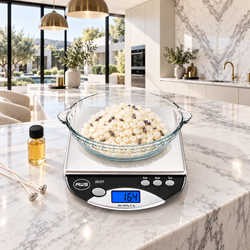
To choose a scale for meal prep, begin with the foods, containers, and batch sizes you expect to weigh. Most households will be well served by a digital kitchen scale with a 5-kilogram or 11-pound capacity, 1-gram resolution, a reliable tare function, and a platform large enough for plates and meal-prep containers.
People who regularly measure spices, salt, yeast, coffee, or small baking ingredients may benefit from 0.1-gram resolution. Those who prepare large family-size batches should prioritize higher capacity, a wide platform, and a display that remains visible beneath a mixing bowl.
The best scale is not necessarily the one with the most decimal places or smart features. It is the model that fits your containers, supports your heaviest batch, produces consistent readings, and remains easy to clean and operate.
Step 1: Decide What You Will Weigh
Before comparing scales, list the foods and recipes you prepare most often.
Common meal-prep measurements include:
-
Meat and fish
-
Cooked rice and grains
-
Pasta
-
Beans
-
Vegetables
-
Fruit
-
Cheese
-
Snacks
-
Sauces and dressings
-
Baking ingredients
-
Coffee
-
Complete prepared meals
Also decide whether you will weigh:
-
Individual ingredients
-
Finished recipes
-
Each meal-prep container
-
Large family batches
-
Small quantities of spices
-
Food before cooking
-
Food after cooking
The AWS kitchen scale collection includes several designs for cooking, baking, coffee preparation, portioning, and general household weighing.
Step 2: Choose the Right Capacity
Capacity is the maximum physical load the scale can support.
The required capacity must include:
-
The food
-
The plate or bowl
-
A meal-prep container
-
Any tray used on the platform
-
A margin below the maximum limit
5 Kilograms or 11 Pounds
A 5-kilogram or 11-pound scale is the best general-purpose choice for most households.
It can accommodate:
-
Individual plates
-
Food-storage containers
-
Mixing bowls
-
Prepared batches
-
Chopped vegetables
-
Multiple servings
-
Baking recipes
The NEPTUNE-5KG digital kitchen scale provides an 11-pound capacity with a platform intended to support a bowl or plate.
2 to 3 Kilograms
A 2- or 3-kilogram capacity can be enough for:
-
Individual portions
-
Coffee
-
Snacks
-
Small baking recipes
-
Lightweight containers
-
Sauces
-
Spices
A lower-capacity scale may provide finer resolution, but it may be inconvenient for full batches.
More Than 5 Kilograms
Choose a higher-capacity model when you regularly use:
-
Heavy cookware
-
Large glass bowls
-
Family-size recipes
-
Bulk produce
-
Large storage containers
Confirm that the scale still offers sufficiently fine resolution for individual portions.
Step 3: Account for Container Weight
Do not choose capacity according to food weight alone.
A glass mixing bowl can weigh significantly more than the ingredients placed inside it. A heavy plate or casserole dish may also consume a large part of the scale’s capacity.
Weigh or estimate the heaviest container you plan to use, then add the weight of your largest expected batch.
Leave extra capacity for:
-
Additional ingredients
-
Unexpectedly heavy produce
-
A larger replacement bowl
-
Accidental pressure on the platform
Operating a scale continuously near its limit is not ideal.
Step 4: Understand Tare
Tare resets the displayed value to zero while a container is resting on the platform. This allows the scale to show the net weight of the food.
A typical process is:
-
Place an empty container on the scale.
-
Press tare.
-
Add the first ingredient.
-
Record the weight.
-
Press tare again.
-
Add the next ingredient.
-
Continue until the meal is assembled.
Tare Does Not Increase Capacity
If a scale has a 5-kilogram capacity and the bowl weighs 1 kilogram, only 4 kilograms of physical range remain after taring.
The display may show zero, but the weighing mechanism still supports the bowl.
Choose a scale with enough capacity for the gross load—not merely the food weight displayed after tare.
Step 5: Select the Best Resolution
Resolution is the smallest change shown on the display.
Choose 1-Gram Resolution for:
-
Meat
-
Fish
-
Rice
-
Pasta
-
Vegetables
-
Fruit
-
Cheese
-
Snacks
-
Prepared meals
-
Most baking ingredients
One-gram resolution provides useful detail for ordinary portions without making the scale excessively sensitive.
Choose 0.1-Gram Resolution for:
-
Coffee
-
Salt
-
Spices
-
Yeast
-
Baking powder
-
Small quantities of sauce
-
Detailed recipe development
The BARISTA-3KG coffee and kitchen scale offers a 3,000-gram capacity with 0.1-gram resolution, making it useful for both coffee and fine kitchen measurements.
Do You Need 0.01-Gram Resolution?
For most meal prep, no. A hundredth-gram scale typically offers lower capacity, a smaller platform, and greater sensitivity to drafts and movement.
It may be useful for specialized culinary projects, but it is unnecessary for everyday portions and must never be used as a substitute for professional medication-dosing equipment.
Step 6: Distinguish Resolution From Accuracy
Resolution describes the smallest displayed increment. Accuracy describes how closely the reading agrees with the actual mass within the scale’s stated tolerance. Repeatability describes whether the same item produces a consistent result when weighed multiple times.
A scale with 0.1-gram resolution is not automatically accurate to exactly 0.1 gram under every condition.
Measurement can be affected by:
-
Weak batteries
-
An uneven counter
-
Airflow
-
Platform contamination
-
Temperature changes
-
Container contact
-
Accidental overload
-
Scale damage
The NIST Office of Weights and Measures provides information about measurement systems and weighing terminology. Home kitchen scales differ from regulated commercial equipment, but these basic distinctions help consumers compare models.
Step 7: Evaluate Repeatability
A meal-prep scale should produce the same or closely grouped readings when the same object is weighed several times.
Perform a simple check:
-
Place the scale on a hard, level surface.
-
Confirm that the platform is clean.
-
Turn on the scale.
-
Wait for zero.
-
Place the same item near the center.
-
Record the result.
-
Remove the item.
-
Wait for zero.
-
Repeat several times.
If the results vary noticeably, inspect:
-
Battery condition
-
Counter stability
-
Airflow
-
Platform cleanliness
-
Container placement
-
Nearby appliances
-
Recent impact or overload
Repeatability is often more valuable than an extra decimal place.
Step 8: Measure Your Containers
A scale can have the right electronic specifications but still be difficult to use if its platform is too small.
Measure the base of your:
-
Meal-prep containers
-
Dinner plates
-
Mixing bowls
-
Portion trays
-
Food-storage containers
The container should:
-
Rest securely on the platform
-
Avoid touching the counter
-
Leave the display visible
-
Avoid pressing the buttons
-
Remain stable when food is added
A broad, flat platform is generally the most versatile option for meal prep.
Step 9: Check Display Placement
Large bowls and plates can hide a display located directly beneath the platform.
Look for:
-
A forward-facing display
-
Large digits
-
Backlighting
-
Clear unit indicators
-
High contrast
-
An easy viewing angle
Controls should remain accessible when a broad container is in place. Side-mounted or front-mounted buttons can be easier to reach.
Step 10: Choose the Necessary Weighing Units
Most meal-prep users need:
-
Grams
-
Ounces
-
Pounds and ounces
Grams Are Useful for:
-
Dividing recipes
-
Tracking portions
-
Scaling recipes
-
Baking
-
International recipes
-
Nutrition databases
Ounces Are Useful for:
-
Meat portions
-
Packaged foods
-
U.S. recipes
-
Familiar household serving records
The scale should clearly identify the active unit. Accidentally switching units can create a much larger error than ordinary scale variation.
Step 11: Decide Between a Flat Platform and Bowl
Choose a Flat Platform If You:
-
Use different container sizes
-
Portion complete meals
-
Weigh plates
-
Divide finished batches
-
Need compact storage
-
Want maximum versatility
Choose a Bowl Scale If You:
-
Weigh loose produce
-
Prepare chopped ingredients
-
Measure grains
-
Mix ingredients on the scale
-
Want a dedicated container
An included bowl should be removable, food-safe, easy to clean, and light enough to preserve useful capacity.
Step 12: Consider Response Time
A useful scale should respond quickly as food is added and settle at a stable value.
A slow or unstable display can make portioning frustrating.
Readings may fluctuate because:
-
The food is still moving
-
The counter is flexible
-
A fan is blowing
-
The container touches another object
-
Batteries are weak
-
The scale has been overloaded
-
Ingredients are added too slowly for the scale’s filtering
Wait for the value to stabilize before recording it.
Step 13: Review Automatic Shutoff
Automatic shutoff conserves battery power, but a short timeout can interrupt a recipe.
Look for:
-
A moderate shutoff interval
-
Adjustable settings
-
Unit-memory settings
-
Fast restart
-
Warning before shutdown
If the scale turns off while a bowl is on the platform, remove the bowl before restarting unless the manufacturer provides different instructions. Confirm zero and tare the bowl again.
Step 14: Choose a Power Source
Replaceable Batteries
Advantages include:
-
Immediate replacement
-
No charging wait
-
Convenient long-term storage
-
Easy availability
Rechargeable Batteries
Advantages include:
-
Reduced disposable-battery use
-
Convenient USB charging
-
Lower ongoing battery purchases
Check whether the scale can operate while charging and whether the port is protected from spills.
A low-battery indicator is important because weak batteries may interrupt a meal-prep session or contribute to unusual readings.
Step 15: Prioritize Easy Cleaning
Meal-prep scales can be exposed to:
-
Oil
-
Sauce
-
Flour
-
Coffee grounds
-
Produce debris
-
Raw-food packaging
-
Condensation
-
Crumbs
Look for:
-
A smooth platform
-
Minimal gaps
-
Protected controls
-
Removable mats
-
Removable bowls
-
Splash-resistant construction
Do not immerse the scale unless its instructions explicitly allow it. Prevent water and cleaning solution from entering the display, buttons, platform gaps, or battery compartment.
AWS provides general scale maintenance guidance covering cleaning, storage, and temperature exposure.
Step 16: Consider Food Safety
Use a plate, bowl, or food-safe barrier when weighing raw meat, seafood, or eggs.
After weighing:
-
Wash hands
-
Clean contaminated surfaces
-
Keep raw and ready-to-eat foods separate
-
Wash reusable containers
-
Follow safe cooking and refrigeration practices
The USDA Food Safety and Inspection Service provides guidance on safe food handling, preparation, storage, and cross-contamination prevention.
Step 17: Decide Whether You Need Calibration
Some kitchen scales support user calibration with a specified reference weight.
Calibration or verification may be helpful after:
-
Transportation
-
Impact
-
Accidental overload
-
Battery replacement
-
Long storage
-
Significant temperature change
-
Unexpected readings
AWS offers calibration weights for compatible models.
Do not substitute coins, food packages, or household objects. Their actual weight may vary because of manufacturing tolerance, wear, contamination, or packaging.
Step 18: Avoid Paying for Unnecessary Features
Smartphone Connectivity
A connected app may be useful if it works with your preferred tracking system. It is not essential for accurate meal portioning.
Large Food Databases
Built-in databases can contain mismatched, outdated, or generic entries. Always confirm the food, brand, and preparation method.
Excessive Measurement Units
Most meal preppers need grams and ounces. Specialized units provide little benefit if they are never used.
Extremely Fine Resolution
Additional decimal places may reduce capacity and increase sensitivity without improving ordinary portions.
Nutritional Claims
A scale measures weight. It cannot independently determine whether a portion is appropriate for your age, body, health, or goals.
Step 19: Plan How You Will Portion Meals
Portioning Ingredients Separately
Place the meal-prep container on the scale, press tare, and add each food separately.
This works well for meals containing:
-
Protein
-
Grain
-
Vegetables
-
Sauce
-
Toppings
Dividing a Complete Recipe
If a finished recipe weighs 2,100 grams and you want seven portions:
2,100 ÷ 7 = 300 grams per portion
Mix the recipe thoroughly when appropriate, then place 300 grams into each tared container.
Equal-weight portions may not contain identical ingredients when a recipe includes large pieces or separates during portioning.
Step 20: Choose a Consistent Raw-or-Cooked Method
Cooking changes food weight through water gain or loss.
-
Rice and pasta absorb water.
-
Meat loses moisture.
-
Vegetables may gain or lose water.
-
Sauces become concentrated through evaporation.
Choose one consistent approach:
-
Weigh ingredients before cooking and calculate the whole recipe
-
Weigh the finished recipe and divide it
-
Use food data specifically describing the cooked product
-
Follow the serving basis on the package
The USDA FoodData Central database provides food-composition information, but entries vary by food, brand, source, and preparation method.
Step 21: Read Nutrition Labels Correctly
The Nutrition Facts label may show a serving in both household measures and metric weight.
The FDA Nutrition Facts Label provides information about labeled serving sizes and nutrients.
When tracking packaged foods:
-
Confirm the gram weight per serving
-
Check the servings per package
-
Use the correct product entry
-
Include sauces or additions
-
Recheck the label when packaging changes
A labeled serving is a standardized reference, not an individualized nutrition prescription.
Meal-Prep Scale Selection Table
| Meal-prep need | Capacity | Resolution | Key feature |
|---|---|---|---|
| Everyday individual meals | 5 kg | 1 g | Large flat platform |
| Family batch cooking | 5 kg or more | 1 g | Visible display |
| Coffee and small ingredients | 2–3 kg | 0.1 g | Fast response |
| Baking and recipe testing | 3–5 kg | 0.1–1 g | Reliable tare |
| Portable portioning | 500 g–3 kg | 0.1–1 g | Protective cover |
| Large containers | 5 kg or more | 1 g | Wide platform |
Additional resolution and capacity combinations are available through the AWS precision scale collection.
Meal Prep as Part of a Balanced Eating Pattern
A food scale provides measurements, but weight alone does not determine nutritional quality.
Meal planning should also consider:
-
Food variety
-
Fruits and vegetables
-
Protein sources
-
Fiber
-
Whole grains
-
Added sugars
-
Sodium
-
Dietary fats
-
Cultural preferences
-
Satisfaction
-
Individual medical needs
The Dietary Guidelines for Americans provide evidence-based guidance about overall eating patterns.
The USDA MyPlate framework also provides general food-group planning tools.
Common Scale-Selection Mistakes
Avoid these errors:
-
Choosing by price alone
-
Buying according to decimal places
-
Ignoring container weight
-
Buying insufficient capacity
-
Assuming tare increases capacity
-
Using a platform too small for your bowls
-
Selecting a hidden display
-
Ignoring automatic shutoff
-
Buying units you do not need
-
Overlooking cleaning requirements
-
Failing to check repeatability
-
Treating labeled servings as personalized recommendations
-
Using the scale for medication dosing
-
Assuming smart features guarantee better measurements
Meal-Prep Scale Buying Checklist
Before purchasing, confirm:
-
Capacity supports your heaviest container and batch
-
Resolution matches the foods you weigh
-
Tare is responsive
-
Grams and ounces are included
-
The platform fits your containers
-
The display remains visible
-
Controls remain accessible
-
Readings stabilize promptly
-
Automatic shutoff suits your workflow
-
Battery type is convenient
-
Low-battery warning is included
-
Overload warning is included
-
The surface is easy to clean
-
Calibration instructions are available
-
Storage dimensions fit your kitchen
-
Warranty and support information are provided
Frequently Asked Questions
What type of scale is best for meal prep?
A digital kitchen scale with a 5-kilogram or 11-pound capacity, 1-gram resolution, tare, grams and ounces, and a wide flat platform works well for most households.
Do I need a precision scale for meal prep?
A standard 1-gram kitchen scale is precise enough for most portions. Choose 0.1-gram resolution when you frequently measure coffee, spices, salt, yeast, or small recipe ingredients.
Is a 3-kilogram scale enough?
It can be enough for individual meals, coffee, snacks, and small recipes. A 5-kilogram model is more versatile for bowls and batch cooking.
Should I choose a smart scale?
Only if its app genuinely improves your workflow. Smart connectivity is not required for accurate weighing or equal portioning.
Can I use a pocket scale for meal prep?
A pocket scale may work for small portions and ingredients, but its platform and capacity may be too limited for plates, bowls, and complete meals.
How can I tell if my food scale is consistent?
Weigh the same appropriate object several times, removing it between tests. The readings should remain closely grouped and the scale should return to zero.
Final Thoughts
To choose a scale for meal prep, begin with your largest container, heaviest batch, smallest regularly measured ingredient, and preferred units.
For most households, a 5-kilogram or 11-pound scale with 1-gram resolution offers the best combination of capacity and usability. Choose 0.1-gram resolution when small ingredients or detailed recipes are a major part of your routine.
Prioritize a responsive tare function, wide platform, visible display, stable readings, sensible automatic shutoff, and easy cleaning. A well-chosen scale should make meal prep simpler, faster, and more repeatable—not add unnecessary complexity.