
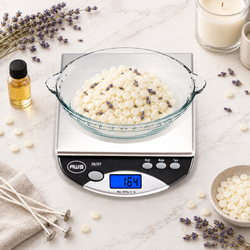
Choosing a scale for pet food begins with the size of your pet’s portions and the weight of the feeding bowl. A scale that works well for a cat’s treats may not have enough capacity for a large dog’s meal, while a high-capacity kitchen scale may not provide the finer resolution desired for very small portions.
For many pet owners, a digital scale with a capacity between 3,000 and 5,000 grams and a resolution of 1 gram is a practical choice. It can accommodate common pet bowls, dry kibble, wet food, and larger servings. A scale reading in 0.1-gram increments may be helpful for small pets, treats, toppers, and detailed intake records.
Capacity and resolution are only part of the buying decision. Platform size, tare performance, calibration capability, display placement, cleaning, and repeatability can determine whether the scale is convenient enough for daily use.
This guide explains how to choose a scale for pet food and how to match its specifications with your feeding routine.
Why Weigh Pet Food?
Measuring cups and scoops estimate food by volume. Their results can vary because of differences in:
-
Kibble size
-
Kibble shape
-
Food density
-
Scoop design
-
Whether the scoop is level or rounded
-
How tightly food is packed
-
The person preparing the meal
A scale measures mass and provides a repeatable value.
Weighing pet food can help you:
-
Serve consistent portions
-
Divide a daily allowance across several meals
-
Measure dry and wet food
-
Portion treats
-
Divide cans and pouches
-
Record food intake
-
Feed multiple pets separately
-
Carry out a veterinarian-directed feeding plan
-
Reduce accidental overfeeding
-
Adjust portions systematically when instructed
Begin by comparing the capacities and platform styles available among AWS digital kitchen scales.
A scale measures the amount served. It cannot independently determine the amount your pet should eat.
Step 1: Identify What You Will Weigh
The best scale depends on whether you need to measure full meals, treats, or ingredients.
Dry Kibble
Kibble portions are straightforward to weigh and generally do not require ultra-fine resolution. One-gram increments work for most regular portions.
Wet Food
Wet food can stick to spoons and containers, making volume estimates less consistent. A tare function lets you measure it directly in the feeding bowl.
Treats
Treats may require a smaller, more precise scale, particularly for small pets or animals following a veterinarian-supervised weight plan.
Toppers
Small amounts of toppers may benefit from 0.1-gram resolution. Remember to include toppers in the pet’s overall feeding plan.
Fresh or Homemade Food
Fresh diets may involve multiple ingredients and larger containers. Choose enough capacity for the bowl and full batch.
A scale improves measurement consistency, but it does not make a recipe nutritionally complete. Homemade feeding plans should be formulated with appropriate veterinary guidance.
Step 2: Weigh the Empty Feeding Bowl
The bowl’s weight counts toward the scale’s maximum capacity, even after you press tare.
Suppose you use:
-
Ceramic bowl weighing 900 grams
-
Pet food weighing 450 grams
The scale supports a total physical load of 1,350 grams.
A 1,000-gram scale would be overloaded. Pressing tare changes the displayed result but does not remove the bowl from the load cell.
Before selecting a scale:
-
Weigh or estimate the heaviest bowl you use.
-
Identify the largest normal food portion.
-
Add those values together.
-
Add extra headroom.
-
Choose a scale with a capacity above that total.
Step 3: Choose the Right Capacity
Up to 500 Grams
This range may work for:
-
Treats
-
Toppers
-
Very small portions
-
Food for small mammals
-
Lightweight trays
It is often too limited for regular meals because a feeding bowl can consume most of the capacity.
1,000 to 2,000 Grams
A capacity of 1 to 2 kilograms may suit:
-
Cat food
-
Small-dog meals
-
Lightweight stainless-steel bowls
-
Wet-food portions
-
Dry kibble
-
Treat preparation
Check the bowl weight carefully before selecting this range.
3,000 to 5,000 Grams
This is the most flexible range for many households. It can accommodate:
-
Most dog and cat bowls
-
Larger kibble portions
-
Wet food
-
Multiple servings
-
Heavier containers
-
Carefully planned recipe ingredients
The Neptune 5-kilogram kitchen scale is an example of a higher-capacity kitchen format that can support common feeding bowls and larger portions.
More Than 5,000 Grams
Choose more capacity when weighing:
-
Large-dog meals
-
Heavy ceramic bowls
-
Multiple portions
-
Bulk food preparation
-
Large ingredient batches
-
Storage containers
Confirm that the scale’s resolution remains appropriate for the smallest portions you measure.
Step 4: Choose the Right Resolution
Resolution is the smallest increment displayed by the scale.
One-Gram Resolution
One-gram readability is suitable for most:
-
Dog-food portions
-
Cat-food portions
-
Kibble servings
-
Wet food
-
Fresh food
-
Larger treats
If the feeding target is approximately 150 grams, a result of 149 or 151 grams is generally practical.
0.1-Gram Resolution
A scale reading in tenths of a gram can be useful for:
-
Small pets
-
Small meals
-
Treats
-
Toppers
-
Small amounts of ingredients
-
Detailed intake records
The Barista 3-kilogram coffee and kitchen scale is listed with a 3-kilogram capacity and 0.1-gram readability, offering a combination of relatively fine measurements and useful capacity.
0.01-Gram Resolution
Most pet meals do not require 0.01-gram resolution. Scales with this readability commonly have low capacities and small platforms.
They may also react visibly to:
-
Drafts
-
Vibration
-
Temperature changes
-
Static electricity
-
Food movement
-
Off-center loads
A general pet food scale should not be used to measure medication unless your veterinarian specifically approves the equipment and procedure.
Step 5: Understand Accuracy and Repeatability
Resolution, accuracy, and repeatability are not interchangeable.
-
Resolution is the smallest displayed increment.
-
Accuracy is closeness to the true weight.
-
Repeatability is consistency across repeated measurements.
-
Capacity is the maximum supported load.
A scale showing 50.00 grams is not automatically more accurate than one showing 50.0 grams.
For daily pet feeding, repeatable measurements are essential. You should be able to weigh the same stable object several times and receive the same or a closely comparable result.
Step 6: Check the Tare Function
Tare allows you to exclude the bowl from the displayed food weight.
To use it:
-
Place the scale on a hard, level surface.
-
Turn it on and wait for zero.
-
Place the empty bowl in the center.
-
Press tare.
-
Wait for the display to return to zero.
-
Add the pet food.
-
Stop when the intended weight appears.
A responsive tare button should be easy to reach with the bowl in place. It should not require enough pressure to move the scale.
When preparing a meal with multiple foods, you can record each ingredient and press tare before adding the next one.
Step 7: Compare Platform Dimensions
A scale may have enough capacity but still be unsuitable if the bowl does not fit properly.
An oversized bowl may:
-
Cover the display
-
Block the tare button
-
Tip or slide
-
Touch the counter
-
Make centering difficult
-
Create an incorrect measurement
Measure the base of the bowl rather than its widest rim. Compare that measurement with the scale’s platform dimensions.
A bowl can extend beyond the platform if it remains stable and does not touch another surface. The scale must support the entire load.
Step 8: Choose Between a Kitchen and Pocket Scale
Kitchen Scale
A kitchen scale is usually best for:
-
Full feeding bowls
-
Standard dog and cat portions
-
Wet food
-
Large dogs
-
Multiple meals
-
Batch preparation
It normally offers a larger platform and higher capacity.
Pocket Scale
A pocket scale may work well for:
-
Treats
-
Toppers
-
Very small food portions
-
Travel
-
Portable measurements
-
Lightweight containers
The AWS collection of digital pocket scales includes compact models with different capacities. Check the platform dimensions and total bowl weight before choosing one for pet feeding.
Some households may benefit from having both: a kitchen scale for meals and a pocket scale for small treats or toppers.
Step 9: Look for Grams and Ounces
A practical pet food scale should offer:
-
Grams
-
Ounces
Grams are particularly convenient because they provide straightforward values without fractions.
Always check the selected unit before adding food. Confusing ounces with grams can produce a significant feeding error.
A scoop or cup measurement does not have a universal weight. One cup of a large, airy kibble may weigh substantially less than one cup of a small, dense formula.
Recheck the gram amount whenever you change pet foods.
Step 10: Check Display Placement
The display should remain visible when the bowl is on the platform.
Look for:
-
Large digits
-
Good contrast
-
Backlighting
-
A clear unit indicator
-
Low-battery warnings
-
Overload warnings
-
A stable-reading symbol
An angled or extended display can be easier to see beneath a wide bowl.
Buttons should remain accessible without moving the bowl after it has been tared.
Step 11: Evaluate Stabilization Speed
The display should settle promptly when the food and bowl stop moving.
Readings can fluctuate because of:
-
A wobbling bowl
-
Food shifting
-
Countertop vibration
-
Air movement
-
Weak batteries
-
Temperature changes
-
An off-center load
-
Excessively fine resolution
Add food gradually and wait for a stable reading before recording the result.
A steady whole-gram measurement may be more useful than a fine-resolution reading that constantly changes.
Step 12: Check Calibration Capability
Calibration compares the scale’s reading with a known reference mass. Compatible models may allow an adjustment when the result does not agree with the reference.
Check calibration:
-
When the scale is new
-
After transportation
-
After a drop or impact
-
Following major temperature changes
-
When readings become inconsistent
-
When a proper reference weight produces an unexpected result
The process varies, but it commonly involves entering calibration mode and placing a specified reference weight in the center of the platform.
Do not use a pet-food package, can, phone, or collection of household objects as a calibration standard. Use the exact mass required by the scale’s instructions.
AWS provides calibration weights and weighing accessories for compatible equipment.
The National Institute of Standards and Technology’s Office of Weights and Measures offers broader information about weighing and dependable measurement practices.
Step 13: Choose an Easy-to-Clean Design
Pet food may leave:
-
Kibble dust
-
Crumbs
-
Oil
-
Wet-food residue
-
Moisture
-
Raw-food residue
Choose a smooth platform with minimal seams and accessible controls.
Wipe spills immediately. Do not allow liquid to enter the buttons, display, or battery compartment. Do not immerse the scale unless the manufacturer specifically identifies it as waterproof.
Additional care recommendations are available in the AWS guide to digital scale maintenance.
Step 14: Review Power and Automatic Shutoff
Automatic shutoff saves battery power, but an overly short timer can interrupt meal preparation and erase the tare value.
Compare:
-
Shutoff timing
-
Battery type
-
Low-battery indicator
-
Battery availability
-
Rechargeable options
-
Optional adapter compatibility
If the scale will be used several times daily, convenient power options become more important.
Step 15: Look for Overload Protection
An overload indicator warns you when the bowl and food exceed the scale’s maximum capacity.
If the warning appears:
-
Remove the load immediately.
-
Turn the scale off.
-
Verify the bowl and food weight.
-
Use a higher-capacity model if necessary.
-
Check the scale’s repeatability before returning it to use.
Overloading can damage the sensor and cause lasting measurement errors.
How to Use Feeding Directions Correctly
Feeding directions on pet-food packaging provide a starting point. They do not account perfectly for every individual animal.
Actual requirements can vary with:
-
Species
-
Age
-
Current weight
-
Ideal weight
-
Body condition
-
Activity
-
Reproductive status
-
Environment
-
Health conditions
-
Treats and supplementary food
The FDA provides information about regulation and labeling through its pet-food resources. The Association of American Feed Control Officials also explains label elements and nutritional adequacy statements.
A scale makes a feeding target repeatable. It does not prove that the target is appropriate.
Consider Body and Muscle Condition
Two pets with the same body weight may need different amounts of food.
Veterinary nutritional assessment may consider:
-
Body condition
-
Muscle condition
-
Weight trends
-
Activity
-
Life stage
-
Health conditions
-
Diet history
-
Treat intake
The World Small Animal Veterinary Association nutrition guidelines provide resources for nutritional assessment. The AAHA nutrition and weight-management guidelines also discuss individualized nutritional care.
Contact your veterinarian if your pet gains or loses weight unexpectedly, has a major appetite change, refuses food, develops digestive symptoms, or requires a therapeutic diet.
Measuring Dry Food
To measure kibble:
-
Place the empty bowl on the scale.
-
Press tare.
-
Pour food slowly.
-
Reduce the pouring speed as you approach the target.
-
Remove individual pieces if necessary.
-
Wait for a stable reading.
Kibble formulations can differ in energy and density. Do not assume that the same gram amount remains appropriate after changing food. Review the new label and consult your veterinarian when necessary.
Measuring Wet Food
To weigh wet food:
-
Tare the empty bowl.
-
Add the food with a spoon.
-
Wait for the reading to settle.
-
Add or remove a small amount as needed.
-
Clean spills promptly.
If dividing a can or pouch across several meals, calculate the intended portion and weigh each serving. Store the remainder according to the manufacturer’s directions.
Measuring Treats and Toppers
One useful approach is to weigh the entire day’s allowance at once.
-
Place a small container on the scale.
-
Press tare.
-
Add all treats planned for the day.
-
Store them separately.
-
Use only that supply for training and rewards.
This reduces the chance that several household members will give untracked treats.
Toppers, chews, table food, and training rewards contribute to total intake and should be considered in the feeding plan.
Recommended Specifications
| Pet-feeding application | Suggested capacity | Suggested resolution |
|---|---|---|
| Standard dog meals | 3,000–5,000 g | 1 g |
| Standard cat meals | 1,000–3,000 g | 0.1–1 g |
| Large-dog meals | 5,000 g or more | 1 g |
| Small-pet meals | 500–2,000 g | 0.1 g |
| Treats and toppers | 200–1,000 g | 0.1 g |
| Tiny quantities | 100–500 g | 0.01–0.1 g |
| Batch preparation | 5,000–10,000 g | 1 g |
These are general ranges. Choose specifications based on the actual bowl and portion, along with veterinary guidance when applicable.
Pet Food Scale Buying Checklist
Before purchasing, confirm that:
-
Capacity exceeds the bowl and food’s combined weight.
-
Resolution matches the smallest normal portion.
-
The bowl fits securely on the platform.
-
The bowl does not cover the display.
-
Tare is included and easy to access.
-
Grams and ounces are available.
-
The scale provides repeatable measurements.
-
Calibration instructions are included.
-
The required calibration mass is practical.
-
A low-battery warning is provided.
-
An overload indicator is included.
-
Automatic shutoff is not too short.
-
The platform is easy to clean.
-
Batteries are easy to obtain.
Common Mistakes to Avoid
Choosing Resolution Before Capacity
A scale must support the bowl and food before its fine increments become useful.
Forgetting Bowl Weight
Tare changes the display but does not increase physical capacity.
Ignoring Platform Size
A bowl that touches the counter prevents the scale from receiving the full load.
Assuming More Decimal Places Mean More Accuracy
Resolution does not guarantee accuracy.
Using a Food Scale for Medication
Medication doses should be measured with veterinarian-approved equipment and methods.
Following the Scale Instead of the Feeding Plan
The scale tells you the weight served. It does not decide the appropriate daily amount.
Ignoring Treats
Treats and toppers contribute to total intake.
Frequently Asked Questions
What type of scale is best for pet food?
A digital kitchen scale with a 3,000- to 5,000-gram capacity, 1-gram resolution, tare, and a platform large enough for the feeding bowl works well for many households.
Is 1-gram resolution sufficient?
Yes. One-gram increments are appropriate for most regular dog and cat food portions.
When should I choose 0.1-gram resolution?
Choose it for smaller pets, small meals, treats, toppers, and detailed intake records.
Does tare increase scale capacity?
No. It subtracts the bowl from the displayed result, but the bowl still counts toward the physical load.
Can a pocket scale be used for pet food?
Yes, particularly for treats and small portions. A kitchen scale is generally better for full feeding bowls.
Can a scale determine how much my pet should eat?
No. It measures the portion. Feeding targets should be based on appropriate label information and individualized veterinary guidance.
How often should the scale be calibrated?
Follow the manufacturer’s directions. Check calibration after transportation, impact, large temperature changes, or unexpected readings.
Why does the measurement fluctuate?
Possible causes include vibration, weak batteries, an uneven surface, air movement, temperature changes, food movement, or the bowl touching another surface.
Can I weigh wet pet food?
Yes. Tare the empty feeding bowl and add the wet food directly.
Should I weigh treats?
It can be helpful, especially for small animals or pets following a veterinarian-directed weight plan.
Final Thoughts
To choose the right scale for pet food, start with the combined weight of the bowl and the largest normal serving. Then select a resolution that matches the smallest portions you need to measure.
For many households, a capacity between 3,000 and 5,000 grams and a resolution of 1 gram provide the best balance. A 0.1-gram scale may be worthwhile for small pets, treats, and toppers.
Confirm that the bowl fits the platform without touching the counter or hiding the display. Look for a responsive tare function, repeatable readings, calibration capability, overload protection, and a surface that can be cleaned easily.
Finally, remember the distinction between measurement and nutritional planning. The scale helps you serve a chosen amount consistently. Your veterinarian and appropriate pet-food guidance help determine whether that amount is right for your pet.