
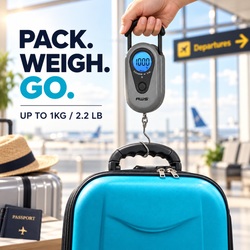
Choosing a scale for travel luggage begins with capacity, but capacity alone does not determine whether a scale will be useful. A good travel scale also needs suitable readability, repeatable measurements, a secure strap or hook, an automatic hold function, and a display that remains visible long enough to record the result.
For most travelers, a digital hanging scale with a capacity of at least 110 pounds or 50 kilograms and readability between 0.1 and 0.2 pound offers a practical combination. It can handle many ordinary checked bags while providing enough detail to show when a suitcase is approaching its airline allowance.
Portability matters as well. The scale should be compact enough to pack for the return flight, yet comfortable enough to grip while lifting a full suitcase.
This guide explains how to compare luggage scales, which features matter most, and how to use a scale without creating unnecessary uncertainty at the airport.
Why Use a Travel Luggage Scale?
Airline baggage rules vary based on:
-
Airline
-
Route
-
Fare class
-
Cabin
-
Loyalty status
-
Credit-card benefits
-
Codeshare arrangements
-
Number of bags
-
Special-equipment policies
A baggage allowance that applied to a previous flight may not apply to the next one.
A portable luggage scale allows you to weigh the bag while you still have time to:
-
Remove unnecessary items
-
Redistribute belongings
-
Transfer permitted items to a carry-on
-
Move items between family members’ bags
-
Purchase baggage in advance
-
Leave space for souvenirs
-
Avoid repacking at the airport
-
Prepare for the return flight
The U.S. Department of Transportation publishes information about airline baggage fees, but travelers should verify the allowance shown on their exact booking.
Step 1: Choose the Right Scale Type
Digital Hanging Scale
A digital hanging scale is usually the best option for travel.
To use it:
-
Wrap the strap around the suitcase handle.
-
Secure the clasp.
-
Lift the bag.
-
Wait for the reading to stabilize.
-
Lower the bag.
-
Read the held result.
This design is compact and does not need a large platform.
The AWS-LS0907 digital luggage scale is an example of a travel-oriented hanging model. Its listing describes a 110-pound capacity, 0.2-pound readability, a durable strap, and a metal clasp.
Mechanical Luggage Scale
Mechanical models do not require batteries. However, they may be:
-
More difficult to read
-
Less convenient in dim areas
-
Larger or heavier
-
Less likely to include automatic hold
-
Harder to interpret between marked increments
Platform Scale
A platform scale can be useful for very heavy or bulky luggage. It is normally less portable but may be safer when the load should not be lifted manually.
Step 2: Select Enough Capacity
Capacity is the maximum weight the scale is designed to support.
Up to 50 Pounds
A 50-pound scale may work for:
-
Carry-ons
-
Backpacks
-
Small suitcases
-
Personal items
-
Lightweight travel
It leaves little headroom for checked bags packed close to common limits.
88 Pounds or 40 Kilograms
A 40-kilogram scale can cover many conventional bags, but it may be insufficient for certain routes, fare allowances, or specialized equipment.
110 Pounds or 50 Kilograms
A capacity of at least 110 pounds or 50 kilograms is a practical choice for most travelers.
It can accommodate:
-
Standard checked suitcases
-
Large duffel bags
-
Family luggage
-
Bags packed near common thresholds
-
Some sports-equipment cases
More Than 110 Pounds
Choose a higher-capacity model for:
-
Heavy equipment
-
Oversized travel cases
-
Commercial travel gear
-
Large sports bags
-
Shipping containers
Do not assume that a person can safely lift the scale’s maximum capacity. For heavy items, use a platform scale or obtain assistance.
AWS offers a range of digital hanging scales for different suspended-weighing applications.
Step 3: Choose Useful Readability
Readability is the smallest increment displayed by the scale.
Possible increments include:
-
1 pound
-
0.5 pound
-
0.2 pound
-
0.1 pound
-
0.05 kilogram
Readability between 0.1 and 0.2 pound is generally adequate for travel luggage.
More decimal places are not necessarily helpful. A suitcase can move while suspended, causing ultra-fine readings to fluctuate. A stable 0.2-pound reading is more practical than a constantly changing result displayed to hundredths of a pound.
Step 4: Understand Accuracy and Repeatability
Readability and accuracy are different.
-
Readability is the smallest displayed increment.
-
Accuracy is closeness to the actual weight.
-
Repeatability is consistency across repeated measurements.
-
Capacity is the maximum supported load.
A scale displaying 49.84 pounds is not automatically more accurate than one displaying 49.8 pounds.
For travel, repeatability is essential. The same unchanged bag should produce similar results when weighed several times with consistent technique.
The National Institute of Standards and Technology’s Office of Weights and Measures provides broader information about dependable weighing and measurement practices.
Step 5: Look for Automatic Hold
Automatic hold captures the measurement after the bag stabilizes.
It allows you to:
-
Lift the suitcase.
-
Wait for the hold signal.
-
Lower the suitcase safely.
-
Read the retained result.
Without hold, you may need to look at the display while supporting a heavy bag or ask someone else to read it.
A beep, light, or hold icon should confirm when the result has been locked.
Step 6: Inspect the Strap or Hook
A luggage scale connects to the suitcase through a strap or hook.
Strap Advantages
A strap can:
-
Fit handles of different shapes
-
Wrap securely around thick grips
-
Pack flat
-
Reduce slipping
-
Distribute pressure across the handle
Hook Advantages
A hook can:
-
Attach quickly
-
Require fewer steps
-
Work well with loops or narrow handles
The connection should have:
-
Strong material
-
Reinforced stitching
-
Secure hardware
-
Enough length
-
Smooth edges
-
No visible damage
Before every use, inspect both the scale strap and the suitcase handle.
Step 7: Evaluate the Grip
The scale should be comfortable to hold while the reading stabilizes.
Look for:
-
Rounded edges
-
Adequate grip width
-
A shape suitable for two hands
-
Buttons positioned away from the grip
-
A display oriented toward the user
-
Enough space between the strap and fingers
An uncomfortable grip can cause the bag to swing and the reading to fluctuate.
If the suitcase is difficult to lift, do not force the measurement. Use a platform scale or ask for help.
Step 8: Confirm Pounds and Kilograms
A travel scale should provide both:
-
Pounds
-
Kilograms
Airlines may publish allowances in either unit depending on the country, route, or website.
Always confirm the active unit before weighing. A reading of 23 kilograms is not the same as 23 pounds.
The International Air Transport Association’s baggage resources explain broader baggage processes, but the operating airline determines the specific allowance for your trip.
Step 9: Check Display Quality
The display should remain easy to read after the bag is lowered.
Look for:
-
Large digits
-
Backlighting
-
High contrast
-
Clear unit symbols
-
Hold indicator
-
Low-battery icon
-
Overload warning
A backlit display is useful in hotel rooms, vehicles, and other dim environments.
The held result should remain visible long enough to confirm or record it.
Step 10: Prioritize Compact Size
A luggage scale should be portable enough for the return trip.
It should fit in:
-
A carry-on pocket
-
A backpack
-
A travel pouch
-
A suitcase organizer
-
A hotel safe
The scale’s own weight should be minimal, but it should not feel fragile.
Protect the display and clasp during travel. Do not pack the scale where hard objects can crush its housing.
Step 11: Compare Battery Features
Digital travel scales often use coin cells or small replaceable batteries.
Check:
-
Battery type
-
Low-battery indicator
-
Automatic shutoff
-
Availability of replacements
-
Battery compartment security
-
Expected operating life
Test the scale before leaving home. Weak batteries may cause a dim display, unstable readings, or failure to capture the result.
If you pack spare batteries, review the FAA’s current PackSafe guidance and the operating airline’s requirements.
Step 12: Look for Overload Protection
An overload warning helps protect the internal sensor.
If it appears:
-
Lower the bag immediately.
-
Remove the scale.
-
Check the rated capacity.
-
Use higher-capacity equipment if needed.
-
Test the scale for repeatability afterward.
Do not continue pulling against an overloaded scale. Sensor damage can cause long-term measurement errors.
Step 13: Consider Stabilization Speed
A good luggage scale should settle quickly once the suitcase stops moving.
Slow or inconsistent readings may be caused by:
-
Bag swinging
-
Sudden lifting
-
A twisted strap
-
Uneven grip
-
Weak batteries
-
Wind
-
Off-center attachment
Lift smoothly and hold the scale level. Do not jerk the bag off the floor.
A scale with automatic hold should capture the result after the load becomes sufficiently stable.
Step 14: Review Calibration and Testing
Some travel scales support calibration, while others rely on factory calibration.
Follow the model-specific instructions before attempting any adjustment.
You can check repeatability without changing calibration:
-
Pack the suitcase completely.
-
Weigh it.
-
Lower it to the floor.
-
Reset the scale.
-
Reattach the strap in the same position.
-
Weigh it again.
-
Repeat the process three times.
The measurements should remain close within the model’s stated tolerance.
AWS offers calibration weights and scale accessories for compatible equipment. Use only the method and reference specified for your scale.
Step 15: Decide Whether You Need a Shipping Scale
A hanging luggage scale is best for portability, but a shipping scale may be better for:
-
Heavy cases
-
Frequent business use
-
Tour operations
-
Large equipment
-
Shipping luggage
-
Bags unsafe to lift by hand
A platform model can offer:
-
Higher capacity
-
Stable loading
-
Remote display options
-
Easier use with bulky cases
-
Less manual lifting
AWS offers digital shipping scales for platform-based weighing applications.
How to Weigh a Suitcase Correctly
Pack Completely
Include everything you intend to check, including straps, locks, toiletries, shoes, and travel accessories.
Check the Handle
Make sure it is secure and capable of supporting the bag.
Attach the Scale
Wrap the strap properly and close the clasp fully.
Select the Unit
Choose the same unit used in the airline’s baggage policy.
Lift Slowly
Raise the suitcase until it clears the floor.
Hold It Steady
Keep the scale level and wait for the measurement to lock.
Lower the Bag
Place the bag down before reading the captured result.
Repeat
Perform at least two or three measurements.
Leave a Margin
Repack if the result is too close to the allowance.
Why You Need a Safety Margin
Your scale and the airline’s equipment may not produce identical readings.
Possible causes include:
-
Calibration differences
-
Rounding
-
Bag movement
-
Strap positioning
-
Lifting technique
-
Battery condition
-
Items added after weighing
-
Environmental differences
The airline’s check-in scale determines whether the bag is accepted and whether fees apply.
Packing clearly below the limit is safer than aiming for the exact final increment.
Confirm Airline Rules Before Packing
Do not assume that every checked bag is allowed the same weight.
Review:
-
Operating airline
-
Fare class
-
Cabin
-
Route
-
Included baggage
-
Loyalty benefits
-
Credit-card benefits
-
Partner-airline rules
-
Sports-equipment policies
-
Oversize restrictions
Check the itinerary itself whenever possible.
Weight and dimensions are separate. A suitcase can be within its weight allowance but still exceed the dimensional limit.
Security Rules Versus Airline Rules
Airline rules determine:
-
Bag weight
-
Bag size
-
Number of bags
-
Additional fees
Security rules determine what may be carried and whether an item belongs in checked or carry-on luggage.
The TSA’s What Can I Bring? tool provides screening information. It does not determine how much the airline allows your suitcase to weigh.
Travelers should review both sets of requirements.
Choosing a Scale for Carry-On Luggage
Carry-on policies vary more than many travelers expect.
Some airlines enforce:
-
Strict dimensions
-
A specific weight limit
-
A combined personal-item allowance
-
Passenger lifting requirements
-
Different rules by fare
A compact scale can help you prepare for stricter carriers and international connections.
However, the scale does not measure dimensions. Use a tape measure for the bag’s exterior length, width, and depth, including wheels or handles when required.
Luggage Scale Versus Bathroom Scale
A bathroom scale can be used through subtraction:
-
Weigh yourself.
-
Weigh yourself holding the suitcase.
-
Subtract the first number from the second.
This method may be less convenient because:
-
It relies on two measurements.
-
Holding the suitcase can affect balance.
-
The bag may hide the display.
-
The scale may round broadly.
-
The method is not portable.
A hanging travel scale weighs the bag directly and can be used again before the return journey.
Safe Lifting Technique
A scale’s maximum capacity does not indicate what you can safely lift.
Use care:
-
Clear the surrounding floor.
-
Wear stable footwear.
-
Keep the suitcase close to your body.
-
Bend at the knees.
-
Avoid twisting.
-
Use two hands when possible.
-
Ask for assistance.
-
Use a platform scale for very heavy cases.
Do not hold a heavy suitcase longer than necessary. Stop if you feel pain or instability.
Travel Luggage Scale Buying Checklist
Before purchasing, confirm that the model offers:
-
At least 110-pound or 50-kilogram capacity
-
Readability of approximately 0.1 to 0.2 pound
-
Pounds and kilograms
-
Automatic hold
-
Durable strap or hook
-
Secure clasp
-
Comfortable grip
-
Clear backlit display
-
Low-battery warning
-
Overload indicator
-
Automatic shutoff
-
Compact size
-
Accessible battery replacement
-
Clear operating instructions
Common Mistakes to Avoid
Buying Too Little Capacity
Choose enough capacity for checked luggage and additional headroom.
Focusing Only on Decimal Places
Extra display digits do not guarantee accuracy.
Ignoring the Hold Function
Hold allows safer reading after the bag is lowered.
Overlooking the Strap
A poor attachment can make the scale difficult or unsafe to use.
Packing Exactly to the Limit
Leave room for scale differences and last-minute items.
Forgetting the Return Trip
Pack the scale so you can check purchases and souvenirs.
Assuming Size and Weight Are the Same Rule
A suitcase must satisfy both requirements.
Maintaining a Luggage Scale
To preserve reliable performance:
-
Store the scale in a dry location.
-
Protect its display.
-
Keep the strap untangled.
-
Inspect the clasp.
-
Replace weak batteries.
-
Avoid drops.
-
Do not exceed capacity.
-
Do not store heavy objects on it.
-
Check repeatability before a trip.
-
Retest after impact.
More recommendations are available in the AWS guide to digital scale maintenance.
Frequently Asked Questions
What type of scale is best for travel luggage?
A compact digital hanging scale with a secure strap, automatic hold, and at least 110-pound or 50-kilogram capacity works well for most travelers.
How much capacity do I need?
At least 110 pounds or 50 kilograms is a practical choice for standard checked luggage.
What readability should I choose?
Readability between 0.1 and 0.2 pound is generally sufficient.
Is automatic hold necessary?
It is strongly recommended because it lets you lower the suitcase before reading the result.
Should I choose a strap or hook?
A strap often fits more handle shapes, while a hook may attach faster. The connection should be durable and secure.
Will the luggage scale match the airport scale?
Not always. Leave a reasonable margin because the airline’s check-in equipment determines the official weight.
Can I use a bathroom scale?
Yes, but a hanging scale is more portable and weighs the bag directly.
Can I calibrate a travel scale?
Some models permit calibration, while others do not. Follow the manufacturer’s instructions.
Can I weigh carry-on luggage?
Yes. Check the airline’s current carry-on size and weight requirements first.
Is it safe to lift 110 pounds with a luggage scale?
The scale may support the load, but lifting that amount may be unsafe. Use help or a platform scale.
Final Thoughts
To choose the best scale for travel luggage, prioritize enough capacity, useful readability, a secure connection, and safe handling.
A digital hanging scale with at least 110 pounds or 50 kilograms of capacity and readability between 0.1 and 0.2 pound is suitable for many travelers. Pounds and kilograms, automatic hold, a clear display, overload protection, and reliable batteries make it easier to use across different trips.
Test the scale before departure, weigh the bag several times, and leave a margin below the airline’s limit. Confirm both the weight and size rules for the exact itinerary.
A reliable luggage scale cannot guarantee what the check-in counter will display, but it can help you discover a problem while you still have time—and space—to repack.