
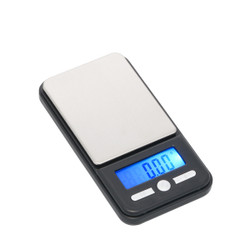
A pocket scale for collectibles should be selected by balancing two specifications:
capacity and resolution.
Capacity tells you the maximum total load the scale is designed to support.
Resolution—also commonly called readability—tells you the smallest increment shown on the display.
For example:
500g × 0.01g
means a scale has a nominal maximum capacity of 500 grams and displays measurements in increments of 0.01 gram.
For many small collectibles, a pocket scale with:
100–500g capacity × 0.01g readability
is a practical starting range.
For maximum versatility within the typical pocket-scale format:
500g × 0.01g
is particularly useful.
That configuration can accommodate many:
-
Coins
-
Tokens
-
Medals
-
Watches
-
Pins
-
Badges
-
Collectible jewelry pieces
-
Trading-card slabs
-
Miniatures
-
Small memorabilia
while still providing hundredth-of-a-gram readability.
Very small objects may justify:
0.001g readability
while larger figurines, die-cast models and boxed collectibles may require:
1–5kg+ capacity
and therefore may be better suited to a larger scale rather than a pocket scale.
The correct scale is not necessarily the one with the most decimal places.
It is the scale that provides:
enough capacity for your heaviest complete load and enough resolution for the smallest difference that matters.
Quick Guide: Pocket Scale Capacity and Resolution for Collectibles
| Collectible | Suggested Capacity | Suggested Readability |
|---|---|---|
| Individual coins | 100–200g | 0.01g |
| Coins in capsules | 100–250g | 0.01g |
| Small coin groups | 250–500g | 0.01g |
| Tokens | 100–500g | 0.01g |
| Pins and badges | 100–250g | 0.01g |
| Small medals | 200–500g | 0.01g |
| Watches | 250–500g | 0.01g–0.1g |
| Individual trading cards | 100–200g | 0.01g–0.1g |
| Graded card slabs | 200–500g | 0.01g–0.1g |
| Collectible jewelry | 100–500g | 0.01g |
| Miniatures | 100–500g | 0.01g |
| Tiny collectible components | 20–100g | 0.001g when genuinely needed |
| Small figurines | 500g–2kg | 0.1g |
| Die-cast models | 500g–5kg | 0.1g |
| Boxed collectibles | 1–5kg+ | 0.1g–1g |
These are general starting ranges.
Always choose around:
your actual objects, holders, trays and intended measurements.
What Is a Pocket Scale for Collectibles?
A pocket scale is a compact digital scale designed for portable small-object weighing.
Compared with larger bench or platform scales, pocket scales generally emphasize:
-
Compact dimensions
-
Portability
-
Fine readability
-
Battery operation
-
Small-object weighing
-
Easy storage
That makes them particularly useful for collectors who handle:
-
Coins
-
Jewelry
-
Tokens
-
Watches
-
Cards
-
Pins
-
Medals
-
Miniatures
They can also be useful at:
-
Coin shows
-
Collector conventions
-
Antique markets
-
Flea markets
-
Card shows
-
Estate sales
-
Dealer meetings
But compact size creates an important limitation:
capacity and platform dimensions are usually smaller than those of larger scales.
What Does Capacity Mean on a Pocket Scale?
Capacity is the maximum total physical load the scale is designed to support.
Suppose your scale has:
500g capacity.
Everything resting on the weighing platform contributes to that limit.
That includes:
-
Collectible
-
Tray
-
Holder
-
Capsule
-
Container
-
Protective dish
-
Multiple objects
For example:
Medal = 310g
Tray = 75g
Total physical load:
385g
A 500g scale has sufficient nominal capacity.
Now consider:
Collectible = 450g
Tray = 80g
Total:
530g
A 500g scale does not have enough capacity.
Tare Does Not Give You More Capacity
This is especially important with pocket scales.
Suppose:
Scale capacity = 500g
Tray = 80g
You place the tray on the scale and press tare.
The display returns to:
0.00g
But the load cell is still physically supporting:
80g.
You do not have another full 500g available.
Approximately:
420g
of nominal physical capacity remains.
Tare changes the displayed zero.
It does not increase the scale's maximum load.
What Does Resolution Mean?
Resolution, or readability, describes the smallest change shown on the display.
Common pocket-scale specifications include:
0.1g
Example:
25.1g
25.2g
25.3g
0.01g
Example:
25.11g
25.12g
25.13g
0.001g
Example:
25.111g
25.112g
25.113g
AWS explains the relationship between capacity and readability in What Does 500g × 0.01g Mean on a Digital Scale?.
The important distinction is:
capacity tells you how much you can weigh.
resolution tells you how finely the display changes.
You need both specifications to match your application.
100g vs. 200g vs. 500g Pocket Scales
These are three useful capacity ranges for collectible applications.
100g Pocket Scale
Best suited to:
-
Individual coins
-
Tokens
-
Rings
-
Small jewelry
-
Pins
-
Tiny components
-
Lightweight cards
Advantages:
-
Compact
-
Lightweight
-
Often available with fine readability
Limitation:
100g can become restrictive quickly.
A watch, heavy medal or group of coins may exceed the capacity.
Is 100g Enough for Coins?
For many individual coins:
yes.
Most individual coins weigh far below 100g.
A 100g × 0.01g scale can therefore provide sufficient capacity for:
-
Individual coins
-
Small tokens
-
Capsules
-
Lightweight holders
But if you want to weigh:
-
Multiple coins
-
Large medals
-
Heavy holders
-
Coin lots
more capacity becomes useful.
200g Pocket Scale
A 200g scale provides additional flexibility while remaining very compact.
It can suit:
-
Individual coins
-
Coin capsules
-
Tokens
-
Pins
-
Jewelry
-
Trading cards
-
Small medals
-
Lightweight watches
For a collector who mostly handles individual small objects:
200g × 0.01g
can be a very practical configuration.
Is 200g Enough for Watches?
Sometimes.
A lightweight watch may weigh:
70–120g.
A heavier stainless-steel watch may approach or exceed:
150–200g.
Add a tray and a 200g scale can become restrictive.
Collectors who routinely weigh watches may therefore prefer:
500g capacity.
500g Pocket Scale
For general collectible use:
500g is one of the most versatile pocket-scale capacities.
It can accommodate many:
-
Coins
-
Coin groups
-
Tokens
-
Medals
-
Watches
-
Pins
-
Badges
-
Jewelry pieces
-
Graded cards
-
Miniatures
-
Small memorabilia
while leaving more room for:
-
Trays
-
Holders
-
Capsules
-
Multiple pieces
If the same 0.01g readability is available at 200g and 500g capacities, the 500g model can provide considerably greater flexibility.
Why 500g × 0.01g Is a Strong All-Around Choice
Consider the types of measurements a mixed collector might make:
Coin = 26.72g
Watch = 158.46g
Medal = 284.32g
Graded card = 48.15g
Miniature = 112.67g
All of these fit comfortably within:
500g capacity.
And 0.01g readability provides enough displayed detail for many small-object comparisons.
This makes:
500g × 0.01g
a particularly strong general-purpose configuration.
When 500g Is Too Much Capacity
More capacity is not automatically necessary.
Suppose you exclusively collect:
-
Individual coins
-
Small tokens
-
Pins
and your heaviest complete load is:
45g.
A:
100g or 200g × 0.01g
pocket scale may be smaller and perfectly adequate.
Choose capacity according to what you actually weigh.
When 500g Is Not Enough
A pocket scale becomes the wrong tool when your objects regularly exceed its useful range.
Examples include:
-
Large figurines
-
Die-cast models
-
Statues
-
Heavy memorabilia
-
Boxed collectibles
Suppose:
Figurine = 780g
Base = 240g
Total:
1,020g
A 500g pocket scale cannot weigh the complete object.
A:
2kg or higher-capacity scale
is more appropriate.
0.1g vs. 0.01g vs. 0.001g for Collectibles
Capacity answers:
How heavy?
Resolution answers:
How detailed?
Let's compare the three most relevant readability levels.
When Is 0.1g Enough?
A 0.1g scale displays:
185.1g
185.2g
185.3g
This can be enough for:
-
Heavy watches
-
Large medals
-
Figurines
-
Die-cast models
-
Large coin groups
-
Memorabilia
For example, if a figurine weighs:
1,240.6g
there is usually little practical collectible value in knowing whether it weighs:
1,240.61g
or:
1,240.62g.
In this situation:
capacity matters more than hundredth-of-a-gram resolution.
When Is 0.01g Better?
A 0.01g scale displays:
26.71g
26.72g
26.73g
For many collectible applications, this provides an excellent balance.
Useful applications include:
-
Coins
-
Tokens
-
Watches
-
Small medals
-
Jewelry
-
Pins
-
Miniatures
-
Small components
AWS's Best Digital Scale for Coins guide identifies 0.01g readability as a practical general-purpose choice for many coin collectors.
For mixed small collectibles:
0.01g should usually be your starting point.
When Do You Need 0.001g?
A 0.001g scale displays thousandths of a gram.
That equals:
one milligram.
It can make sense for:
-
Tiny gemstones
-
Very small precious-metal fragments
-
Micro-components
-
Extremely lightweight collectible parts
-
Specialized research
But 0.001g scales tend to require more careful measurement conditions.
They can be more sensitive to:
-
Drafts
-
Vibration
-
Static
-
Temperature
-
Surface instability
AWS explains the tradeoff in 0.001g vs. 0.01g Scales: Which Precision Do You Need?.
For ordinary collectible weighing:
0.001g is usually unnecessary.
Does More Resolution Mean Better Accuracy?
No.
A scale showing:
26.721g
is not automatically more accurate than one showing:
26.72g.
Resolution describes:
display increment.
Accuracy describes how close the measurement is to the relevant actual or reference value within the scale's performance specifications.
Repeatability describes how consistently the same load produces similar measurements.
NIST's Calibration of Mass Standards program provides technical background on mass calibration and traceability.
When comparing pocket scales, consider:
-
Capacity
-
Readability
-
Stated accuracy
-
Repeatability
-
Minimum usable load
-
Calibration
-
Environmental stability
Do not buy solely by counting decimal places.
Why Repeatability Matters
Suppose you weigh the same collectible three times.
Scale A:
84.32g
84.32g
84.33g
Scale B:
84.321g
84.518g
84.207g
Scale B displays more decimal places.
But Scale A produces more useful consistency in this example.
For collectible documentation:
repeatability is extremely important.
Minimum Load Matters Too
Collectors often ask:
What is the maximum capacity?
But very light objects introduce another consideration:
minimum usable load.
A scale displaying 0.01g does not automatically mean every 0.01g object can be measured reliably.
If you need to weigh extremely small:
-
Gemstones
-
Metal fragments
-
Components
review the manufacturer's specifications carefully.
Best Pocket Scale Capacity for Coins
Coins are ideal pocket-scale objects.
For individual collectible coins:
100–200g × 0.01g
is generally plenty of capacity.
For:
-
Capsules
-
Groups
-
Larger tokens
-
Medals
consider:
250–500g × 0.01g.
AWS's Pocket Scale for Jewelry: What Capacity and Resolution Do You Need? similarly shows how moving from 200g to 500g preserves 0.01g readability while creating additional room for holders and heavier objects.
Can Coin Weight Prove Authenticity?
No.
Weight can be useful supporting evidence.
It can be compared with:
-
Published specifications
-
Known examples
-
Other physical measurements
But a digital scale cannot authenticate a coin by itself.
PCGS describes grading as an assessment of a coin's physical condition and uses established grading classifications. See PCGS Coin Grading.
Authentication can require additional examination of:
-
Diameter
-
Thickness
-
Composition
-
Design
-
Surface
-
Edge
-
Provenance
Weight is one data point.
Best Pocket Scale Capacity for Tokens
For individual tokens:
100–200g
is often sufficient.
For:
-
Multiple tokens
-
Large commemorative pieces
-
Heavy casino tokens
-
Groups
500g
provides more flexibility.
A:
500g × 0.01g
pocket scale therefore works well for collectors who handle both coins and tokens.
Best Pocket Scale for Medals
Medals are usually heavier than coins.
Small medal:
75g
Medium medal:
180g
Large medal:
350g
For mixed medal collections:
500g capacity
can be much more useful than 100g or 200g.
Readability of:
0.01g
provides detailed documentation.
For very large medals:
0.1g with higher capacity
may make more sense.
Best Pocket Scale for Watches
Watches are another reason to favor 500g capacity.
Suppose:
Watch = 175g
Protective tray = 55g
Physical load:
230g
A 200g scale cannot handle it.
A:
500g scale
provides comfortable headroom.
For many collectible watches:
500g × 0.01g
is therefore a practical pocket-scale configuration.
Can Weight Authenticate a Watch?
No.
Weight can be documented and compared.
But authentication may require examination of:
-
Movement
-
Case
-
Dial
-
Serial numbers
-
Materials
-
Finishing
-
Documentation
-
Provenance
A correct-looking weight is not proof of authenticity.
Best Pocket Scale for Trading Cards
Trading cards are extremely lightweight.
A pocket scale can be used to document:
-
Individual cards
-
Sleeved cards
-
Top loaders
-
Graded slabs
-
Small card groups
For ordinary documentation:
0.01g or 0.1g
provides plenty of detail.
Milligram-level 0.001g readability is generally unnecessary.
Card + Holder Weight Matters
Suppose:
Card = 1.8g
Sleeve = 0.7g
Top loader = 7.5g
Combined:
10.0g
If you record 10.0g, make clear that the measurement represents:
card + sleeve + holder.
Likewise, a graded slab measurement represents the entire encapsulated assembly.
Can Weight Grade a Trading Card?
No.
Trading-card grading considers characteristics beyond mass, including condition and authenticity.
Weight can be useful for:
-
Documentation
-
Comparison
-
Inventory research
but should not be treated as a grading method.
Best Pocket Scale for Pins and Badges
Pins and badges are excellent pocket-scale applications.
A:
100–250g × 0.01g
scale can handle most individual pieces easily.
A 500g model provides additional flexibility for:
-
Groups
-
Heavy badges
-
Display holders
-
Trays
Best Pocket Scale for Collectible Jewelry
For:
-
Rings
-
Earrings
-
Pendants
-
Brooches
-
Bracelets
-
Chains
0.01g readability
is highly practical.
Typical capacity ranges include:
100–250g
for individual pieces
and:
500g
for watches, heavy bracelets, multiple pieces and larger trays.
AWS's jewelry pocket-scale guidance likewise identifies 0.01g as a strong general-purpose readability for many jewelry applications.
Best Pocket Scale for Miniatures
Miniatures may weigh:
5–300g
depending on:
-
Material
-
Base
-
Size
-
Accessories
For many:
500g × 0.01g
provides an excellent range.
It can handle:
-
Metal miniatures
-
Resin miniatures
-
Bases
-
Small assemblies
-
Accessories
while still providing fine measurement detail.
Are Figurines Suitable for Pocket Scales?
Small figurines can be.
Large figurines often are not.
Example:
Figure = 390g
Base = 65g
Total:
455g
A 500g scale technically has enough capacity, although headroom is limited.
Now:
Figure = 720g
Base = 180g
Total:
900g
A pocket scale is no longer appropriate.
Choose a higher-capacity scale.
Best Pocket Scale for Small Antiques
Small antiques may include:
-
Keys
-
Small boxes
-
Jewelry
-
Silver pieces
-
Decorative objects
-
Historical accessories
If the objects stay below approximately 500g:
500g × 0.01g
provides a versatile pocket-scale range.
For heavier antiques, choose a larger scale.
Best Pocket Scale for Precious-Metal Collectibles
Precious-metal collectors may value:
-
Gram mode
-
Troy-ounce mode
-
Pennyweight
-
Fine readability
-
Calibration
-
Repeatability
For many coins and small precious-metal objects:
0.01g
is a practical general-purpose readability.
Tiny fragments may justify:
0.001g.
Remember:
weight does not determine purity.
A scale measures mass—not chemical composition.
Platform Size Matters
A pocket scale can have enough capacity but still be too small physically.
Suppose:
Collectible = 320g
Scale capacity = 500g
But the object is wide enough to:
-
Touch the desk
-
Lean against another item
-
Sit unevenly
The scale may not receive the entire load correctly.
The object should be supported appropriately by the weighing setup.
Overhang Is Not Automatically the Problem
An object can extend beyond the edge of a platform and still be weighed if:
-
It is stable.
-
The full load is supported by the platform.
-
It does not touch another surface.
The problem occurs when part of the load is transferred elsewhere.
For irregular objects, a suitable tray may help.
Why Tare Is Important on a Collectible Pocket Scale
Tare allows you to use a:
-
Tray
-
Container
-
Protective dish
without including it in the displayed net measurement.
Example:
Tray = 42.38g
Press tare.
Display:
0.00g
Add coin group.
Display:
156.72g
This is useful when you do not want collectibles resting directly on the platform.
Calibration Matters
Fine readability is useful only when the scale is being operated appropriately.
Look for a pocket scale with:
-
Documented calibration procedure
-
Clearly specified calibration mass
-
Accessible calibration mode
The required reference mass varies by model.
Do not assume:
500g capacity always means 500g calibration weight.
Follow the instructions for your exact scale.
Do Not Use a Random Coin for Calibration
Even if a coin has a published nominal weight, do not automatically treat it as a calibration standard.
Circulated coins can be affected by:
-
Wear
-
Damage
-
Corrosion
-
Residue
-
Contamination
Use an appropriate specified calibration reference.
Stable Surface Is Essential
Place your pocket scale on a:
-
Hard
-
Flat
-
Rigid
-
Stable
surface.
Avoid:
-
Couch
-
Bed
-
Carpet
-
Foam
-
Flexible shelf
-
Unstable table
A precision pocket scale can respond to very small disturbances.
Avoid Vibration
Do not place the scale on the same unstable surface as:
-
Printer
-
Speaker
-
Fan
-
Machinery
Vibration becomes increasingly relevant as readability becomes finer.
Avoid Strong Airflow
At:
0.01g
and especially:
0.001g
drafts can interfere with stable measurements.
Avoid direct airflow from:
-
Air-conditioning
-
Fans
-
Open windows
Give the display time to stabilize.
Static Can Matter
Plastic:
-
Card holders
-
Sleeves
-
Capsules
-
Trays
can contribute to static effects during fine weighing.
If measurements are unexpectedly unstable, consider:
-
Static
-
Drafts
-
Vibration
-
Surface stability
before assuming the scale itself is defective.
Useful Weighing Units for Collectors
A collectible pocket scale may support several units.
Grams
Best general-purpose unit for:
-
Coins
-
Watches
-
Medals
-
Cards
-
Miniatures
-
Jewelry
Troy Ounces
Useful for:
-
Gold
-
Silver
-
Precious-metal collectibles
Pennyweight
Useful in some precious-metal and jewelry applications.
Carats
Useful for:
-
Gemstones
-
Diamonds
Grains
Useful for specialized applications and some historical references.
For a mixed collection:
grams should be your baseline unit.
Portability Matters
One of the strongest reasons to choose a pocket scale is portability.
Collectors may want to carry a scale to:
-
Coin shows
-
Card conventions
-
Antique fairs
-
Estate sales
-
Flea markets
-
Dealer meetings
Look for:
-
Protective cover
-
Battery operation
-
Compact dimensions
-
Durable platform
-
Clear display
-
Easy controls
But portability should never come at the cost of insufficient capacity.
Protective Cover or Tray
Some pocket scales include a protective cover that may also function as a tray.
This can be useful for:
-
Coins
-
Tokens
-
Pins
-
Small components
If using any tray:
include its physical mass when calculating required capacity.
Tare removes its displayed value, not its physical load.
A Practical AWS Pocket Scale for Collectibles
For many mixed collectible applications, the AWS SC501g Precision Digital Pocket Scale provides:
500g capacity × 0.01g readability
along with features such as:
-
Stainless-steel platform
-
Backlit LCD
-
Tare
-
Multiple weighing units
-
Expansion trays
-
Battery operation
The 500g × 0.01g configuration is especially useful for collectors handling:
-
Coins
-
Tokens
-
Watches
-
Small medals
-
Jewelry
-
Pins
-
Miniatures
-
Other lightweight collectibles
AWS documentation confirms the SC-series 500g model uses 0.01g readability.
200g vs. 500g for Collectibles
Consider:
200g × 0.01g
Best for:
-
Individual coins
-
Tokens
-
Pins
-
Cards
-
Lightweight jewelry
-
Small components
500g × 0.01g
Better for:
-
Watches
-
Medals
-
Coin groups
-
Larger jewelry
-
Graded cards
-
Trays
-
Miniatures
Both provide:
0.01g readability.
The difference is:
capacity.
If portability and dimensions are comparable, 500g provides substantially more room for a mixed collection.
0.001g vs. 0.01g for Collectibles
Choose:
0.01g
for most:
-
Coins
-
Tokens
-
Watches
-
Medals
-
Jewelry
-
Miniatures
Choose:
0.001g
for genuinely tiny:
-
Gemstones
-
Precious-metal fragments
-
Micro-components
provided your application actually benefits from milligram-level readability.
For general collecting:
0.01g is usually the more practical choice.
Pocket Scale vs. Larger Scale for Collectibles
A pocket scale generally provides:
-
Portability
-
Compact size
-
Fine readability
-
Easy storage
A larger scale generally provides:
-
Higher capacity
-
Larger platform
-
Better support for large objects
-
Greater versatility for figurines and memorabilia
If your collection includes both tiny coins and multi-kilogram statues:
one scale may not be ideal.
Recommended Two-Scale Setup
For a broad collection:
Pocket Precision Scale
500g × 0.01g
Use for:
-
Coins
-
Tokens
-
Watches
-
Medals
-
Jewelry
-
Cards
-
Miniatures
Higher-Capacity Scale
2–5kg × 0.1g
Use for:
-
Figurines
-
Die-cast models
-
Large memorabilia
-
Boxed collectibles
This provides:
fine readability for small objects + practical capacity for larger objects.
Example 1: Coin
Coin:
26.72g
A:
100–500g × 0.01g
pocket scale provides appropriate capacity and useful detail.
Example 2: Coin Collection
12 coins:
246.35g
Tray:
68.20g
Total physical load:
314.55g
A 200g scale cannot handle the setup.
A:
500g scale
can.
Example 3: Watch
Watch:
182.47g
Tray:
54.28g
Physical load:
236.75g
A 200g scale is insufficient.
A 500g model provides adequate headroom.
Example 4: Medal
Medal:
325.64g
A 500g × 0.01g pocket scale can handle it.
Example 5: Graded Card
Card + slab:
47.8g
A 100g scale has sufficient capacity.
However, a 500g model provides greater flexibility for other collectibles.
Example 6: Miniature
Miniature:
84.37g
Base:
26.44g
Total:
110.81g
A:
200g or 500g × 0.01g
scale works well.
Example 7: Figurine
Figure:
760g
Base:
210g
Total:
970g
A 500g pocket scale cannot weigh it.
Use a:
1–2kg+ scale.
Example 8: Boxed Collectible
Collectible:
1.8kg
Box and inserts:
0.7kg
Total:
2.5kg
A pocket scale is the wrong tool.
A:
5kg scale
provides more appropriate capacity.
Common Pocket Scale Buying Mistakes
Buying Only by Decimal Places
More digits do not automatically mean better measurements.
Buying Too Little Capacity
A 100g scale becomes restrictive when you begin weighing watches, medals or groups.
Buying 0.001g When You Need 500g Capacity
Finer resolution can come with lower capacity.
Confusing Readability With Accuracy
0.01g is the displayed increment, not an automatic guarantee of ±0.01g accuracy.
Ignoring Repeatability
Consistent measurements matter.
Ignoring Minimum Load
Fine readability does not automatically define minimum useful load.
Forgetting Holder Weight
Capsules, slabs and trays count toward physical capacity.
Assuming Tare Restores Capacity
It does not.
Ignoring Platform Size
The collectible must be properly supported.
Letting the Object Touch the Counter
The entire load should be supported by the scale setup.
Ignoring Calibration
Follow model-specific instructions.
Calibrating With a Random Coin
Use the specified reference mass.
Ignoring Drafts
Fine-resolution scales can react to airflow.
Ignoring Vibration
Use a stable surface.
Ignoring Static
Plastic holders can affect very fine measurements.
Assuming Weight Proves Authenticity
It does not.
Using Weight to Determine Grade
Professional grading considers characteristics beyond mass.
Using Weight to Determine Metal Purity
A scale measures mass, not composition.
Using Weight to Determine Value
Rarity, condition, provenance and demand matter far more.
Pocket Scale for Collectibles Buying Checklist
Before buying, ask:
-
What collectibles will I weigh?
-
What is my lightest object?
-
What is my heaviest object?
-
Will I use a tray?
-
Will I weigh holders?
-
Do I need 100g capacity?
-
Is 200g enough?
-
Would 500g provide better flexibility?
-
Do I routinely exceed 500g?
-
Is 0.1g readability sufficient?
-
Do I need 0.01g?
-
Do I genuinely need 0.001g?
-
What accuracy specifications are provided?
-
What is the minimum usable load?
-
Are readings repeatable?
-
Is zero stable?
-
Can the scale be calibrated?
-
What calibration mass does it require?
-
Is the calibration weight included?
-
Does the scale offer tare?
-
Is the platform large enough?
-
Is a tray included?
-
Does it have a protective cover?
-
Does it support grams?
-
Do I need troy ounces?
-
Do I need pennyweight?
-
Do I need carats?
-
Is the display easy to read?
-
Does it use batteries?
-
Is it easy to carry?
-
Will I use it at collector shows?
-
Can I provide a stable weighing surface?
-
Can I avoid strong drafts?
-
Could vibration be a problem?
-
Would a second higher-capacity scale be useful?
-
Am I treating weight as measurement data rather than proof of authenticity or value?
Frequently Asked Questions
What is the best pocket scale for collectibles?
For many general collectible applications:
500g × 0.01g
is one of the most versatile configurations.
It combines useful capacity with fine readability.
What capacity pocket scale do I need?
For individual coins and very small objects:
100–200g
may be sufficient.
For mixed collectibles:
500g
provides greater flexibility.
Is 100g enough for collectibles?
It can be enough for:
-
Individual coins
-
Small tokens
-
Pins
-
Lightweight cards
-
Small jewelry
It becomes restrictive for watches, medals and groups.
Is 200g enough?
For many individual small collectibles:
yes.
But heavier watches, medals and trays may exceed 200g.
Is 500g better?
For a mixed collection:
500g is generally more versatile.
It can accommodate many watches, medals, coin groups, card slabs and miniatures while retaining fine readability.
What resolution do I need?
For most general collectible weighing:
0.01g
is an excellent starting point.
Is 0.1g enough?
For heavier collectibles:
yes.
It can be entirely appropriate for figurines, models and memorabilia.
Do I need 0.001g?
Only when you genuinely need to distinguish differences smaller than 0.01g.
For most collectors:
no.
Is 0.001g more accurate?
Not automatically.
It provides finer readability.
Accuracy and repeatability are separate considerations.
What pocket scale should I use for coins?
For individual coins:
100–250g × 0.01g
is practical.
For groups, medals and holders:
500g × 0.01g
offers more flexibility.
What pocket scale should I use for watches?
For many watches:
500g × 0.01g
provides useful capacity and detailed readability.
What pocket scale should I use for trading cards?
A:
100–500g scale with 0.01g or 0.1g readability
provides more than enough capacity for most cards and slabs.
What pocket scale should I use for medals?
For small and medium medals:
500g × 0.01g
is a useful general-purpose configuration.
What pocket scale should I use for miniatures?
For many small miniatures:
200–500g × 0.01g
works well.
Can I use a pocket scale for figurines?
Only if the complete figurine remains within capacity and can be supported correctly.
Large figurines generally require a higher-capacity scale.
Does tare increase capacity?
No.
The container or tray still contributes to physical load.
Should I calibrate my pocket scale?
Follow the manufacturer's calibration instructions for the exact model.
Can I calibrate with a coin?
Do not assume a coin is an appropriate calibration standard.
Use the specified reference mass.
Why does my pocket scale fluctuate?
Possible causes include:
-
Drafts
-
Vibration
-
Static
-
Weak batteries
-
Unstable surface
-
Improper load placement
-
Calibration problems
Can weight authenticate a collectible?
No.
Weight can support research and comparison, but authentication may require professional examination.
Can weight determine a collectible's grade?
No.
Grade generally reflects condition and other category-specific standards rather than mass alone.
Can weight tell me whether something is gold or silver?
No.
A scale measures mass, not material composition.
Should I buy one scale or two?
If your collection ranges from tiny coins to large figurines:
two scales can be the better solution.
Use:
500g × 0.01g
for small precision work
and:
2–5kg × 0.1g
for larger objects.
Final Verdict: What Pocket Scale Capacity and Resolution Do You Need for Collectibles?
The right pocket scale for collectibles depends on two specifications:
capacity and resolution.
For individual:
-
Coins
-
Tokens
-
Pins
-
Lightweight jewelry
100–200g × 0.01g
may provide everything you need.
For a broader collection including:
-
Coins
-
Watches
-
Medals
-
Jewelry
-
Graded cards
-
Miniatures
-
Small memorabilia
500g × 0.01g
is one of the strongest all-around configurations.
It gives you:
-
Fine hundredth-of-a-gram readability
-
Useful capacity
-
Room for holders and trays
-
Compact dimensions
-
Portability
Choose:
0.001g
only when milligram-level measurement genuinely matters.
Choose:
0.1g with higher capacity
when your collection moves into:
-
Figurines
-
Die-cast models
-
Heavy memorabilia
-
Boxed collectibles
And remember:
a pocket scale is not always the right scale.
Once objects regularly exceed 500g or no longer fit securely on a compact platform, a higher-capacity scale becomes more practical.
For a collector with a wide range of objects, the ideal setup may therefore be:
500g × 0.01g pocket precision scale
plus:
2–5kg × 0.1g higher-capacity scale.
Choose enough capacity for the complete physical load—including trays and holders—and enough resolution to show the smallest difference that actually matters.
That produces a pocket scale that is not merely precise on paper, but genuinely useful for your collection.