
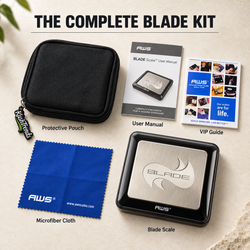
A pocket scale can make portion control more convenient at home, at work, or while traveling. Its compact size makes it easy to store and transport, while its fine resolution can be useful for measuring snacks, nuts, seeds, cheese, coffee, spices, and other small quantities.
The tradeoff is that pocket scales usually have lower capacities and smaller platforms than conventional kitchen scales. A model that measures in 0.01-gram increments may look impressive, but it may not support a normal plate or complete meal. Conversely, a pocket scale with a higher capacity may provide less resolution than you need for very small ingredients.
For general portion control, a pocket scale with a capacity between 500 and 1,000 grams and a resolution of 0.1 gram offers a useful balance. A 1-gram model can work for larger food portions, while a 0.01-gram scale should be reserved for genuinely small quantities.
This guide explains how capacity and resolution work together, which specifications suit different foods, and when a full-size kitchen scale is a better choice.
What Is a Pocket Portion-Control Scale?
A pocket scale is a small digital scale designed for portability and compact storage. It usually has:
-
A small weighing platform
-
Battery-powered operation
-
A protective cover
-
Multiple weighing units
-
A tare function
-
A backlit digital display
-
Fine resolution
-
A lower capacity than a kitchen scale
Despite the name, not every model will fit comfortably into a clothing pocket. The term generally describes a compact scale that is smaller and easier to transport than a countertop kitchen scale.
Pocket scales are commonly used for small objects and ingredients, but suitable models can also support food portioning. Browse the American Weigh Scales selection of digital pocket scales to compare available capacities and form factors.
What Can You Measure With a Pocket Food Scale?
A pocket scale can be useful for:
-
Nuts
-
Seeds
-
Cheese
-
Dried fruit
-
Candy
-
Coffee beans
-
Spices
-
Condiments
-
Baking ingredients
-
Nutritional powders
-
Small protein portions
-
Portable snacks
It may also help when dividing a small package into consistent servings.
Pocket scales are less suitable for:
-
Complete dinner plates
-
Large meal-prep containers
-
Heavy glass bowls
-
Large batches
-
Pots and pans
-
Family-size recipes
The limitation may be capacity, platform size, or both.
Understanding Scale Capacity
Capacity is the maximum total weight the scale is designed to support.
A pocket scale may have a capacity of:
-
100 grams
-
200 grams
-
500 grams
-
650 grams
-
1,000 grams
-
2,000 grams
The stated capacity includes the container. Pressing tare changes the displayed number but does not remove the container’s physical weight from the scale.
Suppose a small bowl weighs 250 grams and the food weighs 300 grams. The total load is:
250 g + 300 g = 550 g
A 500-gram pocket scale would be overloaded, even if you pressed tare after placing the empty bowl on it.
Understanding Scale Resolution
Resolution is the smallest weight increment displayed by the scale.
Common pocket-scale resolutions include:
-
1 gram: shown as whole grams
-
0.1 gram: shown to one decimal place
-
0.01 gram: shown to two decimal places
-
0.001 gram: shown to three decimal places
Resolution does not automatically equal accuracy. A scale may display many decimal places without measuring the true mass to the same degree.
Accuracy is closeness to the true value. Repeatability describes whether the scale provides the same result when the same item is measured repeatedly under unchanged conditions.
For portion control, dependable repeatability and appropriate capacity are normally more important than choosing the finest available resolution.
Recommended Capacity and Resolution
| Portion-control task | Suggested capacity | Suggested resolution |
|---|---|---|
| Spices and seasoning | 100–500 g | 0.01–0.1 g |
| Coffee beans | 500–1,000 g | 0.1 g |
| Nuts and seeds | 500–1,000 g | 0.1 g |
| Cheese portions | 500–1,000 g | 0.1–1 g |
| Small snacks | 500–1,000 g | 0.1–1 g |
| Condiments | 500–1,000 g | 0.1 g |
| Small protein portions | 1,000–2,000 g | 1 g |
| Complete meal containers | 3,000–5,000 g | 1 g |
| Large-batch meal prep | 5,000 g or more | 1 g |
These are general starting points. Include the container’s weight and check whether its base fits on the platform.
Is a 100-Gram Pocket Scale Enough?
A 100-gram scale has limited food applications. It may work for:
-
Spices
-
Seasoning blends
-
Small amounts of coffee
-
Yeast
-
Very small quantities of powder
The container must be extremely lightweight. Even a small cup can use most of the available capacity.
A 100-gram model is better treated as a specialized secondary scale than a general portion-control tool.
When to Choose a 500-Gram Scale
A 500-gram pocket scale provides more flexibility for smaller foods.
It may work for:
-
Nuts
-
Seeds
-
Dried fruit
-
Cheese
-
Coffee
-
Small snacks
-
Condiments
-
Baking ingredients
A lightweight tray or cup is important. If the container weighs 200 grams, only 300 grams of physical capacity remains for food.
For users who measure small portions rather than complete meals, a 500-gram model can offer a practical combination of portability and precision.
When to Choose a 1,000-Gram Scale
A 1,000-gram pocket scale is a versatile choice for general portable portion control.
It can accommodate:
-
Lightweight containers
-
Larger snack portions
-
Fruit
-
Cheese
-
Cooked grains
-
Small protein portions
-
Coffee and baking ingredients
A 1-kilogram capacity provides more headroom than a 500-gram model without necessarily requiring a full-size kitchen scale.
However, platform dimensions still matter. A scale may support 1,000 grams while being too small to hold your container securely.
When to Choose 2,000 Grams or More
A capacity of 2,000 grams can support larger portions and heavier containers, but the scale’s compact platform may become the main limitation.
A large bowl or meal container may:
-
Cover the display
-
Block the buttons
-
Tip or shift
-
Touch the countertop
-
Prevent proper centering
If you regularly need more than 2,000 grams, compare pocket scales with the larger models in the AWS kitchen scale collection. A kitchen format will often be easier to use with complete meals.
Do You Need 0.01-Gram Resolution?
Most portion-control tasks do not require 0.01-gram resolution.
A hundredth of a gram is too small to make a practical difference when weighing:
-
Chicken
-
Fish
-
Rice
-
Pasta
-
Vegetables
-
Fruit
-
Bread
-
Complete snacks
It may be useful for very small quantities of spices, yeast, or other fine ingredients. Even then, the scale’s overall accuracy, minimum useful load, and environmental stability must be appropriate.
A 0.01-gram scale may respond visibly to air movement, vibrations, static electricity, and temperature changes. The extra decimal place can make the reading look more exact without making it more useful.
Why 0.1-Gram Resolution Is Often the Best Choice
A resolution of 0.1 gram is detailed enough for many small food portions without the extreme sensitivity of an ultra-fine scale.
It is useful for:
-
Nuts
-
Seeds
-
Cheese
-
Coffee
-
Condiments
-
Baking ingredients
-
Snack portions
-
Small amounts of dry food
A 0.1-gram scale can show meaningful differences between small portions while remaining straightforward to use.
Some kitchen scales also combine 0.1-gram readability with greater capacity. For example, the Barista 3-kilogram coffee and kitchen scale is listed with a 3-kilogram capacity and 0.1-gram readability. This type of combination may be more practical when you need fine measurements and room for larger containers.
When One-Gram Resolution Is Sufficient
A scale that reads in whole grams is sufficient for most normal food portions.
One-gram resolution is appropriate for:
-
Meat and fish
-
Cooked grains
-
Pasta
-
Potatoes
-
Vegetables
-
Fruit
-
Bread
-
Larger snacks
If your intended portion is approximately 100 grams, a reading of 99 or 101 grams normally provides enough detail.
A whole-gram display may also stabilize more quickly than an ultra-fine display, particularly in a normal kitchen or office environment.
Accuracy Versus Displayed Detail
A common mistake is assuming that a scale displaying 25.47 grams must be more accurate than one displaying 25.5 grams.
Displayed detail is resolution. Accuracy depends on:
-
Sensor quality
-
Calibration
-
Battery condition
-
Surface stability
-
Temperature
-
Load position
-
Overload history
-
Mechanical condition
A scale can provide a highly detailed but incorrect result. Review the manufacturer’s accuracy or tolerance information rather than judging performance solely by decimal places.
The National Institute of Standards and Technology’s Office of Weights and Measures provides broader information about weighing and dependable measurement practices.
Choose Capacity Before Resolution
When selecting a pocket scale, determine the required capacity first.
Use this process:
-
Identify the heaviest food portion you expect to measure.
-
Weigh or estimate the container.
-
Add the two values.
-
Add additional capacity headroom.
-
Select the necessary resolution within that capacity range.
If you reverse the process and choose resolution first, you may end up with a beautifully detailed scale that cannot support your bowl and food.
Platform Size and Load Placement
A compact platform is convenient for storage but can create practical problems.
For an accurate measurement:
-
Center the load.
-
Make sure the container is stable.
-
Prevent the container from touching the counter.
-
Keep the display visible.
-
Avoid pressing against the scale.
-
Do not allow food to fall beneath the platform.
A container can extend beyond the platform as long as it is stable and entirely supported by the scale. If its edge touches the counter, some of the load bypasses the sensor and the reading will be too low.
Why the Tare Function Matters
Tare resets the display to zero while a container remains on the scale.
To use it:
-
Turn on the scale on a stable surface.
-
Wait for zero.
-
Place the empty container in the center.
-
Press tare.
-
Confirm that the display returns to zero.
-
Add food.
-
Record the food weight.
You can also tare between multiple ingredients. This is convenient when building a snack or small meal in one container.
Remember that the container still counts toward maximum capacity.
Important Pocket-Scale Features
Protective Cover
A cover protects the platform and controls during transportation. Some covers can also function as a weighing tray.
If using the cover as a tray, confirm that it is clean, stable, and suitable for contact with the food or food wrapper.
Clear Display
Look for:
-
Large digits
-
Good contrast
-
Backlighting
-
A visible unit indicator
-
An overload message
-
A low-battery warning
The display should remain visible when the container is on the platform.
Multiple Weighing Units
The most useful units for food portioning are grams and ounces. Grams are particularly convenient because they provide straightforward numerical values.
Always confirm the active unit before recording the result.
Automatic Shutoff
Automatic shutoff preserves battery life, but a very short timer may interrupt portioning. Look for enough operating time to prepare and record your food.
Stable Buttons
Buttons should respond without requiring enough pressure to move the scale. Tare and unit controls should be easy to distinguish.
Food-Friendly Surface
A smooth, wipeable platform is easier to maintain. If you weigh food directly, confirm that the surface is suitable for that use. A clean tray, parchment sheet, or lightweight container may simplify cleanup.
Calibration and Performance Checks
Calibration compares the scale’s reading with a known reference mass.
You may need to check calibration:
-
When the scale is new
-
After travel
-
After a drop or impact
-
After substantial temperature changes
-
When readings appear inconsistent
-
When a proper test mass produces an unexpected result
Use only the calibration weight required by the manufacturer. Coins, packaged food, phones, and household objects are not reliable calibration standards.
AWS offers calibration weights and weighing accessories for compatible equipment.
To check repeatability:
-
Weigh the same stable object.
-
Record the result.
-
Remove the object.
-
Let the scale return to zero.
-
Replace the object in the same position.
-
Repeat several times.
Results should remain consistent within the scale’s stated tolerance.
Using a Pocket Scale With Nutrition Information
A scale measures mass. It does not directly calculate calories, protein, carbohydrates, fat, fiber, or sodium.
To estimate nutrients:
-
Weigh the food.
-
Find the appropriate nutrition entry.
-
Match the food’s condition.
-
Calculate nutrients for the measured amount.
-
Record the result consistently.
USDA FoodData Central provides nutrient information for many foods. Make sure the entry matches whether the food is raw, cooked, drained, peeled, or prepared with additional ingredients.
For packaged foods, the FDA Nutrition Facts Label guide explains serving weights and declared nutrient amounts.
More decimal places will not correct an inaccurate food entry. A reliable calculation requires both a dependable weight and appropriate nutrition data.
Portion Size Is Personal
A pocket scale can measure a portion, but it cannot determine the ideal amount for every person.
Portion needs may depend on:
-
Age
-
Activity
-
Health considerations
-
Dietary pattern
-
Personal goals
-
Total daily intake
-
Professional recommendations
The federal MyPlate resource offers general food-group and meal-planning information. Broader dietary recommendations are available through the Dietary Guidelines for Americans.
The goal of a portion-control scale should be greater awareness and consistency—not anxiety over tiny differences that have little practical meaning.
Pocket Scale Versus Kitchen Scale
| Feature | Pocket scale | Kitchen scale |
|---|---|---|
| Portability | Excellent | Moderate |
| Storage | Minimal space | More space |
| Small portions | Excellent | Good |
| Fine resolution | Common | Available |
| Complete meals | Limited | Excellent |
| Large containers | Often difficult | Better suited |
| Typical capacity | Low to moderate | Moderate to high |
| Batch preparation | Limited | Better suited |
Choose a pocket scale for portability and smaller portions. Choose a kitchen scale when you regularly weigh full meals or large containers.
A higher-capacity model such as the Neptune 5-kilogram kitchen scale may be more practical when your food and containers routinely exceed the capabilities of a pocket scale.
Common Mistakes to Avoid
Choosing Resolution Before Capacity
The scale must first support the complete load.
Forgetting Container Weight
Tare changes the display, not the physical weight on the sensor.
Using a Container That Touches the Counter
This prevents the scale from measuring the full load.
Weighing on an Unstable Surface
Soft, tilted, or vibrating surfaces can produce inconsistent readings.
Overloading the Scale
Exceeding capacity can damage the load cell permanently.
Expecting a Pocket Scale to Handle Every Meal
Compact models are excellent for small portions but may not replace a kitchen scale.
Using Household Objects for Calibration
Use the correct reference mass specified in the manual.
Maintaining a Pocket Portion Scale
To preserve performance:
-
Store the scale with its cover in place.
-
Keep the platform clean.
-
Wipe spills promptly.
-
Do not immerse the scale.
-
Avoid drops and impacts.
-
Do not store heavy objects on the platform.
-
Replace weak batteries.
-
Keep it away from heat and steam.
-
Check calibration after extensive travel.
-
Never exceed maximum capacity.
Additional care information is available in the AWS guide to digital scale maintenance.
Frequently Asked Questions
What is the best capacity for a pocket portion-control scale?
A capacity between 500 and 1,000 grams is practical for many snacks and small ingredients. Choose 2,000 grams or more if you need larger portions and containers.
Is 0.1-gram resolution good for portion control?
Yes. It provides useful detail for nuts, seeds, cheese, coffee, condiments, and other small quantities.
Do I need 0.01-gram resolution?
Usually not. It is most useful for very small ingredients and specialized measurements, not normal food portions.
Can I weigh a complete meal on a pocket scale?
Possibly, if the food and container remain below the capacity and fit on the platform. A kitchen scale is generally easier for full meals.
Does tare increase the scale’s capacity?
No. Tare resets the displayed value, but the scale continues to support the container’s physical weight.
Can a pocket scale calculate calories?
No. It measures mass. Calorie estimates require nutrition information from an appropriate label, database, or recipe.
Why does my pocket scale reading fluctuate?
Possible causes include drafts, vibration, temperature changes, weak batteries, an uneven surface, movement, or an off-center load.
How often should I calibrate a pocket scale?
Follow the manufacturer’s instructions. Check calibration after transportation, impact, environmental changes, or unexpected readings.
Is a pocket scale accurate enough for food?
A suitable, properly calibrated model can provide useful food measurements within its stated capacity and tolerance. Choose specifications appropriate for the portion being weighed.
Final Thoughts
The best pocket scale for portion control should balance portability with practical capacity. For many users, a model with a capacity between 500 and 1,000 grams and a resolution of 0.1 gram provides the most useful combination.
Choose 0.01-gram resolution only for very small quantities. Choose 1-gram resolution when your portions are larger and fine decimal measurements offer little practical benefit. If you regularly weigh complete meals, heavy plates, or large containers, a full-size kitchen scale will usually be the better option.
Before buying, calculate the combined weight of your food and container, examine the platform dimensions, confirm the available units, and check whether the model supports proper calibration.
When capacity and resolution match the task, a pocket scale can provide convenient, repeatable portion measurements without taking up valuable space.