
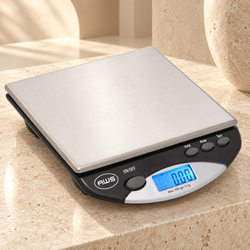
A pocket scale for postage can be useful when you regularly ship lightweight products and want a compact weighing solution that does not take over your packing station.
But postage presents a different challenge from jewelry, ingredients or laboratory-style precision work.
For shipping, you usually do not need extremely fine 0.01g or 0.001g readability.
You need enough:
capacity to support the entire packed shipment
combined with:
useful ounce or gram readability.
For very small parcels, a compact postal or bench scale may be enough.
For broader home-business shipping:
13 lb capacity
can cover many lightweight orders.
For businesses that need greater flexibility:
55 lb × 0.1 oz
is often a much more versatile shipping configuration.
And if your cartons regularly become heavier:
110 lb × 0.1 oz
may be more practical than trying to make a compact low-capacity scale handle every shipment.
The goal is not to buy the smallest scale possible.
It is to choose the smallest scale that still covers your real shipping range.
Quick Answer: What Capacity and Resolution Do You Need?
| Shipping Application | Capacity to Consider | Useful Readability |
|---|---|---|
| Letters and very light mail | Low-capacity postal scale | Fine ounce/gram increments |
| Jewelry shipments | 5–13 lb | 0.1 oz or finer |
| Small accessories | 5–13 lb | 0.1 oz |
| Cosmetics | 13 lb | 0.1 oz |
| Small electronics | 13 lb | 0.1 oz |
| Apparel mailers | 13–25 lb | 0.1 oz |
| Small eCommerce packages | 13–25 lb | 0.1 oz |
| Multi-item orders | 25–55 lb | 0.1 oz |
| General small-business shipping | 55 lb | 0.1 oz |
| Larger cartons | 55–110 lb | 0.1 oz |
| Heavy commercial shipments | 110 lb+ | Appropriate shipping readability |
For a genuinely compact shipping setup:
13 lb capacity
can be useful if your packages consistently stay lightweight.
For greater long-term versatility:
55 lb × 0.1 oz
provides substantially more room.
What Is a Pocket Scale for Postage?
A pocket or compact postage scale is a relatively small digital scale used to weigh:
-
Letters
-
Mailers
-
Small cartons
-
Jewelry packages
-
Cosmetics
-
Accessories
-
Collectibles
-
Small electronics
-
Lightweight eCommerce orders
The primary advantage is:
compact size.
A smaller scale can be useful for:
-
Home businesses
-
Apartment-based sellers
-
Small packing desks
-
Mobile shipping setups
-
Occasional online sellers
But compact dimensions often come with lower capacity or a smaller platform.
That makes capacity selection especially important.
Pocket Scale vs. Full-Size Shipping Scale
A compact postage scale generally prioritizes:
-
Smaller footprint
-
Portability
-
Lightweight-package measurement
-
Easy storage
A larger shipping scale generally prioritizes:
-
Higher capacity
-
Larger boxes
-
Larger platform
-
Remote display
-
Continuous shipping workflows
Neither type is automatically better.
The correct choice depends on what you actually ship.
Start With Your Heaviest Finished Package
Do not choose a postage scale based only on product weight.
Your scale needs to support:
the complete packed shipment.
Suppose:
Product = 10 oz
Mailer = 1.2 oz
Padding = 0.6 oz
Insert = 0.2 oz
Tape and label = 0.1 oz
Total:
12.1 oz
That completed package weight is what matters for the shipping workflow.
USPS specifically advises shippers to include everything—including packing materials—when determining package weight.
Packaging Can Add More Weight Than You Expect
Packaging may include:
-
Corrugated box
-
Poly mailer
-
Bubble wrap
-
Packing paper
-
Foam
-
Product inserts
-
Manuals
-
Promotional cards
-
Tape
-
Labels
Suppose your product weighs:
2.4 lb
Your finished shipment might weigh:
Product = 2.4 lb
Box = 0.6 lb
Packing = 0.3 lb
Total:
3.3 lb
Always plan capacity around:
the finished package.
Is a Very Small Pocket Scale Enough for Postage?
Possibly, if you ship only tiny products.
Examples include:
-
Jewelry
-
Trading cards
-
Small accessories
-
Small replacement components
-
Lightweight collectibles
But a pocket scale designed primarily for fine gram measurements may have only:
-
200g
-
500g
-
1kg
of capacity.
That is far too little for many normal parcel shipments.
For perspective:
500g is only about 1.1 lb.
A padded mailer with several products can exceed that quickly.
Why a 500g Precision Pocket Scale Is Usually Too Small
A 500g × 0.01g pocket scale may be excellent for:
-
Jewelry
-
Components
-
Ingredients
-
Pigments
But for postage, it has two drawbacks.
First:
500g capacity is very limited for packages.
Second:
0.01g readability is far finer than normal postage requires.
For most shipping applications, you would be trading away useful capacity for unnecessary precision.
Is a 1kg Pocket Scale Enough?
A 1kg scale supports approximately:
2.2 lb
That may cover:
-
Jewelry packages
-
Small accessories
-
Lightweight cosmetics
-
Tiny electronics
-
Very small mailers
But even modest multi-item orders can exceed 2.2 lb.
A seller whose business is growing may therefore outgrow a 1kg scale quickly.
Is a 5 lb Scale Enough?
A 5 lb scale can work for a tightly controlled lightweight catalog.
Examples include:
-
Jewelry
-
Accessories
-
Beauty samples
-
Small collectibles
-
Phone accessories
Suppose your normal package range is:
3 oz to 2.5 lb
A 5 lb scale provides adequate headroom.
But if bundled orders are common, more capacity is usually preferable.
Is a 13 lb Scale Better?
For many compact home-business setups:
yes.
A 13 lb scale gives you significantly more flexibility while remaining relatively compact.
It can accommodate:
-
Jewelry orders
-
Cosmetics
-
Accessories
-
Small electronics
-
Apparel
-
Books
-
Small home products
-
Multi-item shipments
A 13 lb-class bench scale can be a useful middle ground between a tiny pocket scale and a larger dedicated shipping platform.
When 13 lb Is Enough
Suppose your shipping history shows:
Average package = 2.8 lb
90% of packages = under 6 lb
Heaviest package = 9 lb
A:
13 lb scale
provides reasonable capacity.
There is still headroom for somewhat heavier orders without moving to a larger shipping scale.
When 13 lb Is Not Enough
Suppose:
Product A = 4 lb
Product B = 5 lb
Product C = 3 lb
Customer orders all three:
Products = 12 lb
Packaging = 1.5 lb
Completed shipment:
13.5 lb
A 13 lb scale is already insufficient.
This is why combined-order weight matters.
Why 55 lb Is More Versatile
A:
55 lb × 0.1 oz
shipping scale can cover everything from lightweight mailers through medium cartons.
This makes it useful for businesses with:
-
Growing catalogs
-
Multi-item orders
-
Product bundles
-
Larger boxes
-
Returns
-
Occasional wholesale orders
The AWS PS-25 provides a 55 lb shipping-scale configuration designed around package and postage weighing.
When Do You Need 110 lb?
A 110 lb model becomes relevant when you regularly ship:
-
Large cartons
-
Wholesale orders
-
Heavy products
-
Multi-product bundles
-
Home goods
-
Equipment
Suppose:
Shipment = 72 lb
A 55 lb scale cannot weigh it.
A:
110 lb scale
provides sufficient nominal capacity.
The AWS SE-50 is designed for this heavier shipping range and uses a remote display that can remain visible when larger packages occupy the platform.
Capacity Matters More Than Extreme Precision
This is one of the most important points when choosing a compact postage scale.
Suppose you are comparing:
Scale A
500g × 0.01g
Scale B
13 lb × 0.1 oz
For shipping a:
4 lb package
Scale A is useless despite its finer resolution.
Scale B can actually perform the job.
For postage:
adequate capacity comes first.
What Does Resolution Mean on a Postage Scale?
Resolution—or readability—is the smallest change displayed by the scale.
A postage scale may display weight in:
-
oz
-
lb
-
lb:oz
-
g
-
kg
For example:
1 lb 4.1 oz
1 lb 4.2 oz
1 lb 4.3 oz
A 0.1 oz increment gives useful detail for many parcel-shipping applications.
Is 1 oz Resolution Enough?
For some larger shipments:
possibly.
If your packages weigh 40–50 lb, whole-ounce resolution may provide sufficient practical information depending on the carrier workflow.
However, for lightweight parcels, finer increments can be much more useful.
Is 0.1 oz Better?
For many home and small-business postage workflows:
0.1 oz readability is highly practical.
It provides useful detail for:
-
Small parcels
-
Mailers
-
Cosmetics
-
Accessories
-
Apparel
-
eCommerce packages
without moving into unnecessary milligram precision.
What About 1g Resolution?
One gram equals approximately:
0.035 oz
Gram resolution can be useful for:
-
Very lightweight shipments
-
Metric records
-
International workflows
-
Product-weight documentation
For example:
Package A = 425 g
Package B = 438 g
That difference can be useful when comparing packaging.
Do You Need 0.1g Resolution?
For ordinary postage:
rarely.
0.1g is far finer than what is normally required for package shipping.
It becomes more relevant for:
-
Ingredients
-
Small components
-
Fine formulation
-
Jewelry
rather than multi-ounce or multi-pound parcels.
Do You Need 0.01g Resolution?
For ordinary package postage:
no.
The difference between:
1,000.00g
and:
1,000.01g
has essentially no practical relevance to normal shipping.
Instead of paying for extreme resolution, prioritize:
-
More useful capacity
-
Stable readings
-
Appropriate platform
-
Clear display
More Decimal Places Do Not Mean a Better Postage Scale
A scale displaying:
1000.00g
is not automatically better for shipping than one displaying:
2 lb 3.3 oz
The latter may be substantially more practical because it:
-
Supports more weight
-
Uses shipping-friendly units
-
Handles packages
-
Provides appropriate readability
Choose the specifications that fit the application.
Readability Is Not Accuracy
A scale displaying:
4 lb 8.2 oz
has a certain readability.
That does not automatically guarantee that the true mass is exactly within ±0.1 oz.
Accuracy is separate from:
-
Display resolution
-
Repeatability
-
Calibration
NIST provides broader technical information about mass measurement and calibration through its calibration programs.
Repeatability Matters
Suppose you place the same package on the scale three times.
You see:
2 lb 8.3 oz
2 lb 8.3 oz
2 lb 8.4 oz
That is useful consistency.
Now suppose you see:
2 lb 8.3 oz
2 lb 12.9 oz
2 lb 5.1 oz
Something may be interfering with the measurement.
AWS discusses possible causes in its article on why digital scales can give different readings.
Platform Size Is Critical for Compact Scales
A compact scale can have enough weight capacity yet still be physically too small.
Suppose:
Scale capacity = 13 lb
Package weight = 5 lb
But your carton is wide enough to:
-
Cover the display
-
Lean against another object
-
Rest partly on the table
The weight capacity is technically sufficient.
The physical weighing setup is not.
Your Package Must Be Properly Supported
The package should sit securely on the weighing platform.
Avoid allowing it to:
-
Lean against a wall
-
Touch shelves
-
Rest partly on a table
-
Sit against another package
External support can reduce the load transferred to the scale.
Large Boxes Can Hide the Display
This is a common disadvantage of compact postage scales.
A large package may completely cover an integrated LCD.
Possible solutions include:
-
Larger platform
-
Raised display
-
Remote display
-
Tilt-up design
If oversized packages are common, a full shipping scale may be better than a true pocket-scale format.
Remote Display vs. Compact Display
Integrated Display
Best for:
-
Small mailers
-
Small cartons
-
Compact products
Remote Display
Better for:
-
Wide boxes
-
Large cartons
-
Warehouse work
-
Heavier shipments
If package size is increasing, display placement becomes an important buying criterion.
Do You Need Tare?
Tare can be useful for shipping-related workflows.
Suppose:
Reusable packing tote = 3 lb
Place it on the scale.
Press tare.
Display:
0 lb
Add products.
The display shows only the added merchandise.
This can help with:
-
Inventory
-
Packing
-
Product preparation
Tare Does Not Restore Capacity
Suppose:
Scale capacity = 13 lb
Container = 3 lb
After pressing tare, the scale displays:
0 lb
But the platform is still physically supporting 3 lb.
Approximate remaining capacity:
10 lb
Tare resets the displayed zero.
It does not increase physical capacity.
Do Not Remove Packaging Weight From Final Postage
When purchasing shipping, you generally need the weight of:
the complete packed parcel.
That includes:
-
Product
-
Box
-
Mailer
-
Padding
-
Tape
-
Inserts
-
Label
USPS explicitly advises including packing materials when determining weight.
Calibration Still Matters
Even a compact postage scale should have a clearly documented calibration process when calibration is supported.
Before buying, ask:
-
Can I calibrate it?
-
What reference weight is required?
-
Is that weight included?
-
Are instructions provided?
AWS explains the general process in its digital-scale calibration guide.
Calibration Requirements Are Model-Specific
Do not assume:
scale capacity = calibration weight.
A 13 lb scale does not automatically require a 13 lb calibration reference.
Likewise, a 55 lb scale does not automatically require 55 lb.
Follow the specific instructions for the model.
Use an Appropriate Calibration Reference
Do not assume that:
-
Dumbbells
-
Bottled water
-
Books
-
Packages
-
Household objects
are suitable substitutes for a specified calibration weight.
NIST provides technical guidance on mass calibration and reference standards.
For ordinary shipping equipment:
follow the manufacturer's specified calibration procedure.
Stable Surface Matters
A compact postal scale should sit on a:
-
Hard
-
Flat
-
Stable
-
Rigid
surface.
Avoid:
-
Carpet
-
Foam
-
Flexible packing mats
-
Upholstery
-
Wobbly tables
A small scale is especially easy to place on an unsuitable surface because of its compact size.
Actual Weight vs. Dimensional Weight
Your pocket postage scale tells you:
actual package weight.
That does not necessarily equal:
billable shipping weight.
Carriers can also apply dimensional-weight rules.
UPS explains dimensional weight as the amount of space a package occupies compared with its actual weight, and notes that dimensional weight may apply to domestic and international package services.
Why Compact Sellers Still Need to Measure Boxes
Suppose your package weighs:
4 lb
but its box is unusually large.
Your scale can correctly report 4 lb.
But package dimensions may result in a higher dimensional weight.
FedEx states that applicable shipments can be charged using actual weight or dimensional weight, whichever is greater.
So even with a perfect scale:
measure your package dimensions too.
USPS Dimensional Weight
USPS also applies dimensional-weight rules to certain large lightweight packages.
Its current shipping guidance states that when applicable, customers need to enter package dimensions in the USPS Price Calculator; USPS's service guidance describes DIM calculations for packages larger than one cubic foot.
Therefore:
weight + dimensions
are both important shipping data.
Best Compact Shipping Station Setup
For a home seller, a compact shipping station can include:
digital postage scale
plus:
measuring tape
plus:
shipping software
The scale provides actual weight.
The measuring tape provides:
-
Length
-
Width
-
Height
The shipping platform applies current carrier rules.
Best Pocket Scale for Jewelry Postage
Jewelry packages are often lightweight.
A compact scale with several pounds of capacity can easily handle:
-
Jewelry
-
Gift box
-
Mailer
-
Padding
However, avoid choosing an ultra-low 200g or 500g precision scale simply because the jewelry itself is light.
The final shipping package can be substantially heavier than the product.
Best Pocket Scale for Cosmetics Postage
Cosmetics may include:
-
Bottles
-
Jars
-
Protective packaging
-
Boxes
-
Multiple-item orders
For this category:
13 lb capacity
can be significantly more practical than a true 500g pocket scale.
If customers regularly purchase multiple products:
25–55 lb
provides additional room.
Best Compact Scale for Apparel Shipping
Apparel is often relatively lightweight, but orders can grow quickly.
One shirt may weigh only:
8 oz
But an order containing:
-
Several shirts
-
Hoodie
-
Packaging
-
Inserts
can weigh several pounds.
A 13 lb scale can work well for many apparel sellers, while 55 lb provides much more flexibility for larger orders.
Best Pocket Scale for Collectibles
Collectibles range from:
-
Trading cards
to:
-
Heavy boxed objects.
If your inventory is consistently tiny:
5–13 lb
may be sufficient.
If product size varies greatly:
55 lb
may provide better long-term flexibility.
Best Compact Scale for Etsy Sellers
A small Etsy seller shipping:
-
Jewelry
-
Art prints
-
Accessories
-
Small handmade products
may find 13 lb capacity sufficient.
But sellers handling:
-
Candles
-
Ceramics
-
Décor
-
Product bundles
may benefit from:
25–55 lb capacity.
Best Compact Scale for eBay Sellers
An eBay reseller may ship:
-
Cards
-
Electronics
-
Collectibles
-
Parts
-
Tools
-
Home products
Because inventory can change rapidly, a very low-capacity pocket scale may become restrictive.
For a broad reseller catalog:
55 lb capacity
can offer better long-term flexibility.
Best Compact Scale for Small Businesses
For a small business, determine:
the heaviest realistic combined order
rather than the average package.
Average shipment:
3 lb
does not mean your maximum shipment is 3 lb.
If occasional bundles reach:
20–30 lb
a 13 lb scale will not cover your full workflow.
A Compact 13 lb AWS Option
For relatively lightweight shipping workflows, a compact bench-scale configuration around:
13 lb
can provide a useful balance between size and capacity.
This can suit sellers shipping:
-
Jewelry
-
Cosmetics
-
Accessories
-
Books
-
Small products
-
Lightweight multi-item orders
A 13 lb scale makes far more sense for postage than a 500g precision pocket scale when packages regularly exceed one pound.
A More Versatile 55 lb AWS Option
If you want considerably more capacity while retaining useful postage readability, the AWS PS-25 offers:
55 lb × 0.1 oz
This configuration can accommodate:
-
Small mailers
-
Medium boxes
-
Multi-product orders
-
eCommerce parcels
-
Larger home-business shipments
For many sellers, it offers a better long-term shipping range than a very small postal scale.
When the AWS SE-50 Makes More Sense
If your cartons routinely exceed the range of compact scales, the AWS SE-50 provides:
110 lb × 0.1 oz
This is no longer really a pocket-scale application.
But that is precisely the point:
do not force a compact scale into a job that requires a full shipping scale.
For heavier cartons, adequate capacity and package support matter more than compact dimensions.
Example 1: Jewelry Shipment
Jewelry = 1.5 oz
Box = 2.0 oz
Mailer = 0.8 oz
Padding and insert = 0.4 oz
Total:
4.7 oz
A compact postal scale is ideal.
Example 2: Cosmetics Shipment
Products = 4.5 lb
Box and packing = 0.8 lb
Total:
5.3 lb
A 13 lb scale provides sufficient capacity.
Example 3: Multi-Item Apparel Order
Products = 10.5 lb
Box and packing = 1.4 lb
Total:
11.9 lb
A 13 lb scale can handle it, but there is little room for larger orders.
A higher-capacity model may be more future-proof.
Example 4: 26 lb eCommerce Order
Products = 24 lb
Packaging = 2 lb
Total:
26 lb
A compact 13 lb scale cannot measure it.
A:
55 lb postage scale
is appropriate.
Example 5: 64 lb Shipment
Products = 60 lb
Packaging = 4 lb
Total:
64 lb
A 55 lb scale cannot handle the package.
A:
110 lb shipping scale
is required.
Example 6: Large Lightweight Box
Package actual weight:
6 lb
But the carton is very large.
The scale correctly measures 6 lb.
However, the final shipping rate may be based on dimensional weight rather than the six-pound actual weight. FedEx and UPS both describe dimensional-weight pricing based on package volume relative to actual mass.
This is why package size matters even when using a precision postage scale.
Common Pocket Postage Scale Buying Mistakes
Buying a Jewelry Scale for Package Shipping
Fine resolution does not compensate for insufficient capacity.
Choosing Only 500g Capacity
Many normal parcels exceed 500g easily.
Buying Based on Decimal Places
Postage rarely requires 0.01g resolution.
Ignoring Finished Package Weight
Packaging counts.
Forgetting Multi-Item Orders
Capacity should cover combined orders.
Ignoring Future Growth
A scale that works today may become restrictive quickly.
Ignoring Platform Size
A package may be light but physically too large.
Allowing the Box to Touch Another Surface
External support can affect measurements.
Blocking the Display
Large packages may cover compact displays.
Ignoring Tare Capacity
Tare does not increase physical capacity.
Removing Packaging From Final Shipment Weight
The carrier receives the packaging too.
Ignoring Calibration
Follow the model-specific procedure.
Guessing Calibration Weight
Use the specified reference mass.
Confusing Readability With Accuracy
They are different characteristics.
Ignoring Repeatability
Stable measurements matter.
Forgetting Dimensional Weight
The scale determines actual mass, not necessarily final billable weight.
Assuming a Pocket Scale Is Always More Convenient
For large boxes, a proper shipping scale may be much easier to use.
Pocket Scale for Postage Buying Checklist
Before choosing a compact postage scale, ask:
-
What is my lightest shipment?
-
What is my average shipment?
-
What is my heaviest shipment?
-
What is my heaviest realistic multi-item order?
-
How much does packaging add?
-
Do I need under 5 lb capacity?
-
Do I need 13 lb?
-
Do I need 25 lb?
-
Would 55 lb be more practical?
-
Do I occasionally exceed 55 lb?
-
Is 0.1 oz readability sufficient?
-
Do I need gram mode?
-
Do I actually need 0.1g?
-
Do I actually need 0.01g?
-
What accuracy specifications are provided?
-
Are readings repeatable?
-
Is the platform large enough?
-
Can the package sit completely on the platform?
-
Will packages block the display?
-
Would a remote display help?
-
Does the scale offer tare?
-
Do I understand that tare does not restore capacity?
-
Can the scale be calibrated?
-
What calibration reference does it require?
-
Does it support lb:oz?
-
Does it support grams?
-
Is battery power useful?
-
Is continuous power available?
-
Can I store the scale easily?
-
Will the scale still suit my business in two years?
-
Do I also measure package dimensions?
-
Do I understand dimensional weight?
Frequently Asked Questions
Can I use a pocket scale for postage?
Yes, if the completed package stays within the scale's capacity and fits properly on the platform.
For very small shipments, a compact scale can work extremely well.
What capacity pocket scale should I use for postage?
For tiny products, several pounds of capacity may be sufficient.
For broader lightweight eCommerce shipping:
13 lb
can be useful.
For substantially more flexibility:
55 lb
is preferable.
Is a 500g pocket scale enough for postage?
Only for extremely lightweight shipments.
500g equals approximately:
1.1 lb
so many normal packages will exceed its capacity.
Is a 1kg scale enough for postage?
A 1kg scale supports approximately 2.2 lb.
That can work for very lightweight parcels but is restrictive for general eCommerce shipping.
Is 13 lb enough for postage?
For many lightweight businesses, yes.
It can cover:
-
Jewelry
-
Accessories
-
Cosmetics
-
Lightweight apparel
-
Small electronics
But larger multi-item orders may exceed 13 lb.
Is 55 lb better?
For broad small-business shipping:
55 lb capacity
provides much greater flexibility.
What resolution do I need for postage?
For many normal parcel-shipping workflows:
0.1 oz readability
is useful.
Do I need 0.01g for postage?
No, not for normal package shipping.
That degree of resolution is generally unnecessary.
Is 1g resolution useful?
It can be useful for lightweight parcels and metric workflows.
Does packaging count toward shipment weight?
Yes.
USPS specifically advises including packing materials when weighing a package.
Should I weigh before or after packing?
For postage:
after packing.
You want the completed shipment weight.
Does tare increase capacity?
No.
Tare resets the displayed value but does not increase physical load capacity.
Is platform size important for a pocket postage scale?
Yes.
A package can fall within the weight limit yet still be too large to sit properly on the platform.
What if the box covers the display?
Consider a scale with:
-
Raised display
-
Remote display
-
Larger platform
For large cartons, a full-size shipping scale may be more suitable.
Can a pocket scale calculate postage?
A standard scale measures actual weight.
Your shipping carrier or platform calculates postage based on current rules.
Does a scale calculate dimensional weight?
No.
Dimensional weight also requires:
-
Length
-
Width
-
Height
FedEx and UPS both use dimensional-weight concepts for applicable shipments.
Can I use a pocket scale for USPS packages?
Yes, provided the package fits properly and remains within capacity.
USPS recommends using a kitchen or postal scale rather than a bathroom scale for package preparation at home.
What is the best compact scale for an eCommerce seller?
For consistently lightweight orders:
13 lb capacity
may be enough.
For a wider product and order range:
55 lb × 0.1 oz
is considerably more versatile.
When should I stop using a pocket scale?
Move to a larger shipping scale when:
-
Packages exceed capacity.
-
Boxes no longer fit properly.
-
Packages regularly obscure the display.
-
Your business increasingly handles heavy cartons.
Final Verdict: What Pocket Scale Capacity and Resolution Do You Need for Postage?
The best pocket scale for postage depends primarily on:
your heaviest realistic completed package
—not the weight of your smallest product.
For very lightweight products and parcels:
5–13 lb capacity
can provide a compact solution.
For a broad lightweight home-business workflow:
13 lb
is a useful starting point.
For growing eCommerce businesses and multi-item orders:
55 lb × 0.1 oz
offers substantially more flexibility.
For heavy cartons:
110 lb × 0.1 oz
or another appropriately rated shipping scale is more practical than attempting to remain within a pocket-scale format.
For ordinary postage, extreme resolution is rarely necessary.
Prioritize:
capacity + appropriate ounce readability + repeatability + platform size + tare + calibration + display usability.
And remember:
the completed package matters.
Product weight alone is not enough.
Your box, mailer, padding, inserts and other packing materials contribute to actual shipment weight.
Finally, the scale determines:
actual weight
but not necessarily:
final billable weight.
Carriers can also consider package dimensions and dimensional weight.
For many small online sellers, the most practical progression is:
13 lb compact scale for consistently lightweight shipping
moving to:
55 lb × 0.1 oz when orders become larger or more varied.
Choose the smallest scale that comfortably covers your actual shipping range—not the smallest scale that can barely handle today's average package.