
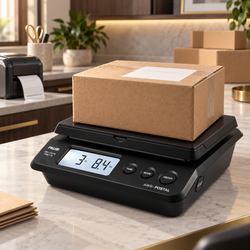
A pocket scale can be useful for postal mail when you primarily send letters, rigid envelopes, jewelry, trading cards, samples or other lightweight products. The right model should have enough capacity for the complete mailpiece, fine enough resolution to detect small weight changes and a platform that supports the envelope without allowing it to touch the surrounding table.
For most lightweight postal applications, a pocket scale with 500 to 2,000 grams of capacity and 0.1-gram resolution provides a practical balance. A 0.01-gram model may be useful for extremely light products or internal product measurement, but that degree of sensitivity is not normally necessary for a finished envelope. If your shipments regularly exceed a few pounds or include medium boxes, a dedicated shipping scale will usually be a better option.
The correct choice depends on more than the product’s weight. You must consider:
-
The entire packaged shipment
-
The lightest and heaviest mailpieces
-
Platform dimensions
-
Display visibility
-
Tare capacity
-
Repeatability
-
Calibration
-
Carrier requirements
-
Actual versus dimensional weight
This guide explains how to select a pocket scale for postal mail and recognize when a larger postal scale is necessary.
Can You Use a Pocket Scale for Postal Mail?
Yes, a pocket scale can weigh postal mail when the complete shipment falls within the scale’s capacity and fits securely on the platform.
Common pocket-scale mailing applications include:
-
Letters
-
Greeting cards
-
Documents
-
Trading cards
-
Stickers
-
Jewelry
-
Coins
-
Small collectibles
-
Product samples
-
Seeds
-
Craft supplies
-
Miniature parts
-
Small electronics
-
Lightweight accessories
-
Thin padded envelopes
American Weigh Scales offers digital pocket scales with different combinations of portability, capacity and resolution.
A pocket scale is generally less suitable for:
-
Medium or large boxes
-
Subscription packages
-
Multi-item orders
-
Heavy books
-
Large clothing shipments
-
Bulk products
-
Packages that block or exceed the platform
-
Mailpieces above the scale’s rated capacity
For those applications, compare dedicated digital shipping scales with higher capacities and larger platforms.
Quick Capacity and Resolution Recommendations
| Postal Mail Type | Suggested Capacity | Suggested Resolution |
|---|---|---|
| Lightweight letters and cards | 500 g | 0.1 g |
| Jewelry and small accessories | 500–1,000 g | 0.01–0.1 g |
| Rigid envelopes and small mailers | 1,000–2,000 g | 0.1 g |
| Small padded mailers | 2,000–5,000 g | 0.1–1 g |
| Packages above 5 kg | Dedicated shipping scale | 1–5 g or suitable ounce increment |
These are general starting points. The best combination depends on your complete packages, not merely the individual products.
What Does Scale Capacity Mean?
Capacity is the maximum physical load a scale is designed to support.
When choosing a pocket postal scale, include the weight of:
-
Product
-
Product packaging
-
Shipping envelope
-
Protective wrapping
-
Inserts
-
Documentation
-
Tape
-
Label
-
Promotional sample
-
Any weighing tray
For example, a piece of jewelry may weigh only 20 grams, but the finished shipment could include a box, pouch, care card, padding and padded envelope. The postal weight might be several times greater than the item weight.
Leave a Capacity Margin
Do not choose a scale that barely accommodates your heaviest shipment.
If your heaviest completed mailer weighs approximately 900 grams, a 1,000-gram scale technically covers it but leaves little room for packaging changes or larger orders. A 1,200- or 2,000-gram model may be more practical.
The AWS 1200-gram digital pocket scale series illustrates a capacity range that can be useful for letters, lightweight merchandise and smaller completed mailers.
Never Overload a Pocket Scale
Overloading can:
-
Cause error messages
-
Produce unstable readings
-
Affect calibration
-
Damage the load cell
-
Reduce long-term reliability
If the mailpiece exceeds the rated capacity, remove it and use a higher-capacity model. Do not press the package onto the platform or attempt to weigh it in sections.
Tare Does Not Increase Capacity
Tare subtracts the weight of a container or tray from the displayed result. It does not remove the physical load.
Suppose you place a 200-gram tray on a pocket scale with a 1,000-gram capacity and press tare. The display returns to zero, but only approximately 800 grams of physical capacity remain.
This matters when using:
-
Envelope-support trays
-
Small bins
-
Product dishes
-
Protective covers
-
Mailing baskets
Always add the tray weight to the expected shipment weight when determining the required capacity.
What Does Resolution Mean?
Resolution is the smallest weight increment shown on the display.
Common pocket-scale resolutions include:
-
1 gram
-
0.1 gram
-
0.01 gram
-
0.001 gram
A scale with 0.1-gram resolution displays weight in tenths of a gram. A model with 0.01-gram resolution displays hundredths of a gram.
Finer resolution provides more detail, but additional decimal places are useful only if the application requires them and the scale produces stable, repeatable results.
Is 1-Gram Resolution Enough for Postal Mail?
A one-gram scale can be suitable for:
-
Heavier letters
-
Padded mailers
-
Small packages
-
Books
-
Clothing accessories
-
Products weighing several hundred grams
It may not be ideal when:
-
The entire letter is very light
-
Small inserts affect the mailing decision
-
Individual products weigh only a few grams
-
You need to compare closely matched mailpieces
-
Fine internal product measurements are required
For general lightweight postal mail, 0.1-gram resolution usually provides more flexibility.
Is 0.1-Gram Resolution Best for Pocket Postal Scales?
A 0.1-gram resolution is a strong general-purpose choice for:
-
Letters
-
Rigid envelopes
-
Jewelry shipments
-
Collectible cards
-
Small product samples
-
Lightweight padded envelopes
It is detailed enough to show small packaging differences without introducing the sensitivity of a 0.01- or 0.001-gram scale.
A 2,000-gram model with 0.1-gram resolution can be especially versatile because it combines useful capacity with relatively fine measurement increments. For example, the SC2KGA precision digital pocket scale provides a compact format with an external-power option for stationary use.
When Does 0.01-Gram Resolution Make Sense?
A 0.01-gram scale may be useful when weighing:
-
Individual jewelry pieces
-
Tiny components
-
Lightweight samples
-
Small quantities of craft materials
-
Miniature products before packaging
However, final postage decisions usually do not require hundredth-of-a-gram measurement. Shipping platforms and carriers commonly use larger billing increments.
A 0.01-gram scale may also be more sensitive to:
-
Air movement
-
Vibration
-
Static
-
Temperature changes
-
Operator movement
-
Uneven surfaces
Choose 0.01 gram when you have an internal precision-weighing reason, not simply because the display shows more digits.
Do You Need 0.001-Gram Resolution for Postal Mail?
Generally, no.
A 0.001-gram pocket scale is intended for milligram-level applications. That sensitivity is unnecessary for ordinary letters and parcels, and a small environmental disturbance can affect the final digits.
For postal mail, the priority is a stable, repeatable measurement that fits the carrier’s required weight format—not laboratory-level readability.
Resolution Is Not the Same as Accuracy
A pocket scale that displays 0.01 gram is not automatically accurate to exactly ±0.01 gram.
Resolution describes the display increment. Accuracy describes how closely the result corresponds to an accepted reference mass.
Other important characteristics include:
-
Repeatability
-
Linearity
-
Minimum practical load
-
Stabilization time
-
Calibration
-
Corner-load performance
-
Environmental stability
Do not select a postal scale based solely on the number of digits shown on its display.
Check the Minimum Practical Load
A scale should be able to detect your lightest mailpiece reliably.
Ask:
-
What is the lightest envelope you send?
-
Can the scale detect a single insert?
-
Does it respond when a label is added?
-
Does the display return to zero consistently?
-
Are repeated measurements similar?
A high-capacity scale may perform poorly with extremely light letters. This is one of the main reasons a pocket scale can complement a larger package scale.
Test Repeatability Before Relying on the Scale
Repeatability describes whether the scale reports a similar result each time an unchanged mailpiece is weighed.
Use this simple check:
-
Place the scale on a firm, level surface.
-
Turn it on with the platform empty.
-
Confirm a zero reading.
-
Center a representative envelope.
-
Wait for the display to stabilize.
-
Record the weight.
-
Remove the envelope.
-
Allow the scale to return to zero.
-
Repeat five to ten times.
-
Compare the results.
If the readings vary noticeably, check for:
-
Weak batteries
-
Vibration
-
Drafts
-
Uneven surfaces
-
Static
-
Temperature changes
-
Platform debris
-
Off-center placement
-
Improper calibration
Platform Size May Be the Limiting Factor
A pocket scale can have enough capacity while still being unsuitable for a large envelope.
The mailpiece must not:
-
Touch the surrounding table
-
Lean against the display
-
Press the control buttons
-
Rest against a wall
-
Tip or rock
-
Shift while being weighed
Any contact outside the weighing platform can support part of the mailpiece and produce an incorrect result.
Using a Tray With Large Envelopes
A lightweight rigid tray can support a flexible mailer.
The tray should:
-
Sit securely on the platform
-
Be centered
-
Remain within the scale’s capacity
-
Avoid touching the table
-
Be tared before the mailpiece is added
Remember that the tray’s physical weight still counts against capacity.
Protective Covers Can Double as Trays
Many pocket scales include a protective cover. On some models, the cover can be removed, placed on the platform and used as a tray.
This can help contain small products or support lightweight mail, but only if the cover:
-
Fits securely
-
Does not touch the scale housing
-
Does not interfere with buttons
-
Can be tared
-
Leaves enough capacity for the shipment
Follow the model’s instructions rather than assuming every protective cover is designed for this purpose.
Choose the Right Weight Units
A useful pocket postal scale may display:
-
Grams
-
Ounces
-
Pounds
-
Kilograms
-
Pounds and ounces
For lightweight mail, grams and ounces are typically the most useful.
Confirm that the scale’s format matches the format accepted by your shipping software.
Decimal Pounds Versus Pounds and Ounces
These formats are different.
For example:
-
1 pound 8 ounces equals 1.5 decimal pounds.
-
It does not equal 1.8 pounds.
A clear unit indicator reduces the risk of entering a correct reading in the wrong format.
Actual Weight Versus Dimensional Weight
A pocket scale measures actual weight. It cannot determine dimensional weight by itself.
Dimensional weight reflects the amount of space occupied by a package. For some services, the billable weight may be the greater of actual and dimensional weight.
UPS explains the relationship between package measurements and dimensional weight in its package dimensions and weight guide.
FedEx also explains how dimensional weight works and why a large, lightweight package may be billed at a higher calculated weight.
Dimensional weight is less likely to affect a typical letter-sized mailpiece, but it becomes relevant as packaging grows.
A complete mailing station should include:
-
Scale
-
Measuring tape
-
Current carrier instructions
-
Shipping software
-
Standard packaging procedures
Weigh the Complete Mailpiece
Do not use the product’s listed weight as the postal weight.
The final measurement should include:
-
Product
-
Product box
-
Pouch or protective wrap
-
Envelope or mailer
-
Inserts
-
Tape
-
Label
-
Any included gift or sample
Even lightweight additions can matter when a shipment is close to a postal weight boundary.
The USPS Postage Price Calculator can use current shipment information when displaying applicable mailing options.
Do Not Guess How the Carrier Rounds Weight
Different services can use specific rules for weight increments and package eligibility. Enter the stable scale result in the required format and follow the current carrier instructions.
USPS provides information about parcel size, weight and fee standards.
Avoid:
-
Rounding downward
-
Reusing an old package weight
-
Ignoring packaging
-
Assuming similar mailers weigh exactly the same
-
Entering ounces as decimal pounds
-
Using product-catalog weights
Carriers may reweigh packages after acceptance. Accurate input helps reduce adjustments.
Why USPS Verification Matters
USPS uses automated systems to evaluate shipment information. Its description of Automated Package Verification explains how differences involving package weight, dimensions or postage may result in adjustments.
A pocket scale can help reduce weight-related discrepancies when:
-
The package is within capacity
-
The platform supports it properly
-
The scale is verified
-
The correct units are used
-
The finished mailpiece is weighed
-
The result is entered accurately
The scale cannot compensate for incorrect dimensions or an ineligible service.
Useful Pocket-Scale Features for Postal Mail
Tare
Subtracts a tray or container from the displayed weight.
Backlit Display
Improves readability in dim workspaces.
Large Digits
Reduces transcription errors.
Stable-Weight Indicator
Helps the user know when to record the result.
Unit Selection
Allows the result to match the postal or shipping platform.
Protective Cover
Protects the platform during storage and transport.
Overload Indicator
Warns when the load exceeds the scale’s range.
Adjustable Auto-Off
Prevents the scale from shutting down in the middle of a mailing task.
External Power
Supports frequent use at a permanent shipping station.
Low-Battery Warning
Helps prevent interruptions and unstable operation.
Battery Versus External Power
Battery Power
Battery operation is useful for:
-
Occasional home mailing
-
Portable shipping stations
-
Craft fairs
-
Shared workspaces
-
Inventory rooms
-
Mobile sellers
External Power
An adapter or USB power source is useful for:
-
Daily ecommerce shipping
-
Permanent workstations
-
High-volume label preparation
-
Long packing sessions
A scale offering both options provides the greatest flexibility.
Calibration and Verification
Calibration establishes or adjusts the scale’s response using a known reference mass. Verification checks whether the scale produces an acceptable result.
Before buying, determine:
-
Whether calibration is supported
-
Which mass is required
-
Whether a weight is included
-
Whether compatible weights are available
-
Whether instructions are accessible
Use suitable calibration weights rather than coins, hardware or packaged products.
Household objects can vary because of wear, contamination and manufacturing differences.
When to Verify a Pocket Postal Scale
Check the scale:
-
When first received
-
After moving it
-
After an overload
-
After a drop or impact
-
When readings appear inconsistent
-
After long storage
-
After a major temperature change
-
At regular intervals
For continuing accuracy, follow AWS guidance on scale maintenance.
Environmental Factors Affecting Pocket Scales
Pocket scales are often more sensitive than large shipping scales.
Air Movement
Fans, vents and open windows can affect lightweight measurements.
Vibration
Printers, machinery and unstable tables can cause fluctuating readings.
Static
Plastic mailers and packaging materials may develop static charges that affect very sensitive scales.
Temperature
Allow a scale moved from a cold or hot location to reach room temperature.
Uneven Surfaces
Use a firm, level bench rather than carpet, upholstery or a soft mat.
Off-Center Loading
Place mailpieces in the center and use consistent positioning.
Debris
Remove tape, paper scraps and dust from the platform and surrounding area.
When a Pocket Scale Is Not Enough
Choose a dedicated shipping scale when:
-
Packages regularly exceed pocket-scale capacity
-
Boxes are too large for the platform
-
Mailers block the display
-
A remote screen is needed
-
Employees handle heavy shipments
-
The scale is used continuously
-
Shipping software connectivity is required
-
Large trays consume too much capacity
A pocket scale should not be forced into a job for which it was not designed.
Recommended Pocket Postal Scale Configurations
Letters and Cards
-
Capacity: 500 g
-
Resolution: 0.1 g
-
Platform: Large enough for a small support tray
-
Best for: Documents, cards and stickers
Jewelry and Collectibles
-
Capacity: 500–1,000 g
-
Resolution: 0.01–0.1 g
-
Platform: Compact with removable cover
-
Best for: Jewelry, coins and trading cards
Small Ecommerce Mailers
-
Capacity: 1,000–2,000 g
-
Resolution: 0.1 g
-
Platform: Suitable for rigid or padded mailers
-
Best for: Accessories, samples and small parts
Mixed Letters and Packages
-
Pocket scale: 1,000–2,000 g × 0.1 g
-
Shipping scale: 25–110 lb × approximately 0.1 oz
-
Best for: Businesses with a wide shipment range
Common Buying Mistakes
Choosing Capacity Based Only on the Product
Packaging can represent a substantial portion of the final weight.
Selecting a Platform That Is Too Small
An envelope touching the table can create an incorrect result.
Assuming Finer Resolution Means Greater Accuracy
Resolution is only one part of measurement performance.
Ignoring the Minimum Load
A high-capacity scale may not respond well to a lightweight letter.
Forgetting the Tray Weight
A tared tray still reduces available physical capacity.
Using the Scale for Oversized Packages
Overloading or balancing a large box on a pocket scale can damage it.
Ignoring Dimensional Weight
The scale measures actual weight only.
Using Improvised Calibration Objects
Random household items are not dependable calibration standards.
Entering the Wrong Unit
Confusing grams, ounces, decimal pounds or pounds-and-ounces can produce an incorrect label.
Pocket Postal Scale Buying Checklist
Before choosing a scale, confirm:
-
Lightest completed mailpiece
-
Heaviest completed mailpiece
-
Required capacity
-
Desired safety margin
-
Required resolution
-
Minimum practical load
-
Platform dimensions
-
Need for a support tray
-
Tray weight
-
Available weighing units
-
Display visibility
-
Battery type
-
External power option
-
Auto-off settings
-
Overload warning
-
Calibration capability
-
Required calibration weight
-
Expected shipping volume
-
Whether larger packages require a second scale
Frequently Asked Questions
What capacity pocket scale is best for postal mail?
A capacity of 500 to 2,000 grams works for many letters and lightweight mailers. Choose a model that comfortably exceeds the weight of your heaviest completed mailpiece.
What resolution should a pocket postal scale have?
A 0.1-gram resolution provides a useful balance for many letters, cards and small mailers. A 0.01-gram model may be helpful for tiny products but is generally unnecessary for final postage weight.
Can a pocket scale weigh packages?
It can weigh small packages that fit securely on the platform and remain below the rated capacity. Larger boxes should be weighed on a shipping scale.
Is a 500-gram scale enough for mail?
It may be enough for ordinary letters, cards and very lightweight products. It is usually too limited for padded mailers containing multiple items.
Is a 2,000-gram scale better?
A 2,000-gram model provides more flexibility for small ecommerce mailers while retaining relatively fine resolution.
Does tare increase the scale’s capacity?
No. Tare removes the container from the displayed result, but the container still applies a physical load.
Can I use the protective cover as a tray?
Possibly, if the manufacturer’s design permits it. The cover must sit securely without touching the housing or controls.
Should I weigh the product before packaging?
You may do so for internal records, but postage should be based on the complete, prepared mailpiece.
Does a pocket scale calculate postage?
No. It measures actual weight. A carrier calculator or shipping platform uses the weight with dimensions, destination and service information.
Can a pocket scale calculate dimensional weight?
No. Dimensional weight is calculated from package measurements according to the carrier’s applicable rules.
How often should the scale be calibrated?
Follow the manufacturer’s instructions. Verify performance after movement, overload, impact or unusual readings, and calibrate when necessary.
Do I need a legal-for-trade scale?
A scale used only to prepare your own shipment may be treated differently from one used to determine a customer’s charge. NIST provides guidance about commercial applications in its weighing and scales FAQs.
Final Thoughts
A pocket scale can be an excellent tool for postal mail when shipments are small, light and compatible with the platform.
For most letters, cards, jewelry shipments and small padded envelopes, a capacity between 500 and 2,000 grams with 0.1-gram resolution offers a practical balance. Choose 0.01-gram resolution only when you also need to measure extremely light products or components before packaging.
Always weigh the complete shipment, including the envelope, inserts, padding, tape and label. Leave capacity above your heaviest mailpiece, remember that a tared tray still uses physical capacity and keep the envelope from touching the surrounding table.
If packages regularly exceed a few pounds or do not fit securely on the platform, move to a dedicated shipping scale. A two-scale setup—one pocket scale for lightweight mail and one postal scale for boxes—can provide the most dependable coverage for a growing ecommerce operation.