
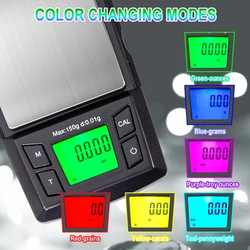
A pocket scale for resin can be useful for small batches, jewelry projects, pigments, additives, color testing, and other precision craft work.
But choosing the right model requires balancing two specifications:
Capacity and resolution.
Capacity tells you the maximum total physical load the scale can support.
Resolution—often called readability—tells you the smallest increment displayed by the scale.
For example:
500g x 0.01g
means the scale has a maximum capacity of 500 grams and displays measurements in increments of 0.01 gram.
For resin work, neither specification should be considered alone.
A 100g x 0.01g scale may provide fine measurements for pigment testing but cannot support a 400g resin batch.
A 2kg x 0.1g scale can accommodate much larger mixing containers and resin batches but displays less detail than a 0.01g model.
So, what capacity and resolution do you actually need?
Let's break it down.
Quick Answer: What Pocket Scale Do You Need for Resin?
A practical starting guide is:
| Resin Task | Suggested Capacity | Suggested Resolution |
|---|---|---|
| Tiny pigment tests | 100–200g | 0.01g |
| Mica and colorants | 100–500g | 0.01g |
| Small additives | 100–500g | 0.01g |
| Tiny resin jewelry batches | 200–500g | 0.01g–0.1g |
| General resin jewelry | 500g–1kg | 0.1g |
| Small molds | 500g–2kg | 0.1g |
| Coasters | 1–2kg | 0.1g |
| Medium resin batches | 2kg | 0.1g |
| Larger molds and pours | 2kg+ | 0.1g or appropriate resolution |
These are scale-selection ranges rather than universal resin-mixing requirements.
Always follow the resin manufacturer's instructions regarding whether a product should be measured by weight or volume and which mixing ratio applies.
What Is a Pocket Scale for Resin?
A pocket scale is a compact digital scale designed for portable or space-efficient weighing.
Pocket scales are typically smaller than conventional kitchen, bench, or shipping scales and are commonly used for lightweight materials and objects.
For resin makers, a pocket scale can be useful for measuring:
-
Resin
-
Hardener
-
Pigments
-
Mica powder
-
Glitter
-
Dyes
-
Fillers
-
Small additives
-
Jewelry batches
-
Small repair batches
-
Formula-development samples
The important limitation is physical size.
A pocket scale needs enough capacity and platform space for the material and container you intend to use.
For tiny pigments, almost any resin mixing scale may appear large.
For a 1kg batch in a large mixing cup, however, many conventional pocket scales will be too small.
Capacity vs. Resolution: What's the Difference?
Understanding these two specifications is the foundation of choosing a resin scale.
Capacity
Capacity is the maximum total load the scale is designed to support.
A:
500g x 0.01g
scale can support up to 500g.
A:
2000g x 0.1g
scale can support up to 2,000g.
Everything physically resting on the weighing platform contributes to that load.
Resolution
Resolution or readability tells you the smallest displayed increment.
A 0.1g scale displays tenths of a gram:
125.1g
125.2g
125.3g
A 0.01g scale displays hundredths:
12.31g
12.32g
12.33g
A 0.001g scale displays thousandths:
1.251g
1.252g
1.253g
More decimal places do not automatically mean a scale is better for resin.
The right resolution depends on what you actually need to measure.
Why Capacity Matters for Resin
Resin makers frequently underestimate how much capacity they need because they consider only the resin itself.
Suppose you plan to mix:
300g resin + 150g hardener
You might assume a 500g scale is sufficient because the material totals 450g.
But your mixing container weighs:
80g
The complete physical load is now:
300 + 150 + 80 = 530g
A 500g scale does not provide enough capacity.
The correct calculation is:
Container + resin + hardener + pigments + additives = total scale load
Choose your capacity based on that number.
Tare Does Not Give You the Capacity Back
This deserves special attention because tare can create confusion.
Suppose you put a 100g mixing cup on a 500g scale.
The display shows:
100.00g
You press tare.
The display changes to:
0.00g
But the physical cup did not disappear.
The scale's load cell is still supporting 100g.
That means only approximately 400g of physical capacity remains before reaching the nominal 500g maximum.
Tare changes the displayed value.
It does not increase the physical capacity of the scale.
Is a 100g Pocket Scale Good for Resin?
A 100g pocket scale is generally too small to serve as the primary scale for ordinary resin mixing.
However, it can be extremely useful as a secondary precision scale.
Consider a 100g model for:
-
Mica powder
-
Pigment tests
-
Concentrated dyes
-
Tiny additives
-
Formula experiments
-
Very small jewelry batches
A model with:
100g x 0.01g
can provide fine displayed increments for small craft materials.
But its low capacity means it should not be expected to handle normal mixing cups and medium resin batches.
Is a 200g Pocket Scale Good for Resin?
A 200g scale gives you more flexibility while remaining compact.
A:
200g x 0.01g
pocket scale can be useful for:
-
Pigments
-
Mica
-
Glitter
-
Small colorant quantities
-
Jewelry findings
-
Tiny resin batches
-
Small formula tests
-
Lightweight additives
However, container weight quickly becomes important.
If your cup weighs 50g, only approximately 150g of physical capacity remains.
A 200g model is therefore better viewed as a precision craft scale than a general resin mixing scale.
Is a 500g Pocket Scale Good for Resin?
For small resin projects, 500g is one of the most useful pocket-scale capacities.
It provides enough room for applications such as:
-
Resin jewelry
-
Small molds
-
Pigment batches
-
Small repair mixes
-
Formula development
-
Color testing
-
Additives
The exact usefulness depends heavily on resolution.
Consider two examples:
500g x 0.1g
This provides 500g capacity with tenth-of-a-gram increments.
500g x 0.01g
This provides the same maximum capacity but hundredth-of-a-gram increments.
The second scale provides finer displayed resolution.
That can be valuable when measuring pigments and additives.
However, always compare the complete specifications rather than assuming finer resolution automatically means greater accuracy.
500g x 0.01g: A Strong Combination for Resin Pigments
A 500g x 0.01g pocket scale can be particularly useful as a precision scale in a resin workshop.
It provides enough capacity for many:
-
Small mixing containers
-
Pigment jars
-
Resin jewelry batches
-
Additive measurements
-
Color-development samples
while displaying measurements to the nearest hundredth of a gram.
For example, you could document:
Resin sample: 50.00g
Pigment A: 0.75g
Pigment B: 0.25g
Additive: 0.40g
Recording precise quantities can make successful colors and formulas easier to reproduce later.
Is a 1kg Pocket Scale Better for Resin?
Moving toward 1kg capacity gives you significantly more flexibility.
A scale around:
1000g x 0.1g
can be useful for:
-
Resin jewelry
-
Coasters
-
Small molds
-
Small resin artwork
-
Heavier mixing cups
-
Larger craft batches
The tradeoff is that higher-capacity pocket scales may not always offer the same fine resolution as smaller models.
This is why capacity and resolution should always be compared together.
When Does a 2kg Pocket Scale Make Sense?
A 2kg pocket scale is particularly interesting for resin makers because it begins to bridge the gap between a conventional small pocket scale and a larger craft scale.
A specification of:
2000g x 0.1g
provides enough capacity for many:
-
Coaster batches
-
Medium molds
-
Resin-art projects
-
Small casting jobs
-
Heavier mixing containers
-
General craft batches
while still maintaining tenth-of-a-gram readability.
For makers who want one compact scale to cover a broad range of resin projects, 2kg x 0.1g can be a highly practical combination.
200g vs. 500g Pocket Scale for Resin
Which should you choose?
Choose 200g when:
-
Pigments are your primary application
-
Your batches are tiny
-
0.01g resolution is important
-
Your containers are lightweight
-
Portability matters
-
You already have a larger resin scale
Choose 500g when:
-
You make resin jewelry
-
You need more container capacity
-
You weigh larger pigment batches
-
You want more flexibility
-
You occasionally weigh small resin/hardener batches
For most resin makers choosing between these two capacities, 500g provides more flexibility.
But a 200g model can still be excellent as a dedicated precision scale.
500g vs. 1kg Pocket Scale for Resin
A 500g model is better suited to:
-
Pigments
-
Additives
-
Jewelry
-
Tiny molds
-
Small repair batches
A 1kg model provides more room for:
-
Coasters
-
Larger jewelry batches
-
Heavier cups
-
Small art projects
-
Larger molds
If your normal complete load approaches 400–450g, moving to 1kg can provide much more comfortable headroom.
1kg vs. 2kg Pocket Scale for Resin
Choose approximately 1kg if your work remains relatively small.
Choose approximately 2kg when:
-
Your mixing cups are heavier
-
You make multiple coasters
-
You work with medium molds
-
You want room for project growth
-
Your batches regularly exceed several hundred grams
For general resin crafting, 2kg x 0.1g is one of the most versatile specifications.
0.1g vs. 0.01g for Resin
This is another important decision.
Choose 0.1g when:
-
Resin and hardener are your primary materials
-
Your batches are relatively large
-
You need more capacity
-
You're weighing tens or hundreds of grams
-
You make coasters or molds
-
You're using a general resin scale
Choose 0.01g when:
-
Pigments regularly weigh less than 1g
-
You make tiny jewelry batches
-
You're developing repeatable colors
-
You measure small additives
-
Hundredth-of-a-gram differences matter
Neither resolution is universally better.
The correct choice depends on the measurement.
Do You Need 0.001g for Resin?
Usually not.
A 0.001g scale displays measurements in thousandths of a gram.
That equals one milligram.
This can be useful when working with genuinely tiny quantities.
However, milligram scales tend to have:
-
Lower capacities
-
Smaller platforms
-
Greater sensitivity to drafts
-
Greater sensitivity to vibration
-
Greater sensitivity to static
-
More demanding setup requirements
For ordinary resin work, 0.01g or 0.1g is generally more practical.
Choose 0.001g only when the quantities you actually measure require milligram-level readability.
Resolution Does Not Equal Accuracy
A common mistake is assuming:
More decimal places = more accurate scale
That isn't necessarily true.
Resolution tells you the smallest change shown on the display.
Accuracy concerns how closely the measurement corresponds with the relevant reference value within the scale's stated specifications.
You should also consider:
-
Repeatability
-
Minimum usable load
-
Calibration requirements
-
Tolerance
-
Environmental conditions
-
Platform stability
A scale displaying 0.001g isn't automatically more appropriate for resin than one displaying 0.1g.
Minimum Load Matters for Pigments
Suppose your pocket scale displays to:
0.01g
That doesn't automatically mean 0.01g is the smallest quantity you should practically measure.
Check the scale manufacturer's specifications for:
-
Minimum load
-
Accuracy
-
Tolerance
-
Repeatability
This becomes increasingly important as pigment and additive quantities get smaller.
Why Platform Size Matters
A pocket scale may have enough capacity on paper but still be inconvenient if your mixing container is too large.
The container should:
-
Sit securely
-
Remain centered
-
Be fully supported
-
Avoid touching the table
-
Leave the display visible
If a large cup extends beyond the scale and touches the workbench, the scale may no longer support the complete load.
That can affect the measurement.
Don't Let the Mixing Cup Block the Display
A large container can make an otherwise excellent pocket scale frustrating to use.
Look for:
-
A visible LCD
-
Large digits
-
Backlighting
-
A clear decimal point
-
A platform that works with your containers
Test the dimensions against your normal mixing cups before buying.
Why Tare Is Essential
Tare makes weight-based resin preparation much easier.
A typical workflow is:
-
Place the empty mixing container on the scale.
-
Allow the reading to stabilize.
-
Press tare.
-
Confirm the display returns to zero.
-
Add Part A to the required target.
-
Add Part B according to the manufacturer's specified weight ratio.
-
Confirm the final amount.
-
Mix according to the resin manufacturer's instructions.
Remember that the scale only measures mass.
It does not determine what ratio you should use.
Never Assume Volume Ratio Equals Weight Ratio
Suppose an epoxy system is described as:
2:1 by volume
Do not automatically mix:
200g resin + 100g hardener
unless the manufacturer specifically confirms that the product also uses 2:1 by weight.
Resin and hardener can have different densities.
Because of that, the numerical ratio by weight may differ from the ratio by volume.
When using your pocket scale, always follow the product-specific weight ratio provided or approved by the resin manufacturer.
Calibration Matters
A pocket scale should provide clear calibration or performance-check instructions.
Calibration requirements differ between models.
One scale may require a 100g reference weight.
Another may require 500g, 1kg, or another specified mass.
Follow the instructions for your exact scale.
Do not assume the procedure is universal.
Don't Use Random Objects for Calibration
Avoid trying to calibrate your scale with:
-
Coins
-
Resin bottles
-
Pigment jars
-
Tools
-
Cured resin
-
Household objects
Use the calibration weight specified by the manufacturer.
Calibration is only useful when an appropriate reference and procedure are used.
Keep the Scale on a Hard, Level Surface
Precision scales perform best on stable surfaces.
Avoid:
-
Fabric
-
Towels
-
Foam
-
Soft silicone mats
-
Flexible tables
-
Uneven countertops
-
Wobbly workbenches
A rigid, level work surface helps improve measurement stability and repeatability.
Keep 0.01g Scales Away From Airflow
The finer the resolution, the more environmental conditions can matter.
Keep precision pocket scales away from:
-
Fans
-
Open windows
-
HVAC vents
-
Strong air movement
This is particularly important when measuring very small amounts of lightweight pigments or additives.
Watch for Vibration
Workshop vibration can come from:
-
Sanders
-
Drills
-
Rotary tools
-
Compressors
-
Speakers
-
Foot traffic
-
Flexible workbenches
If you're trying to measure a tiny amount of pigment to 0.01g, perform the measurement away from active vibrating equipment.
Protect Your Pocket Scale From Resin
Pocket scales contain electronics, buttons, sensors, and gaps that uncured resin can damage.
Keep resin away from:
-
Buttons
-
Display seams
-
Platform gaps
-
Battery compartments
-
Charging ports
A removable tray can be useful where appropriate.
Follow the scale manufacturer's cleaning instructions.
One Pocket Scale or Two?
For many serious resin makers, two scales make more sense than forcing one instrument to cover every measurement.
Consider:
Main Resin Scale
2kg x 0.1g
Use for:
-
Resin
-
Hardener
-
Mixing cups
-
Coasters
-
Medium batches
-
Molds
Precision Pocket Scale
100–500g x 0.01g
Use for:
-
Pigments
-
Mica
-
Colorants
-
Tiny additives
-
Formula development
This combination covers a much wider measurement range.
An AWS Pocket Scale for General Resin Work
One particularly relevant option from American Weigh Scales is the:
SC-2KG Precision Digital Pocket Scale
Its specifications include:
Capacity: 2000g
Readability: 0.1g
This combination provides substantially more capacity than a conventional 100g, 200g, or 500g pocket scale while retaining tenth-of-a-gram readability.
The SC-2KG also features:
-
Large stainless-steel weighing surface
-
Backlit LCD
-
Three-button operation
-
Linear calibration
-
Compact construction
-
Protective/weighing trays
American Weigh Scales specifically identifies resin materials among the SC-2KG's hobby applications.
That makes it particularly relevant for makers who want a compact scale but need considerably more capacity than a conventional small pocket scale.
When a Pocket Scale Isn't Enough
Pocket scales have an obvious advantage:
They're compact.
But compact size can become a disadvantage for larger resin work.
A larger bench or kitchen-style scale may be more appropriate when:
-
Your containers are physically large
-
You routinely exceed 2kg
-
You make tabletop pours
-
You work with large molds
-
You use heavy mixing buckets
-
Your container blocks the display
-
Your project requires substantially more capacity
Do not force a pocket scale into an application simply because portability is convenient.
Use the scale format that fits the actual job.
Common Pocket Scale Mistakes for Resin
Buying by decimal places alone
0.001g isn't automatically better than 0.01g or 0.1g.
Buying too little capacity
Remember the container.
Forgetting that tare doesn't increase capacity
The load cell still supports the cup.
Buying by capacity alone
A high-capacity model may have resolution too coarse for pigments.
Ignoring platform dimensions
Your cup needs proper support.
Blocking the LCD
Check the scale with your actual containers.
Ignoring minimum usable load
Fine displayed increments do not automatically guarantee reliable performance at extremely small loads.
Working on a soft surface
Use a hard, stable workbench.
Weighing next to vibrating equipment
Precision measurements require stability.
Using random calibration objects
Use the manufacturer's specified reference weight.
Assuming volume and weight ratios are identical
Follow the exact resin manufacturer's instructions.
Pocket Scale for Resin Buying Checklist
Before buying, ask:
-
What resin projects will I make?
-
What is my smallest batch?
-
What is my largest batch?
-
How much does my container weigh?
-
What is my maximum complete load?
-
Is 100g enough?
-
Would 200g be enough?
-
Do I need 500g?
-
Would 1kg provide better headroom?
-
Should I choose 2kg?
-
Do I need more than 2kg?
-
Is 0.1g resolution sufficient?
-
Do I need 0.01g for pigments?
-
Do I genuinely need 0.001g?
-
What accuracy does the manufacturer specify?
-
What is the minimum usable load?
-
Does it provide consistent repeatability?
-
Does the scale have tare?
-
Does it measure grams?
-
Is the platform large enough?
-
Can I see the display with my mixing cup?
-
Is the display backlit?
-
Can the scale be calibrated?
-
What calibration weight does it require?
-
Is the calibration weight included?
-
Can I protect the platform from resin?
-
Is the scale easy to store?
-
Is it genuinely portable?
-
Does the auto-off behavior suit resin work?
-
Would two different scales be more practical?
Frequently Asked Questions
What is the best pocket scale for resin?
For general resin craft work, a 2kg x 0.1g pocket scale provides a useful combination of capacity and readability.
For pigments and tiny additives, a separate 100–500g x 0.01g precision pocket scale may be more appropriate.
Is a 500g scale enough for resin?
It can be excellent for resin jewelry, pigments, tiny molds, formula development, and small batches.
Remember to include the mixing container when calculating your total load.
Is 200g enough for resin?
A 200g pocket scale is better suited to pigments, additives, and very small batches than general resin mixing.
Is 1kg enough for resin?
A 1kg scale can work well for many small craft projects, including jewelry, coasters, and small molds.
Is 2kg good for resin?
Yes.
A 2kg x 0.1g scale can provide a versatile combination for regular resin crafting.
Is 0.1g precise enough for resin?
For many general craft-scale resin and hardener measurements, 0.1g readability can be practical when the scale's other performance specifications are appropriate.
When should I use 0.01g?
Consider 0.01g for:
-
Pigments
-
Mica
-
Tiny additives
-
Small jewelry batches
-
Color development
-
Formula testing
Do I need 0.001g?
Usually not for normal resin crafting.
Choose milligram readability only when your actual measurement task requires thousandth-of-a-gram increments.
What's better for resin: 500g x 0.01g or 2kg x 0.1g?
They serve different purposes.
Choose 500g x 0.01g when fine measurements of pigments, additives, or tiny batches are most important.
Choose 2kg x 0.1g when you need enough capacity for larger mixing cups and general resin batches.
Many makers can benefit from owning both.
Does tare increase the scale's maximum capacity?
No.
Tare changes the displayed value but does not physically remove the container's weight from the scale.
Can I use a pocket scale to mix epoxy by weight?
Yes, when the resin manufacturer provides or approves a mixing ratio by weight.
Use the exact ratio specified for that product.
Is a 2:1 epoxy ratio the same by weight and volume?
Not necessarily.
Resin and hardener can have different densities, so a numerical ratio given by volume may differ from the correct ratio by weight.
Why does my 0.01g pocket scale fluctuate?
Possible causes include:
-
Air movement
-
Vibration
-
Static
-
Temperature changes
-
Weak batteries
-
Unstable surfaces
-
Off-center loading
-
Overloading
-
Calibration problems
Fine-resolution scales require a stable weighing environment.
Final Verdict: What Capacity and Resolution Do You Need?
The right pocket scale for resin depends on the range of material you actually weigh.
For pigments, mica, colorants, and small additives, consider:
100–500g x 0.01g
For resin jewelry and small craft batches:
500g–1kg x 0.1g
can provide more practical capacity.
For general resin crafting, coasters, molds, and medium batches, a:
2kg x 0.1g
pocket scale provides a useful balance between capacity and readability.
American Weigh Scales' SC-2KG Precision Digital Pocket Scale is particularly relevant here. It offers 2000g x 0.1g capacity/readability, a large stainless-steel weighing surface, backlit LCD, weighing trays and linear calibration. AWS specifically lists resin materials among its hobby applications.
The biggest mistake is treating capacity and resolution as competing numbers.
They answer two completely different questions:
Capacity: How much can I put on the scale?
Resolution: How small a change can the display show?
Calculate your maximum complete load from:
Container + resin + hardener + pigments + additives
Then choose enough capacity to comfortably support it.
After that, select resolution according to the smallest quantity that matters to your project.
For many resin makers, the most flexible solution isn't one scale at all.
It's a higher-capacity 0.1g scale for the main resin batch plus a 0.01g precision pocket scale for pigments and additives.
That combination lets each scale do the job it is best suited to do.